
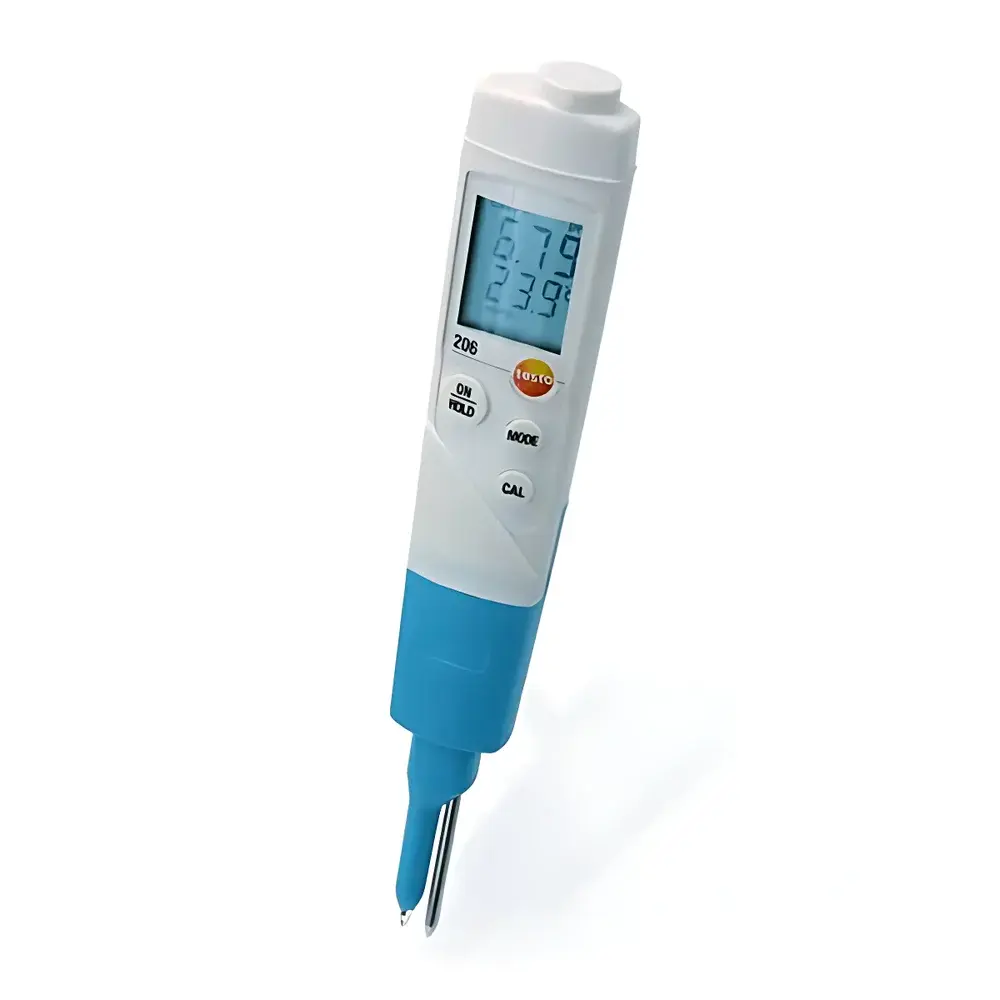
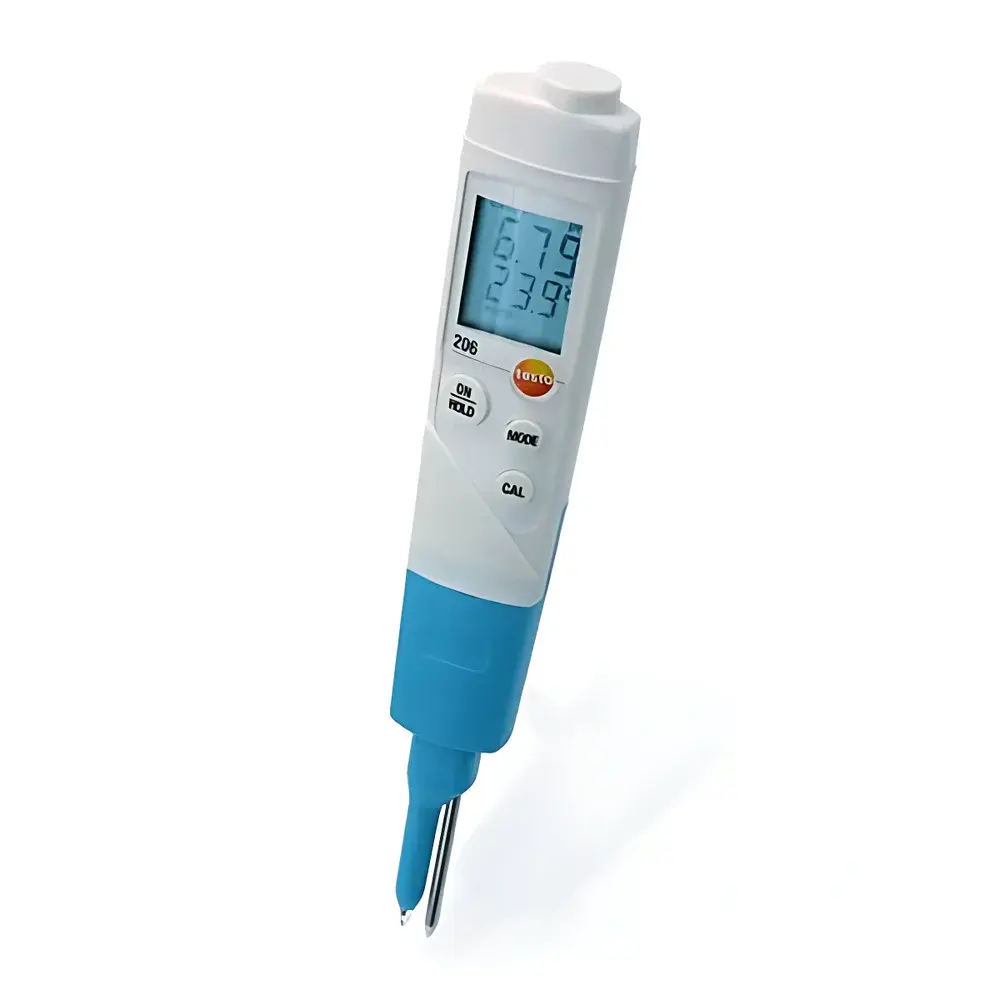
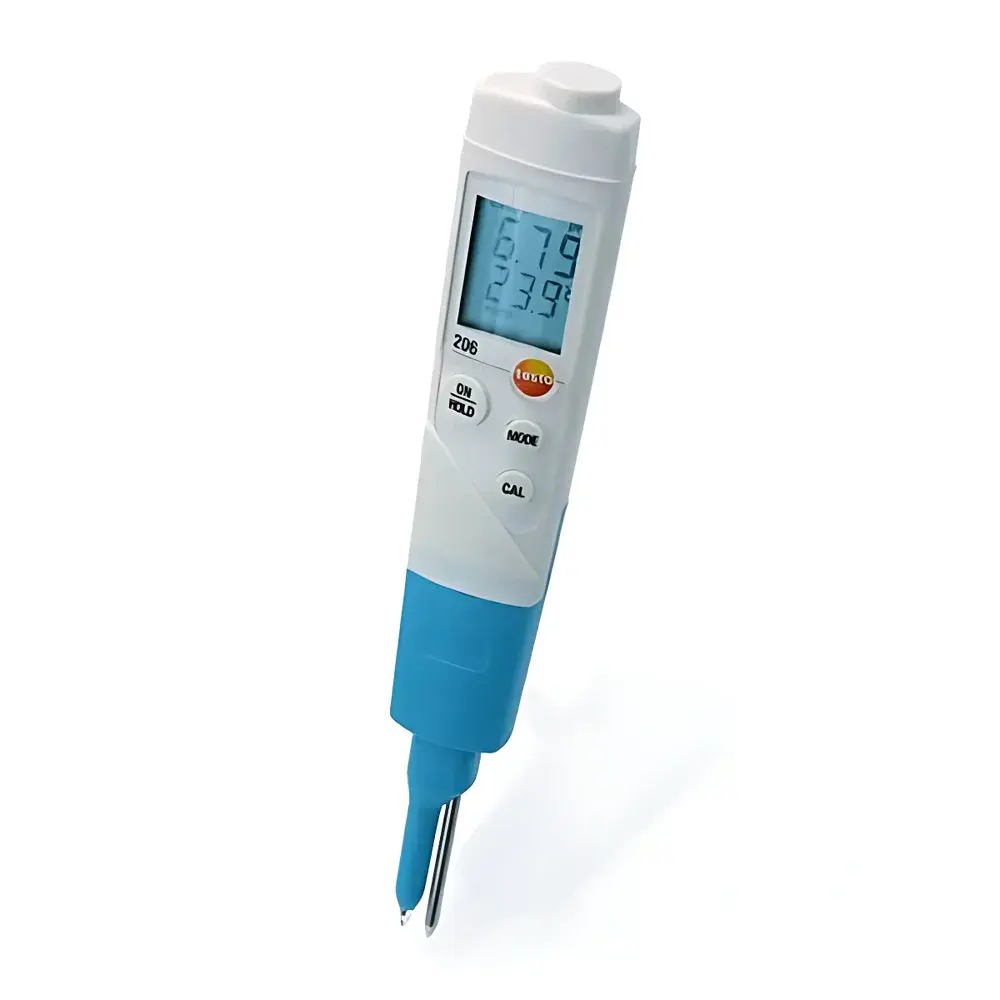
testo 206-pH2 Portable Dual-Parameter pH and Temperature Meter
| Brand | testo |
|---|---|
| Origin | Germany |
| Model | 0563 2062 |
| Instrument Type | Pen-style pH Meter |
| Parameter Types | pH + Temperature (NTC) |
| pH Range | 0–14 pH |
| pH Resolution | 0.01 pH |
| pH Accuracy | ±0.02 pH |
| Temperature Range | 0–+60 °C (short-term up to +80 °C for ≤5 min) |
| Temperature Accuracy | ±0.4 °C |
| Temperature Resolution | 0.1 °C |
| Calibration | 1-, 2-, or 3-point with NIST-traceable buffer solutions |
| Electrode Type | Integrated gel-filled pH electrode with annular transparent reference junction |
| Probe Diameter | 11 mm |
| Probe Sleeve Length | 35 mm |
| IP Rating | IP68 |
| Display | 2-line LCD |
| Power | 1 × CR2032 battery (≈80 h operation) |
| Weight | 115 g (with TopSafe protective sleeve), 65 g (without) |
| Dimensions | 197 × 33 × 20 mm (L×W×H, with probe & sleeve) |
| Housing Material | ABS |
| Operating Temperature | 0–+60 °C |
| Storage Temperature | −20–+70 °C |
| Compliance | CE 2014/30/EU |
Overview
The testo 206-pH2 is a purpose-engineered portable dual-parameter meter designed for reliable, field-deployable pH and temperature measurement in challenging semi-solid and heterogeneous matrices. Unlike conventional glass-electrode pH meters optimized for aqueous solutions, the testo 206-pH2 integrates a robust, gel-filled pH sensor with an integrated NTC temperature sensor and a patented annular transparent reference junction—enabling stable electrochemical potential measurement across viscous, protein-rich, and particulate-laden samples such as cheese curds, fruit pulps, meat emulsions, cream-based formulations, and water-miscible metalworking coolants. Its operational principle relies on potentiometric measurement of hydrogen ion activity relative to a stable internal reference system, with automatic temperature compensation (ATC) applied via the co-located NTC element to ensure thermodynamically correct pH reporting per ISO 3696 and ASTM E70. The device complies with IEC 60746-1 for electrochemical analyzers and meets essential requirements under the EU Electromagnetic Compatibility Directive (2014/30/EU).
Key Features
- Gel-filled, maintenance-free pH electrode with annular transparent reference junction—resists clogging, minimizes liquid junction potential drift, and eliminates electrolyte refilling or membrane replacement.
- IP68-rated TopSafe protective sleeve—fully submersible, impact-resistant, washable, and compliant with hygienic design principles for food and cosmetic manufacturing environments.
- Simultaneous dual-channel measurement: real-time pH and center-point temperature acquisition at 2 readings per second, enabling precise ATC without manual input or external probes.
- Intuitive calibration workflow supporting 1-, 2-, or 3-point calibration using NIST-traceable standard buffers (e.g., pH 4.01, 7.00, 10.01), with automatic buffer recognition and drift monitoring.
- Compact pen-style form factor (197 mm L × 33 mm W × 20 mm H) and lightweight construction (115 g with sleeve) for ergonomic handheld use in production lines, cold rooms, and mobile QA/QC inspections.
- Long-life CR2032 battery (≈80 h continuous operation) and low-power LCD display with two-line readout for simultaneous pH and temperature values.
Sample Compatibility & Compliance
The testo 206-pH2 is validated for direct insertion into non-homogeneous, high-viscosity, and proteinaceous media where conventional pH electrodes fail due to junction fouling or slow response. It meets hygiene requirements for food contact surfaces per EC 1935/2004 and supports GLP-aligned documentation when used with traceable calibration records. Its measurement stability under dynamic thermal conditions (±0.4 °C accuracy from 0–60 °C, short-term tolerance to +80 °C) ensures compliance with USP , ISO 29541, and DIN 19268 for process-critical pH verification in dairy, meat processing, cosmetics, and metalworking fluid management. The device does not require recalibration between sample types, provided appropriate cleaning (e.g., mild detergent rinse followed by deionized water) is performed per testo’s validated protocol.
Software & Data Management
While the testo 206-pH2 operates as a standalone instrument without Bluetooth or USB connectivity, its measurement architecture supports audit-ready manual data recording aligned with FDA 21 CFR Part 11 principles through documented calibration logs, operator identification, and environmental condition annotation. Each unit ships with a calibration certificate referencing NIST-traceable standards, and users may generate internal SOPs incorporating defined calibration frequency (e.g., pre-shift, post-clean-in-place), acceptance criteria (±0.02 pH deviation from certified buffer), and corrective action thresholds. The device’s auto-hold function freezes stable readings, reducing transcription errors during high-throughput sampling.
Applications
- Food Industry: pH monitoring of ripening cheese, fermented sausages, fruit purees, yogurt gels, and chilled ready-to-eat meals where surface vs. core acidity impacts shelf life and pathogen inhibition.
- Cosmetics & Personal Care: Quality control of emulsions, creams, and hydrogels where phase separation or viscosity inhibits conventional probe immersion.
- Industrial Lubrication: Verification of pH stability in water-miscible cutting fluids to prevent microbial growth and corrosion in machining systems.
- Research & Development Labs: Rapid screening of novel semi-solid formulations during product development cycles without requiring benchtop meter infrastructure.
- Regulatory Audits: Field verification of pH compliance in USDA-FSIS, EFSA, or BRCGS-certified facilities where portability and hygiene are mandatory.
FAQ
Can the testo 206-pH2 be used for aqueous solutions?
Yes—it delivers full specification performance (±0.02 pH accuracy) in liquids, but its mechanical and electrochemical design specifically enhances reliability in semi-solids.
Is the electrode replaceable as a standalone component?
No—the pH/temperature sensor is permanently integrated; the entire probe assembly is serviced as a single unit to maintain calibration integrity and IP68 sealing.
Does it support automatic temperature compensation for all pH measurements?
Yes—ATC is active by default and uses the built-in NTC sensor; no user configuration or external temperature input is required.
What cleaning procedures are recommended between samples?
Rinse with deionized water after each use; for proteinaceous residues, use a mild enzymatic cleaner followed by thorough DI water rinse and air-drying—avoid alcohol or abrasive agents.
Is the TopSafe sleeve autoclavable?
No—TopSafe is rated for washdown and chemical resistance (e.g., 2% NaOH, 1% HNO₃), but not steam sterilization; repeated autoclaving compromises material integrity and seal performance.





