
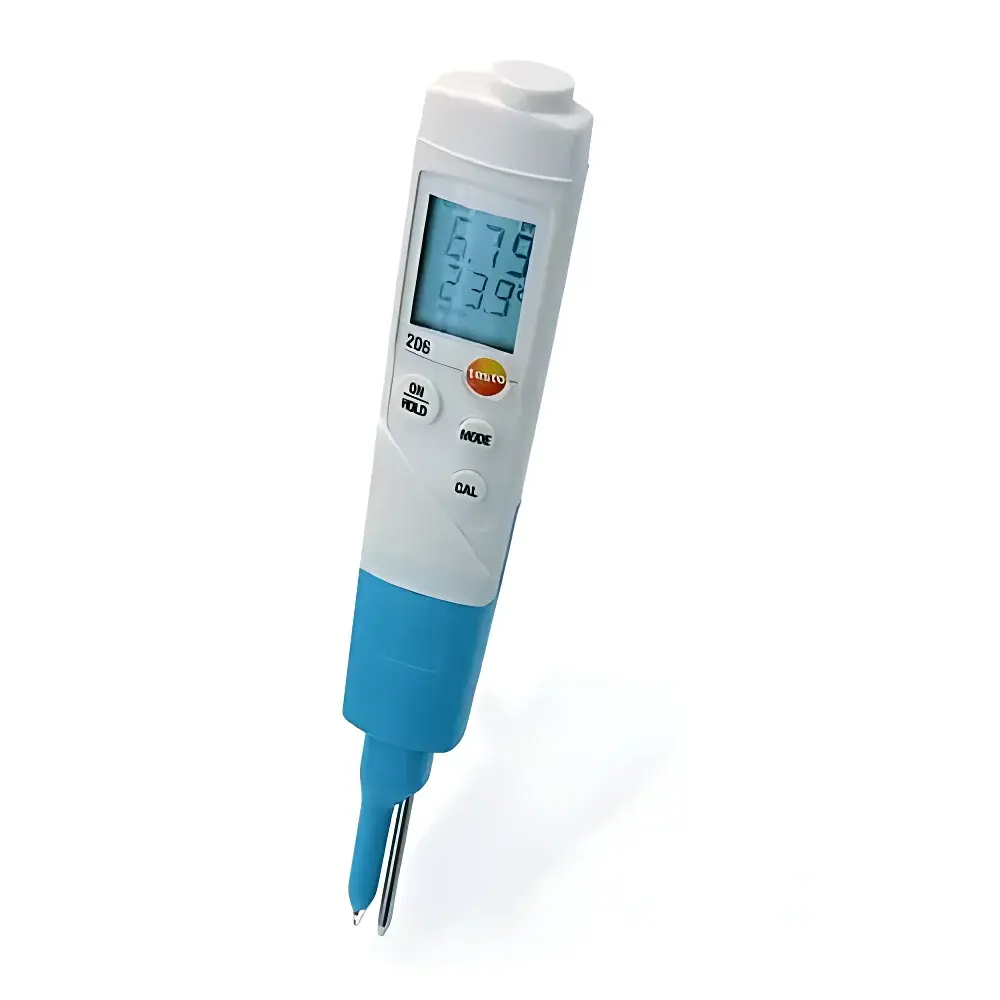
testo 206-pH2 Precision Pen-Style pH Meter for Semi-Solid and Water-Miscible Solid Samples
| Brand | testo |
|---|---|
| Origin | Germany |
| Model | 0563 2062 |
| Instrument Type | Pen-Style |
| Parameter Types | pH & Temperature |
| Measurement Accuracy | ±0.02 pH |
| pH Range | 0–14 pH |
| pH Resolution | 0.01 pH |
| Temperature Range (NTC) | 0–60 °C (short-term up to 80 °C, max 5 min) |
| Temp. Accuracy | ±0.4 °C |
| Temp. Resolution | 0.1 °C |
| Calibration | 1-, 2-, or 3-point with automatic buffer recognition |
| Calibration Standard | NIST-traceable buffers |
| Protection Rating | IP68 |
| Electrode Type | Integrated gel-filled ring-electrode with built-in temperature sensor |
| Probe Shaft Diameter | 11 mm |
| Sleeve Length | 35 mm |
| Weight | 115 g (with TopSafe protective sleeve), 65 g (without) |
| Dimensions | 197 × 33 × 20 mm (L×W×H, with probe & sleeve) |
| Display | 2-line LCD |
| Battery | CR2032 (≈80 h operation) |
| Housing Material | ABS |
| Operating Temperature | 0–60 °C |
| Storage Temperature | −20–+70 °C |
| CE Marked | 2014/30/EU |
Overview
The testo 206-pH2 is a precision-engineered pen-style pH meter specifically designed for reliable, on-site measurement of pH in semi-solid, viscous, and heterogeneous matrices—such as cheese curds, fruit pulps, meat emulsions, dairy gels, and water-miscible metalworking coolants. Unlike conventional glass-electrode pH meters optimized for aqueous solutions, the testo 206-pH2 integrates a robust, gel-filled ring electrode with an embedded NTC temperature sensor, enabling simultaneous, auto-compensated pH and temperature readings without external probes or manual correction. Its measurement principle relies on potentiometric detection across a stable Ag/AgCl reference system and a pH-sensitive glass membrane, calibrated against NIST-traceable standard buffers. The instrument’s architecture prioritizes reproducibility in non-homogeneous samples: the electrode’s low-profile, cylindrical geometry (11 mm shaft diameter, 35 mm active sleeve length) ensures consistent penetration depth and minimizes surface film interference, while the gel electrolyte eliminates leakage risk and eliminates routine refilling or maintenance—a critical advantage in food-grade and hygiene-critical environments.
Key Features
- Gel-filled ring electrode with integrated NTC temperature sensor for concurrent pH and temperature measurement with automatic temperature compensation (ATC)
- IP68-rated protective sleeve (TopSafe) providing full dust ingress protection and submersion resistance up to 1 m for 30 minutes—enabling thorough cleaning, steam sterilization compatibility (non-autoclavable but wipe-clean), and compliance with hygiene requirements in food and cosmetic production
- One-, two-, or three-point calibration with automatic buffer recognition, supporting standard NIST-traceable pH 4.01, 7.00, and 10.01 buffers
- High-resolution 2-line LCD display showing real-time pH value and temperature simultaneously, with 0.01 pH resolution and ±0.02 pH accuracy over the full 0–14 pH range
- Compact, ergonomic ABS housing (197 × 33 × 20 mm) weighing only 115 g with sleeve; field-deployable with CR2032 battery offering ≈80 hours of continuous operation
- No liquid junction maintenance required—the sealed gel reference system ensures long-term stability and resistance to protein fouling, fat adsorption, and particulate clogging common in dairy, meat, and fruit processing
Sample Compatibility & Compliance
The testo 206-pH2 is validated for direct insertion into semi-solid and heterogeneous media where traditional immersion electrodes fail: soft cheeses (e.g., Camembert, ricotta), fermented dairy products, fruit compotes, minced meats, batter-based mixtures, and water-oil-coolant emulsions. Its mechanical design prevents sample drag and enables repeatable positioning at defined depths. In regulated environments, the device supports GLP-compliant documentation when used with traceable calibration records and controlled storage conditions. While not intrinsically 21 CFR Part 11 compliant (as a standalone handheld instrument), its measurement data—when transferred via manual entry or optional IR interface—can be incorporated into validated laboratory information management systems (LIMS) under documented SOPs. It conforms to EN 61326-1 (EMC) and EN 61010-1 (electrical safety), bearing CE marking per Directive 2014/30/EU.
Software & Data Management
The testo 206-pH2 operates as a fully autonomous field instrument with no onboard memory or Bluetooth/Wi-Fi connectivity. All measurements are displayed in real time and must be manually recorded or transcribed. However, its standardized calibration protocol—including automatic buffer identification and linear interpolation between calibration points—ensures metrological traceability. Users may integrate readings into digital workflows by pairing with testo’s optional infrared data transfer accessories (e.g., testo 115i logger) or third-party IR-enabled loggers compliant with ISO/IEC 17025 documentation standards. For audit readiness, laboratories are advised to maintain calibration logs referencing NIST-traceable buffer certificates, instrument ID (0563 2062), and environmental operating conditions (temperature/humidity).
Applications
- Food & Beverage QA/QC: Monitoring pH during cheese ripening, yogurt fermentation, meat curing, and fruit processing—critical for microbial safety (e.g., Listeria inhibition), texture development, and shelf-life prediction
- Cosmetic Manufacturing: Verifying pH stability in emulsions, gels, and creams where phase separation or viscosity impedes conventional electrode use
- Metalworking Fluid Management: Assessing pH of water-miscible coolants to prevent corrosion, bacterial growth, and emulsion breakdown
- Academic & Pilot-Scale Research: Rapid screening of pH in novel food matrices, biopolymer hydrogels, and fermentation broths without sample dilution or homogenization
- Regulatory Sampling: Field verification of pH compliance per FDA Food Code §3-201.11, EC No. 2073/2005 (microbiological criteria), and ISO 21527-1 (yeast/mold enumeration preparation)
FAQ
Can the testo 206-pH2 measure pH in pure oils or anhydrous substances?
No. The instrument requires ionic mobility for potentiometric response; it is unsuitable for non-aqueous or low-conductivity media such as mineral oil, silicone fluids, or dry powders.
Is the electrode suitable for autoclaving?
No. The gel-filled electrode and ABS housing are not rated for autoclave conditions (121 °C, saturated steam). Cleaning is limited to warm water, mild detergent, or 70% ethanol wipe-down.
How often should calibration be performed?
Calibration is recommended before each measurement series, after exposure to extreme pH or temperature, and at least once per shift in continuous production environments—per ISO 7870-2 and ASTM E70 guidelines.
Does the device support offset adjustment or slope verification?
Yes. During calibration, the instrument displays electrode slope (%), allowing users to verify performance against the theoretical 59.16 mV/pH at 25 °C; slopes below 85% indicate electrode aging or contamination.
What is the expected service life of the electrode under typical food plant conditions?
With proper cleaning and storage in the supplied gel cap, the electrode typically maintains specification for 12–18 months of regular use—subject to exposure frequency, matrix aggressiveness, and thermal cycling.






