
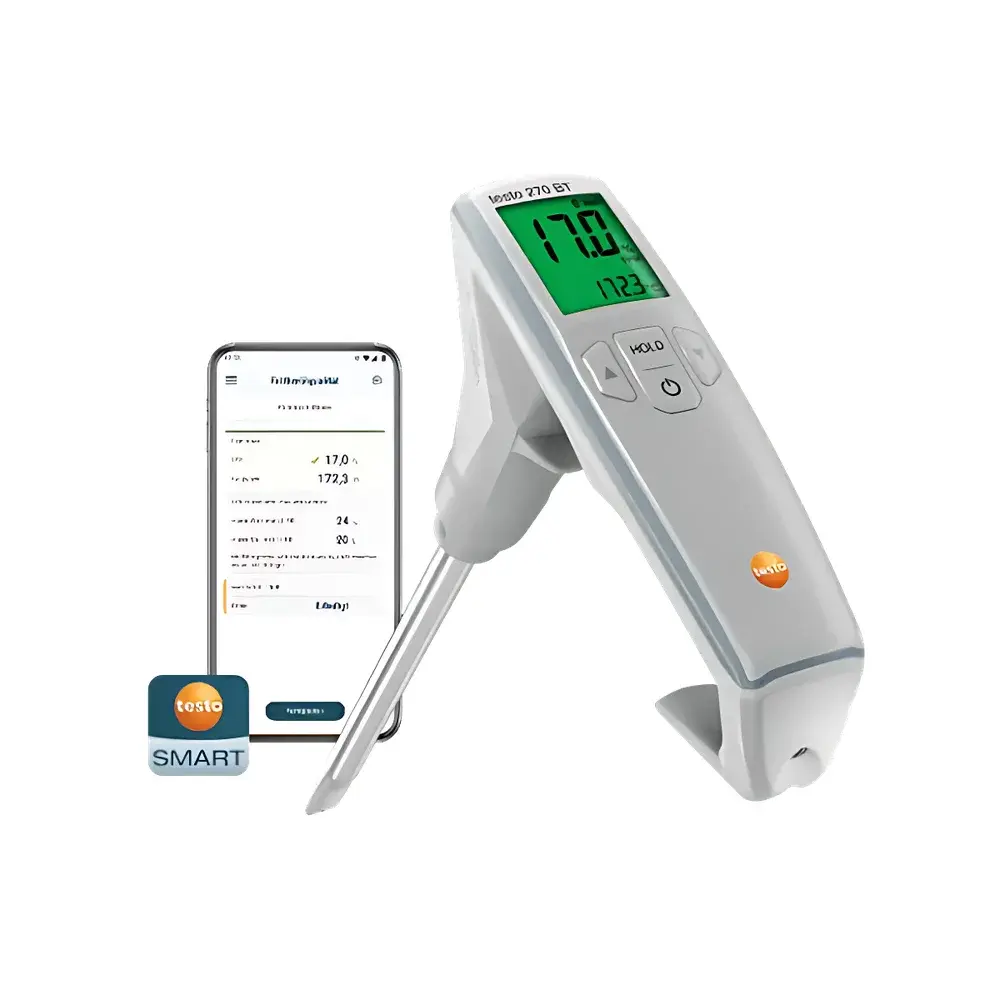
testo 270 BT Total Polar Materials (TPM) Analyzer for Frying Oil
| Brand | testo |
|---|---|
| Origin | Germany |
| Model | testo 270 BT |
| Instrument Type | Portable |
| Measurement Principle | Infrared Absorption Spectroscopy (IR) |
| Temperature Range | +40 to +200 °C |
| Detection Limit | < 0.2 mg/L (as reference standard for polar contaminants) |
| Accuracy | ±1.5 °C (temperature), ±2 % TPM (at +40 to +190 °C) |
| Resolution | 0.1 °C / 0.1 % TPM |
| Response Time | ~30 s |
| IP Rating | IP65 |
| Weight | 255 g |
| Dimensions (L×W×H) | 170 × 50 × 300 mm |
| Power Supply | 2 × AAA batteries (operating time ≈ 25 h / ~500 measurements) |
| Compliance | HACCP International certified, NSF registered |
Overview
The testo 270 BT Total Polar Materials (TPM) Analyzer is a purpose-engineered portable instrument designed for real-time, on-site assessment of frying oil degradation in commercial food preparation environments. It operates on the principle of infrared absorption spectroscopy, selectively detecting changes in the molecular composition of heated edible oils—specifically the accumulation of polar compounds such as free fatty acids, oxidized triglycerides, and polymerized species—that result from thermal stress and repeated use. These total polar materials (TPM) serve as internationally recognized indicators of oil deterioration; regulatory frameworks—including EU Regulation (EU) No 215/2014 and national food safety guidelines—commonly set actionable TPM thresholds between 24–27 % for discard decisions. The testo 270 BT delivers quantitative TPM values (% w/w) directly in hot oil, eliminating reliance on subjective sensory evaluation and enabling objective, repeatable decision-making aligned with HACCP-based preventive controls.
Key Features
- Integrated dual-sensor architecture: PTC thermistor for precise temperature measurement (+40 to +200 °C, ±1.5 °C accuracy) and capacitive TPM sensor (0.0–40.0 %, ±2 % TPM) co-located within a single stainless-steel probe head.
- Three-color LED backlit LCD display (green/orange/red) provides immediate visual status feedback based on user-defined TPM limit thresholds—supporting rapid operational response without interpretation delay.
- IP65-rated rugged housing constructed from glass-fiber-reinforced ABS/PC blend, engineered for resistance to thermal shock, mechanical impact, and frequent cleaning with running water.
- Ergonomic vertical grip design minimizes operator exposure to hot oil surfaces while ensuring stable immersion depth during measurement.
- On-device measurement lock function retains final stabilized reading for documentation or verification prior to data transfer.
- PIN-protected configuration settings prevent unauthorized modification of critical parameters including TPM alarm limits, calibration offsets, and display units.
Sample Compatibility & Compliance
The testo 270 BT is validated for direct immersion into all common vegetable-based frying media—including soybean, sunflower, palm, canola, and peanut oils—as well as blended formulations used in institutional kitchens, fast-food chains, and industrial food production lines. Its measurement methodology conforms to the technical basis of ISO 8534:2017 (determination of polar compounds in frying oils by IR spectroscopy) and supports compliance with HACCP International’s certification requirements for oil monitoring equipment. Instrument calibration is traceable to testo-certified reference standards (e.g., TPM calibration oil sets), and full calibration reports are generated per session. The device meets NSF/ANSI Standard 18 for food equipment materials and is suitable for environments operating under FDA 21 CFR Part 11-compliant quality systems when paired with testo Smart App’s audit-trail-enabled data export.
Software & Data Management
When connected via Bluetooth 5.0 to the testo Smart App (iOS/Android), the 270 BT enables fully digital workflow integration. Users configure custom TPM alert thresholds, assign location tags, annotate measurements with voice notes or text comments, and generate timestamped PDF reports—including electronic signature fields and revision history—for internal QA audits or third-party inspections. All raw data—including TPM value, temperature, date/time stamp, and instrument ID—is exportable in CSV format for traceability and statistical process control (SPC) analysis. The app enforces GLP-aligned data integrity through encrypted local storage, automatic session logging, and tamper-evident file generation—ensuring alignment with GMP and ISO/IEC 17025 documentation expectations.
Applications
- Real-time monitoring of fryer oil condition across restaurant kitchens, catering facilities, and food service operations to optimize oil replacement cycles and reduce operational costs.
- Verification of vendor-supplied oil quality upon delivery and after initial heating cycles.
- Supporting internal quality assurance protocols by generating auditable records for HACCP plan validation and management review.
- Training staff on objective oil quality criteria through intuitive color-coded feedback and guided measurement workflows.
- Integration into centralized food safety dashboards via API-enabled data synchronization (via testo Cloud services).
FAQ
How does the testo 270 BT differ from traditional lab-based TPM testing methods?
It eliminates sample extraction, solvent handling, and off-site laboratory turnaround—providing quantitative results in ~30 seconds directly in the fryer.
Is field calibration possible without sending the unit to a service center?
Yes—using testo-certified calibration oil and the guided routine within the Smart App, users perform on-site verification and adjustment with full traceable documentation.
Can measurement data be integrated into existing enterprise quality management systems (QMS)?
CSV exports support import into LIMS, SAP QM, or custom SPC platforms; testo Cloud APIs enable automated ingestion for centralized analytics.
What environmental conditions affect measurement reliability?
The device operates reliably between 0–50 °C ambient temperature; immersion must occur only within its specified +40–+200 °C oil temperature range to ensure sensor stability and optical path consistency.
Does the instrument require periodic recalibration by an accredited lab?
While field calibration suffices for daily operation, annual verification against NIST-traceable reference standards is recommended for ISO/IEC 17025 or GMP-regulated environments.
Related Products







