
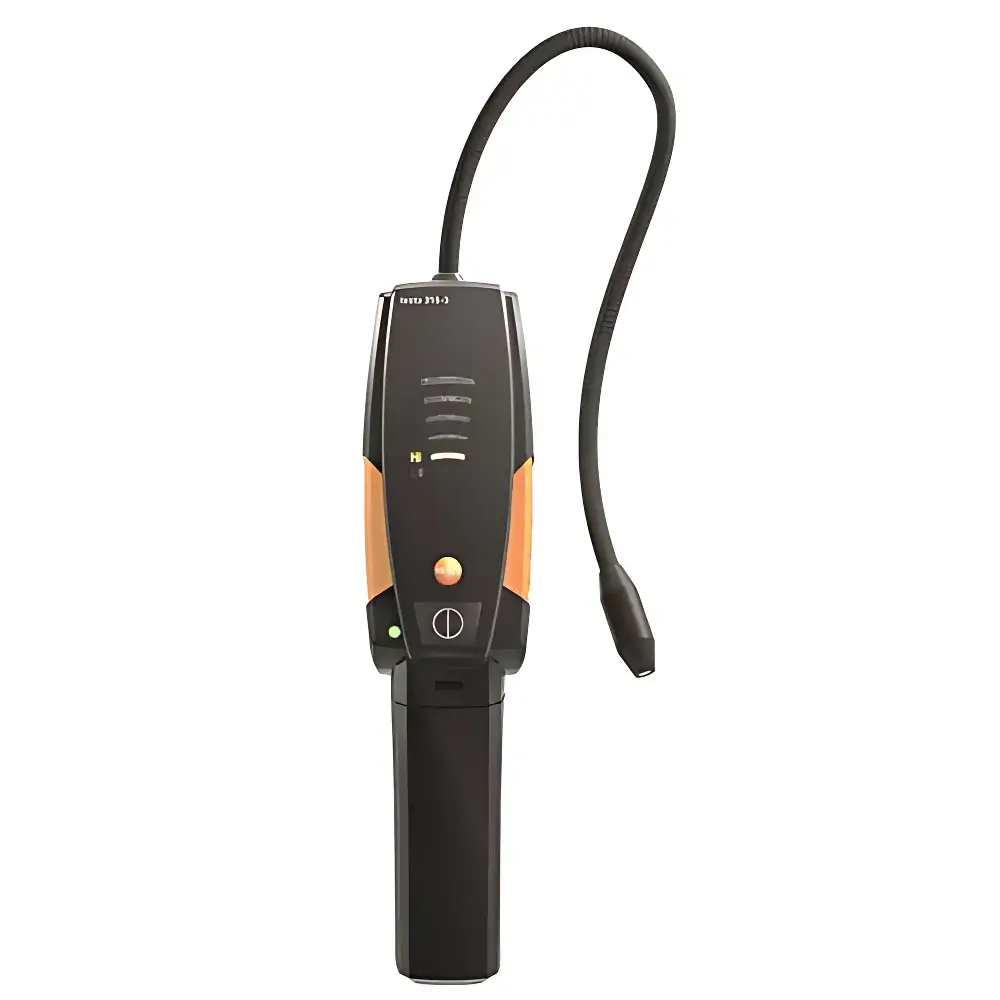
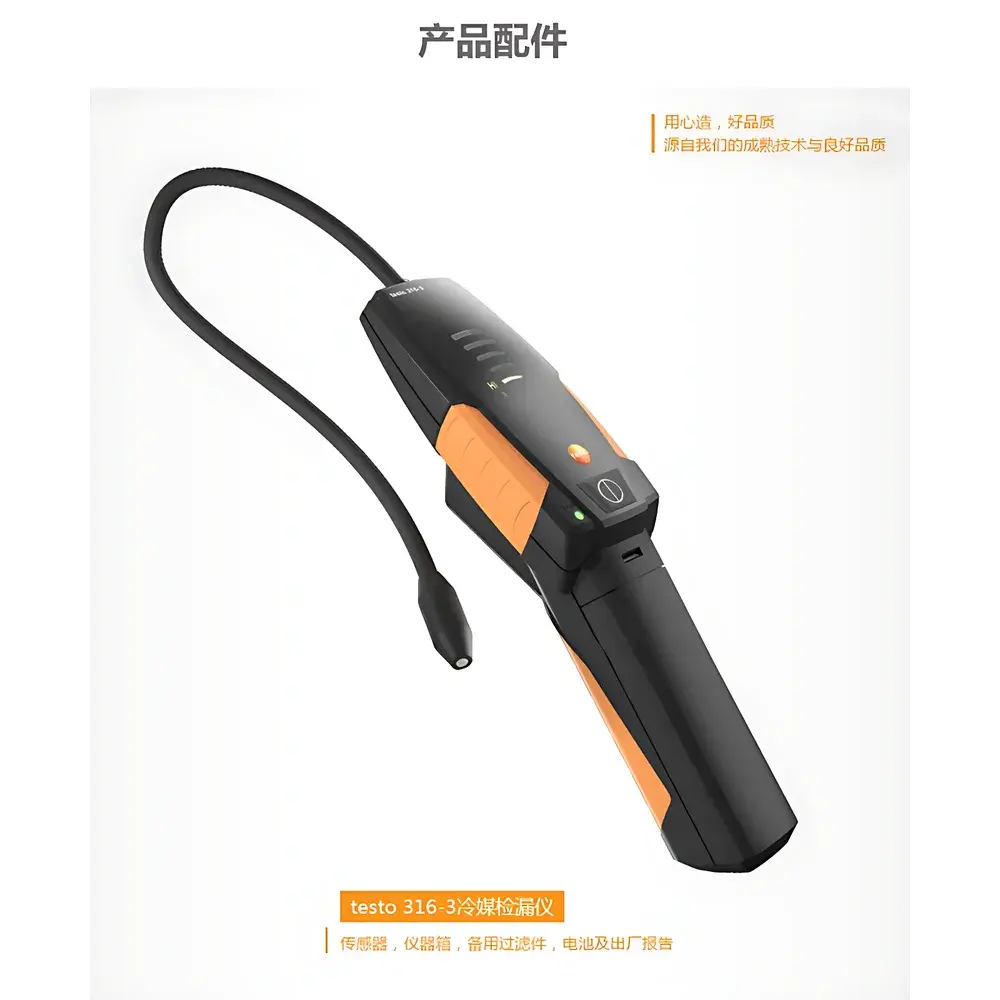
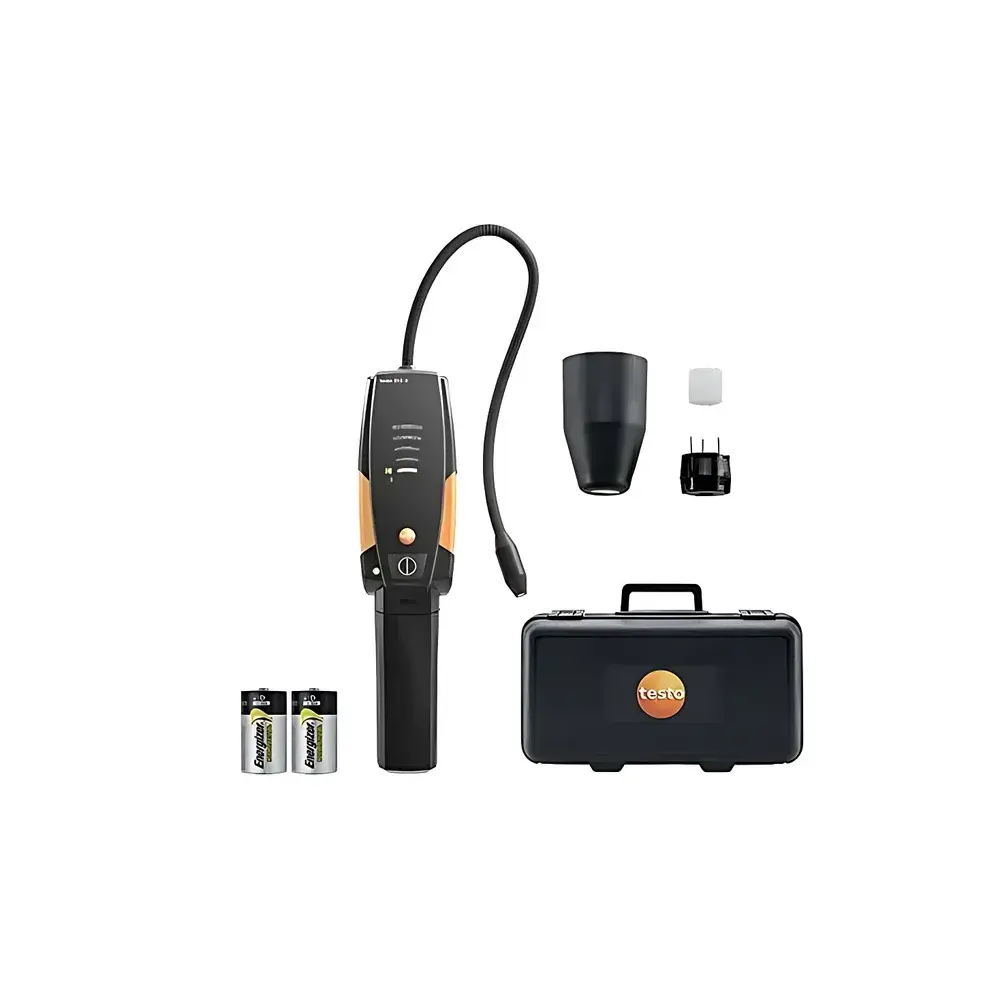
testo 316-3 Refrigerant Leak Detector
| Brand | testo |
|---|---|
| Origin | Germany |
| Model | 0563 3163 |
| Detection Principle | Heated Diode (HD) Sensor |
| Sensitivity | 4 g/year (0.15 oz/yr) |
| Detectable Refrigerants | R22, R134a, R404A, R410A, R507, R438A, and all CFCs, HCFCs, HFCs |
| Operating Temperature | −18 °C to +50 °C |
| Storage Temperature | 0 °C to +50 °C |
| Relative Humidity Range | 20–80 % RH |
| Weight | 500 g (incl. batteries) |
| Dimensions | 270 × 60 × 61 mm |
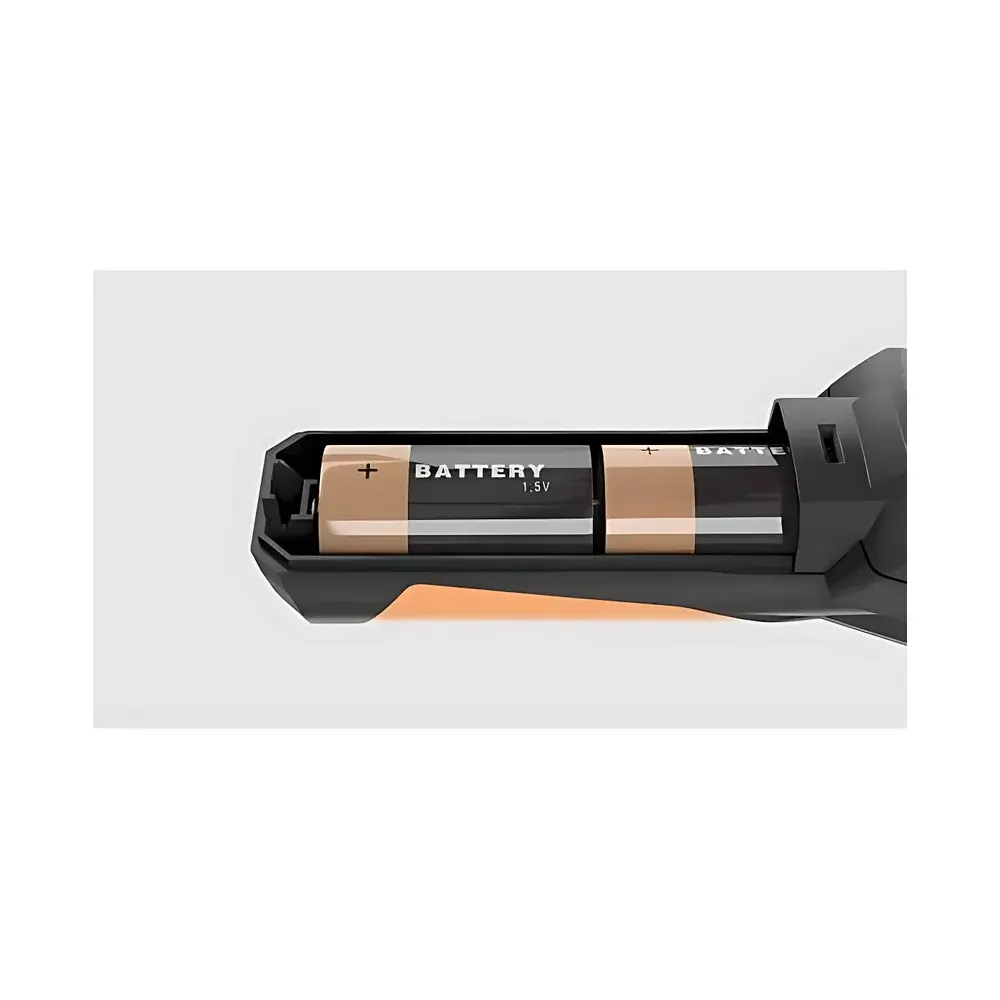
| Power Supply | 2 × D-cell batteries |
| Battery Life | ~16 h continuous operation |
| Sensor Lifetime | 80–100 h (approx. 1 year under typical field use) |
| Compliance | EN 14624:2012, SAE J1627, EU Regulation (EC) No 842/2006 & (EU) No 517/2014 (F-gas Regulation) |
Overview
The testo 316-3 Refrigerant Leak Detector is a portable, handheld instrument engineered for precise, field-deployable detection of halogenated refrigerants in HVAC/R maintenance, commissioning, and regulatory compliance workflows. It operates on the heated diode (HD) detection principle—where refrigerant molecules are thermally dissociated at the sensor surface, generating a measurable current proportional to concentration. This electrochemical response delivers stable, repeatable sensitivity down to 4 g/year (0.15 oz/yr), meeting the minimum performance threshold defined in EN 14624:2012 for refrigerant leak detectors used in professional service environments. Designed for immediate operational readiness, the device requires no pre-calibration or user configuration—power-on initiates automatic zero adjustment, compensating for ambient background interference from residual refrigerants or cross-contaminants. Its ruggedized black housing, ergonomic grip, and IP-rated internal layout ensure reliable function across diverse installation conditions—from rooftop chillers to low-temperature cold storage facilities.
Key Features
- Heated diode (HD) sensor technology optimized for broad-spectrum halocarbon detection—including CFCs (e.g., R11, R12), HCFCs (e.g., R22), and HFCs (e.g., R134a, R404A, R410A, R507, R438A)
- Automatic baseline compensation: Real-time zero-point correction adapts to fluctuating ambient gas concentrations, maintaining measurement integrity in contaminated or multi-refrigerant environments
- Intuitive single-button operation: No mode selection, menu navigation, or parameter setup required—ideal for time-critical diagnostics and technician mobility
- Visual leak indication via dual-color LED array: Green steady = background; yellow pulsing = low-level leak; red rapid flash = high-concentration leak—enabling rapid spatial localization without audio dependency
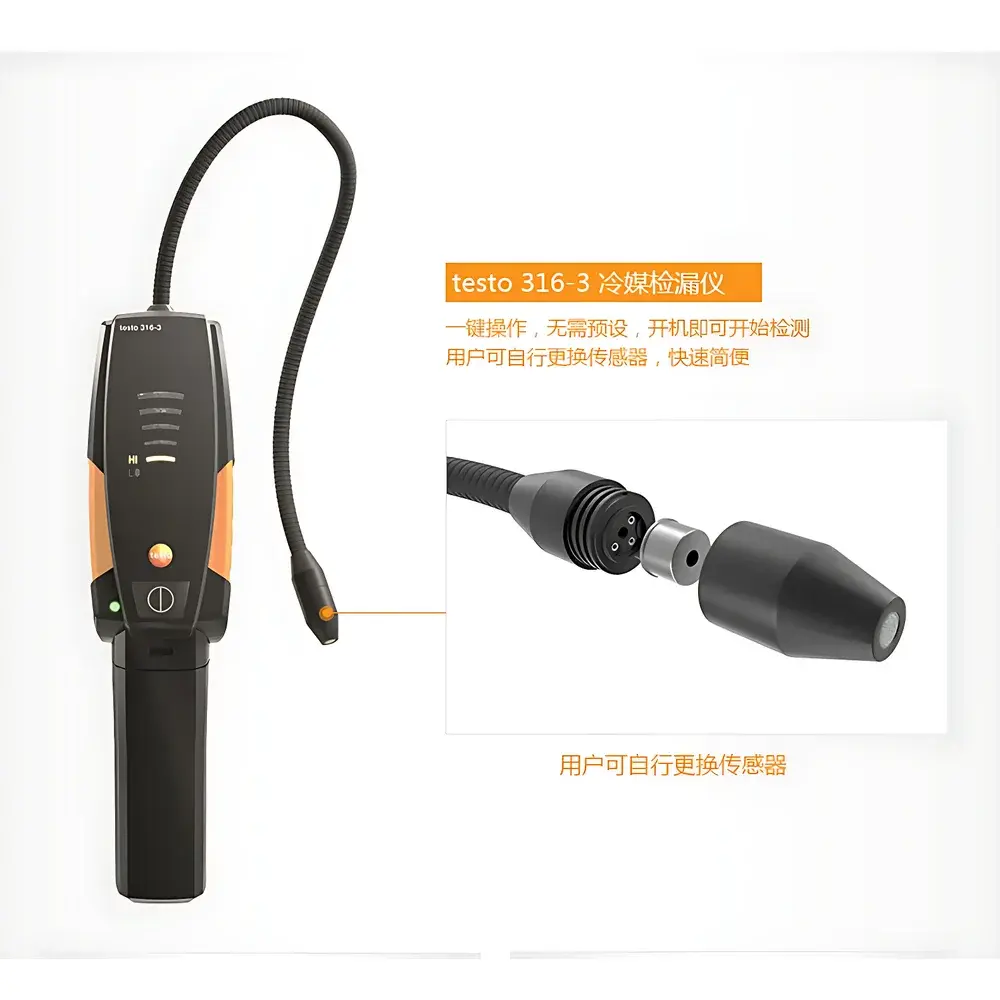
- User-replaceable sensor module: Field-swappable HD sensor cartridge minimizes downtime and eliminates need for return-to-factory recalibration
- Integrated battery management: Two D-cell alkaline batteries support up to 16 hours of continuous operation; low-battery indicator provides advance warning prior to shutdown
Sample Compatibility & Compliance
The testo 316-3 is validated for quantitative leak screening across the full spectrum of legacy and modern refrigerants regulated under international environmental frameworks. It satisfies the functional requirements of EN 14624:2012 (leak detection equipment for fluorinated greenhouse gases) and SAE J1627 (performance criteria for electronic leak detectors). Its detection capability aligns with the mandatory leak-check intervals and repair thresholds stipulated in EU F-gas Regulation (EC) No 842/2006 and its successor (EU) No 517/2014—supporting legally defensible documentation for facility audits and technician certification records. While not a certified metrological standard reference, the instrument’s repeatability and drift characteristics are traceable to testo’s internal calibration protocols, ensuring consistency across instruments deployed within a service fleet or multi-site maintenance program.
Software & Data Management
The testo 316-3 operates as a standalone detection tool without embedded data logging or Bluetooth/Wi-Fi connectivity. However, it supports structured documentation workflows through compatibility with testo’s optional reporting accessories—including the testo 316-3 Calibration Certificate (issued per unit at factory) and the testo Smart Probes app (when paired with compatible testo data loggers for timestamped photo-log entries). All units ship with a factory-issued conformity report detailing serial-number-specific verification against EN 14624:2012 sensitivity and response time criteria. For GLP/GMP-aligned environments, users may integrate the device into existing QA/QC procedures by recording inspection timestamps, location identifiers, and pass/fail outcomes manually or via external digital checklists compliant with ISO/IEC 17025 documentation practices.
Applications
- Routine leak verification during HVAC/R system commissioning and post-service verification
- Periodic regulatory inspections mandated under EU F-gas Regulation and EPA Section 608 requirements
- Troubleshooting micro-leaks in brazed joints, valve stems, flare fittings, and heat exchanger tubing
- Verification of seal integrity after refrigerant recovery, recycling, or recharging operations
- Training and competency assessment for apprentices and certified technicians under CEN/TR 15643 and REFCOM standards
- Preventive maintenance programs targeting refrigerant charge loss reduction and energy efficiency optimization
FAQ
Does the testo 316-3 require periodic calibration?
Yes—while automatic zeroing compensates for short-term drift, annual sensor verification against a certified reference gas (e.g., R134a at 100 ppm) is recommended per EN 14624:2012 Clause 6.3 to maintain traceable performance.
Can the device detect non-halogenated refrigerants such as ammonia (R717) or CO₂ (R744)?
No—the heated diode sensor is chemically selective for chlorine- and fluorine-containing compounds; it does not respond to ammonia, hydrocarbons, or carbon dioxide.
What is the expected service life of the sensor under typical field use?
Approximately 80–100 hours of cumulative active detection time, equivalent to ~1 year of average technician usage; replacement sensors are available as testo part number 0563 3163 01.
Is the testo 316-3 suitable for use in explosive atmospheres?
No—it is not ATEX- or IECEx-certified and must not be operated in Zone 0, 1, or 2 hazardous areas per Directive 2014/34/EU.
How does the automatic zero function handle high-background environments, such as workshops with multiple open refrigerant lines?
The algorithm samples ambient air for 30 seconds upon power-up and establishes a dynamic baseline; however, sustained exposure above 10 ppm total halocarbon concentration may reduce sensitivity—users should perform zeroing in clean air before entering high-risk zones.
Related Products







