
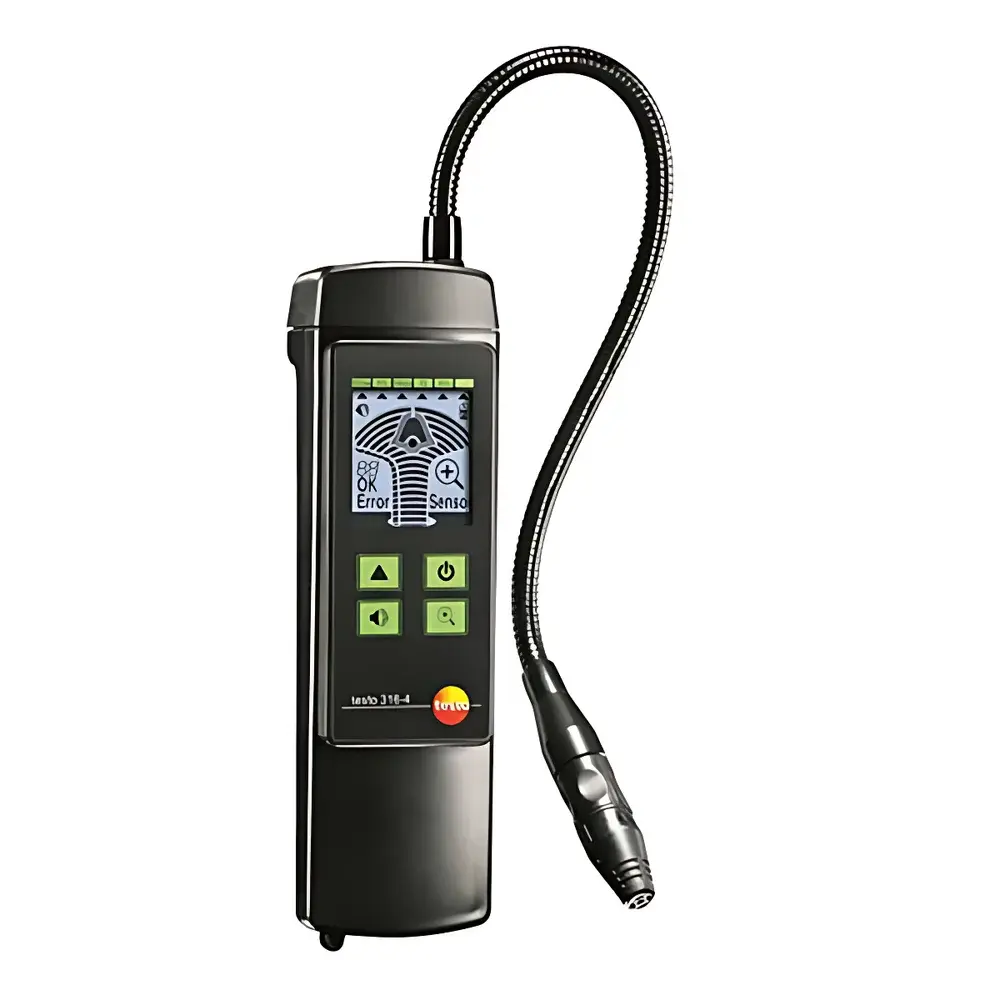
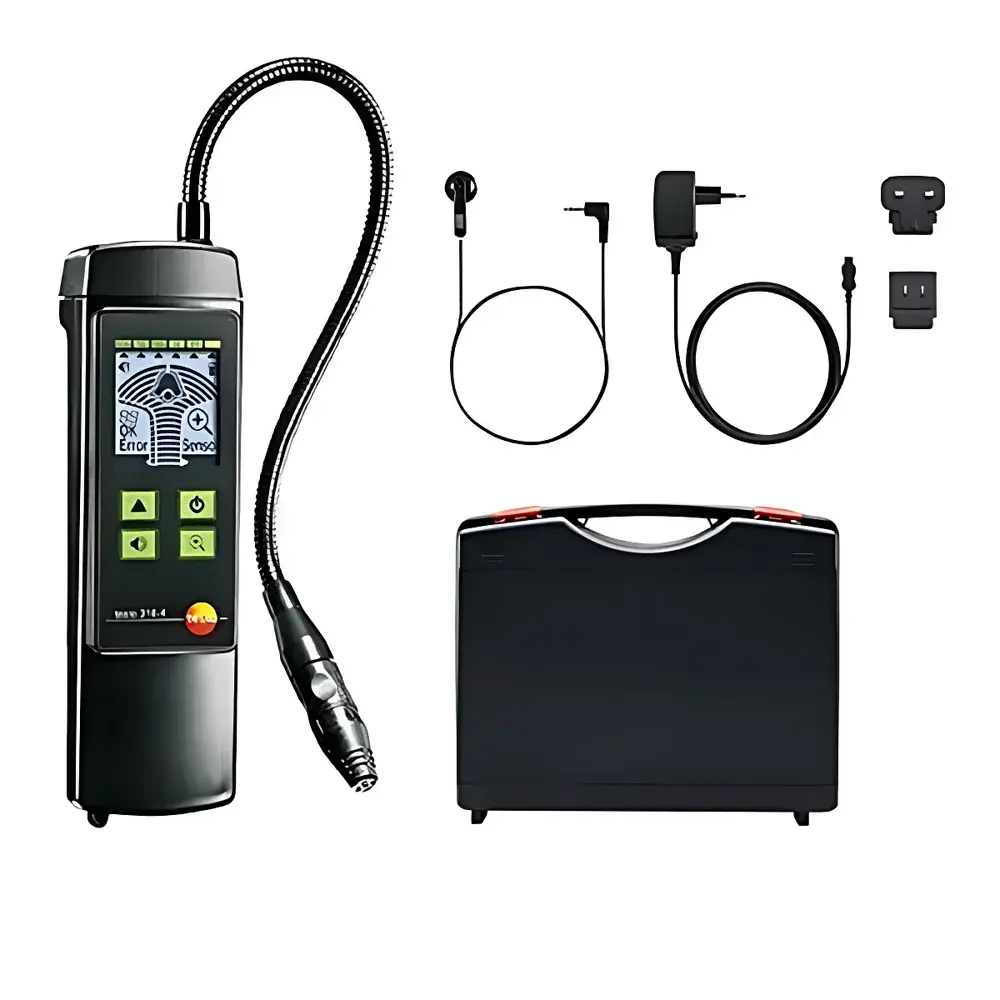
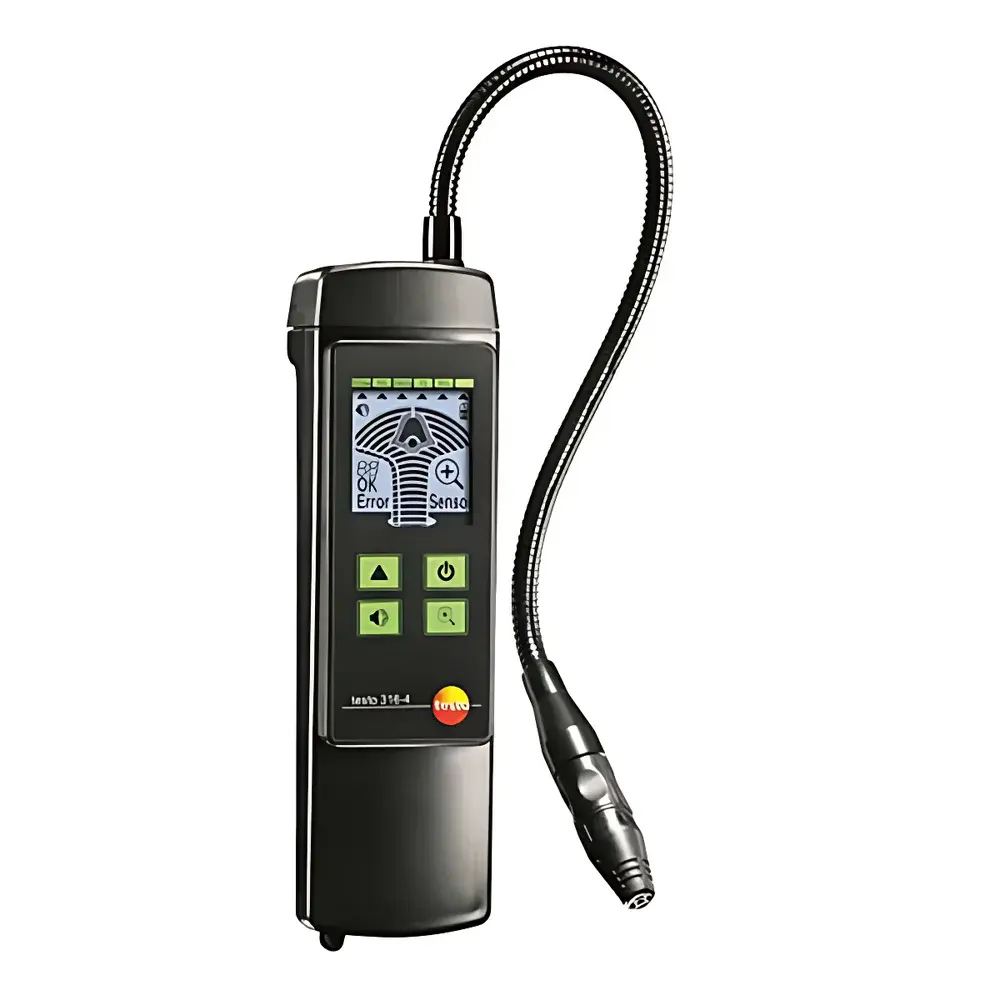
testo 316-4 Refrigerant Leak Detector Kit (Model 0563 3164)
| Brand | testo |
|---|---|
| Origin | Germany |
| Model | 0563 3164 |
| Detection Sensitivity | < 3 g/year (per EN 14624:2012) |
| Operating Temperature | −20 °C to +50 °C |
| Storage Temperature | −25 °C to +70 °C |
| Relative Humidity Range | 20–80 % RH |
| Weight | 348 g |
| Dimensions (L × W × H) | 190 × 57 × 42 mm |
| Gooseneck Length | 370 mm |
| Response Time | < 1 s |
| Warm-up Time | < 50 s (at 0–50 °C) |
| Battery | Integrated NiMH battery pack (6 cells), ~6 h continuous operation |
| Detectable Refrigerants | R134a, R22, R404A, H₂, CFCs, HCFCs, HFCs |
Overview
The testo 316-4 Refrigerant Leak Detector Kit (Model 0563 3164) is a field-deployable, handheld electrochemical gas detection system engineered for precise, real-time identification of refrigerant leaks across industrial, commercial, and HVAC/R service applications. It operates on a calibrated metal-oxide semiconductor (MOS) sensing principle optimized for trace-level detection of halogenated and hydrogen-based refrigerants—including CFCs, HCFCs, HFCs, and molecular hydrogen—while maintaining robust immunity to common interferents such as alcohol vapors, solvents, and ambient hydrocarbons. Its design adheres strictly to EN 14624:2012, the European standard governing performance requirements and test methods for refrigerant leak detectors, ensuring metrological traceability and regulatory acceptability in CE-marked markets. The instrument delivers sub-gram-per-year sensitivity (< 3 g/year for R134a), enabling early-stage leak identification before system efficiency degrades or environmental compliance thresholds are breached.
Key Features
- Ultra-high sensitivity compliant with EN 14624:2012 (< 3 g/year for R134a), supporting preventive maintenance and F-Gas Regulation (EU No. 517/2014) reporting obligations
- Replaceable and cleanable MOS sensor head with integrated gooseneck (370 mm length), allowing access to confined or obstructed joints, flanges, and brazed connections without disassembly
- Dual-mode visual-auditory alarm: green-to-red LED status transition plus adjustable audible tone; included noise-isolating earphones enable reliable leak localization in high-background-noise environments (e.g., compressor rooms, rooftop units)
- Real-time analog bar graph and digital concentration display (ppm-equivalent scale) with peak-hold function to identify maximum leak intensity during scanning
- Rugged ABS housing with IP54-rated ingress protection; operational across −20 °C to +50 °C ambient range, suitable for year-round outdoor and cold-storage facility use
- Integrated NiMH rechargeable battery pack (6-cell configuration) providing up to 6 hours of continuous runtime; charging via included universal AC adapter
Sample Compatibility & Compliance
The testo 316-4 detects a broad spectrum of refrigerants used in legacy and modern systems: chlorofluorocarbons (CFCs), hydrochlorofluorocarbons (HCFCs), hydrofluorocarbons (HFCs), hydrogen (H₂), and ammonia (NH₃) — the latter requiring an optional, chemically selective NH₃ sensor probe (not included in base kit). Its calibration protocol supports multi-gas verification per ISO 17025-accredited procedures when used with certified span gases (e.g., R134a in N₂ at 100 ppm). The device meets electromagnetic compatibility (EMC) requirements per EN 61326-1 and carries CE marking for conformity with EU Directive 2014/30/EU (EMC) and 2014/35/EU (LVD). It is validated for use in environments governed by VDI 2047 Part 2 (hygienic operation of cooling systems) and aligns with best practices referenced in ASHRAE Standard 34 and ISO 8573-1 for compressed air purity monitoring where refrigerant cross-contamination is a concern.
Software & Data Management
While the testo 316-4 operates as a standalone field instrument without onboard data logging, its analog output interface (0–1 V DC) enables integration with external dataloggers or building management systems (BMS) for time-stamped leak event recording. All firmware updates and sensor diagnostics are performed via testo’s proprietary service software (testo Comsoft Basic), which supports audit trail generation for GLP-compliant maintenance logs. Though not FDA 21 CFR Part 11–compliant out-of-the-box, the instrument may be incorporated into validated workflows when paired with qualified electronic record systems meeting ALCOA+ principles (Attributable, Legible, Contemporaneous, Original, Accurate, Complete, Consistent, Enduring, Available).
Applications
- HVAC/R commissioning and post-installation leak verification per EN 378-2 and ISO 5149
- Preventive maintenance of chiller plants, refrigerated transport units, and supermarket cascade systems
- F-Gas Regulation compliance audits for operators handling ≥ 3 kg of fluorinated greenhouse gases
- Leak investigation in low-temperature ammonia refrigeration systems (with NH₃-specific probe)
- Quality assurance during brazing, welding, and flare joint fabrication in refrigerant piping networks
- Field verification of hermetic seal integrity in heat exchangers, compressors, and expansion valves
FAQ
What refrigerants does the standard testo 316-4 kit detect?
The base kit includes a multi-gas sensor calibrated for CFCs, HCFCs, HFCs (e.g., R134a, R22, R404A), and H₂. NH₃ detection requires a separately ordered, application-specific sensor probe.
Is the sensor user-replaceable and cleanable?
Yes—the MOS sensor head is designed for field replacement and can be cleaned using isopropyl alcohol and lint-free swabs; full functional recovery occurs within seconds after drying.
Does the device meet international calibration standards?
It complies with EN 14624:2012 for sensitivity, response time, and alarm reliability. Calibration verification should be conducted annually using traceable reference gases per ISO/IEC 17025 guidelines.
Can the testo 316-4 be used in explosive atmospheres?
No—it is not ATEX- or IECEx-certified. Use only in non-hazardous zones per IEC 60079-0.
What is the expected service life of the sensor under typical field conditions?
With proper cleaning and storage, the MOS sensor maintains specified performance for ≥ 24 months; accelerated degradation may occur in high-humidity or solvent-rich environments.



