
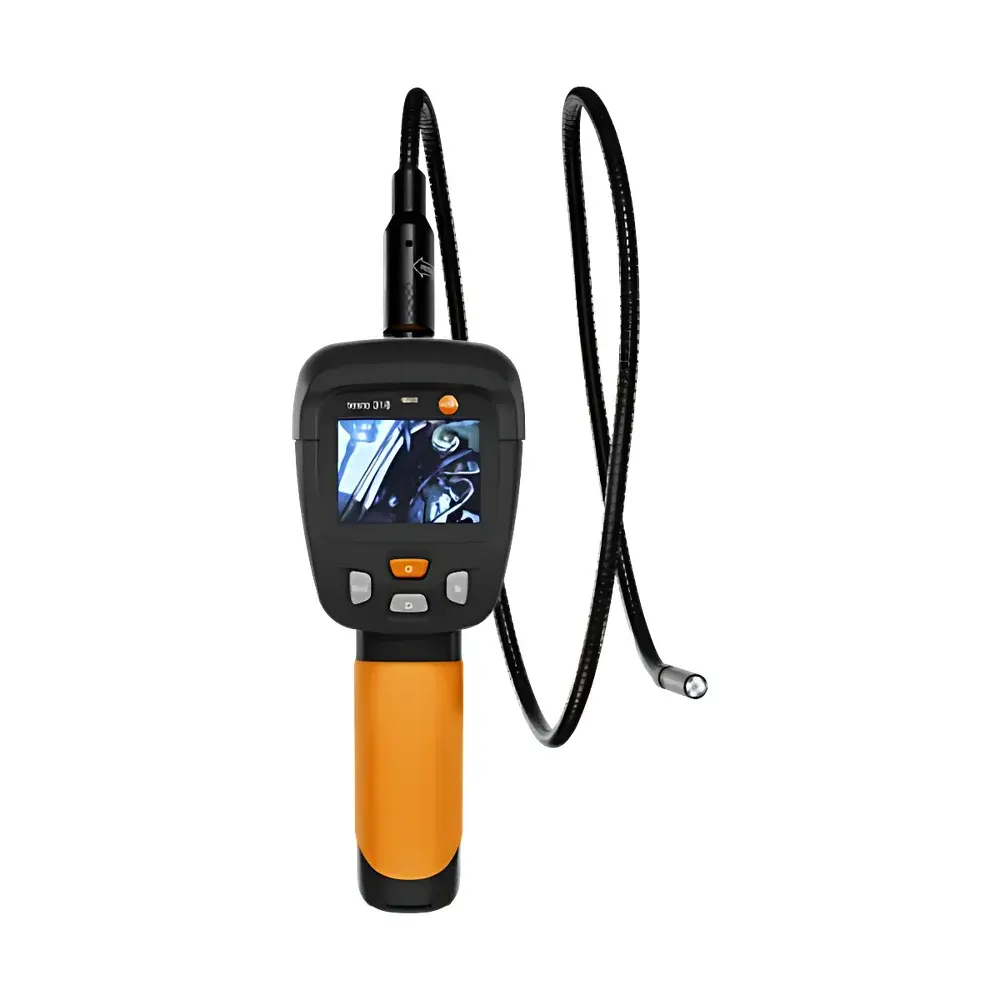
testo 318 Industrial Rigid Borescope
| Brand | testo |
|---|---|
| Origin | Germany |
| Model | testo 318 |
| Imaging Type | Optical Rigid Endoscope |
| Material Classification | Rigid Endoscope |
| Application Field | Aerospace, HVAC, Boiler & Chimney Inspection |
| Camera Resolution | 640 × 480 pixels |
| Display | 2.4" Color LCD (480 × 234 px) |
| Illumination | 10-Step Adjustable LED |
| Field of View | 70° |
| Image Refresh Rate | >24 FPS |
| Digital Zoom | 2× (5-step: 1.2×, 1.4×, 1.6×, 1.8×, 2.0×) |
| Insertion Tube | 1,000 mm Flexible Waterproof Gooseneck (IP67) |
| Lens Diameter | 9 mm |
| Lens Rotation | 180° Image Rotation |
| Operating Temperature | −10 °C to +50 °C |
| Storage Temperature | −20 °C to +60 °C |
| Battery Life | 8 h (at 40 % LED brightness) |
| Power Supply | 4 × AA Alkaline Batteries |
| Protection Rating | IP67 (insertion tube), IP40 (main unit) |
| Certifications | CE, FCC, RoHS, UKCA |
| Warranty | Standard testo Manufacturer Warranty |
Overview
The testo 318 Industrial Rigid Borescope is a precision-engineered optical inspection instrument designed for non-destructive visual examination in confined, inaccessible, or hazardous environments. Built on a rigid optical imaging core with a fixed-focus lens system and high-fidelity light transmission path, the device delivers real-time, high-clarity visualization without reliance on electronic image sensors at the distal tip—ensuring mechanical robustness, thermal stability, and immunity to electromagnetic interference. Its 9 mm diameter rigid probe features a 70° field of view and integrated 180° digital image rotation capability, enabling orientation-adjusted inspection without physical repositioning of the insertion tube. The 2.4″ color LCD display (480 × 234 px resolution) provides immediate visual feedback at >24 frames per second, supporting dynamic assessment of moving components or fluid flow within ducts, combustion chambers, turbine casings, and heat exchangers. Designed for frontline industrial maintenance, the testo 318 meets the operational demands of aerospace MRO, power generation, HVAC commissioning, and boiler safety inspections where repeatability, traceability, and regulatory compliance are essential.
Key Features
- Rigid optical imaging architecture with 640 × 480 pixel CMOS sensor and precision-ground lens assembly for consistent resolution and minimal geometric distortion
- 10-step adjustable high-output LED illumination system optimized for variable reflectivity surfaces and low-contrast internal geometries
- 1,000 mm flexible, IP67-rated gooseneck insertion tube with reinforced braided sheath and chemical-resistant silicone coating for repeated use in oily, humid, or particulate-laden environments
- Real-time image rotation (180° digital flip) and 2× digital zoom (five discrete steps: 1.2×, 1.4×, 1.6×, 1.8×, 2.0×) for enhanced defect localization without probe retraction
- Integrated accessory interface supporting magnetic tip adapters, articulated hook tools, and 90° side-view mirrors—enabling simultaneous inspection and minor foreign object removal
- Compliance-ready design: CE, FCC, RoHS, and UKCA certified; fully documented conformity assessment files available upon request for ISO 9001 or AS9100-aligned quality systems
Sample Compatibility & Compliance
The testo 318 is validated for direct visual inspection of metallic, ceramic, and composite internal surfaces across ASME B31.1, ASTM E2578, and EN 13643-1 compliant workflows. Its rigid-optical construction ensures dimensional stability under thermal cycling (−10 °C to +50 °C operating range), making it suitable for post-combustion chamber inspection in boilers and exhaust manifolds. The IP67-rated probe withstands immersion in water up to 1 m for 30 minutes and resists dust ingress during turbine blade cavity inspection. While not intended for quantitative metrology, its optical geometry supports qualitative pass/fail assessments aligned with FAA AC 43.13-1B, EASA AMC 20-27, and ISO 17020 requirements for NDT personnel competence and equipment verification.
Software & Data Management
The testo 318 operates as a standalone hardware inspection platform with no embedded firmware-based storage or wireless connectivity. All captured still images and video clips (recorded externally via HDMI output or third-party capture devices) retain native timestamp metadata and are compatible with industry-standard asset management platforms including SAP PM, IBM Maximo, and Siemens Teamcenter. Optional testo Smart Probes software (v3.2+) enables annotation, report generation, and export in PDF/A-1b or CSV formats—supporting FDA 21 CFR Part 11 audit trails when deployed with validated Windows-based workstations. Calibration documentation and certificate of conformance are supplied with each unit, traceable to DAkkS-accredited reference standards.
Applications
- Aerospace: Visual inspection of turbine vane cooling passages, fuel nozzle orifices, and APU compressor housings per SRM Chapter 51 guidelines
- Energy Infrastructure: In-service examination of boiler tubes, economizer bends, and flue gas desulfurization (FGD) duct liners
- HVAC&R: Verification of coil cleanliness, drain pan integrity, and duct liner adhesion in LEED-certified facilities
- Manufacturing: Post-machining verification of blind holes, weld root conditions, and casting porosity in automotive cylinder heads
- Facility Maintenance: Routine smokestack liner assessment, fire damper actuation verification, and rooftop unit heat exchanger inspection
FAQ
Is the testo 318 compatible with digital reporting workflows required under ISO/IEC 17020?
Yes—the device’s HDMI output and standardized image resolution enable integration into accredited inspection documentation systems; full traceability requires external timestamping and user authentication protocols.
Can the gooseneck tube be sterilized or cleaned with industrial solvents?
The IP67-rated tube may be wiped with isopropyl alcohol (70 %) or mild alkaline detergents; autoclaving, chlorinated solvents, and ultrasonic cleaning are prohibited.
Does testo provide calibration services for the optical path?
testo offers annual optical verification against NIST-traceable resolution targets (MTF measurement); formal calibration certificates are issued per ISO/IEC 17025 by authorized service centers.
What is the maximum working distance for reliable focus?
The fixed-focus optical system is optimized for 10–100 mm object distance; extended depth-of-field performance is maintained across this range without manual refocusing.
Are replacement lenses or custom tip configurations available?
Standard accessories include 90° side-view mirror, magnetic retrieval tip, and dual-angle hook; custom OEM lens assemblies require minimum order quantities and 12-week lead time.



