
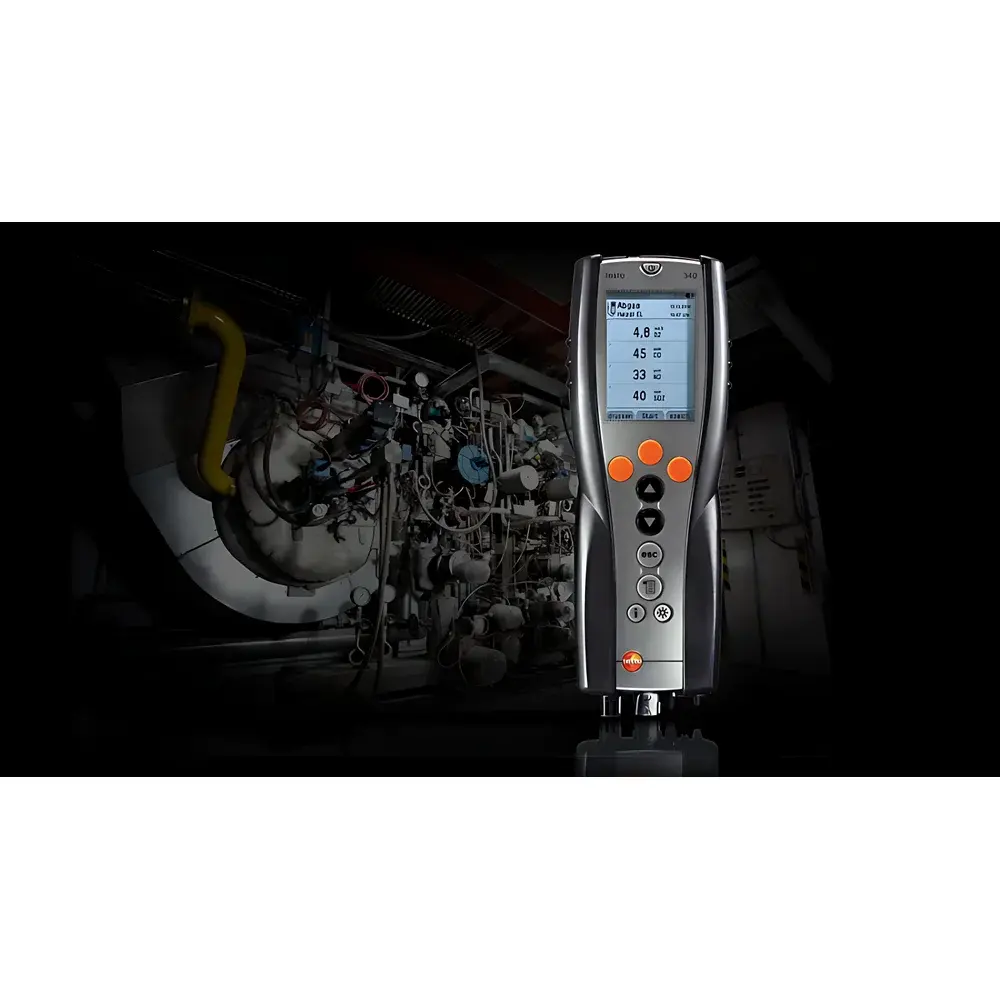
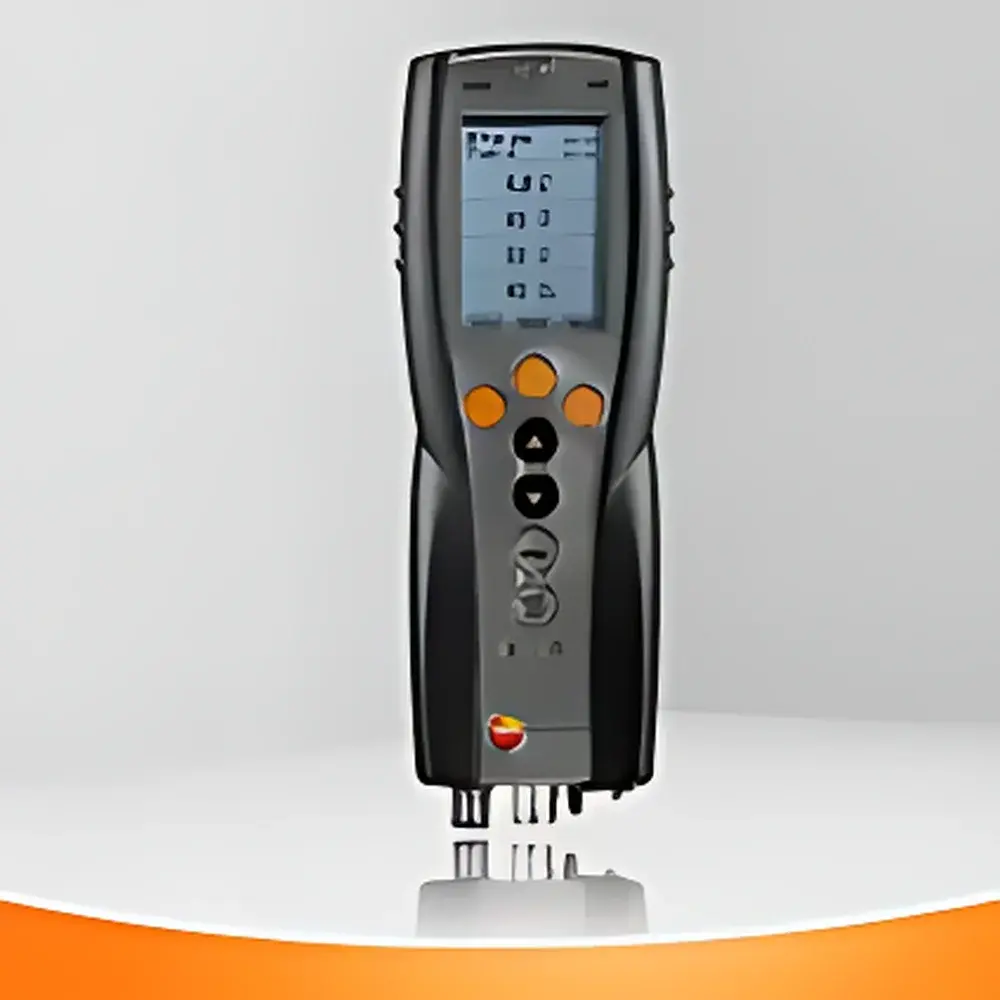
testo 340 Advanced Portable Flue Gas Analyzer
| Brand | testo |
|---|---|
| Origin | Germany |
| Model | 0632 3341 |
| Instrument Type | Portable Flue Gas Analyzer |
| Differential Pressure Accuracy | ±0.5 hPa (–49.9 to +49.9 hPa) |
| Repeatability | < 2 % |
| Response Time | < 20 s |
| Stability | ±1.5 % of reading (remaining pressure range) |
| Measured Gases | CO, COlow, NO, NOlow, NO₂, SO₂ (CO-interference-resistant SO₂ sensor up to 10,000 ppm CO) |
Overview
The testo 340 Advanced Portable Flue Gas Analyzer is an engineered solution for precision flue gas emission monitoring in industrial combustion processes. Based on electrochemical sensor technology with integrated paramagnetic O₂ detection, the instrument delivers trace-level accuracy and robust field performance under variable thermal and chemical conditions. Designed for compliance-driven applications—including routine stack testing, boiler commissioning, thermal process optimization, and regulatory reporting—the testo 340 operates across a wide dynamic range while maintaining metrological integrity per EN 15267-3, EN 14181, and EPA Method 6C/7E requirements. Its modular architecture supports configurable 4-channel gas analysis (O₂ plus three user-selectable gases), enabling application-specific sensor combinations without hardware redesign. The analyzer incorporates automatic dilution-based range extension for high-concentration flue gas streams—eliminating the need for separate high-range sensors during transient overload events.
Key Features
- Modular 4-channel gas measurement: Standard O₂ sensor plus selection of three from CO, COlow, NO, NOlow, NO₂, or SO₂ (with CO-compensated SO₂ sensor certified for accurate operation at CO concentrations up to 10,000 ppm)
- Integrated differential pressure and velocity sensing: Enables real-time mass flow calculation per ISO 5167 principles; differential pressure range –200 to +200 hPa, resolution 0.1 hPa
- Automatic range extension (dilution mode): Activates dynamically when gas concentrations exceed nominal sensor limits—ensuring uninterrupted measurement continuity during peak emission events
- Field-serviceable pre-calibrated electrochemical sensors: Tool-free replacement with NIST-traceable calibration certificates; no recalibration required post-installation
- High-resolution graphical display (160 × 240 pixels) with intuitive multilingual firmware—including native Chinese UI and Bluetooth 4.2 wireless data export for remote logging and QA/QC traceability
- Rugged TPE-PC housing (IP40 rated), operating temperature range –5 °C to +50 °C, and lightweight design (960 g) optimized for extended handheld use in confined or elevated access points
Sample Compatibility & Compliance
The testo 340 is validated for sampling hot, humid, and particulate-laden flue gases from coal-, oil-, gas-, and biomass-fired systems—including industrial boilers, cement kilns, waste incinerators, and combined heat and power (CHP) units. It accommodates probe diameters up to 12 mm and supports sampling hose lengths up to 7.8 m via certified extension kits. All gas sensors meet EN 50104 (CO), EN 50105 (NO/NO₂), and EN 50106 (SO₂) standards for hazardous area suitability. Data acquisition complies with GLP and ISO/IEC 17025 documentation requirements; audit trails, user authentication, and timestamped measurement records support FDA 21 CFR Part 11 readiness when paired with testo’s certified software suite.
Software & Data Management
Data capture is managed via testo’s proprietary Smart Probes software (Windows/macOS compatible), which enables structured project-based storage, automated report generation (PDF/CSV), and digital signature workflows. Each measurement includes full metadata: ambient temperature, barometric pressure, probe insertion depth, fuel type (10 user-definable profiles), and calculated derived parameters—including flue gas loss (%), dew point (°Ctd), combustion efficiency (%), and CO₂ concentration (calculated from O₂). Bluetooth connectivity permits live streaming to mobile devices for on-site verification and immediate annotation. All stored data are encrypted at rest and support secure cloud synchronization through testo’s optional CloudLink service—facilitating centralized fleet management and cross-site comparative analytics.
Applications
- Regulatory stack emission testing per EU IED (Industrial Emissions Directive), US Clean Air Act Title V, and China’s GB 13223–2011 standards
- Commissioning and periodic performance verification of industrial burners, thermal oxidizers, and catalytic cracking units
- Energy efficiency audits—quantifying excess air, flue gas temperature, and heat loss to optimize combustion stoichiometry
- Troubleshooting incomplete combustion in metallurgical furnaces, glass melting tanks, and ceramic kilns
- Pre-compliance screening prior to third-party CEMS validation or continuous emissions monitoring system (CEMS) certification
- Academic and R&D studies involving transient combustion behavior, alternative fuel characterization, and low-NOₓ burner development
FAQ
What is the minimum number of gas sensors required for operation?
The testo 340 requires at least two gas sensors installed—including the mandatory O₂ sensor—to initialize measurement routines.
Can the SO₂ sensor operate reliably in the presence of high CO concentrations?
Yes—the optional CO-interference-resistant SO₂ sensor maintains accuracy up to 10,000 ppm CO, verified per EN 15267-3 Annex D interference testing protocols.
Is the instrument suitable for measuring flue gas at negative pressure conditions?
Yes—it supports differential pressure measurements from –200 hPa to +200 hPa and tolerates sustained negative flue gas pressure down to –200 mbar.
How is calibration traceability maintained across sensor replacements?
Each pre-calibrated sensor ships with a factory-issued calibration certificate referencing NIST or DAkkS-accredited reference standards; no field recalibration is needed.
Does the device support custom fuel definitions for efficiency calculations?
Yes—up to ten user-defined fuel profiles can be configured, including stoichiometric coefficients, lower heating value (LHV), and typical ash/sulfur content for precise combustion efficiency derivation.







