
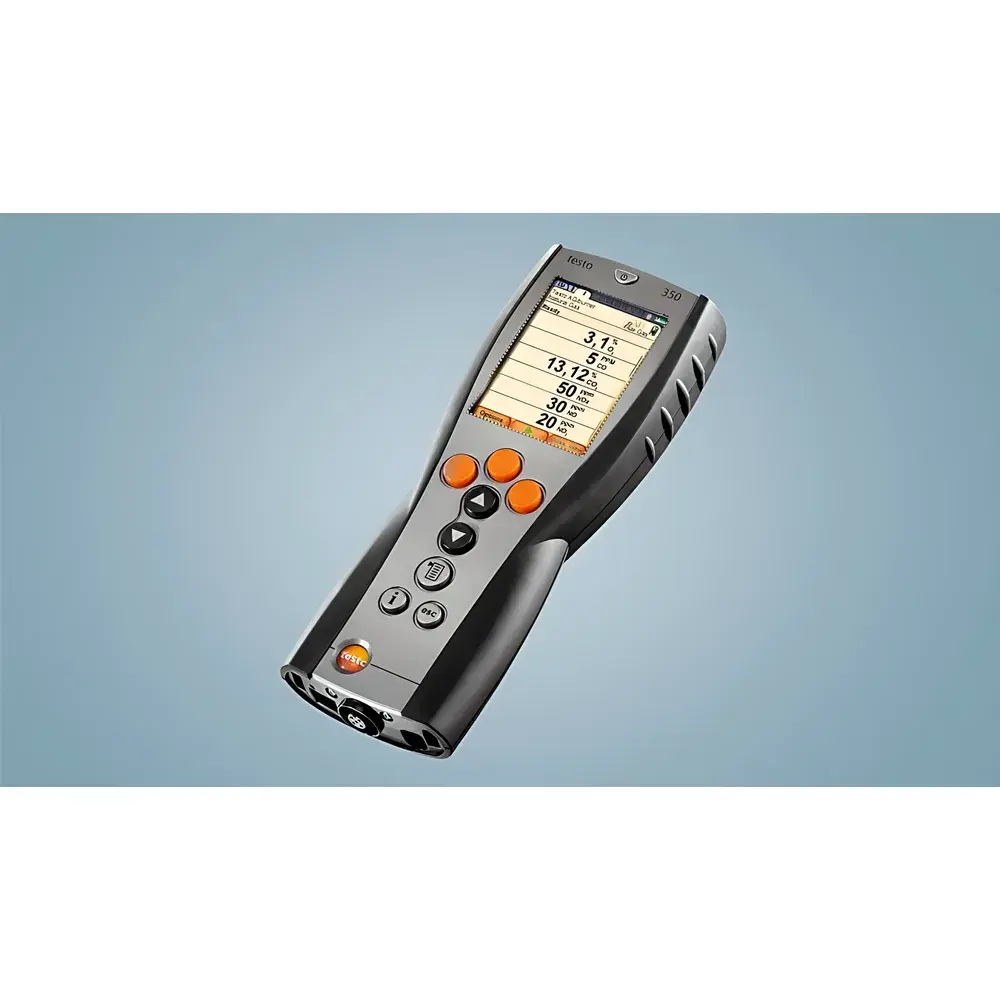
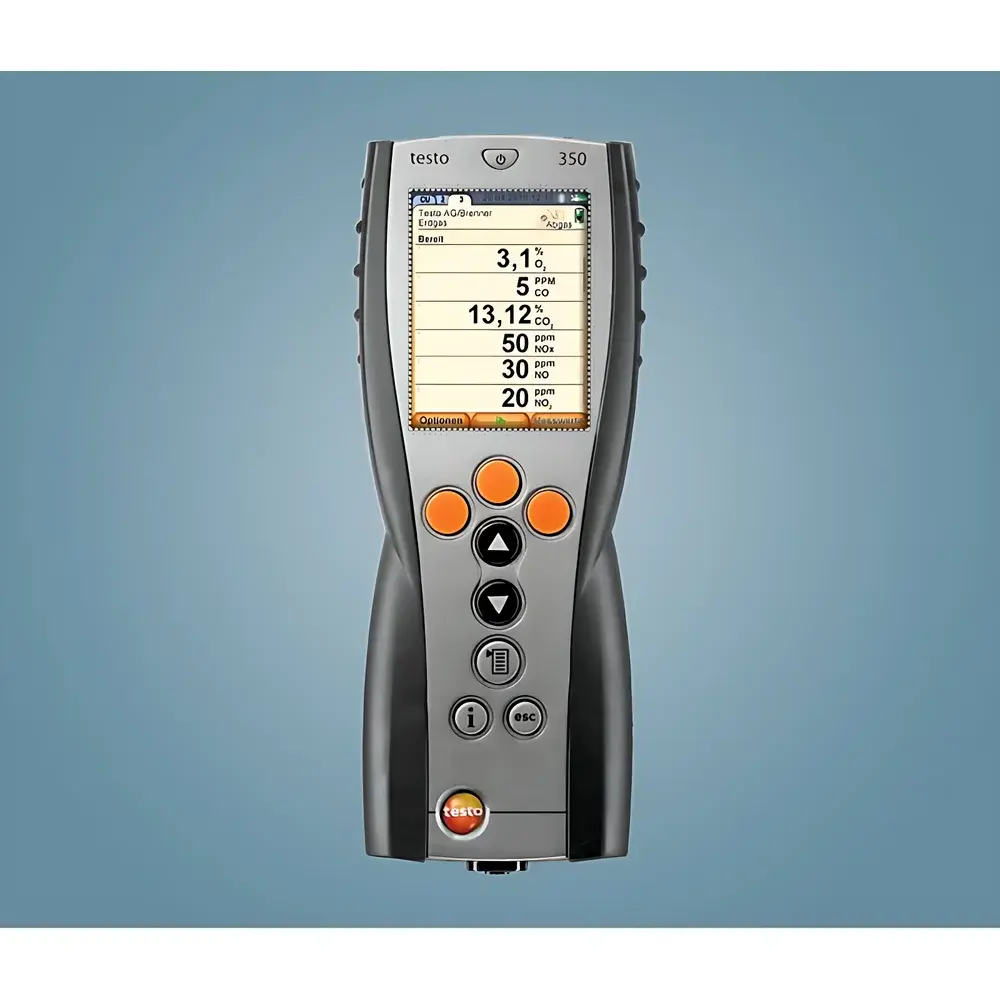
testo 350 Blue Edition Handheld Controller for Flue Gas Analyzer
| Brand | testo |
|---|---|
| Origin | Germany |
| Model | 0632 3521 |
| Instrument Type | Portable Flue Gas Analyzer |
| Measurement Accuracy | ±5 % of reading |
| Repeatability | ≤2 % |
| Response Time | 10 s |
| Stability | ±5 % |
| Measurable Gases | CO, CO₂, NO, NO₂, SO₂, H₂S, CₓHᵧ |
Overview
The testo 350 Blue Edition Handheld Controller is the intelligent, ergonomic interface designed exclusively for operation, real-time visualization, and remote control of the testo 350 flue gas analyzer system. Engineered in accordance with EN 50379-1/-2 and compliant with ISO 12039, ISO 10849, and VDI 3862 standards, this handheld unit implements a microprocessor-based embedded architecture to manage multi-sensor gas analysis workflows in industrial combustion and emissions monitoring applications. Unlike conventional standalone analyzers, the testo 350 system adopts a modular two-component design: the analyzer box houses gas sensors (O₂ standard; up to five optional electrochemical or infrared sensors), sampling pump, filtration, and signal conditioning electronics, while the handheld controller serves as the human-machine interface—executing measurement protocols, displaying dynamic data streams, and coordinating wireless or wired communication. Its core function is not direct gas sensing but precise orchestration of the analyzer box’s acquisition logic, calibration routines, and data handling—enabling traceable, repeatable, and auditable flue gas measurements under field conditions ranging from boiler rooms to combined-cycle turbine exhaust stacks.
Key Features
- Intuitive guided-menu navigation—structured around four preconfigured application profiles: burner, turbine, engine (λ > 1), engine (λ ≤ 1), and custom mode—reducing operator training time and minimizing procedural errors.
- High-resolution 240 × 320 pixel color graphical display supporting simultaneous numeric readouts, trend curves, and bar-chart visualizations for O₂, CO, NOₓ, SO₂, H₂S, CₓHᵧ, and calculated parameters (e.g., η, q₃, λ, CO/CO₂ ratio).
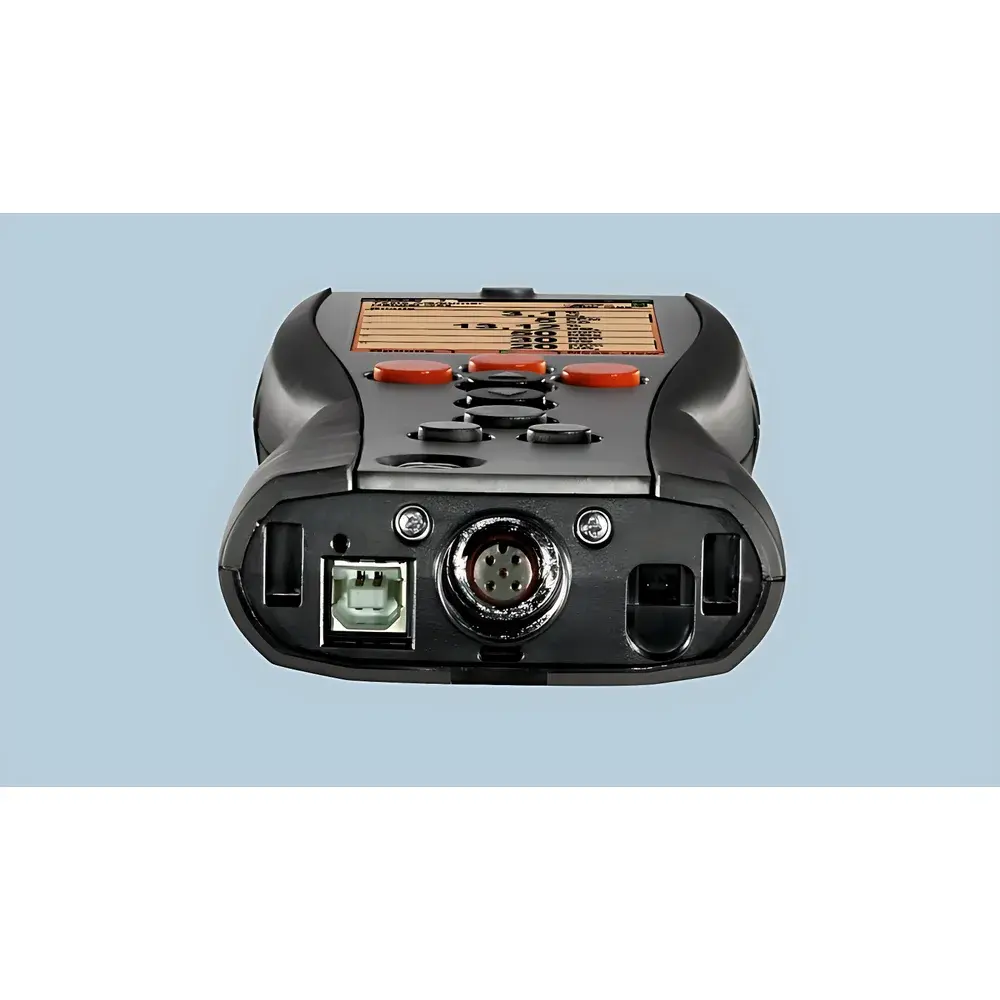
- Dual-mode connectivity: Bluetooth 4.0 (Class 1) and infrared (IrDA) for wireless transmission of measurement data to printers (including Chinese-language output); USB 2.0 and testo DataBus interface for wired PC synchronization and firmware updates.
- Integrated 2 MB internal memory capable of storing up to 250,000 timestamped measurement records with full metadata (date/time, sensor IDs, calibration status, ambient temperature/pressure).
- Robust ABS housing rated IP40, operating temperature range −5 °C to +45 °C, and 440 g weight optimized for extended handheld use during on-site audits and routine stack testing.
- Automatic range extension functionality: when gas concentrations exceed nominal sensor limits, the controller triggers programmable dilution or electronic scaling (user-selectable multiplication factors) for CO, NO, NO₂, SO₂, and H₂S—ensuring uninterrupted measurement integrity during transient high-concentration events.
Sample Compatibility & Compliance
The handheld controller supports all certified sensor configurations compatible with the testo 350 analyzer box, including electrochemical cells for CO, NO, NO₂, SO₂, and H₂S (per EN 45544-1), NDIR modules for CO₂ and hydrocarbons (CₓHᵧ), and paramagnetic or zirconia-based O₂ sensors. It fully accommodates testo’s proprietary particulate-resistant gas filters and heated probe accessories for wet-stack applications. All measurement data generated via the controller comply with EU Directive 2010/75/EU (IED), US EPA Method 7E and 3A, and China’s HJ/T 397–2007 standard requirements for stationary source emission monitoring. Audit trails—including calibration logs, zero/span checks, and error codes—are stored with ISO/IEC 17025-aligned traceability and support GLP/GMP documentation workflows.
Software & Data Management
The controller operates testo’s proprietary firmware v4.x, which embeds built-in diagnostics reporting in plain-text format—eliminating ambiguity in fault identification while maintaining continuous measurement display. Data export is supported in CSV and PDF formats via USB or Bluetooth; raw files include sensor-specific calibration coefficients, drift compensation flags, and environmental compensation parameters (T, P, RH). When connected to testo’s analysis software (testo IRSoft or testo EasyHeat), the controller enables advanced post-processing: combustion efficiency modeling, emission factor calculation per IPCC Tier 2 guidelines, and automated report generation compliant with ISO 14064-3 verification protocols. Firmware updates are delivered via signed binary packages with SHA-256 checksum validation—ensuring secure, version-controlled device management across fleet deployments.
Applications
- Regulatory compliance testing of industrial boilers, incinerators, and cement kilns per local air quality ordinances and national emission limits.
- Performance tuning and efficiency optimization of gas turbines, reciprocating engines, and waste-to-energy plants.
- Commissioning and periodic verification of continuous emission monitoring systems (CEMS) according to EN 14181 QAL1/QAL2 requirements.
- Field validation of low-NOₓ burner retrofits and selective catalytic reduction (SCR) system effectiveness.
- Educational and vocational training in combustion science and environmental engineering laboratories.
FAQ
Can the handheld controller operate independently without the analyzer box?
No—the testo 350 Handheld Controller has no integrated gas sensors and cannot perform measurements autonomously. It functions solely as a command and display interface for the analyzer box.
Does the controller support FDA 21 CFR Part 11-compliant electronic signatures?
While the controller itself does not implement digital signature workflows, its data export structure and audit-log metadata are compatible with third-party LIMS or ELN platforms that provide Part 11-compliant user authentication and record retention.
Is Chinese language display available on the handheld unit?
Yes—both Simplified and Traditional Chinese UI languages are embedded in firmware and selectable via system settings.
What is the battery runtime under continuous Bluetooth usage?
Battery life is reduced to approximately 3.5 hours when actively streaming data over Bluetooth; disabling wireless interfaces extends operational time to 5 hours.
How is sensor cross-interference compensated during multi-gas measurement?
Cross-sensitivity correction algorithms—preloaded per sensor type and validated against NIST-traceable reference gases—are applied in real time by the analyzer box firmware; the controller displays only corrected, finalized values.
Related Products







