
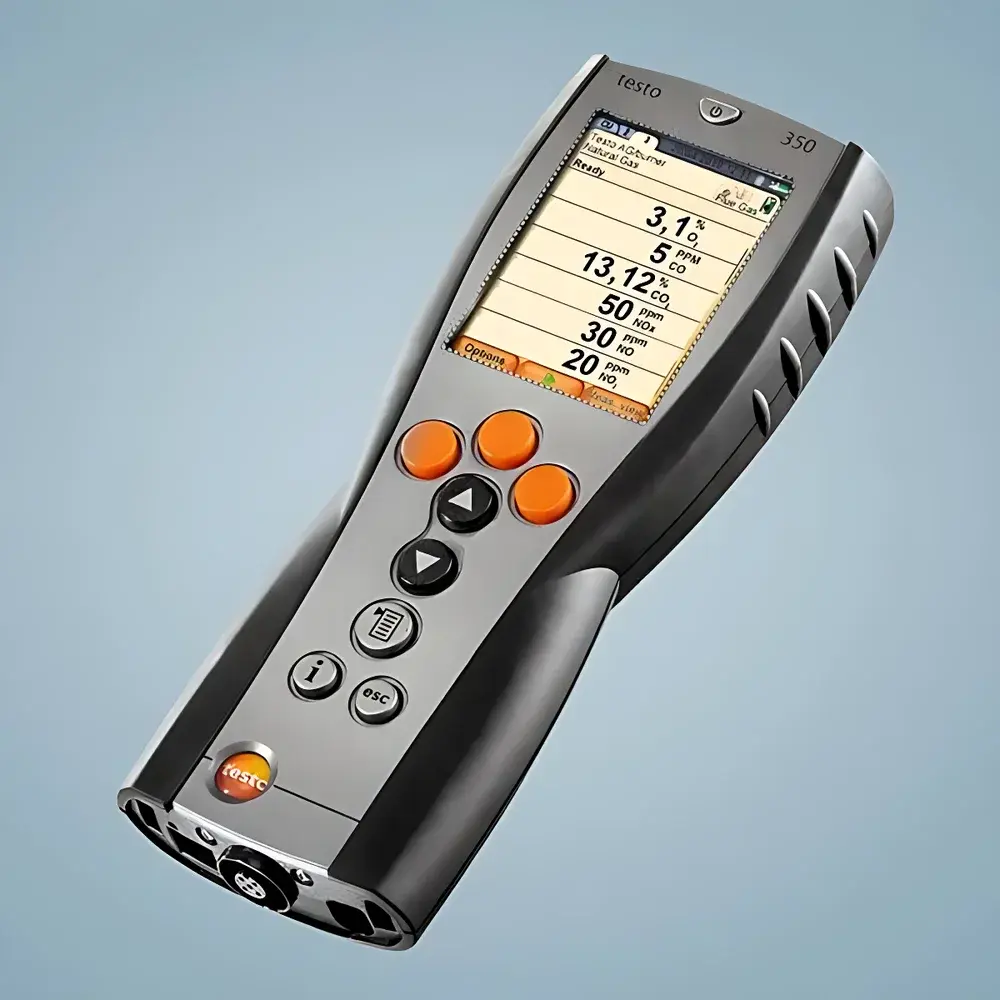
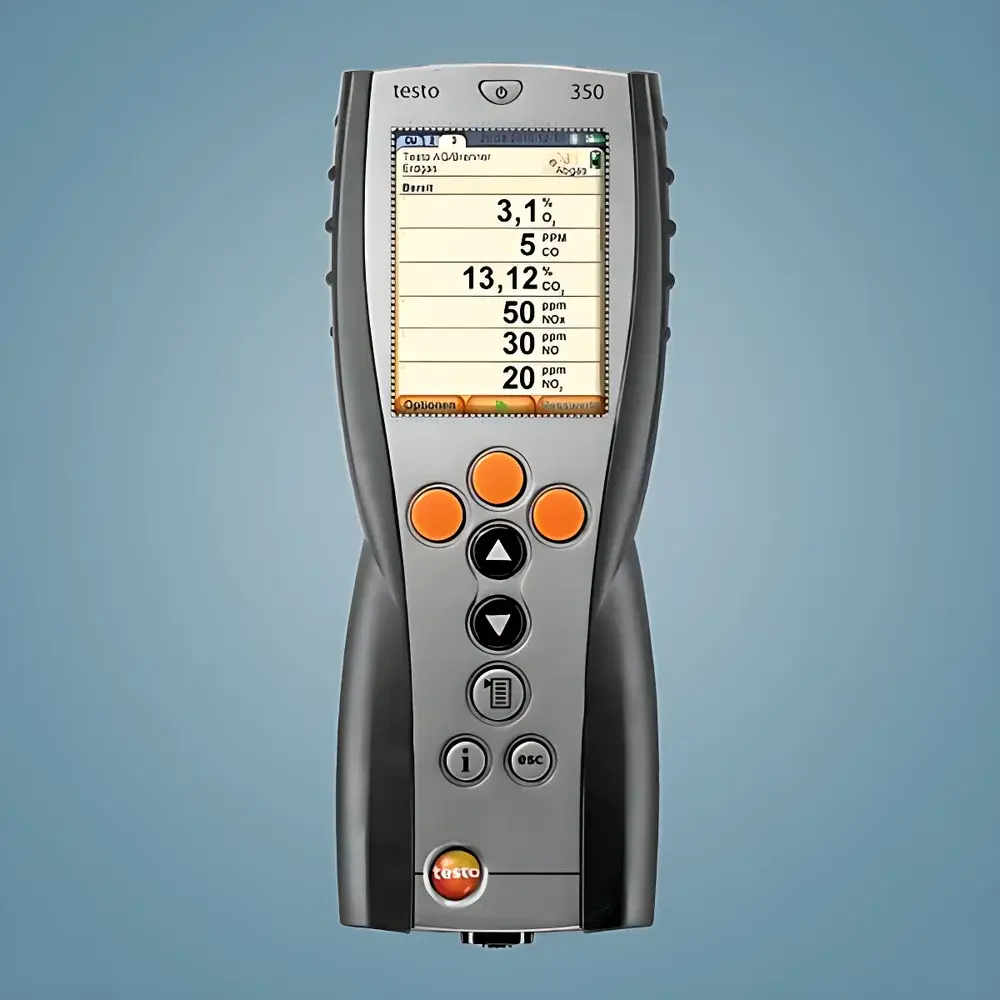
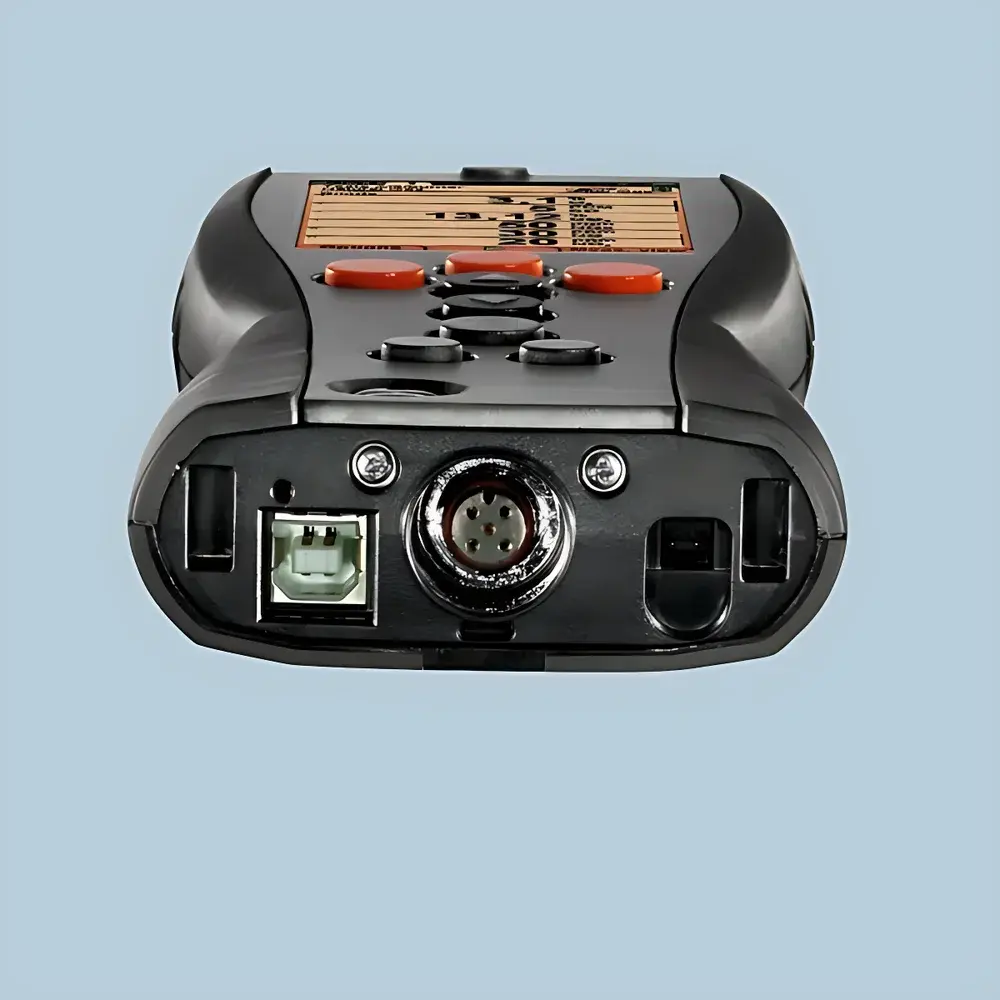
testo 350 Flue Gas Analyzer Handheld Controller (Model 0632 3521)
| Brand | testo |
|---|---|
| Origin | Germany |
| Model | 0632 3521 |
| Instrument Type | Portable Flue Gas Analyzer |
| Measurement Accuracy | ±5 % of reading |
| Repeatability | ≤2 % |
| Response Time | 10 s |
| Stability | ±5 % |
| Measured Gases | CO, CO₂, NO, NO₂, SO₂, H₂S, and CₓHᵧ |
Overview
The testo 350 Flue Gas Analyzer Handheld Controller (Model 0632 3521) is a purpose-built, field-deployable control unit designed exclusively for operation and real-time visualization of the testo 350 analyzer box—the core measurement module in testo’s modular flue gas analysis system. Unlike integrated single-unit analyzers, the testo 350 architecture separates sensor electronics (housed in the rugged analyzer box) from human interface and data management functions (executed by this handheld controller), enabling flexible deployment in complex industrial environments. The controller communicates with the analyzer box via testo DataBus—a proprietary, electrically isolated digital interface—or wirelessly via Bluetooth® v4.0 (Class 1). It operates on an embedded Linux-based platform with a high-contrast 240 × 320 pixel color TFT display, supporting intuitive touch-assisted navigation and multi-format data presentation (numerical values, trend graphs, bar charts, and time-series curves). Its design adheres to DIN EN 50081-1/2 and EN 61326-1 for electromagnetic compatibility in industrial settings, and meets IP40 ingress protection requirements for dust resistance during routine handling.
Key Features
- Guided workflow interface with four preconfigured application menus: Burner, Turbine, Engine (λ > 1), Engine (λ ≤ 1), and Custom—each embedding default stoichiometric coefficients, calibration gas references, and regulatory calculation logic per EN 15319, VDI 3862, and EPA Method 7E.
- Real-time bidirectional control: initiate sampling, adjust dilution ratios, trigger zero/span calibration sequences, and modify sensor configuration—all remotely from the handheld unit while the analyzer box remains mounted at the stack or duct.
- On-device data management: internal 2 MB flash memory stores up to 250,000 timestamped readings with full metadata (gas concentrations, O₂%, CO₂ calc, excess air, η efficiency, NOₓ as NO₂, and dew point if optional humidity sensor is installed).
- Battery-powered operation: rechargeable Li-ion battery delivers ≥5 hours of continuous use without Bluetooth or infrared activation; supports hot-swap charging via micro-USB while maintaining active communication with the analyzer box.
- Multi-modal data export: measurements can be transmitted via USB cable, Bluetooth to PC/mobile devices, or infrared (IrDA) to compatible thermal printers—supporting UTF-8–encoded output including simplified and traditional Chinese character sets for localized reporting compliance.
Sample Compatibility & Compliance
The handheld controller itself does not perform direct gas sensing but fully supports all certified sensor configurations available for the testo 350 analyzer box, including electrochemical cells for CO, NO, NO₂, SO₂, H₂S; NDIR for CO₂ and CₓHᵧ; and paramagnetic or zirconia-based O₂ sensors. Optional range extension modules enable automatic 2×, 5×, or 10× signal attenuation for high-concentration events (e.g., boiler start-up transients), ensuring linearity preservation per ISO 12039 and EN 14181 QAL1 requirements. All measurement calculations—including combustion efficiency (η), dew point estimation, and NOₓ conversion—are traceable to NIST-traceable calibration gases and conform to EN 15267-3 (performance certification) and EN 14181 (QA/QC procedures). The system supports audit-ready data logging compliant with GLP and ISO/IEC 17025 documentation standards.
Software & Data Management
The controller runs testo’s proprietary firmware (v3.x series), which integrates seamlessly with testo IRSoft desktop software (Windows 10/11) for post-processing, report generation (PDF/CSV/XLSX), and long-term database archiving. Raw data files include embedded instrument ID, operator tag, GPS coordinates (when paired with external GNSS module), and full sensor diagnostic logs—including pump status, filter saturation alerts, and cross-sensitivity compensation flags. Firmware updates are delivered via encrypted OTA packages signed with testo’s PKI certificate, satisfying FDA 21 CFR Part 11 electronic record integrity requirements when used in regulated emission monitoring applications.
Applications
This controller is engineered for professional emission verification across stationary combustion sources: utility-scale boilers, combined heat and power (CHP) plants, cement kilns, waste incinerators, and gas turbine exhaust stacks. Its remote-control capability is particularly valuable during multi-point traverses in large ducts (>2 m diameter), where mounting the analyzer box at a fixed access port eliminates repeated insertion/retraction of probe assemblies. It also serves as the primary interface in continuous emission monitoring system (CEMS) validation protocols—supporting relative accuracy test audits (RATA) per EPA PS-12A and EN 15267-3 Annex D. Field technicians routinely deploy it alongside testo’s smoke density meters and draft gauges for holistic combustion optimization studies.
FAQ
Can the handheld controller operate independently without the testo 350 analyzer box?
No—it has no built-in gas sensors and requires active communication with a powered testo 350 analyzer box to acquire or display measurement data.
Does the controller support firmware updates over Bluetooth?
Firmware updates must be performed via USB connection to a Windows PC running testo IRSoft; Bluetooth is reserved for data streaming only.
Is Chinese language display supported natively?
Yes—both simplified and traditional Chinese UI localization is embedded in firmware v3.2.1 and later, including menu labels, error messages, and printer output templates.
What is the maximum operating temperature range for sustained use?
The controller is rated for continuous operation between –5 °C and +45 °C; extended exposure above 40 °C may reduce battery cycle life and LCD contrast.
How is data security ensured during wireless transmission?
Bluetooth pairing uses Secure Simple Pairing (SSP) with AES-128 encryption; no data is stored on the mobile device unless explicitly exported via IRSoft synchronization.







