
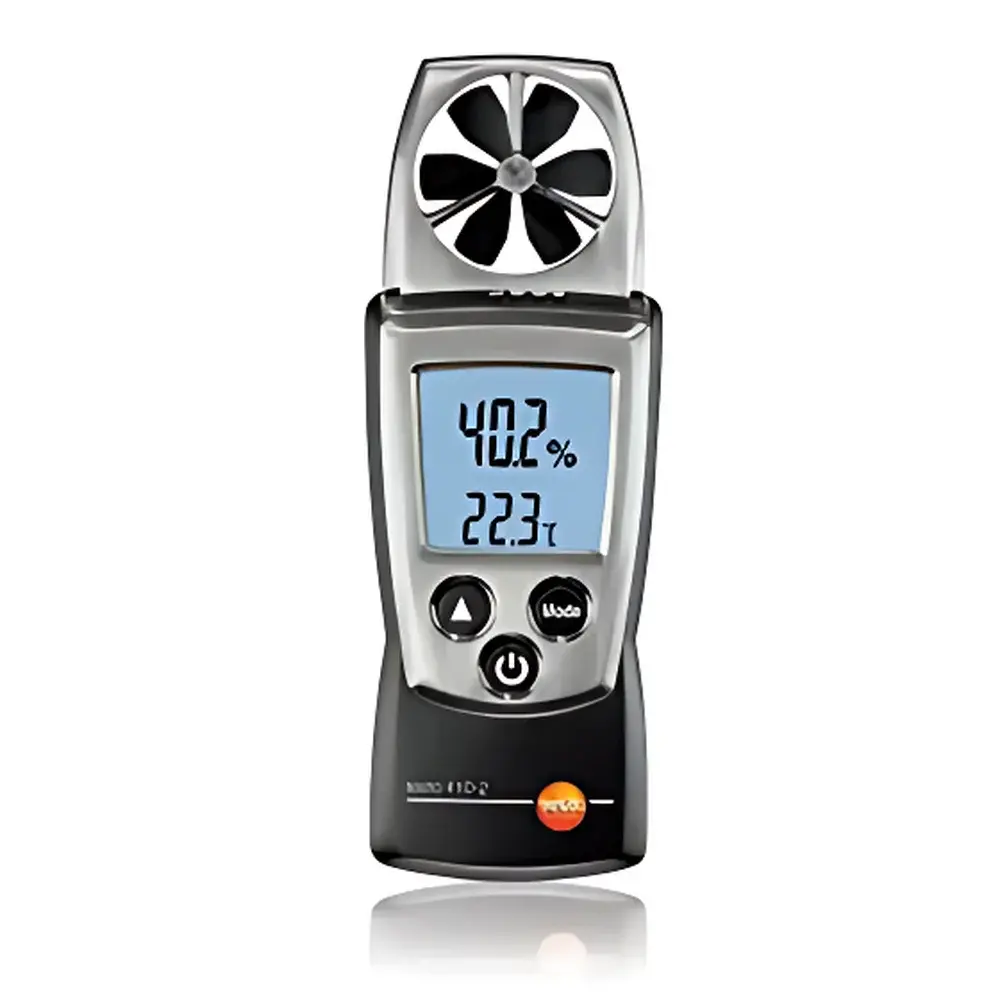
testo 410-1 Portable Vane Anemometer with Integrated NTC Air Temperature Sensor
| Brand | testo |
|---|---|
| Origin | Germany |
| Model | 0560 4101 |
| Instrument Type | Vane Anemometer |
| Resolution | 0.1 m/s |
| Measurement Range | 0.4–20 m/s |
| Accuracy | ±(0.2 m/s + 2 % of reading) |
| Operating Temperature | −10 to +50 °C |
| Operating Humidity | 0–100 % RH |
| Air Temperature Range | −10 to +50 °C |
| Air Temperature Accuracy | ±0.5 °C |
| Air Temperature Resolution | 0.1 °C |
| Response Time | 0.5 s |
| Weight | 110 g (incl. batteries & protective cap) |
| Dimensions | 133 × 46 × 25 mm (with protective cap) |
| Protection Class | IP10 |
| Power Supply | 2 × AAA batteries |
| Battery Life | up to 100 h (backlight off, typical use) |
| Storage Temperature | −20 to +70 °C |
Overview
The testo 410-1 is a compact, handheld vane anemometer engineered for reliable and repeatable measurement of air velocity and ambient temperature in HVAC commissioning, indoor air quality (IAQ) assessments, environmental hygiene audits, and outdoor meteorological spot checks. Its 30 mm diameter vane probe operates on the principle of rotational torque conversion—where airflow imparts angular momentum to the calibrated vane rotor, and the resulting rotation frequency is linearly converted into velocity via factory-traceable calibration against NIST-traceable wind tunnel standards. Simultaneously, an integrated Class B NTC thermistor measures air temperature with high thermal response (0.5 s time constant), enabling real-time calculation of wind chill index (WCI) and Beaufort scale equivalents per ISO 8502-1 and WMO Guide to Meteorological Instruments and Methods of Observation. Designed for field portability and rapid deployment, the device meets the mechanical robustness and environmental resilience requirements for both laboratory-adjacent and unconditioned site use.
Key Features
- 30 mm precision-machined vane probe optimized for full cross-sectional sampling of HVAC grilles, diffusers, and duct openings
- Dual-parameter measurement: simultaneous air velocity (0.4–20 m/s) and air temperature (−10 to +50 °C)
- On-device calculation of wind chill temperature (°C/°F) and Beaufort wind force scale (0–12)
- Multi-unit display support: m/s, km/h, fpm, mph, knots, °C, °F, Beaufort, and wind chill
- Real-time statistical functions: hold (freeze current readings), min/max tracking (since power-on or reset), and single-point averaging
- Backlit LCD for legibility under low-light conditions (e.g., ceiling plenums, basements, nighttime field work)
- Integrated protective cap and wrist strap for secure handling during elevated or confined-space measurements
- IP10-rated enclosure suitable for non-dusty, non-splash environments; compliant with IEC 60529 for basic ingress protection
Sample Compatibility & Compliance
The testo 410-1 is validated for use across standard indoor and semi-outdoor environments where airflow is laminar or mildly turbulent—such as supply/exhaust grilles, cleanroom returns, laboratory fume hood faces, and building envelope leakage points. It is not intended for high-velocity jet streams (>20 m/s), corrosive or particulate-laden airstreams, or explosive atmospheres. The instrument complies with EN 61000-6-3 (EMC emission limits) and EN 61000-6-2 (immunity requirements), and its temperature sensor conforms to DIN EN 60751 Class B tolerance specifications. While not certified for regulatory reporting under ISO/IEC 17025, it supports GLP-aligned documentation workflows when paired with testo’s optional calibration certificates (traceable to DAkkS-accredited labs). Its measurement uncertainty budget aligns with ASTM D1078-21 (Standard Test Method for Air Velocity in Ventilation Systems) for preliminary IAQ screening.
Software & Data Management
The testo 410-1 operates as a standalone field instrument with no embedded memory or PC connectivity. All data are viewed and interpreted in real time on the integrated LCD. For traceable recordkeeping, users may manually log readings alongside contextual metadata (location, date/time, grille ID, operator) in accordance with internal QA procedures. Optional testo calibration services provide DAkkS-traceable certificates valid for 12 months, including as-found/as-left data and uncertainty statements per GUM (JCGM 100:2008). When used within a broader testo ecosystem, the device complements software platforms such as testo Comsoft Basic for manual entry and trend annotation—though no direct Bluetooth or USB export is supported by this model.
Applications
- HVAC system balancing and commissioning: verification of face velocity at supply diffusers and return grilles
- Indoor air quality (IAQ) surveys per ASHRAE Standard 62.1 and EN 16798-1
- Occupational health & safety assessments: local air movement evaluation in workspaces per ISO 7726
- Building diagnostics: detection of unintended infiltration/exfiltration paths and pressure differentials
- Educational laboratories: hands-on instruction in fluid mechanics, psychrometrics, and environmental physics
- Field validation of CFD models requiring point-velocity ground truthing
FAQ
What is the minimum measurable air velocity with the testo 410-1?
The lower limit is 0.4 m/s, making it suitable for low-velocity applications such as occupied zone air distribution and natural ventilation monitoring.
Can the device measure in ducts or only at grilles?
It is designed primarily for open-face or grille-mounted measurements; insertion into ducts is not recommended due to probe geometry and lack of pitot-static compensation.
Is the temperature sensor interchangeable or user-calibratable?
No—the NTC sensor is factory-integrated and sealed; calibration requires professional service using traceable reference sources.
Does the testo 410-1 meet FDA 21 CFR Part 11 requirements?
No—it lacks electronic audit trail, user authentication, or data export capabilities required for regulated GxP environments.
How often should the vane anemometer be recalibrated?
Annual recalibration is recommended for critical applications; more frequent verification (e.g., pre/post survey) using a known reference source is advised for compliance-sensitive work.
Related Products







