
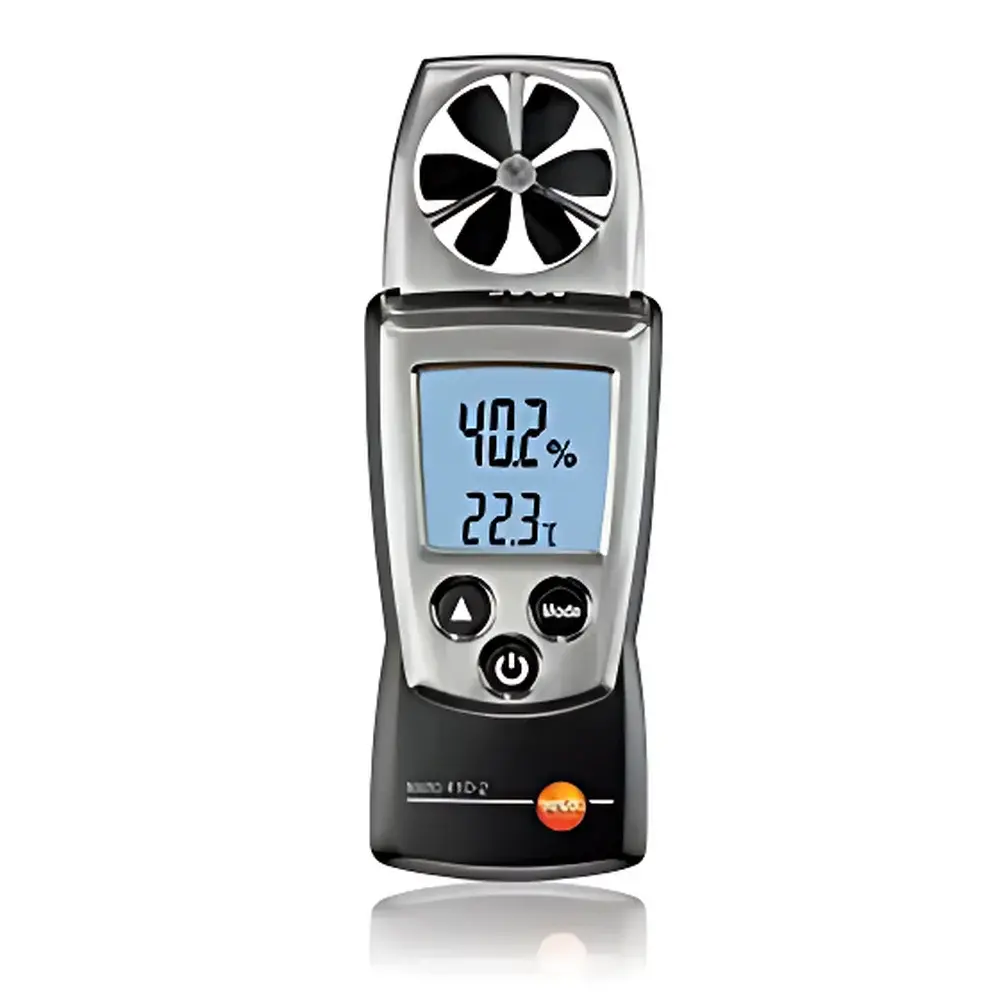
testo 410-2 Portable Vane Anemometer with Integrated Humidity and Temperature Sensors
| Brand | testo |
|---|---|
| Origin | Germany |
| Model | 0560 4102 |
| Instrument Type | Vane Anemometer |
| Velocity Range | 0.4–20 m/s |
| Velocity Resolution | 0.1 m/s |
| Velocity Accuracy | ±(0.2 m/s + 2 % of reading) |
| Air Temperature Range | −10 to +50 °C |
| Air Temperature Accuracy | ±0.5 °C |
| Air Temperature Resolution | 0.1 °C |
| Relative Humidity Range | 0–100 %RH |
| Relative Humidity Accuracy | ±2.5 %RH (5–95 %RH) |
| Relative Humidity Resolution | 0.1 %RH |
| Operating Environment | −10 to +50 °C, 0–100 %RH |
| Weight | 110 g (incl. batteries and protective cap) |
| Dimensions | 133 × 46 × 25 mm (with protective cap) |
| Protection Rating | IP10 |
| Power Supply | 2 × AAA batteries |
| Battery Life | up to 60 h (backlight off, typical use) |
| Measurement Update Rate | 0.5 s |
Overview
The testo 410-2 is a compact, handheld vane anemometer engineered for field-based environmental air characterization in HVAC commissioning, indoor air quality (IAQ) verification, and outdoor meteorological spot-checking. It employs a precision-machined 30 mm diameter axial vane sensor operating on the principle of rotational drag torque conversion—where airflow induces proportional angular velocity in the impeller, transduced via optical or magnetic sensing into calibrated linear velocity output. Simultaneously, it integrates a capacitive humidity sensor and an NTC thermistor for concurrent measurement of relative humidity (RH) and ambient air temperature. Derived parameters—including dew point temperature, wet-bulb temperature, wind chill index, and Beaufort scale equivalent—are computed in real time using industry-standard psychrometric algorithms compliant with ISO 7726 and ASHRAE Fundamentals Chapter 1. Designed for rapid deployment at air grilles, diffusers, duct openings, and open-air locations, the instrument delivers traceable, repeatable data without requiring external calibration hardware.
Key Features
- Integrated triple-sensor architecture: vane anemometer (0.4–20 m/s), capacitive RH sensor (0–100 %RH), and NTC air temperature probe (−10 to +50 °C)
- Real-time psychrometric calculations: dew point, wet-bulb temperature, wind chill, and Beaufort scale classification—all accessible via single-button navigation
- Multi-point averaging function: enables statistically representative mean velocity calculation across multiple grille or duct outlet positions
- Data-holding mode: freezes current readings of velocity, RH, and temperature for side-by-side comparison or annotation during site surveys
- Min/Max tracking: logs extremal values since power-on or reset—critical for identifying transient airflow anomalies or thermal/hygrometric excursions
- Backlit LCD display with dual-unit support: selectable units include m/s, km/h, fpm, mph, knots, °C, °F, %RH, and Beaufort scale
- Robust portable design: IP10-rated housing, integrated protective cap, and wrist strap for secure operation in elevated or confined spaces
- Long battery life: up to 60 hours of continuous operation on two AAA cells (backlight disabled); low-power firmware architecture ensures stable sensor biasing over extended field shifts
Sample Compatibility & Compliance
The testo 410-2 is validated for direct measurement of turbulent and laminar airstreams in non-corrosive, non-particulate-laden environments—including supply/exhaust grilles, ceiling diffusers, window openings, and outdoor microsites. It complies with EN 13725 (ambient air quality—measurement of volatile organic compounds), ISO 16814 (HVAC performance testing), and ASHRAE Guideline 12-2020 (management of building-related infection risk). While not intrinsically rated for hazardous areas, its IP10 enclosure meets basic protection against solid ingress per IEC 60529. All factory-calibrated sensors are supplied with individual traceable calibration certificates referencing DIN EN ISO/IEC 17025-accredited standards laboratories. The device supports GLP-aligned documentation practices through manual entry of operator ID, location tag, and timestamped measurement notes.
Software & Data Management
The testo 410-2 operates as a standalone field instrument with no mandatory software dependency. However, measurement records—including min/max/average values, hold snapshots, and derived psychrometric outputs—can be manually transcribed into standardized HVAC commissioning reports, IAQ audit logs, or preventive maintenance databases. For users requiring digital traceability, testo’s optional Smart Probes app (iOS/Android) enables Bluetooth-assisted logging when paired with compatible gateway devices (not included). All internal computations adhere to internationally accepted thermodynamic models: Magnus formula for dew point, Stull equation for wet-bulb, and JAG/TI-223 wind chill algorithm. No proprietary data formats or vendor-locked export protocols are used; numeric outputs conform to SI base units and ASTM E2234 conventions for reporting uncertainty.
Applications
- HVAC system balancing: quantitative verification of face velocity at terminal devices per SMACNA and ACCA Manual D protocols
- Indoor air quality assessments: correlation of air motion with thermal comfort (PMV/PPD estimation) and moisture accumulation risk
- Occupational health & safety inspections: evaluation of local exhaust ventilation (LEV) capture velocity compliance with OSHA 1910.146 and HSE HSG258
- Building envelope diagnostics: detection of unintended infiltration/exfiltration pathways via localized low-velocity mapping
- Educational laboratory use: hands-on instruction in fluid mechanics, psychrometrics, and environmental metrology
- Facility management audits: periodic validation of air curtain performance, smoke control systems, and pressurization differentials
FAQ
What is the recommended recalibration interval for the testo 410-2?
Testo recommends annual functional verification against traceable reference standards; full recalibration is advised every 24 months or after mechanical shock, exposure to condensation, or operation beyond specified environmental limits.
Can the testo 410-2 measure airflow in ducts?
It is optimized for grille/diffuser face velocity measurement—not for traversing inside rectangular or round ducts. For duct applications, testo offers dedicated pitot tube or thermal anemometer probes with traverse accessories.
Does the device meet FDA 21 CFR Part 11 requirements?
As a manual-readout field instrument without electronic audit trail, password protection, or electronic signature capability, it does not comply with Part 11—but supports compliant documentation when integrated into validated paper-based or LIMS-managed workflows.
Is the humidity sensor interchangeable or user-replaceable?
The capacitive RH sensor is factory-integrated and sealed; replacement requires return to an authorized testo service center to maintain metrological integrity and calibration traceability.
How does the wind chill calculation account for variable skin emissivity and clothing insulation?
The displayed wind chill index follows the Joint Action Group for Temperature Indexes (JAG/TI-223) standard, which assumes standardized human thermal modeling (1.8 m height, 70 kg mass, light windproof clothing) and does not incorporate real-time physiological variables.
Related Products







