
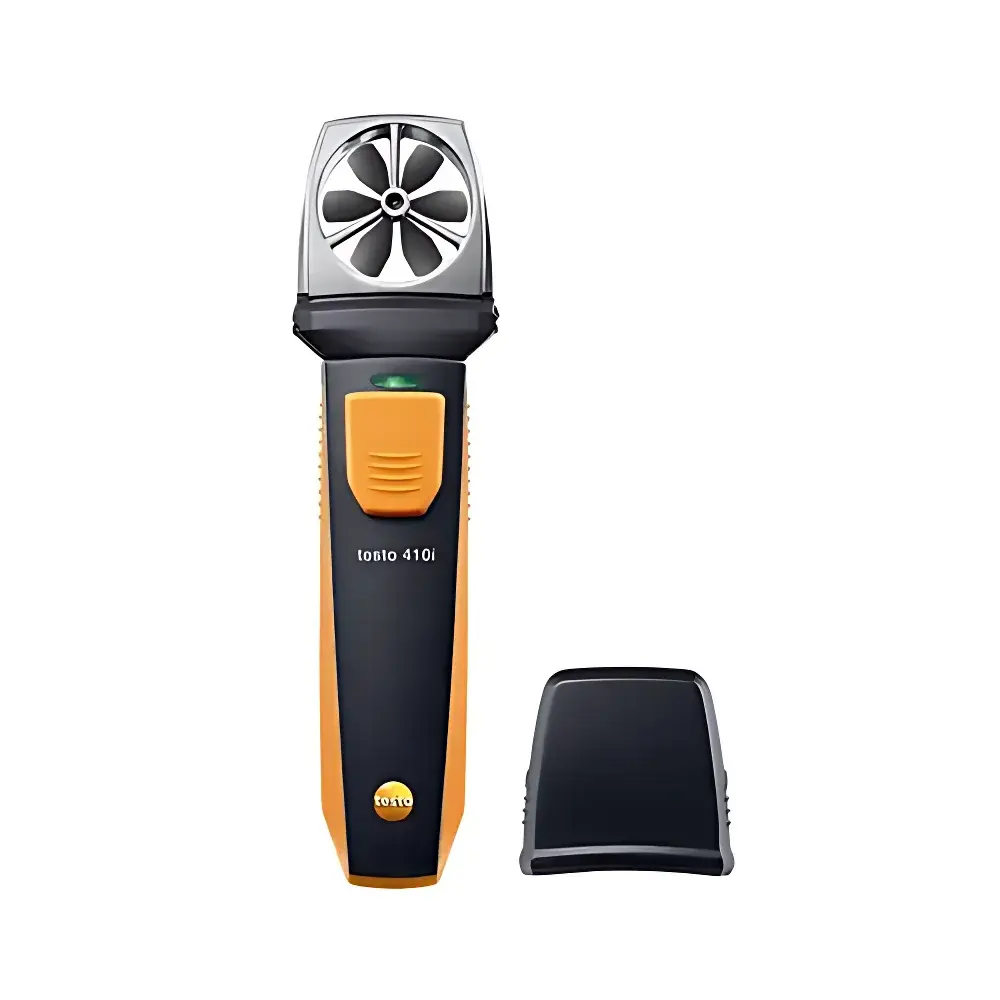
testo 410i Smart Wireless Mini Vane Anemometer
| Brand | testo |
|---|---|
| Origin | Germany |
| Model | 0560 1410 |
| Instrument Type | Vane Anemometer |
| Resolution | 0.1 m/s |
| Measurement Range | 0.4–30 m/s |
| Accuracy | ±(0.2 m/s + 2 % of reading) (0.4–20 m/s) |
| Operating Temperature | −20 to +50 °C |
| Relative Humidity Range | 0–95 % RH (non-condensing) |
| Temperature Sensor Type | NTC |
| Temp. Range | −20 to +60 °C |
| Temp. Accuracy | ±0.5 °C |
| Temp. Resolution | 0.1 °C |
| Weight | 117.8 g |
| Dimensions | 154 × 43 × 21 mm |
| Battery | 3 × AAA rechargeable |
| Battery Life | up to 130 h |
| Impeller Diameter | 30 mm |
| Connectivity | Bluetooth 4.0 |
| Compatible OS | iOS 11.0+, Android 6.0+ |
Overview
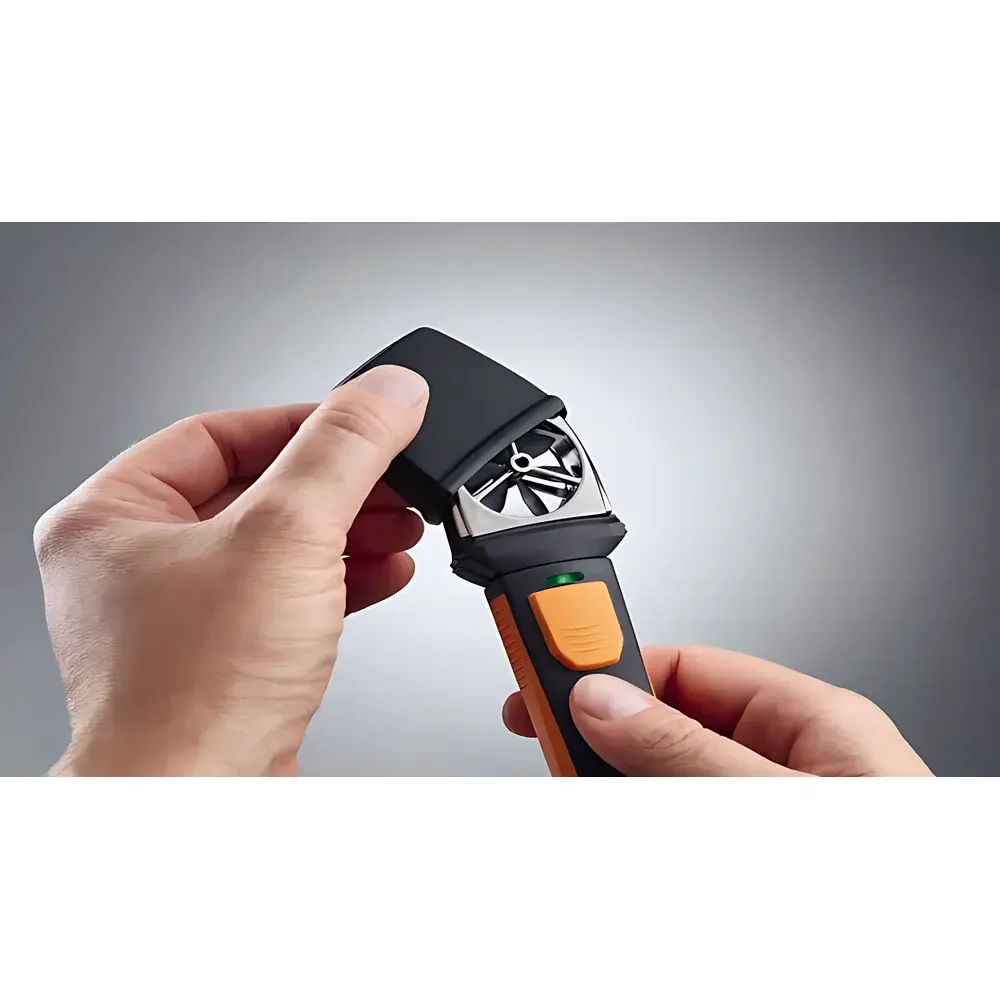
The testo 410i Smart Wireless Mini Vane Anemometer is a compact, handheld instrument engineered for precise, real-time measurement of air velocity, volumetric flow rate, and temperature in HVAC commissioning, maintenance, and indoor air quality (IAQ) assessments. Based on proven vane anemometry principles—where airflow rotation drives a calibrated impeller whose angular velocity correlates linearly with local air speed—the device delivers traceable, repeatable measurements across ducts, grilles, diffusers, and terminal devices. Its miniaturized form factor (154 × 43 × 21 mm) and lightweight construction (117.8 g) enable single-hand operation in confined or overhead spaces, while the integrated NTC temperature sensor allows simultaneous thermal profiling. Designed for field-deployed metrology rather than laboratory-grade calibration, the testo 410i meets the functional accuracy requirements defined in ISO 16813 (HVAC design standards), EN 12599 (commissioning procedures), and ASHRAE Guideline 12–2020 for air system verification.
Key Features
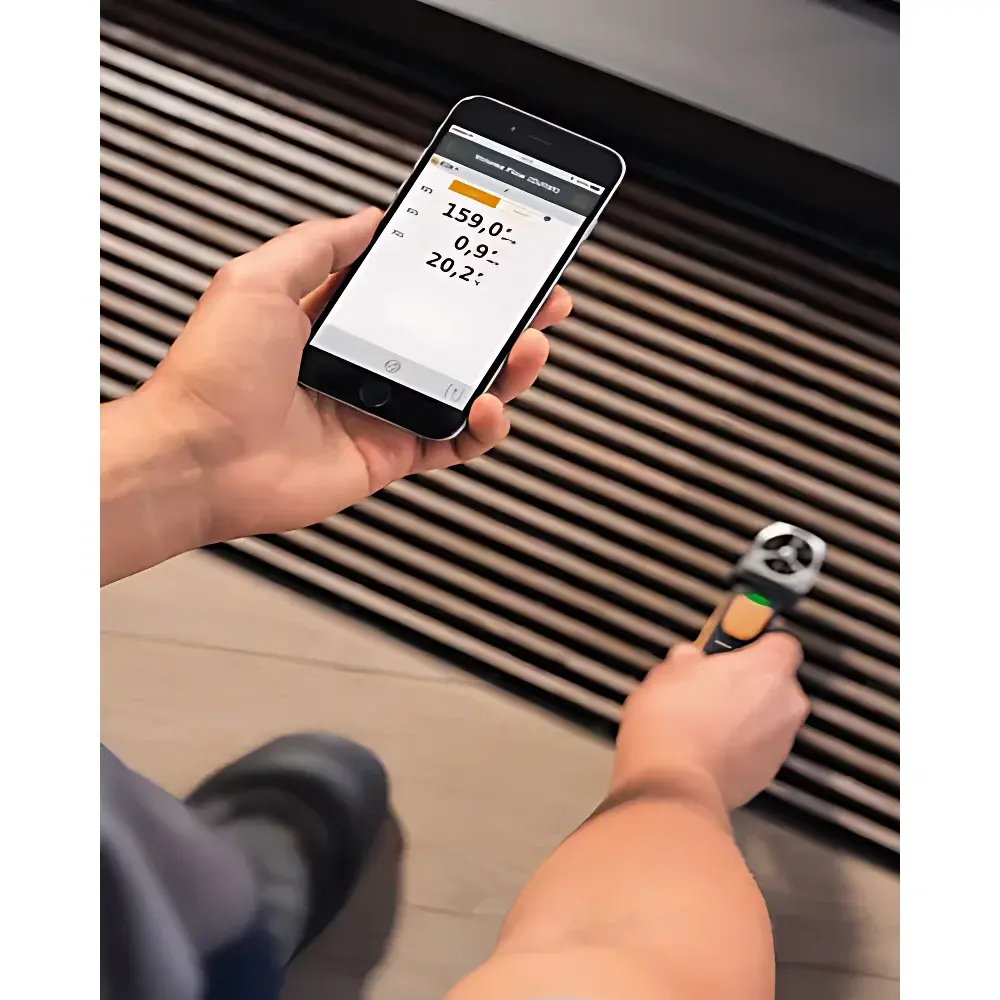
- Wireless Bluetooth 4.0 connectivity enabling real-time data streaming to iOS (v11.0+) and Android (v6.0+) mobile devices via the official testo Smart App
- Volumetric flow calculation engine supporting customizable grille/diffuser geometry input—including rectangular, square, and circular cross-sections—with automatic area derivation and flow integration
- Multi-point averaging mode with programmable sampling intervals (1–30 s) and user-defined measurement duration (up to 60 min), generating statistically robust mean velocity values per outlet
- Timed measurement logging with timestamped records, including velocity, temperature, and calculated flow rate (m³/h or CFM), stored locally on-device and synced to mobile app
- High-visibility dual-color housing (black/orange) optimized for industrial environments; IP52-rated enclosure resists dust ingress and incidental water splashing
- Rechargeable AAA battery system delivering up to 130 hours of continuous operation—validated under typical field conditions at 25 °C ambient and 1 Hz sampling frequency
Sample Compatibility & Compliance
The testo 410i is validated for use across standard HVAC components including supply/exhaust grilles, ceiling diffusers, linear slot outlets, and perforated panels. Its 30 mm impeller diameter ensures stable response in turbulent or low-velocity flows (≥0.4 m/s), while maintaining linearity up to 30 m/s in laminar streamlines. The instrument complies with electromagnetic compatibility (EMC) requirements per EN 61326-1:2013 and carries CE marking under the EU Radio Equipment Directive (2014/53/EU). All factory calibrations are performed against NIST-traceable reference standards, with documented uncertainty budgets included in the supplied calibration protocol. While not certified for Class I Div 1 hazardous locations, it is routinely deployed in non-explosive commercial, institutional, and light-industrial ventilation systems conforming to NFPA 90A and local mechanical code enforcement.
Software & Data Management
The testo Smart App serves as both control interface and data management platform. Users configure measurement parameters—including unit selection (m/s, ft/min, °C, °F, m³/h, CFM), averaging mode, and geometric profile—directly on-device or remotely via mobile UI. All raw and processed data are stored in a structured SQLite database within the app, supporting export in PDF (with header metadata, measurement summary, and digital signature) and Excel (.xlsx) formats for QA documentation and regulatory submission. Audit trails record operator ID (optional login), device serial number, timestamp, GPS coordinates (if enabled), and firmware version—supporting GLP-aligned workflows and internal quality audits. The app enforces secure local storage; no telemetry or cloud upload occurs unless explicitly initiated by the user.
Applications
- HVAC system balancing and TAB (Testing, Adjusting, and Balancing) reporting per AABC and NEBB standards
- Post-installation verification of air terminal performance against design specifications
- Indoor air quality (IAQ) surveys assessing ventilation rates per ASHRAE Standard 62.1
- Energy audit support, including duct leakage estimation and fan efficiency baseline assessment
- Educational labs for thermofluid dynamics instruction, emphasizing practical sensor integration and real-world uncertainty propagation
- Facility management routine checks of filter pressure drop effects on downstream airflow distribution
FAQ
What is the recommended recalibration interval for the testo 410i?
Testo recommends annual verification against a certified reference anemometer or accredited calibration lab—especially when used in regulated environments or after mechanical shock exposure.
Can the testo 410i measure in ducts with high turbulence or swirl?
Yes, but best practice requires positioning the probe perpendicular to bulk flow and at least 5 duct diameters downstream of elbows or dampers to minimize flow distortion effects.
Does the device store measurements when Bluetooth is disconnected?
Yes—up to 10,000 timestamped records are retained internally and automatically synchronized upon reconnection.
Is the calibration protocol NIST-traceable?
Yes, each unit ships with a manufacturer-issued calibration certificate referencing NIST-traceable standards, including expanded uncertainty (k=2) for velocity and temperature channels.
How does the app handle unit conversions during export?
All exported reports retain the units selected during measurement setup; no automatic conversion occurs post-export—ensuring consistency with project-specific reporting conventions.
Related Products







