
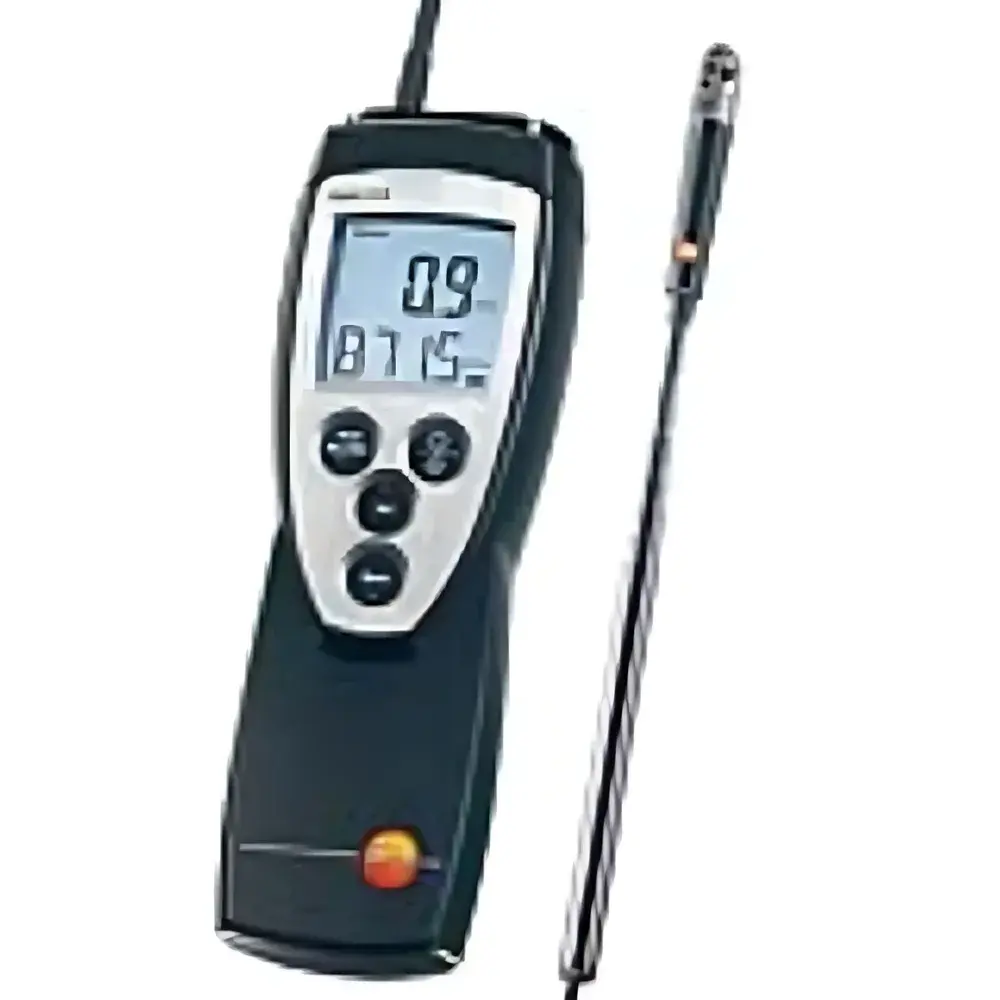
testo 416 Precision Vane Anemometer
| Brand | testo |
|---|---|
| Origin | Germany |
| Model | 0560 4160 |
| Instrument Type | Vane Anemometer |
| Measurement Range | 0.6 – 40 m/s |
| Resolution | 0.1 m/s |
| Accuracy | ±(0.2 m/s + 1.5 % of reading) |
| Operating Temperature | −20 °C to +50 °C |
| Operating Humidity | 0 % RH (non-condensing) |
| Weight | 325 g |
| Dimensions (L × W × H) | 182 × 64 × 40 mm |
| Housing Material | ABS |
| Power Supply | 9 V battery |
| Battery Life | up to 80 h |
| Storage Temperature | −40 °C to +70 °C |
Overview
The testo 416 Precision Vane Anemometer is an engineered field instrument designed for reliable, real-time measurement of air velocity in HVAC ducts, ventilation systems, cleanrooms, and industrial exhaust applications. Based on calibrated vane-wheel aerodynamics, the device employs a fixed-diameter 16 mm impeller mounted on a telescoping probe shaft—extendable to 890 mm—to access confined or deep duct sections without compromising mechanical stability or airflow disturbance. Its core transduction principle relies on rotational speed conversion of the vane wheel into linear velocity output via factory-traceable calibration against NIST-traceable reference standards. The instrument delivers direct wind speed readouts in m/s, with integrated volumetric flow calculation enabled by user-input cross-sectional area—supporting both single-point verification and multi-location survey protocols required under ASHRAE Standard 111 and ISO 16813 for indoor air quality assessment.
Key Features
- Fixed 16 mm diameter vane probe with robust, low-inertia impeller optimized for laminar-to-turbulent transition detection across the full 0.6–40 m/s range
- Telescoping handle extending up to 890 mm for non-intrusive duct penetration—maintains probe alignment and minimizes boundary layer interference
- Backlit large-format LCD display with high-contrast numeric readout for rapid interpretation under low-light or high-glare conditions
- Real-time statistical functions: min/max tracking, hold function to freeze current reading, and time-weighted or spatially averaged mean calculation (user-defined point count or duration)
- Auto power-off after 20 minutes of inactivity—preserves battery life while complying with IEC 60529 IP20 environmental protection requirements
- Lightweight (325 g), ergonomic housing constructed from impact-resistant ABS polymer—designed for extended handheld operation during field audits
Sample Compatibility & Compliance
The testo 416 is validated for use in non-corrosive, particle-free airstreams with relative humidity ≤ 95 % RH (non-condensing). It is not rated for explosive atmospheres (ATEX/IECEx) or wet-gas environments. Its mechanical design conforms to EN 61000-6-2 (immunity) and EN 61000-6-3 (emission) for electromagnetic compatibility in commercial building infrastructure. While not certified to FDA 21 CFR Part 11, its data logging accessories (e.g., testo ComSoft software) support audit trails and electronic signature workflows compatible with GLP/GMP-aligned HVAC validation protocols. Calibration certificates provided at time of shipment are traceable to national metrology institutes per ISO/IEC 17025 guidelines.
Software & Data Management
When paired with optional testo ComSoft PC software and USB interface cable (sold separately), the testo 416 supports export of time-stamped velocity logs—including min/max/mean values per measurement session—to CSV or PDF formats. The software enables annotation of individual readings with location tags, operator ID, and environmental notes—facilitating report generation compliant with ISO 5167-4 (ventilation system performance testing) and ASHRAE Guideline 12 (HVAC infection control). No embedded memory or onboard storage is included; all data transfer is performed via real-time serial communication to ensure integrity and eliminate risk of on-device corruption.
Applications
- Commissioning and balancing of HVAC supply/return ducts per TAB (Testing, Adjusting, and Balancing) industry standards
- Verification of face velocity at fume hoods and biosafety cabinets per ANSI/ASHRAE 110 and NSF/ANSI 49
- Periodic maintenance checks of air handling units (AHUs), fan coil units (FCUs), and rooftop units (RTUs)
- Occupational health & safety assessments of local exhaust ventilation (LEV) systems under OSHA 1910.146 and EU Directive 2004/37/EC
- Educational laboratory instruction in fluid mechanics and building science curricula requiring portable, repeatable velocity instrumentation
FAQ
What is the recommended recalibration interval for the testo 416?
Testo recommends annual calibration for routine QA/QC use; more frequent verification (e.g., pre- and post-survey) is advised when operating near measurement extremes or after mechanical shock.
Can the testo 416 measure air volume flow directly without manual input?
No—the instrument calculates volumetric flow only after the user enters duct cross-sectional area (in m²); no built-in geometry sensor or automatic area recognition is implemented.
Is the 16 mm probe suitable for round ducts smaller than 200 mm in diameter?
Yes—the compact probe diameter ensures minimal flow obstruction and avoids wall interference effects when positioned at duct centerlines per ISO 12599 sampling guidelines.
Does the device meet any international standards for airflow measurement accuracy?
Its stated accuracy specification (±0.2 m/s + 1.5 %) aligns with the tolerance bands defined in ISO 5167-4 Annex C for in-situ velocity probe validation, though formal certification requires third-party verification.
How does temperature variation affect measurement stability?
The internal thermal compensation circuit maintains consistent rotor response across the specified −20 °C to +50 °C operating range; however, measurements outside this envelope may induce drift exceeding stated uncertainty limits.







