
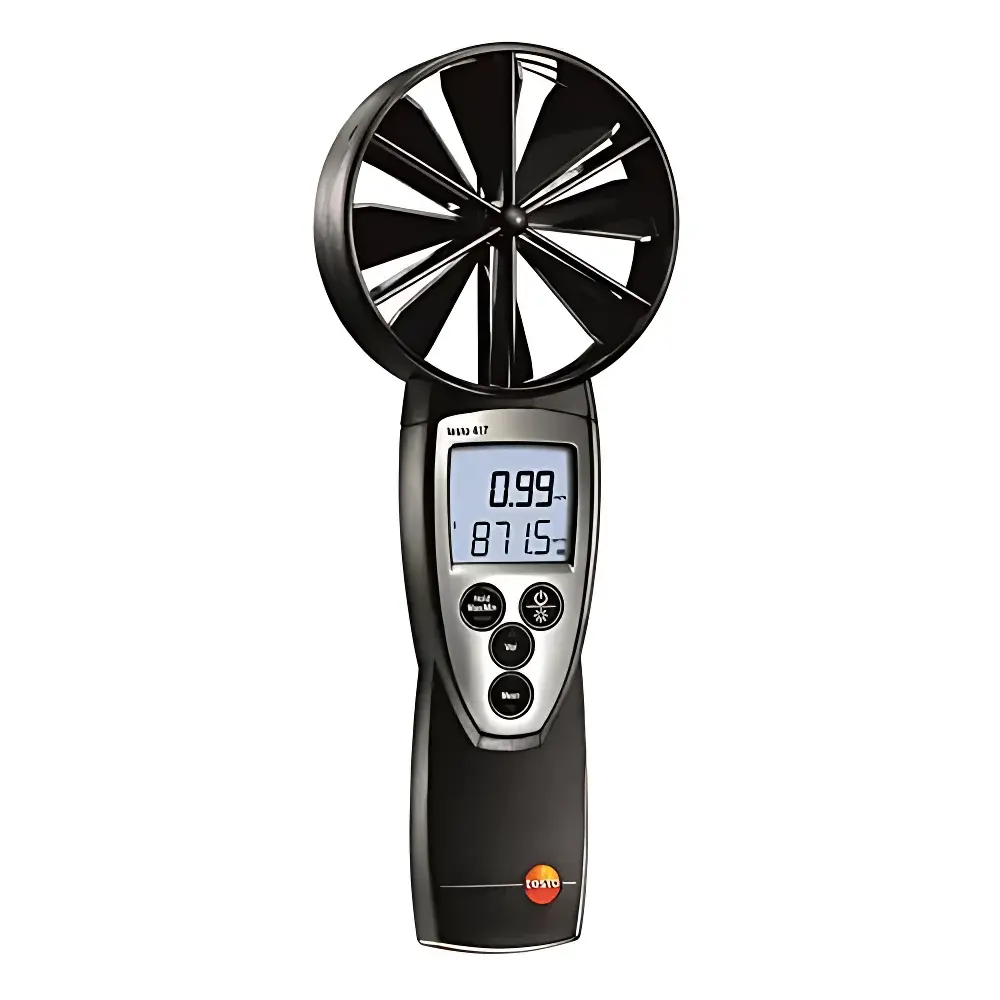
testo 417 Advanced Vane Anemometer with Integrated 100 mm Probe
| Brand | testo |
|---|---|
| Origin | Germany |
| Model | 0560 4170 |
| Instrument Type | Vane Anemometer |
| Resolution | 0.01 m/s |
| Measurement Range | +0.3 to +20 m/s |
| Accuracy | ±(0.1 m/s + 1.5 % of reading) |
| Operating Temperature | 0 to +50 °C |
| Operating Humidity | 0 to 95 % RH (non-condensing) |
| Temperature Measurement Range | 0 to +50 °C |
| Temperature Accuracy | ±0.5 °C |
| Temperature Resolution | 0.1 °C |
| Air Volume Flow Range | 0 to 99,999 m³/h (dependent on duct area or accessory configuration) |
| Weight | 230 g |
| Dimensions | 277 × 105 × 45 mm |
| Housing Material | ABS |
| Power Supply | 9 V battery |
| Battery Life | up to 50 h |
| Storage Temperature | −40 to +70 °C |
Overview
The testo 417 Advanced Vane Anemometer is a precision-engineered handheld instrument designed for reliable, real-time measurement of air velocity, volumetric flow rate, and ambient temperature in HVAC commissioning, indoor air quality (IAQ) assessment, and environmental system validation. Built upon the proven principle of rotational vane anemometry—where airflow induces proportional angular velocity in a calibrated 100 mm diameter impeller—the device delivers high reproducibility across turbulent and laminar flow regimes typical of supply and exhaust grilles, diffusers, ducts, and terminal units. Its integrated probe eliminates interfacial error associated with detachable sensor assemblies, ensuring mechanical stability and consistent aerodynamic response. The instrument complies with fundamental metrological requirements for field-deployable airflow instrumentation per ISO 5167 (flow measurement principles), EN 12599 (HVAC system testing), and ASHRAE Guideline 12-2020 (for IAQ verification procedures).
Key Features
- Integrated 100 mm vane probe with factory-calibrated aerodynamic profile for minimized turbulence disturbance and optimized low-flow sensitivity (down to 0.3 m/s)
- Simultaneous real-time display of air velocity (m/s), volumetric flow (m³/h), and temperature (°C) on a backlit LCD screen
- Configurable averaging function supporting time-weighted (user-defined duration) and multi-point spatial averaging modes
- Max/Min value capture with single-button activation for transient flow characterization
- Hold function for freezing displayed values during data annotation or cross-reference comparison
- Pre-programmed grille correction factors for common diffuser types (e.g., linear slot, perforated plate, louvered) to compensate for local velocity non-uniformity
- Rugged ABS housing rated for field use, IP52 ingress protection against dust and dripping water
Sample Compatibility & Compliance
The testo 417 is validated for use in non-corrosive, particle-free airstreams encountered in commercial and institutional HVAC systems. It supports direct insertion into rectangular and round ducts (with optional area input), as well as surface-mounted measurements at registers and grilles using compatible accessories—including the testovent 417 funnel set (0563 4170) and the funnel + flow straightener kit (0554 4172). All configurations maintain traceability to national standards via included factory calibration certificate (DIN EN ISO/IEC 17025 accredited). The device meets electromagnetic compatibility (EMC) requirements per EN 61326-1 and safety standards per EN 61010-1 for portable measuring equipment used in industrial environments.
Software & Data Management
While the testo 417 operates as a standalone field instrument, its measurement logs—including timestamps, averaged values, and extremum records—can be manually transcribed for inclusion in commissioning reports compliant with ASHRAE Standard 111, ISO 16813, or EU Directive 2010/31/EU (Energy Performance of Buildings). For digital workflow integration, testo’s optional Smart Probes ecosystem enables Bluetooth-enabled data transfer to iOS/Android devices running testo Smart App, supporting CSV export, PDF report generation, and audit-trail-ready documentation aligned with GLP and ISO 9001 quality management frameworks. No proprietary software installation is required for basic operation.
Applications
- HVAC system balancing and airflow verification per TAB (Testing, Adjusting, and Balancing) protocols
- Commissioning of VAV boxes, fan coil units, and air handling units (AHUs)
- Indoor air quality (IAQ) surveys including ventilation rate assessment (e.g., per ASHRAE 62.1)
- Validation of cleanroom and laboratory fume hood face velocities
- Post-installation performance checks of kitchen exhaust systems and restroom ventilation
- Educational demonstrations of fluid dynamics and thermal comfort parameters
FAQ
What is the minimum measurable air velocity?
The testo 417 achieves stable readings starting at +0.3 m/s, supported by its low-inertia 100 mm vane design and high-resolution analog-to-digital conversion.
Can the instrument calculate volumetric flow without external accessories?
Yes—by entering the cross-sectional area of the duct or grille manually, the device computes volume flow in m³/h using the formula Q = v × A, where v is measured velocity and A is user-input area.
Is the temperature sensor independently calibrated?
Yes—the integrated NTC thermistor is calibrated separately from the vane assembly and conforms to DIN EN 60751 Class B tolerances, with stated accuracy of ±0.5 °C over 0–50 °C.
How does the grille correction factor improve measurement accuracy?
It applies empirically derived coefficients that adjust raw vane readings based on the geometric and aerodynamic characteristics of common diffuser types, reducing systematic bias caused by local velocity gradients.
What battery type is required, and how long does it last under continuous use?
A standard 9 V alkaline battery powers the unit for approximately 50 hours of active measurement, verified under typical field conditions (25 °C, 50 % RH, backlight enabled intermittently).







