
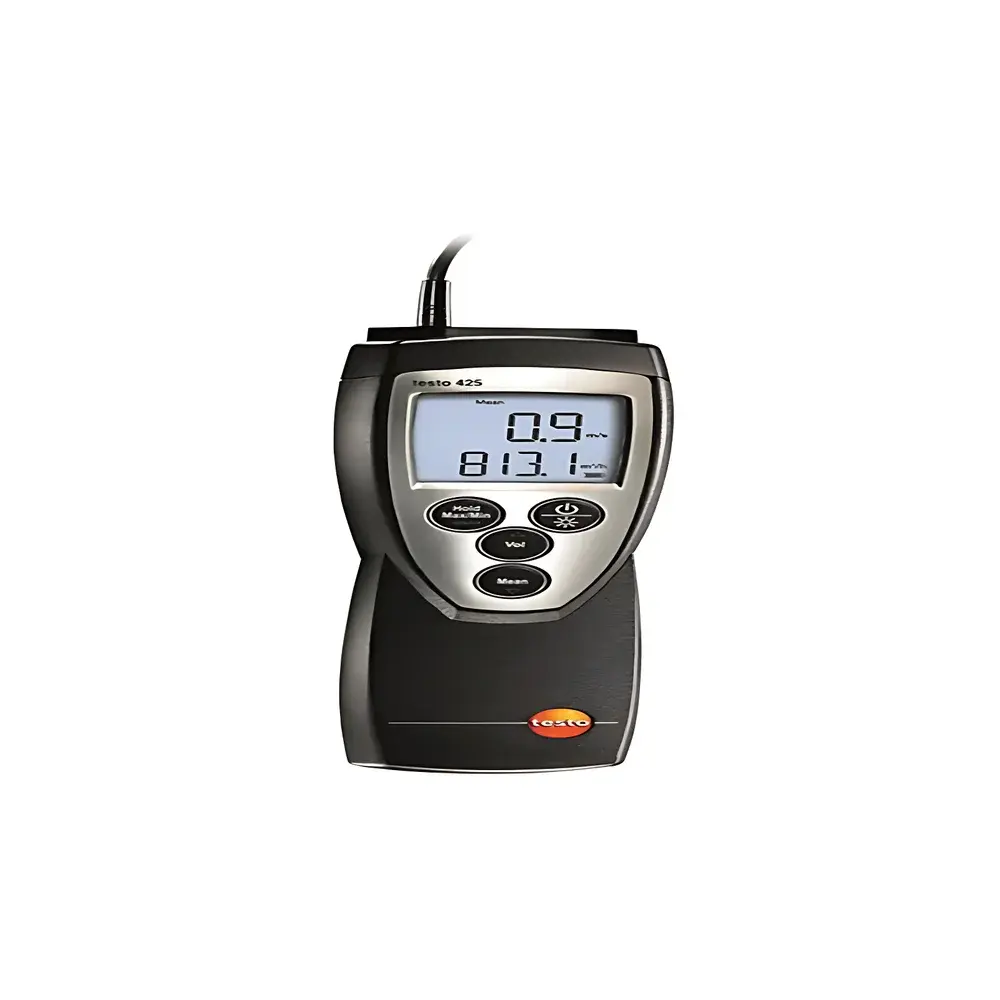
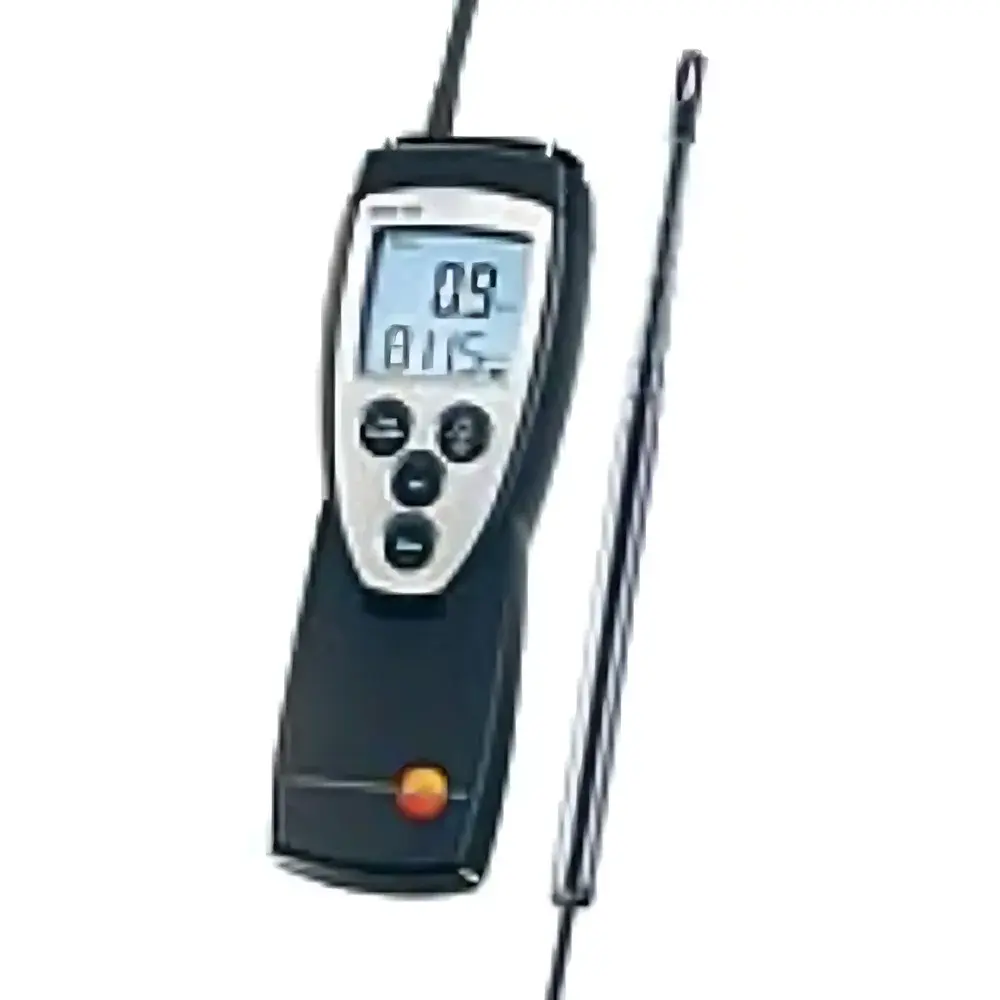
testo 425 Hot-Wire Anemometer
| Brand | testo |
|---|---|
| Origin | Germany |
| Model | 0560 4251 |
| Measuring Range (Air Velocity) | 0–20 m/s |
| Measuring Range (Temperature) | –20 to +70 °C |
| Accuracy (Velocity) | ±(0.03 m/s + 5% of reading) |
| Accuracy (NTC Temp) | ±0.5 °C (0–60 °C), ±0.7 °C (remaining range) |
| Resolution (Velocity) | 0.01 m/s |
| Resolution (Temp) | 0.1 °C |
| Telescopic Probe Length | 820 mm |
| Probe Diameter | 7.5 mm |
| Weight | 285 g |
| Dimensions (L×W×H) | 182 × 64 × 40 mm |
| Operating Temperature | –20 to +50 °C |
| Storage Temperature | –40 to +70 °C |
| Power Supply | 9 V battery |
| Battery Life | ~20 h |
| Housing Material | ABS |
Overview
The testo 425 hot-wire anemometer is a precision-engineered handheld instrument designed for reliable, real-time measurement of air velocity and temperature in HVAC, ventilation, and indoor air quality (IAQ) applications. Based on constant-temperature anemometry (CTA), the device employs a fine platinum-coated tungsten wire sensor that maintains thermal equilibrium with the surrounding airflow—enabling highly responsive and repeatable velocity readings across laminar and turbulent flow regimes. Its integrated NTC temperature sensor simultaneously captures ambient or duct-mounted thermal conditions, supporting thermodynamic analysis of air distribution systems. The instrument is calibrated per ISO 16813 and ASTM D1076 standards for residential and commercial HVAC commissioning, making it suitable for functional testing of supply/return ducts, grilles, diffusers, and exhaust hoods. With a compact form factor and ergonomic design, the testo 425 delivers field-deployable metrology without compromising traceability or operational robustness.
Key Features
- Telescopic probe with 820 mm extension length and 7.5 mm diameter—optimized for insertion into ducts, plenums, and confined air pathways while minimizing flow disturbance.
- Automatic volumetric flow calculation: enter duct cross-sectional area (rectangular or circular) to derive real-time m³/h or ft³/min values directly on-screen.
- Multi-point and time-weighted averaging functions—supports ISO 12599-compliant duct traverse measurements and long-term stability assessment over user-defined intervals.
- Backlit LCD display showing simultaneous live values for velocity, temperature, min/max extremes, and calculated averages—enhancing readability in low-light mechanical rooms or ceiling cavities.
- Hold function for freezing instantaneous readings during critical comparisons or documentation; automatic power-off after 10 minutes of inactivity preserves battery life (up to 20 hours).
- Rugged ABS housing rated for industrial environments; operating temperature range from –20 °C to +50 °C ensures consistent performance in unconditioned basements, rooftops, or chilled water plant rooms.
Sample Compatibility & Compliance
The testo 425 is validated for use with standard rectangular and round HVAC ducts (diameters ≥100 mm), ceiling diffusers, and linear slot outlets. It complies with EN 13725 (ambient air quality—measurement of VOCs and airflow), ISO 16813 (HVAC design principles), and ASHRAE Guideline 12-2020 (prevention of infectious aerosol transmission). All factory calibrations are traceable to PTB (Physikalisch-Technische Bundesanstalt) standards, and the device supports GLP-compliant documentation when paired with testo’s optional reporting software. No external calibration gas or reference fans are required for routine verification—zero-point and span checks can be performed using ambient still-air and fan-generated flow references per ISO/IEC 17025 internal verification protocols.
Software & Data Management
While the testo 425 operates as a standalone meter, it integrates seamlessly with testo’s Smart Probes ecosystem via optional Bluetooth-enabled adapters (e.g., testo 160 series loggers). Raw measurement data—including timestamps, min/max tracking, and averaged profiles—can be exported in CSV format for post-processing in Excel, MATLAB, or building energy modeling platforms such as EnergyPlus. Firmware updates are delivered through testo’s official desktop application (testo Comsoft 5), which also enables audit-trail generation compliant with FDA 21 CFR Part 11 requirements when used in regulated pharmaceutical or cleanroom HVAC validation workflows.
Applications
- HVAC system commissioning and TAB (Testing, Adjusting, Balancing) per NEBB and AABC standards.
- Indoor air quality audits—including ASHRAE 62.1 ventilation rate verification and sick building syndrome diagnostics.
- Energy efficiency assessments: quantifying airflow imbalances, duct leakage estimates, and fan system efficiency degradation.
- Occupational health & safety monitoring: assessing local exhaust ventilation (LEV) capture velocity at fume hoods and welding stations.
- Academic and research applications: boundary layer studies, wind tunnel calibration support, and classroom demonstrations of fluid dynamics principles.
FAQ
What is the recommended calibration interval for the testo 425?
Annual calibration is advised for ISO/IEC 17025-accredited laboratories; field users should perform functional verification before each shift using zero-air and known-velocity references.
Can the testo 425 measure air velocity in high-humidity or condensing environments?
The probe is not sealed against condensation; prolonged exposure to saturated air or direct water contact may affect sensor stability. Use only in non-condensing conditions per IP20 ingress protection rating.
Does the device support custom duct shape input for flow calculation?
No—it accepts only rectangular and circular cross-section definitions. Irregular geometries require manual integration or third-party CFD-derived area weighting.
Is the 9 V battery replaceable in the field?
Yes—the battery compartment is tool-free and accessible via a sliding cover on the rear housing.
How does the testo 425 handle turbulent or pulsating flows?
Its 100 Hz sampling rate and digital filtering algorithm suppress short-term fluctuations while preserving mean flow integrity—validated per ISO 5167 Annex F for turbulent duct flow characterization.







