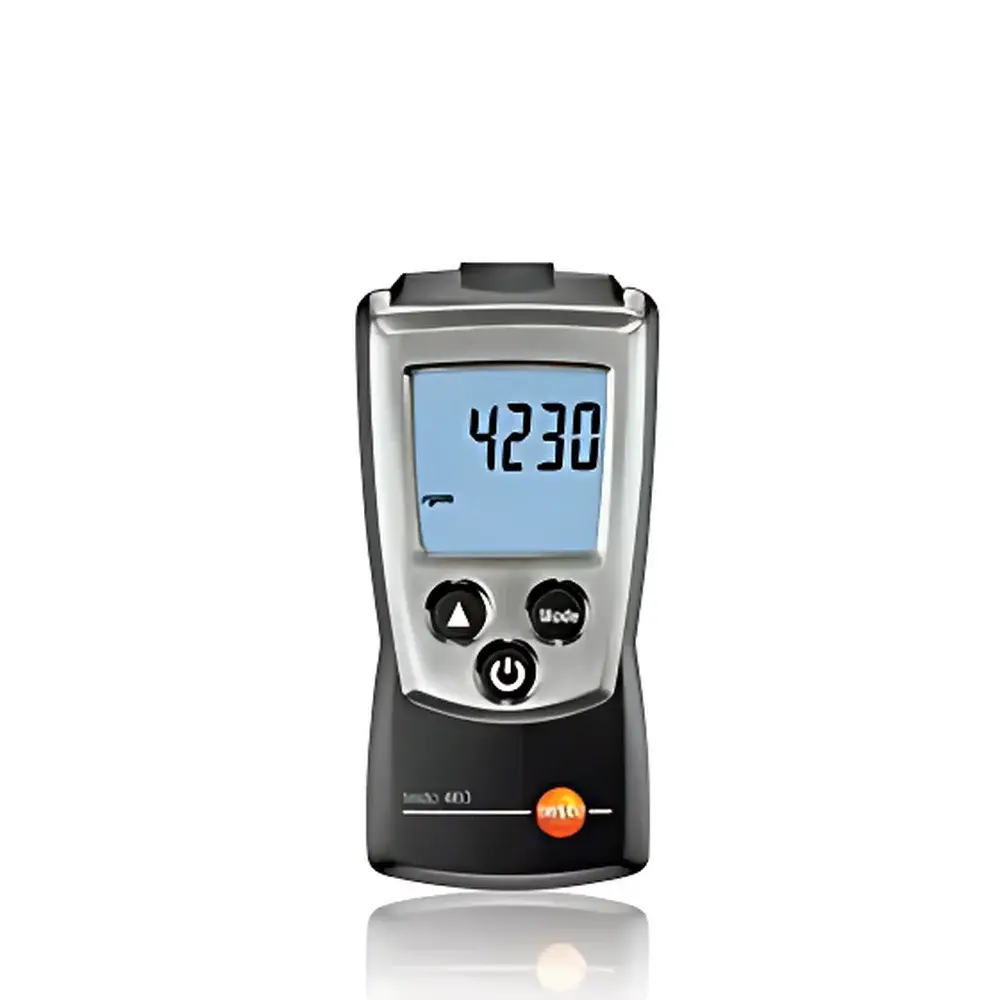
testo 460 Optical Tachometer
| Brand | testo |
|---|---|
| Origin | Germany |
| Model | 0560 0460 |
| Measurement Principle | Non-contact optical reflection method |
| Distance Range | 10–40 cm |
| RPM Range | 100–29,999 rpm |
| Accuracy | ±0.02 % of reading |
| Resolution | 0.1 rpm (100–999.9 rpm), 1 rpm (1,000–29,999 rpm) |
| Response Time | 0.5 s |
| Display | Backlit LCD |
| Power Source | Included battery |
| Compliance | CE, RoHS, ISO/IEC 17025 traceable calibration certificate supplied |
Overview
The testo 460 Optical Tachometer is a precision-engineered, handheld non-contact rotational speed measurement instrument designed for industrial maintenance, quality assurance, and laboratory applications where operational continuity is critical. Utilizing an LED-based optical reflection principle, the device detects rotational velocity by measuring the time interval between successive reflections from a retro-reflective tape affixed to the rotating surface. This method eliminates mechanical contact, enabling safe, real-time RPM assessment without interrupting machinery operation—ideal for in-situ diagnostics of fans, motors, shafts, conveyors, pumps, and HVAC components. Its compact form factor (128 × 55 × 35 mm), ergonomic wrist strap, and protective cap support field-deployable usability across factory floors, utility sites, and R&D labs. The instrument operates within a calibrated working distance of 10–40 cm, ensuring consistent signal capture under variable alignment conditions.
Key Features
- Non-contact optical measurement via integrated high-intensity LED emitter and photodiode receiver
- Backlit LCD display with automatic brightness adaptation for readability in low-light or high-ambient-light environments
- Hold function to freeze and retain the last measured value for documentation or comparison
- Integrated 0.5-second response time for rapid acquisition of stable rotational speeds
- Resolution of 0.1 rpm at lower ranges (100–999.9 rpm) and 1 rpm at higher ranges (1,000–29,999 rpm), supporting both fine-tuning and coarse monitoring tasks
- Factory-calibrated with ISO/IEC 17025-traceable certificate; no user recalibration required during standard service intervals
- Supplied with self-adhesive reflective tape (multiple pieces), protective cap, adjustable wrist strap, AAA battery, and calibration report
Sample Compatibility & Compliance
The testo 460 is compatible with any rotating surface that permits secure application of the included reflective tape—aluminum, steel, plastic, rubber, or painted surfaces are routinely measured without modification. Tape placement is flexible and reversible, allowing repeated use on different targets or repositioning on the same component. The instrument complies with EU directives CE 2014/30/EU (EMC) and 2011/65/EU (RoHS), and its measurement uncertainty budget is documented per ISO/IEC 17025 requirements. While not a GLP/GMP-certified system per se, its traceable calibration record supports audit readiness in regulated environments where periodic verification of process equipment speed is mandated (e.g., pharmaceutical cleanroom fan validation per ISO 14644-3, or food processing line belt speed verification per FDA 21 CFR Part 11–aligned SOPs).
Software & Data Management
The testo 460 operates as a standalone measurement tool with no embedded data logging or PC connectivity. All readings are displayed and held locally on the LCD screen. For integration into structured QA/QC workflows, users may manually transcribe values into electronic logbooks compliant with 21 CFR Part 11 (when paired with validated entry procedures) or import results into LIMS or CMMS platforms via secondary documentation. Optional accessories—including testo’s IRSoft reporting software suite (used with compatible infrared instruments)—do not interface directly with the 460 model; however, its consistent accuracy and repeatability make it suitable for inclusion in multi-instrument validation protocols requiring cross-device correlation.
Applications
- Preventive maintenance: Monitoring motor and bearing speed drift indicative of wear or misalignment
- HVAC commissioning: Verifying fan RPM against design specifications under load conditions
- Manufacturing line validation: Confirming conveyor, spindle, or pump rotational rates prior to batch release
- Energy efficiency audits: Correlating speed changes with power draw and airflow metrics
- Educational laboratories: Demonstrating rotational dynamics principles without mechanical coupling constraints
- Field service engineering: Rapid verification of gear ratio outputs or VFD-controlled drive performance
FAQ
What is the minimum and maximum measurable distance between the testo 460 and the target surface?
The optimal working distance is 10–40 cm. Measurements outside this range may yield inconsistent reflection signals due to beam divergence or insufficient intensity.
Can the testo 460 measure rotational speed on dark or non-reflective surfaces without tape?
No. The device requires the included retro-reflective tape for reliable optical detection. Unmodified matte-black or highly absorptive surfaces will not return sufficient signal.
Is the calibration certificate valid for regulatory submissions?
Yes—the supplied ISO/IEC 17025-traceable certificate documents measurement uncertainty and is accepted as evidence of metrological fitness in third-party audits, provided the instrument remains undamaged and used within specified environmental conditions (10–40 °C, <80 % RH).
Does the testo 460 support analog output or Bluetooth connectivity?
No. It is a dedicated optical tachometer with no external communication interfaces. Data capture relies on visual readout and manual recording.
How often should the reflective tape be replaced?
Tape longevity depends on surface cleanliness, ambient temperature, and mechanical abrasion. Under typical industrial conditions, replacement every 3–6 months is recommended to maintain signal fidelity.