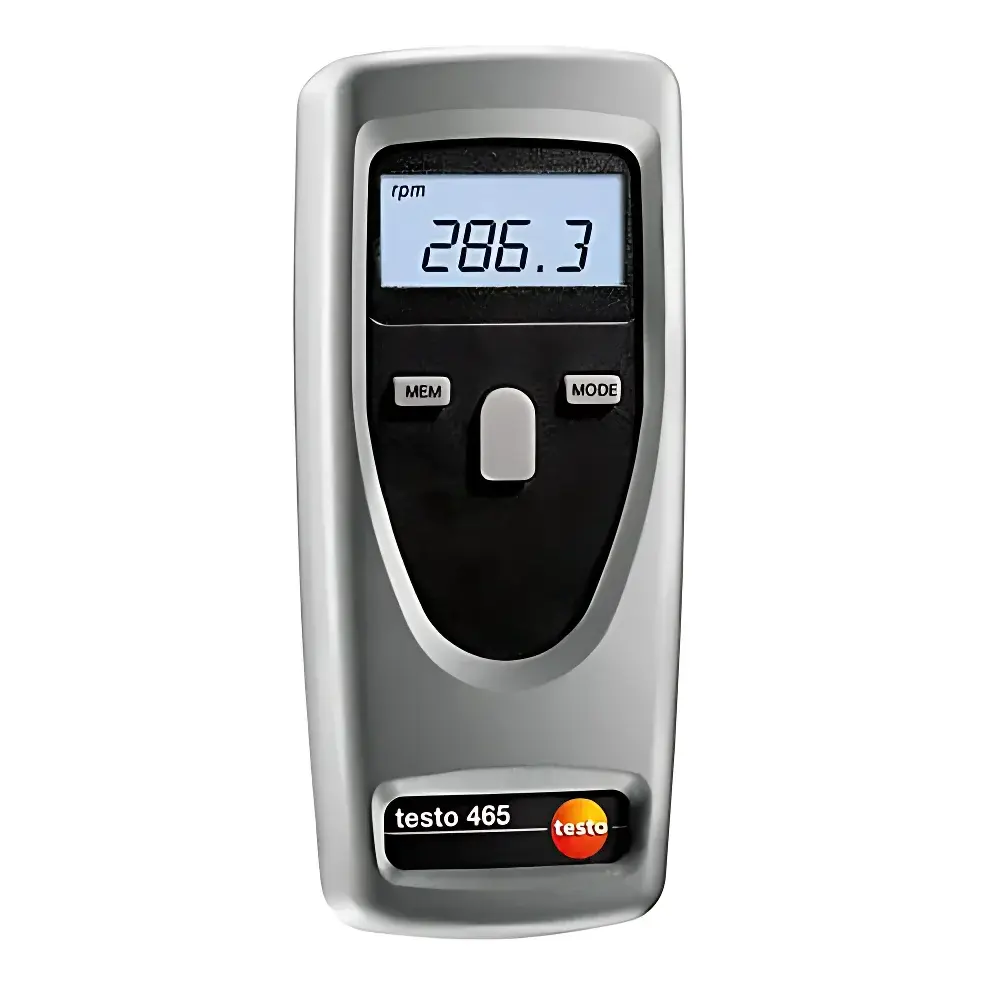
testo 465 Optical Tachometer
| Brand | testo |
|---|---|
| Origin | Germany |
| Model | 0563 0465 |
| Measurement Principle | Non-contact optical reflection (visible/infrared LED) |
| Distance Range | Up to 600 mm |
| Display | Single-line LCD |
| RPM Range | 1–99,999 rpm |
| Accuracy | ±0.02% of reading |
| Resolution | 0.01 rpm (1–99.99 rpm), 0.1 rpm (100–999.9 rpm), 1 rpm (1,000–99,999 rpm) |
| Data Hold | Min/Max/Avg/Last value storage |
| Included Accessories | Protective SoftCase, reflective tape, plastic instrument case, batteries |
Overview
The testo 465 Optical Tachometer is a precision-engineered handheld instrument designed for non-contact rotational speed measurement of rotating machinery components in industrial maintenance, HVAC system commissioning, and laboratory validation environments. Operating on the principle of optical reflection photometry, the device emits a visible or near-infrared LED beam onto a retroreflective tape affixed to the rotating surface. Each reflection event is detected by a high-sensitivity photodiode, and the time interval between successive pulses is converted into rotational speed (RPM) using microprocessor-based timing algorithms. This method eliminates mechanical coupling, wear-related drift, and electromagnetic interference—ensuring long-term stability and repeatability across diverse operational conditions. With a maximum working distance of 600 mm and a wide dynamic range (1–99,999 rpm), the testo 465 supports both low-speed fan blades and high-speed turbine shafts without recalibration or sensor reconfiguration.
Key Features
- Non-contact optical measurement via integrated visible/near-IR LED emitter and photodetector array
- Single-hand ergonomic operation with intuitive trigger-based interface and tactile feedback
- Real-time statistical data capture: simultaneous storage of minimum, maximum, average, and last measured RPM values
- High-resolution display with adaptive digit precision: 0.01 rpm (1–99.99 rpm), 0.1 rpm (100–999.9 rpm), and 1 rpm (1,000–99,999 rpm)
- Calibration-traceable accuracy of ±0.02% of reading, compliant with internal testo metrology standards
- Ruggedized housing with IP54-rated ingress protection against dust and water splashes
- Included protective SoftCase, calibrated reflective tape set (ISO/IEC 17025 traceable application instructions), and impact-resistant plastic transport case
Sample Compatibility & Compliance
The testo 465 is compatible with any rotating surface where a standard 12 mm × 12 mm reflective tape can be securely applied—including fan hubs, ventilation duct impellers, motor couplings, pump shafts, and centrifuge rotors. Surface finish, ambient lighting (including direct sunlight), and rotational symmetry do not compromise measurement integrity due to the instrument’s dual-wavelength pulse discrimination and automatic gain control. The device complies with EN 61326-1:2013 (EMC requirements for electrical equipment used in industrial environments) and conforms to RoHS Directive 2011/65/EU. While not certified for intrinsic safety (ATEX/IECEx), it is routinely deployed in Class 1 Div 2 zones under documented risk assessment protocols. All supplied reflective tapes meet ISO 3597-2:2018 specifications for retroreflective coefficient stability over 12 months under typical indoor operating temperatures (−10 °C to +50 °C).
Software & Data Management
The testo 465 operates as a standalone field instrument with no proprietary software dependency. Measured values are retained in volatile memory until power-off; however, all stored Min/Max/Avg/Last values can be manually transcribed for inclusion in maintenance logs, ISO 9001 audit trails, or GLP-compliant calibration records. For integration into digital workflows, users may document readings via testo’s free SmartProbes app (iOS/Android) using companion Bluetooth-enabled devices (e.g., testo 176 series loggers), though the 465 itself lacks wireless connectivity. Internal firmware adheres to IEC 62443-3-3 security principles for embedded systems, ensuring resistance to unauthorized configuration changes. Device calibration history and certificate documentation follow ISO/IEC 17025 guidelines, supporting traceability to national metrology institutes (e.g., PTB Germany).
Applications
- HVAC system balancing: verification of fan speed compliance with ASHRAE 111-2013 airflow measurement protocols
- Preventive maintenance: trending RPM deviations in belt-driven blowers to detect slippage or bearing degradation
- Commissioning of industrial exhaust systems: validating rotational performance against OEM nameplate specifications
- Academic and vocational training labs: teaching fundamental concepts of rotational dynamics and optical sensing
- Pharmaceutical facility qualification: monitoring centrifuge rotor speeds during cleaning validation (per USP analytical instrument qualification)
- Energy efficiency audits: correlating fan speed with static pressure and power consumption per ISO 5801
FAQ
What type of reflective tape is required for accurate measurement?
The testo 465 requires the included high-gain retroreflective tape (part no. 0554 0051), which provides consistent reflectivity across the 650–850 nm spectral band. Generic reflective materials are not recommended due to inconsistent angular response and potential signal dropout.
Can the device measure through transparent barriers such as glass or acrylic?
No—optical path obstruction (e.g., glass, mesh guards, or condensation) will scatter or attenuate the LED beam, resulting in invalid or unstable readings. Direct line-of-sight to the reflective tape is mandatory.
Is periodic recalibration required, and how is it performed?
Annual calibration is recommended per ISO/IEC 17025 and internal quality management systems. Calibration must be conducted using a NIST-traceable rotary standard (e.g., Fluke 720A Speed Calibrator) at an accredited lab; field adjustment is not supported.
Does the testo 465 support analog output or data logging?
No—the device has no analog output port, SD card slot, or internal memory beyond the four-value statistical buffer. It is optimized for immediate visual verification, not continuous monitoring.
How does ambient light affect measurement reliability?
The instrument employs synchronized pulsed illumination and narrow-band optical filtering to reject broadband ambient interference, enabling reliable operation under fluorescent, LED, and daylight conditions up to 10,000 lux.