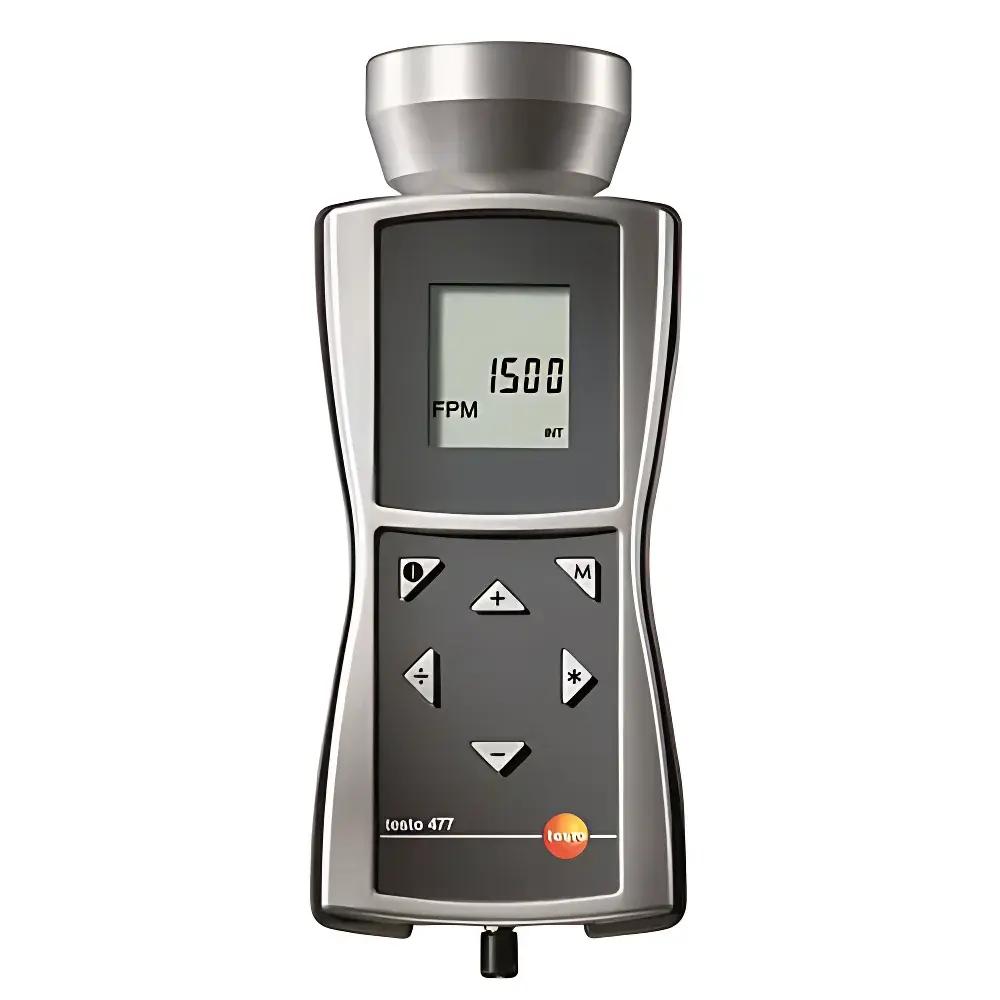
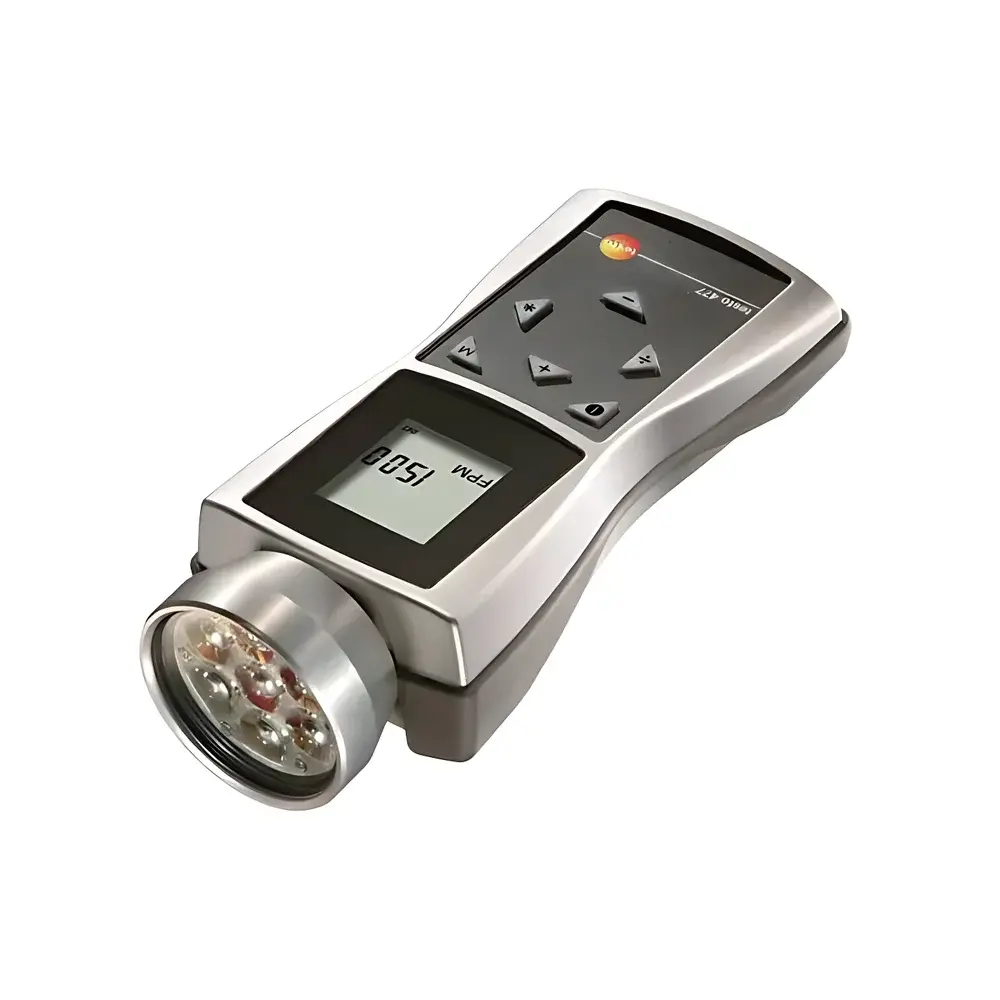
testo 477 LED Handheld Stroboscope
| Brand | testo |
|---|---|
| Origin | Germany |
| Model | 0563 4770 |
| Measurement Range | 30–300,000 fpm (flashes per minute) |
| Flash Intensity | up to 1500 lux at 30 cm |
| Flash Duration | Adjustable |
| Display | LCD |
| IP Rating | IP65 |
| Battery Life | Up to 5 h (alkaline), up to 11 h (NiMH, at 6000 fpm) |
| Resolution | ±0.1 fpm (30–999 fpm), ±1 fpm (1000–300,000 fpm) |
| Accuracy | ±0.02 % of reading |
| Trigger I/O | Yes |
| Operating Temperature | –10 to +50 °C |
| Weight | 380 g |
Overview
The testo 477 LED Handheld Stroboscope is an industrial-grade optical measurement instrument engineered for non-contact rotational speed analysis and dynamic motion visualization in live operating environments. It operates on the principle of stroboscopic synchronization: by emitting precisely timed, high-intensity LED flashes at adjustable frequencies, it optically “freezes” periodic motion—enabling visual inspection, vibration assessment, and RPM verification without mechanical contact or process interruption. Designed for continuous use in demanding production settings, the device delivers stable flash output across its full 30–300,000 fpm range, supporting accurate evaluation of rotating, reciprocating, or oscillating components—from textile guide eyes and printing cylinder gears to turbine blades and conveyor sprockets. Its solid-state LED light source eliminates filament degradation, ensures consistent spectral output (~6500 K correlated color temperature), and enables repeatable photometric performance critical for comparative diagnostics.
Key Features
- Ultra-wide measurement range: 30–300,000 flashes per minute (fpm), corresponding to rotational speeds up to 300,000 rpm for single-flash-per-cycle applications.
- High-brightness LED flash source delivering up to 1500 lux at 30 cm distance; peak intensity reaches 4800 lux at 6000 fpm and 30 cm—optimized for visibility under ambient industrial lighting conditions.
- Adjustable flash duration to balance temporal resolution and perceived brightness, minimizing motion blur during high-speed observation.
- Integrated trigger input/output interface enabling external synchronization with encoders, proximity sensors, or PLC signals—essential for phase-locked diagnostics and automated test sequences.
- Ruggedized housing rated IP65: dust-tight and protected against low-pressure water jets from any direction; impact-resistant polycarbonate casing with wipe-clean surface for maintenance in oily, humid, or particulate-laden environments.
- Long operational autonomy: up to 5 hours with standard alkaline AA batteries (tested at 6000 fpm); extended runtime up to 11 hours using rechargeable NiMH batteries under identical conditions.
- High-resolution LCD display with intuitive menu navigation, real-time frequency readout, and battery status indicator—designed for glove-compatible operation in industrial settings.
Sample Compatibility & Compliance
The testo 477 is compatible with all periodically moving mechanical elements—including shafts, belts, gears, fans, spindles, rollers, and micro-components—regardless of size, material reflectivity, or accessibility. No retroreflective tape, paint, or physical markers are required, eliminating contamination risk and calibration drift associated with adhesive-based tachometry. The device complies with IEC 61000-6-2 (immunity) and IEC 61000-6-4 (emissions) for industrial electromagnetic environments. Its optical design meets EN 62471 (Photobiological Safety of Lamps) Class 1 requirements—safe for unrestricted use without protective eyewear under normal operating conditions. While not a certified metrology standard reference, its ±0.02 % reading accuracy and traceable factory calibration report support routine QC documentation in ISO 9001 and IATF 16949 quality management systems.
Software & Data Management
The testo 477 operates as a standalone field instrument with no embedded firmware update capability or PC connectivity. All configuration and measurement data reside locally on the device; no internal storage or export functionality is provided. However, its trigger I/O port supports integration into larger test architectures via TTL-level signals—enabling synchronization with oscilloscopes, data loggers, or programmable logic controllers for time-correlated multi-sensor analysis. The included factory calibration certificate documents initial performance verification against traceable standards and may be retained for GLP-compliant audit trails where periodic functional checks are mandated.
Applications
- Real-time validation of spindle speeds on CNC lathes and milling machines without shutdown.
- Vibration mode identification on HVAC fans and centrifugal blowers through strobed amplitude mapping.
- Dynamic alignment verification of web-guiding rollers and tension control systems in converting lines.
- Functional inspection of high-speed packaging machinery—e.g., fill-nozzle indexing, label applicator timing, and case-sealer cam phasing.
- Non-intrusive monitoring of knitting machine needle carriers and warp beam rotation in textile manufacturing.
- Verification of print registration stability on rotary offset presses by freezing gear-mesh interaction points.
- Diagnostics of bearing-induced harmonics on rotating equipment via strobed surface texture analysis.
FAQ
Does the testo 477 require reflective tape or markings to measure RPM?
No. It relies solely on optical synchronization with inherent surface features or periodic motion—eliminating the need for surface preparation or process interruption.
Can the device measure non-rotational motion such as vibration or oscillation?
Yes. When configured to match the fundamental frequency of linear or angular oscillation, it enables qualitative assessment of amplitude, phase, and waveform symmetry.
Is the flash output suitable for use in brightly lit factory environments?
The 1500 lux output at 30 cm provides sufficient contrast for reliable stroboscopic effect under typical indoor industrial illumination (≤5000 lux). For outdoor or high-ambient-light applications, operation at closer working distances (<20 cm) is recommended.
What safety certifications does the testo 477 hold?
It conforms to IEC 61000-6-2/6-4 for EMC and EN 62471 Class 1 for photobiological safety—ensuring safe, interference-free operation in regulated production facilities.
How is calibration maintained over time?
The unit ships with a traceable factory calibration report. Users are advised to perform functional verification using a known-frequency reference (e.g., calibrated motor or signal generator) at regular intervals per internal QA procedures.