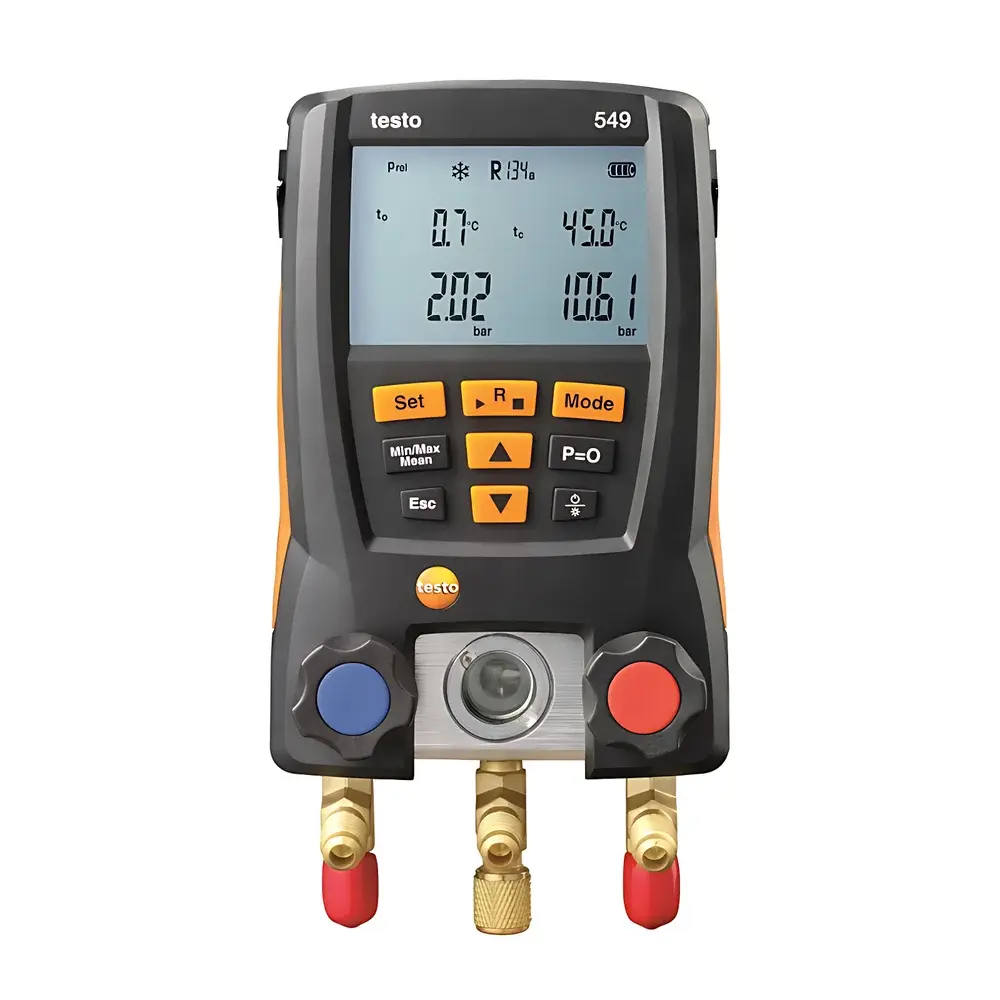
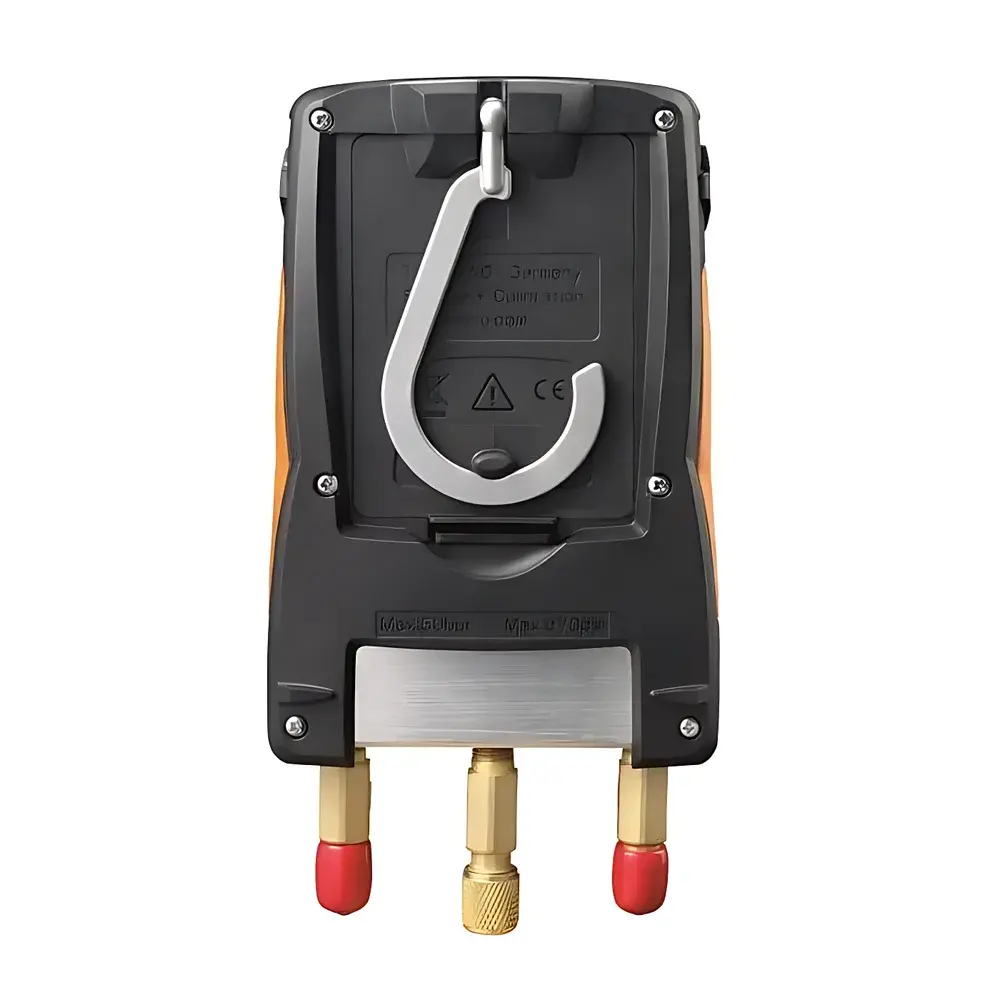
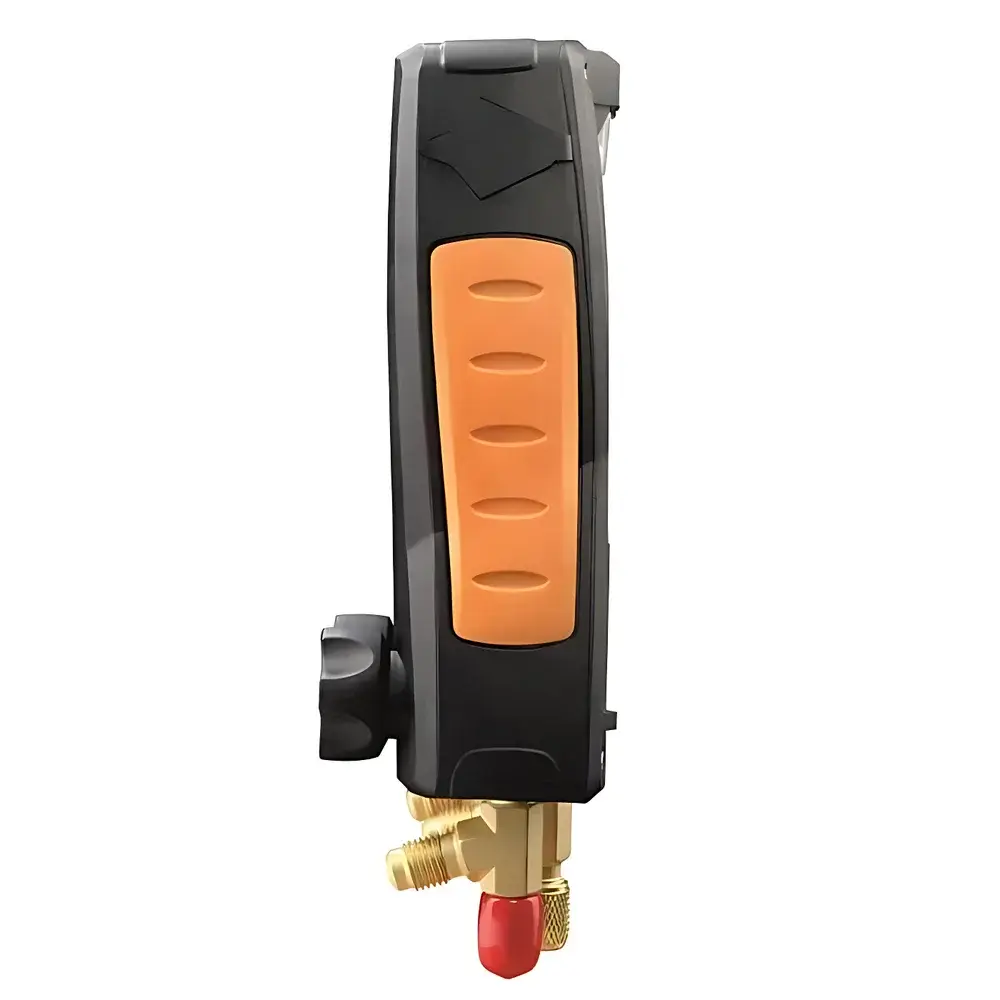
testo 549 Basic Digital Refrigerant Manifold Gauge Set
| Brand | testo |
|---|---|
| Origin | Germany |
| Model | 0560 0550 |
| Pressure Range | −1 to +60 bar (rel.), −1 to 0 bar (vacuum) |
| Temperature Range | −50 to +150 °C |
| Pressure Accuracy | ±0.5 % FS |
| Temperature Accuracy | ±0.5 °C |
| Resolution | 0.01 bar / 0.1 °C |
| Weight | 1060 g |
| Dimensions | 200 × 109 × 63 mm |
| IP Rating | IP42 |
| Battery Life | 250 h (no backlight, no Bluetooth®) |
| Refrigerants | 60 preloaded (including R134a, R404A, R410A, R454B, R744, R290, R600a, etc.) |
| Probe Interfaces | 2 × NTC plug-in, 3 × 7/16"–UNF pressure ports |
Overview
The testo 549 Basic Digital Refrigerant Manifold Gauge Set is an engineered solution for HVAC/R technicians performing commissioning, maintenance, and troubleshooting of refrigeration systems and heat pumps. Built upon dual temperature-compensated pressure sensors and integrated thermodynamic algorithms, the device implements real-time saturation temperature calculation based on measured pressure and selected refrigerant—enabling precise determination of evaporator and condenser saturation temperatures without manual reference tables. Its core architecture adheres to fundamental thermodynamic principles: pressure–temperature relationship mapping per ASHRAE RP-148 and ISO 8573-1-compliant traceability frameworks, ensuring metrological integrity across field conditions. Unlike analog manifold gauges subject to parallax error and thermal drift, the testo 549 delivers repeatable, digitally stabilized readings under ambient temperature fluctuations between −20 °C and +50 °C—critical for field diagnostics where environmental stability cannot be controlled.
Key Features
- Dual high-stability pressure sensors with integrated temperature compensation, minimizing thermal-induced zero-shift in both high-side (+60 bar max) and low-side (−1 bar vacuum) measurements
- Preloaded database of 60 refrigerants—including legacy (R12, R22), transitional (R404A, R410A), low-GWP alternatives (R454B, R452B, R32, R290, R600a), and natural refrigerants (R744/CO₂, R718/H₂O)
- Automatic superheat and subcooling calculation using two independent NTC temperature probe inputs—compatible with clamp-on surface probes for non-invasive pipe temperature acquisition
- Temperature-compensated leak testing mode: records initial system pressure, monitors drift over user-defined time intervals, and computes pressure differential corrected for ambient thermal expansion effects per ASTM D6792 methodology
- Auto heat pump mode eliminates manual hose swapping during cycle reversal—automatically reassigns high/low side ports based on operational direction detection
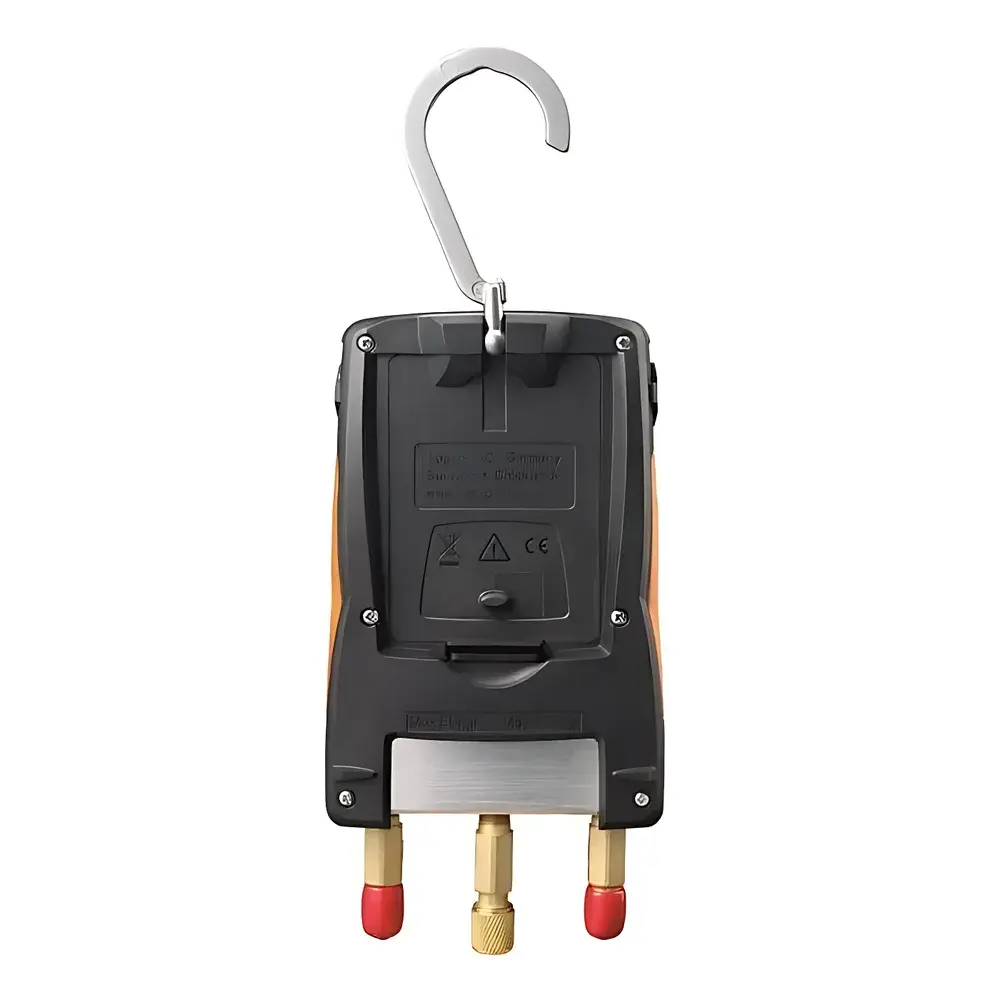
- Rugged metal chassis with IP42 ingress protection, integrated hanging hook for hands-free operation, and large backlit LCD display optimized for low-light mechanical rooms or outdoor rooftop units
Sample Compatibility & Compliance
The testo 549 supports all common refrigerant classes: CFCs, HCFCs, HFCs, HFOs, hydrocarbons (A3 safety class), and inorganic refrigerants. Its pressure sensor calibration is traceable to national standards (DKD/DAkkS-accredited), and firmware complies with EN 61326-1 (EMC) and EN 61010-1 (electrical safety). While not certified for SIL or ATEX environments, its design meets general-purpose industrial requirements for service tools used in commercial refrigeration, chillers, VRF systems, and residential heat pumps. Refrigerant updates are performed exclusively via testo’s authorized service centers—ensuring consistency with ASHRAE Standard 34 nomenclature revisions and EPA SNAP program listings. The instrument does not perform direct mass flow or composition analysis; it operates strictly as a calibrated thermodynamic state indicator for vapor-compression cycles.
Software & Data Management
Data logging is supported via Bluetooth® 4.2 LE (optional) to the free testo Smart Probes app (iOS/Android), enabling timestamped measurement capture, PDF report generation, and cloud export (CSV/Excel). Raw pressure and temperature values—along with calculated superheat/subcooling and saturation points—are stored locally with full audit trail metadata (date/time, refrigerant ID, probe assignment). Though not FDA 21 CFR Part 11 compliant out-of-the-box, the device supports GLP-aligned documentation when paired with testo’s validated reporting workflows. Firmware updates require testo Service Center authorization to maintain refrigerant property table integrity—preventing unverified thermodynamic coefficient modifications that could compromise saturation temperature accuracy.
Applications
- Startup verification of new refrigeration installations per AHRI 750 guidelines
- Charging optimization using superheat/subcooling targets defined by OEM technical bulletins
- Performance benchmarking of condensing units and evaporator coils under varying ambient loads
- Troubleshooting abnormally high discharge temperatures or low suction pressures in scroll/compressor systems
- Leak quantification in low-charge systems where pressure decay must be interpreted alongside ambient thermal inertia
- Heat pump defrost cycle validation during winter operation, leveraging automatic mode switching
FAQ
Does the testo 549 support custom refrigerant entries?
No. Refrigerant data—including P-T curves, critical points, and specific volume coefficients—is factory-programmed and updated only through official testo Service Center firmware revisions to ensure thermodynamic consistency and regulatory alignment.
Can the device measure absolute pressure?
No. All pressure measurements are referenced to ambient atmospheric pressure (gauge scale); vacuum range extends from −1 bar (full vacuum) to 0 bar (ambient).
Is the battery replaceable in the field?
Yes. The unit uses standard AA alkaline batteries (4×), accessible via a screw-secured compartment—designed for rapid swap during extended service calls without specialized tools.
What is the calibration interval recommendation?
testo recommends annual calibration verification against a certified reference standard, particularly after exposure to pressure spikes exceeding 65 bar (overload limit) or prolonged operation above 50 °C ambient.
Are the pressure ports compatible with standard HVAC quick-connect fittings?
Yes. The three 7/16″–UNF female ports accept industry-standard R-134a, R-410A, and R-22 service hoses with O-ring-sealed male connectors per SAE J2196 specifications.