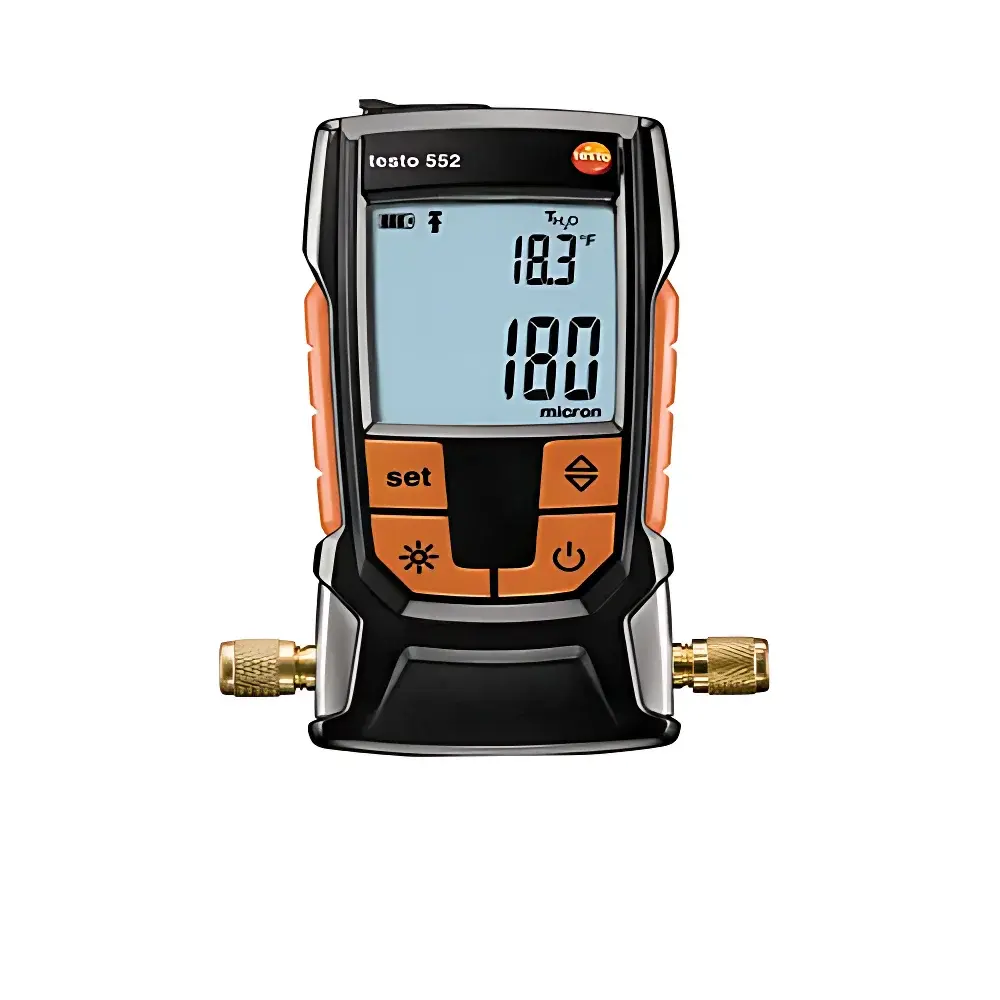
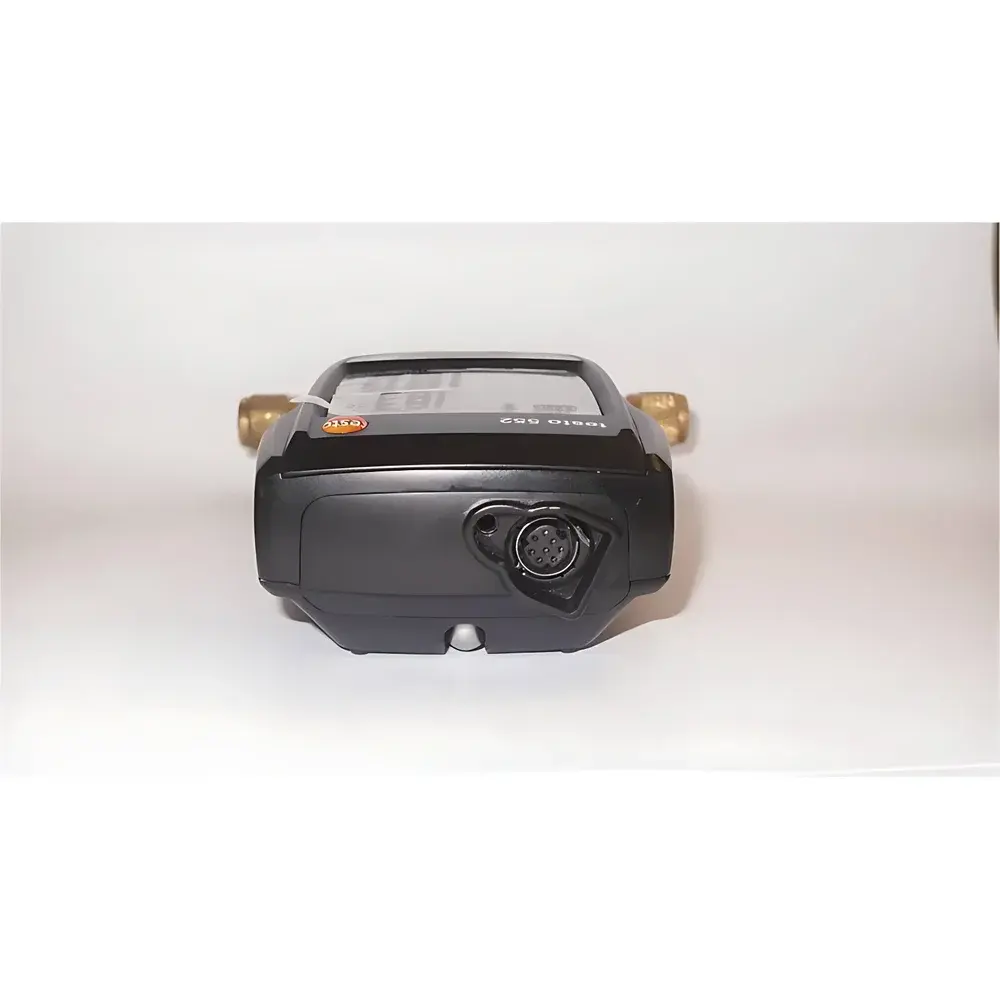
testo 552 Digital Absolute Vacuum Gauge
| Brand | testo |
|---|---|
| Origin | Germany |
| Model | 0560 5522 |
| Measurement Principle | Piezoresistive Absolute Pressure Sensing |
| Pressure Type | Absolute |
| Measurement Range | 0–26.66 mbar / 0–20,000 µm Hg (micron) |
| Accuracy | ±(10 µm + 10% of reading) (100–1,000 µm range) |
| Resolution | 1 µm (0–1,000 µm), 10 µm (1,000–2,000 µm), 100 µm (2,000–5,000 µm) |
| Overpressure Rating | 6.0 bar absolute / 5.0 bar relative |
| Media Compatibility | Refrigerants (R134a, R410A, R32, R290, etc.) |
| Operating Temperature | –10 °C to +50 °C |
| Storage Temperature | –20 °C to +50 °C |
| Ingress Protection | IP42 |
| Weight | 500 g |
| Dimensions | 160 × 110 × 50 mm |
| Power Supply | 2 × AA batteries (50 h typical life, Bluetooth/backlight off) |
| Wireless Interface | Bluetooth® 4.0 |
| Supported OS | iOS 11.0+, Android 6.0+ |
| Display Units | mbar, µm Hg (micron), mmHg, Torr, inHg, inH₂O, hPa, Pa |
| Response Time | 0.5 s |
| Connection Port | 2 × 7/16″ UNF |
Overview
The testo 552 Digital Absolute Vacuum Gauge is an engineered field instrument designed for precise, traceable vacuum measurement in refrigeration and heat pump system commissioning, maintenance, and leak diagnostics. It employs a calibrated piezoresistive absolute pressure sensor referenced to high-vacuum sealed reference cavities, delivering true absolute pressure readings without atmospheric dependency—critical for verifying deep vacuum integrity during system evacuation. Unlike differential or gauge-type instruments, the testo 552 measures pressure relative to perfect vacuum (0 µm Hg), enabling unambiguous assessment of moisture removal efficiency and non-condensable gas presence. Its measurement range spans 0–20,000 µm Hg (0–26.66 mbar), covering the full operational envelope required by ASHRAE Standard 15, ISO 8573-1 (compressed air purity), and OEM specifications for modern low-GWP refrigerants including R32, R290, and R454B. The device meets IEC 61000-4 electromagnetic compatibility requirements and is constructed to withstand repeated exposure to refrigerant oils, condensate, and shop-floor contaminants.
Key Features
- True absolute pressure sensing with factory-calibrated piezoresistive transducer, certified for long-term stability under thermal cycling
- High-resolution digital display with configurable units (µm Hg, mbar, Torr, etc.) and real-time trend visualization
- Integrated Bluetooth® 4.0 wireless interface for secure, low-latency data streaming to iOS and Android mobile devices
- testo Smart APP integration enabling on-site report generation, timestamped measurement logging, and PDF export with embedded calibration metadata
- Programmable visual alarm thresholds for rapid pass/fail verification against manufacturer-specified evacuation targets (e.g., ≤500 µm Hg for R410A systems)
- Ruggedized housing rated IP42—protected against dripping water and solid particulates encountered in HVAC service environments
- Optimized for refrigerant compatibility: validated for use with common hydrofluorocarbons (HFCs), hydrocarbons (HCs), and hydrofluoroolefins (HFOs) without sensor degradation
Sample Compatibility & Compliance
The testo 552 is specifically validated for direct connection to refrigerant circuits via standard 7/16″ UNF service ports. Its wetted materials—including stainless steel diaphragm, fluorosilicone O-rings, and chemically inert internal pathways—are compatible with saturated and superheated vapors of R134a, R404A, R410A, R32, R290, and R1234yf. No oil trapping or condensate accumulation occurs under normal operating conditions due to its vertical sensor orientation and self-draining port geometry. The instrument conforms to EN 14511 (air-conditioning and heat pump testing standards) and supports GLP-compliant documentation workflows when used with testo Smart APP’s audit-trail-enabled reporting module. While not intrinsically safe, it complies with ATEX Category 3G (Zone 2) ambient classification when operated outside explosive atmospheres per Directive 2014/34/EU.
Software & Data Management
The testo Smart APP serves as both a real-time control interface and a regulatory-grade documentation platform. Measurements are time-stamped with GPS coordinates (optional), annotated with technician ID, system ID, and refrigerant type, then compiled into ISO/IEC 17025-aligned PDF reports featuring digital signatures and calibration certificate references. All data—including raw µm Hg values, trend curves, and alarm events—is stored locally on the mobile device and optionally synchronized to secure cloud storage (GDPR-compliant infrastructure). The app enforces data integrity through immutable log entries and supports FDA 21 CFR Part 11 readiness via optional electronic signature modules and user-access controls. Firmware updates are delivered over-the-air, ensuring continued alignment with evolving refrigerant handling regulations such as EU F-Gas Regulation (EU) No 517/2014.
Applications
- Verification of deep vacuum integrity prior to refrigerant charging in split-system AC, VRF, and chiller installations
- Quantitative assessment of dehydration efficacy—correlating final micron levels with residual moisture content per ASHRAE Guideline 3
- Troubleshooting persistent high-side pressure anomalies linked to non-condensable ingress or incomplete evacuation
- Commissioning validation for low-charge and microchannel coil systems where sub-100 µm Hg precision is mandatory
- Field calibration cross-checking against master vacuum standards in mobile service labs
- Training and certification scenarios requiring demonstrable, repeatable vacuum measurement proficiency
FAQ
What vacuum level must be achieved before charging R410A systems?
ASHRAE recommends ≤500 µm Hg for R410A; the testo 552 provides resolution down to 1 µm Hg in this critical range, supporting compliance verification.
Can the testo 552 measure pressures above atmospheric?
No—it is an absolute vacuum gauge optimized for sub-atmospheric measurement only. Its overpressure rating (6.0 bar abs) protects against accidental pressurization but does not enable positive-pressure operation.
Is calibration traceable to national standards?
Yes—each unit ships with a testo DAkkS-accredited calibration certificate (DIN EN ISO/IEC 17025), traceable to PTB (Physikalisch-Technische Bundesanstalt), Germany.
How does temperature affect accuracy during field use?
The sensor incorporates integrated temperature compensation across –10 °C to +50 °C, maintaining stated accuracy without external correction factors.
Does Bluetooth connectivity impact battery life?
Continuous Bluetooth streaming reduces runtime to ~25 hours; power management settings in the testo Smart APP allow adaptive polling intervals to extend operation.