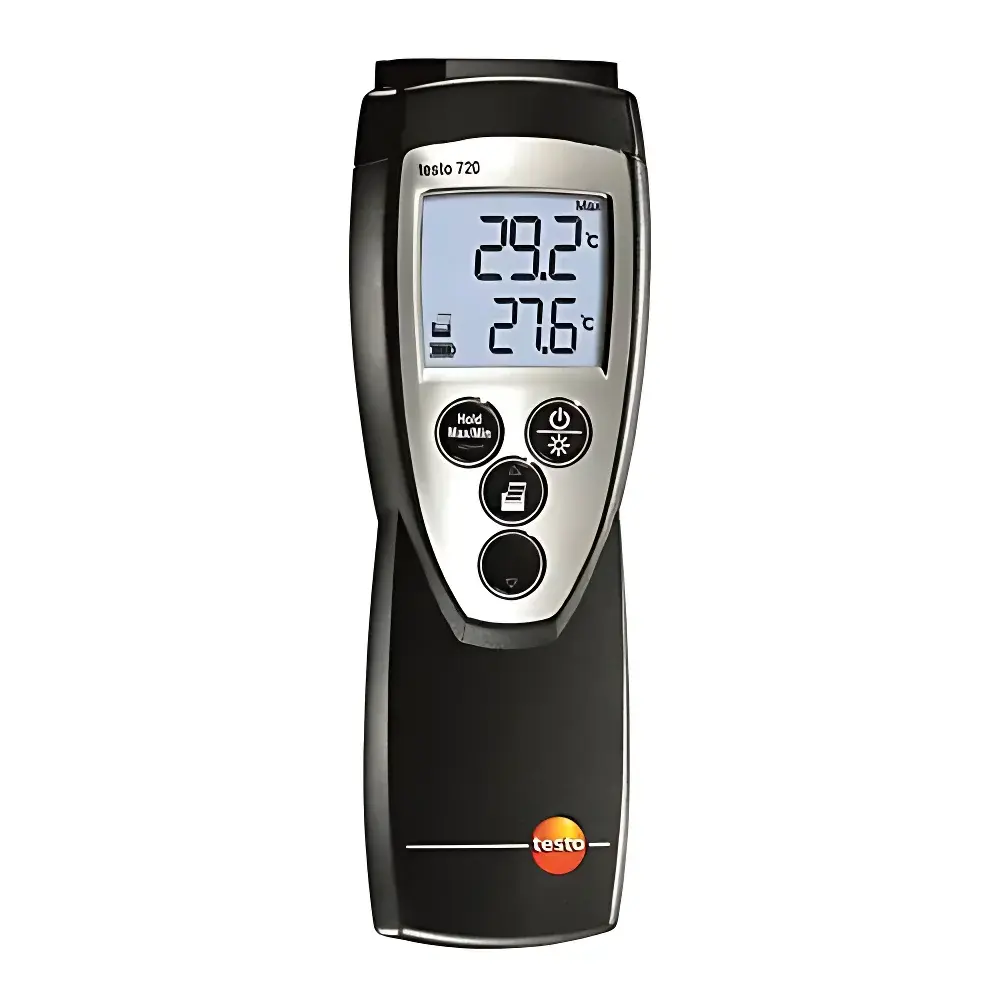
testo 720 Single-Channel Precision Contact Thermometer
| Brand | testo |
|---|---|
| Origin | Germany |
| Model | 0560 7207 |
| Temperature Measurement Principle | Resistance Thermometry (Pt100/NTC) |
| Measurement Method | Contact |
| Temperature Range (NTC) | -50 to +150 °C |
| Temperature Range (Pt100) | -100 to +800 °C |
| Resolution | 0.1 °C |
| Accuracy (NTC) | ±0.2 °C (-25 to +40 °C) |
| Accuracy (Pt100) | ±0.2 % of reading (200 to +800 °C) |
| Stability | ±0.2 °C (typical, across most operating range) |
| Display | Backlit LCD |
| Dimensions | 182 × 64 × 40 mm |
| Weight | 171 g |
| Operating Temperature | -20 to +50 °C |
| Storage Temperature | -30 to +70 °C |
| Enclosure Material | ABS |
| IP Rating (with optional protective sleeve) | IP65 |
| Power Supply | 9 V alkaline battery |
| Battery Life | Up to 70 hours |
| Included | Instrument, 9 V battery, calibration certificate |
Overview
The testo 720 is a single-channel, high-accuracy contact thermometer engineered for traceable, repeatable temperature measurements in demanding laboratory, quality control, and industrial process environments. Unlike infrared or thermocouple-based instruments, the testo 720 relies exclusively on resistance thermometry—supporting both Pt100 (IEC 60751 Class A/B) and NTC sensor inputs via a standardized probe interface. This architecture ensures metrological integrity aligned with ISO/IEC 17025-compliant calibration practices. The instrument functions as a dedicated readout device: it does not contain an integrated sensor but serves as a precision digital interface for externally connected probes, enabling users to select optimal sensing elements—whether glass-encapsulated Pt100 probes for corrosive liquid immersion, flexible surface thermistors for thermal mapping, or ruggedized penetration probes for food safety audits. Its design emphasizes signal stability, low thermal drift, and immunity to electromagnetic interference—critical attributes when validating sterilization cycles (e.g., autoclave chamber profiling per EN 285), monitoring environmental chambers (ISO 17025 Clause 5.4), or performing routine QC checks in pharmaceutical manufacturing (aligned with USP analytical instrument qualification).
Key Features
- Single-channel universal input compatible with standardized Pt100 (2-/3-/4-wire) and NTC temperature probes
- High-resolution 0.1 °C display with adjustable backlight for low-light laboratory or field use
- User-configurable upper/lower alarm limits with audible alert activation upon threshold breach
- Max/min value tracking with hold function for transient event capture (e.g., peak sterilization temperature)
- Robust ABS housing with optional IP65-rated protective sleeve for dust/moisture resistance during wet-process validation
- Calibration certificate included; supports periodic verification against NIST-traceable reference standards
- Extended battery life (up to 70 hours) using standard 9 V alkaline cells—no proprietary power requirements
Sample Compatibility & Compliance
The testo 720 itself does not interact directly with samples; rather, its measurement fidelity depends entirely on the selected probe’s physical and metrological characteristics. Compatible probe types include:
- Pt100 immersion probes with borosilicate glass sheaths (for aggressive chemical media per ASTM D1500)
- Surface-mount NTC sensors with silicone adhesive backing (for non-invasive thermal profiling of HVAC ducts or packaging surfaces)
- Penetration probes with stainless steel tips (validated for food core temperature monitoring per FDA Food Code §3-401.11)
When used with appropriate accessories—including corrosion-resistant lab sleeves, magnetic mounts, or tripod adapters—the system meets functional requirements for GLP-compliant data recording and supports audit-ready documentation workflows under 21 CFR Part 11 when paired with testo’s optional IR printer (model 0554 0001) for timestamped hardcopy output.
Software & Data Management
While the testo 720 operates as a standalone handheld unit without onboard data logging, it integrates seamlessly into broader QA/QC ecosystems through analog output compatibility and peripheral interoperability. The optional testo IR printer enables immediate generation of traceable measurement reports—including date/time stamp, probe ID, measured value, and alarm status—without requiring PC connectivity. For laboratories implementing electronic record retention, the instrument’s stable analog output (0–10 V or 4–20 mA, depending on probe configuration) can feed into SCADA systems or validated LIMS platforms. All calibration certificates comply with ISO/IEC 17025 Annex A.3 requirements for uncertainty reporting, and probe-specific accuracy contributions are documented per manufacturer specifications—ensuring full transparency in total system error budgeting.
Applications
- Pharmaceutical cold chain monitoring: validation of refrigerated storage units (2–8 °C) and freezer mapping (-20 to -80 °C)
- Food safety compliance: HACCP-critical control point verification (e.g., post-cook holding at ≥60 °C per USDA FSIS Directive 8000.3)
- Chemical process control: exothermic reaction temperature profiling in jacketed reactors
- Environmental testing: stability chamber qualification per ICH Q5C guidelines
- Mechanical engineering: bearing and motor winding temperature surveillance during preventive maintenance
- Academic research: reproducible thermal characterization of phase-change materials (PCMs) and polymer curing kinetics
FAQ
Does the testo 720 include a built-in temperature sensor?
No. The testo 720 is a dedicated probe readout device and requires an external Pt100 or NTC temperature probe to perform measurements.
Can the testo 720 be calibrated independently of the probe?
Yes—however, total measurement uncertainty is determined by the combined error of both the instrument electronics and the connected probe. Full system calibration (probe + readout) is recommended for ISO/IEC 17025 compliance.
Is the testo 720 suitable for use in cleanroom environments?
When equipped with an IP65-rated protective sleeve and compatible non-shedding probes (e.g., smooth-surface Pt100 with PTFE insulation), it meets typical ISO 14644-1 Class 5–7 operational requirements.
What standards does the testo 720 support for regulatory compliance?
It supports implementation of ASTM E2877 (temperature mapping), ISO 17025 (calibration traceability), USP (analytical instrument qualification), and FDA 21 CFR Part 11 when used with validated peripherals and documented procedures.
How is measurement data exported for audit purposes?
Via optional testo IR printer (0554 0001) for real-time printed records, or via analog output interfacing with validated data acquisition systems.