testo 826-T2 Infrared Thermometer
| Brand | testo |
|---|---|
| Origin | Germany |
| Model | testo 826-T2 |
| Type | Portable Infrared Thermometer |
| Optical Resolution | 6:1 |
| Temperature Range | -50 to +300 °C |
| Accuracy | ±1.5 °C (-20 to +100 °C), ±2 °C or ±2 % of reading (remaining range) |
| Measurement Speed | 0.5 s per reading |
| Resolution | 0.1 °C |
| Display | Single-line LCD |
| Weight | 80 g |
| Dimensions | 148 × 34.4 × 19 mm |
| Operating Temperature | -20 to +50 °C |
| Storage Temperature | -40 to +70 °C |
| Power Supply | 2 × AAA batteries |
| Battery Life | Approx. 20 h |
| IP Rating | IP67 (with protective sleeve) |
| Compliance | EN 13485 |
Overview
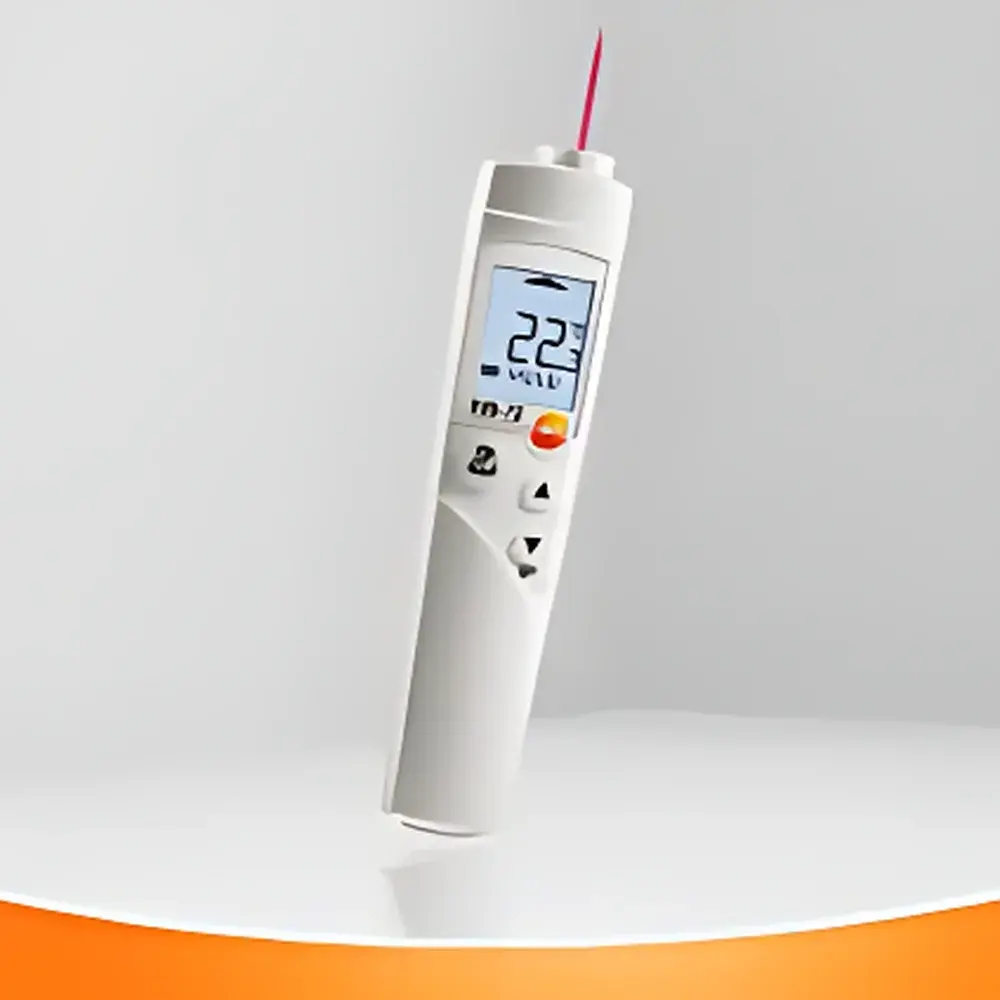
The testo 826-T2 Infrared Thermometer is a handheld, non-contact temperature measurement instrument engineered for precision, speed, and compliance in regulated food handling environments. Based on infrared radiation detection principles—specifically measuring emitted thermal energy in the 8–14 µm spectral band—the device calculates surface temperature without physical contact, eliminating cross-contamination risk and enabling rapid scanning of perishable goods, transport pallets, refrigerated display units, and production line surfaces. Its fixed 6:1 optical resolution ensures reliable spot measurement at short working distances (e.g., 60 cm distance yields ~10 cm spot diameter), making it ideal for targeted checks in confined spaces such as cold rooms, bakery ovens, or retail chillers. Designed to support Hazard Analysis and Critical Control Point (HACCP) protocols, the instrument delivers traceable, repeatable readings essential for daily temperature verification logs required under EU Regulation (EC) No 852/2004 and FDA Food Code §3-201.12.
Key Features
- Non-contact infrared measurement with 0.5-second response time and 0.1 °C digital resolution
- Single-point laser targeting system for precise center-spot alignment
- Dual user-defined temperature limit function with audible and visual alarm activation upon exceedance
- Auto-tracking min/max values since power-on—enabling continuous monitoring of temperature drift across batches or storage zones
- Hold function to freeze and retain the most recent reading on the single-line LCD display
- IP67-rated protective sleeve included—fully dust-tight and submersible up to 1 m for 30 minutes; compatible with industrial dishwasher cleaning cycles
- Ergonomic, lightweight design (80 g) with integrated stand for hands-free operation during extended checks
- Compliant with EN 13485:2016 for medical device quality management systems—validating its suitability for use in certified food safety management systems
Sample Compatibility & Compliance
The testo 826-T2 is validated for surface temperature assessment of food-grade materials including stainless steel trays, plastic packaging, vacuum-sealed meat, baked goods, dairy products, and chilled produce. It does not measure internal (core) temperature—therefore, it is intended for surface screening only, consistent with HACCP prerequisite programs requiring periodic verification of equipment and environment temperatures. The instrument meets EN 13485:2016 requirements for design control, calibration traceability, and documentation integrity. While not FDA 21 CFR Part 11 compliant as a standalone device (lacking electronic signature or audit trail functionality), its measurement outputs are suitable for manual entry into GMP/GLP-compliant logbooks. Calibration certificates traceable to national standards (e.g., PTB, NIST) can be obtained separately for ISO/IEC 17025-accredited verification.
Software & Data Management
The testo 826-T2 operates as a standalone field instrument without onboard data logging or Bluetooth connectivity. All measurements are displayed in real time and must be manually recorded. For integration into digital quality management systems, users may pair the device with external testo Smart Probes or upgrade to the testo 826-T4 model, which supports optional Pt100 probe interfaces for hybrid surface/core validation. Documentation workflows remain compatible with standard food safety software platforms (e.g., SafetyChain, TraceGains) when used in conjunction with structured SOPs and paper-based or tablet-assisted checklists aligned with Codex Alimentarius guidelines.
Applications
- Routine pre-delivery inspection of incoming raw materials and finished goods
- Verification of refrigerated/frozen storage conditions (e.g., cold chain break detection)
- Monitoring surface temperatures of cooking equipment, proofing cabinets, and blast chillers
- Validation of cleaning-in-place (CIP) rinse temperatures and sanitization efficacy
- Temperature auditing during transportation handover points (e.g., dock doors, warehouse loading bays)
- Supporting internal audits against BRCGS Food Issue 9 Clause 4.9.2 and IFS Food v7 Section 4.10.1
FAQ
Does the testo 826-T2 measure internal food temperature?
No—it measures only surface-emitted infrared radiation. Core temperature verification requires a calibrated contact probe (e.g., thermocouple or Pt100), as specified in USP , FDA Guidance for Industry: Fish and Fishery Products Hazards and Controls Guidance, and EC Regulation 853/2004.
Is calibration required before each use?
Daily verification using an ice bath (0 °C) or calibrated blackbody source is recommended per HACCP Principle 6; formal recalibration is advised annually or after impact exposure, following ISO/IEC 17025 procedures.
Can the device be used in high-humidity or steam-rich environments?
Yes—when equipped with the IP67 sleeve, it withstands condensation and splashing. However, direct exposure to saturated steam or fog may attenuate IR signal and reduce accuracy; maintain clear line-of-sight and allow lens to acclimate before measurement.
What is the emissivity setting?
The testo 826-T2 uses a fixed emissivity of ε = 0.95, optimized for organic surfaces (meat, cheese, bread). For low-emissivity surfaces (e.g., polished aluminum or stainless steel), apply matte tape or paint and remeasure.
How is battery life affected by ambient temperature?
At operating extremes (40 °C), battery discharge accelerates; alkaline AAA cells deliver nominal runtime within the -20 to +50 °C specification range.