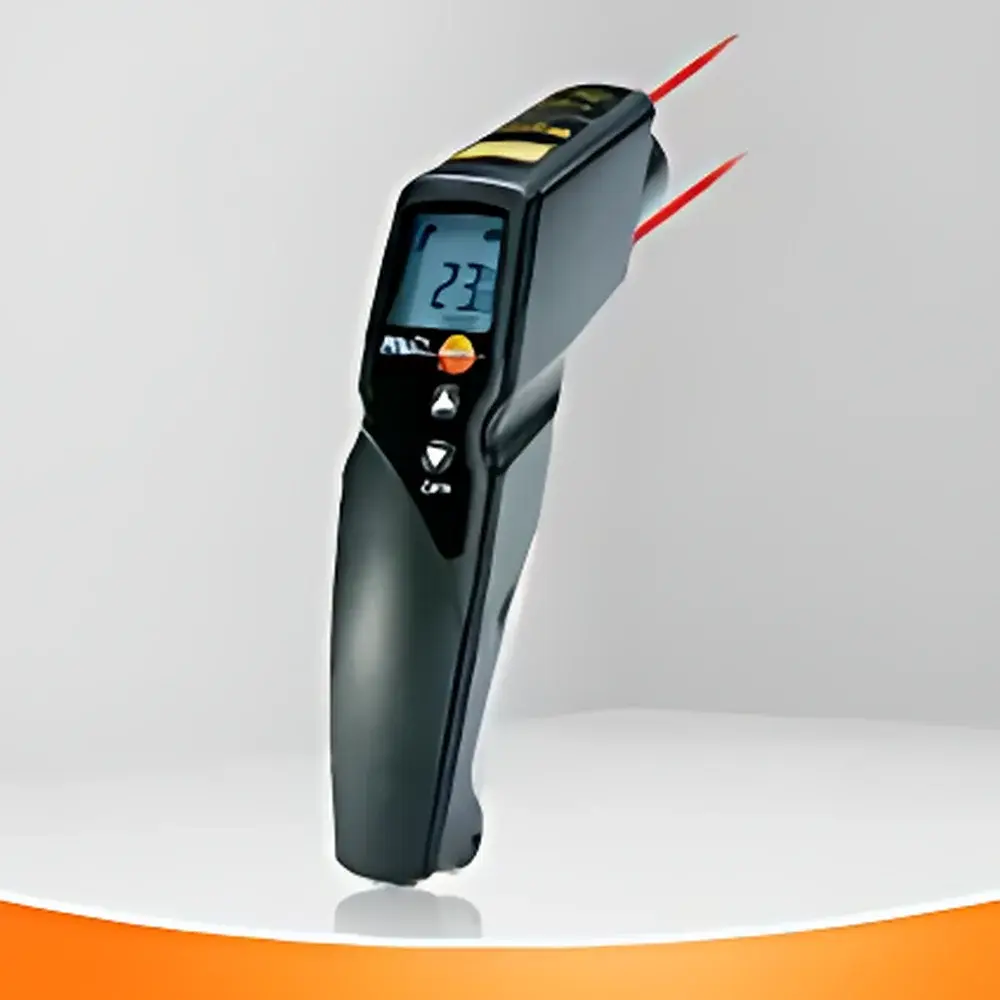
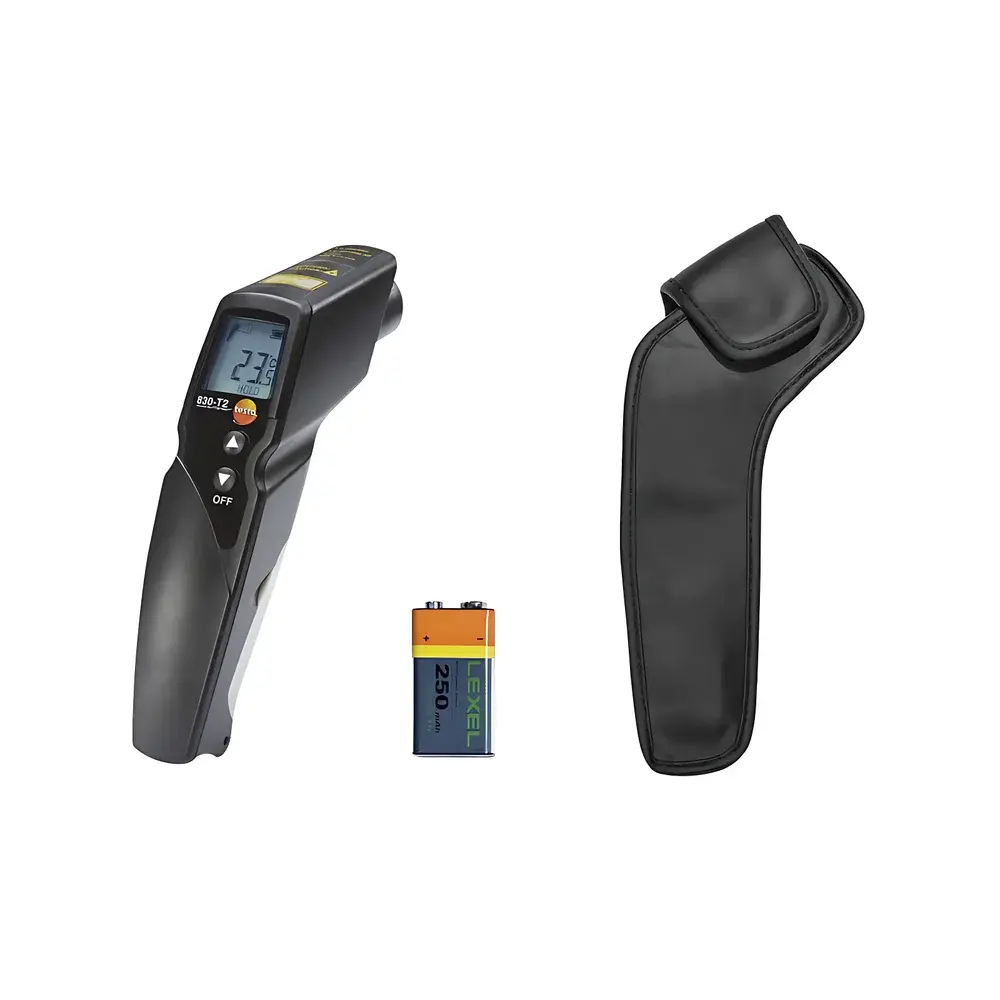
testo 830-T2 Infrared Thermometer with Contact Surface Probe
| Brand | testo |
|---|---|
| Model | 830-T2 |
| Type | Portable Infrared Thermometer |
| Optical Resolution | 12:1 |
| Laser Targeting | Dual-point |
| Emissivity Adjustment | Yes |
| Temperature Range (IR) | –30 °C to +400 °C |
| Temperature Range (Contact Probe) | –50 °C to +500 °C |
| IR Accuracy | ±1.5 °C or ±1.5 % of reading (whichever is greater) from 0.1 °C to 400 °C |
| Contact Probe Accuracy | ±0.5 °C + 0.5 % of reading |
| IR Resolution | 0.1 °C |
| Contact Resolution | 0.1 °C |
| IR Response Time | 0.5 s |
| Contact Response Time | 1.75 s |
| Probe Type | K-type (NiCr–Ni) thermocouple |
| Display | Backlit LCD |
| Alarm Function | Dual user-defined high/low limits with audible and visual alert |
| Data Hold & Min/Max Tracking | Yes |
| Housing Material | ABS |
| Weight | 200 g |
| Dimensions | 190 × 75 × 38 mm |
| Operating Temperature | –20 °C to +50 °C |
| Storage Temperature | –40 °C to +70 °C |
| Power Supply | 9 V battery (included) |
| Battery Life | ~15 hours |
Overview
The testo 830-T2 Infrared Thermometer with Integrated Contact Surface Probe is a dual-mode precision temperature measurement instrument engineered for reliability and versatility in industrial maintenance, HVAC commissioning, food safety verification, and quality assurance environments. It combines non-contact infrared radiometry with direct-contact thermocouple measurement—enabling accurate surface temperature assessment across a broad emissivity spectrum. The device operates on the principle of detecting infrared energy emitted from object surfaces and converting it into temperature values via a calibrated thermopile sensor. Its 12:1 optical resolution ensures spatial accuracy at moderate working distances, while dual-point laser targeting precisely defines the measurement spot geometry. The integrated K-type (NiCr–Ni) cross-spring surface probe provides traceable contact validation—critical when measuring low-emissivity materials such as polished metals, anodized aluminum, or reflective coatings where emissivity uncertainty compromises IR-only readings.
Key Features
- Dual-mode operation: Simultaneous infrared and contact temperature measurement for cross-verification and extended application coverage
- 12:1 optical resolution with dual-point laser targeting for unambiguous spot identification and improved geometric confidence
- Adjustable emissivity (0.10–1.00 in 0.01 increments) to accommodate diverse material surfaces—from oxidized steel (ε ≈ 0.8) to stainless steel mirror finish (ε ≈ 0.16)
- User-configurable high/low alarm thresholds with simultaneous audible beep and visual indicator for real-time process deviation detection
- Min/Max value tracking and data hold function for transient thermal events and comparative analysis
- Ergonomic pistol-grip housing with textured ABS casing, optimized for one-handed use in confined or elevated workspaces
- Backlit LCD display with clear numeric readout and intuitive icon-based status indicators (e.g., battery level, laser active, emissivity setting)
Sample Compatibility & Compliance
The testo 830-T2 is validated for use on solid, non-transmissive surfaces including painted metal, concrete, plastic housings, rubber belts, electrical enclosures, and food-grade packaging. It complies with IEC 61326-1 for electromagnetic compatibility in industrial environments and meets CE marking requirements for measurement instrumentation within the European Economic Area. While not certified for intrinsically safe applications, its design adheres to general-purpose safety standards (IEC 61010-1) for handheld test equipment. The included K-type thermocouple probe conforms to ASTM E230/E230M specifications for standard thermocouple tolerances and is suitable for GLP-aligned calibration recordkeeping when used with NIST-traceable reference sources.
Software & Data Management
The testo 830-T2 operates as a standalone field instrument without mandatory software dependency. However, measurement logs—including timestamped min/max values, alarm triggers, and emissivity settings—can be manually transcribed for inclusion in internal QA documentation or audit trails. For organizations requiring electronic data integrity, the device supports manual entry into LIMS or CMMS platforms. Its analog output capability (via optional interface cable) enables integration into basic SCADA monitoring loops for trend logging. Though not FDA 21 CFR Part 11 compliant out-of-the-box, the unit’s deterministic measurement behavior, stable calibration memory, and absence of firmware-updatable parameters support retrospective validation under GMP/GLP frameworks when paired with documented calibration procedures.
Applications
- Electrical infrastructure: Thermal scanning of circuit breakers, busbars, transformer bushings, and motor windings to detect resistive heating anomalies
- HVAC/R systems: Surface temperature profiling of ductwork, condenser coils, refrigerant lines, and insulation integrity checks
- Food processing: Verification of holding temperatures on conveyor belts, griddles, ovens, and chilled storage surfaces per HACCP critical control point requirements
- Mechanical maintenance: Bearing temperature trending, steam trap functionality assessment, and heat exchanger fouling detection
- Automotive service: Exhaust manifold diagnostics, brake rotor thermal mapping, and cabin HVAC performance evaluation
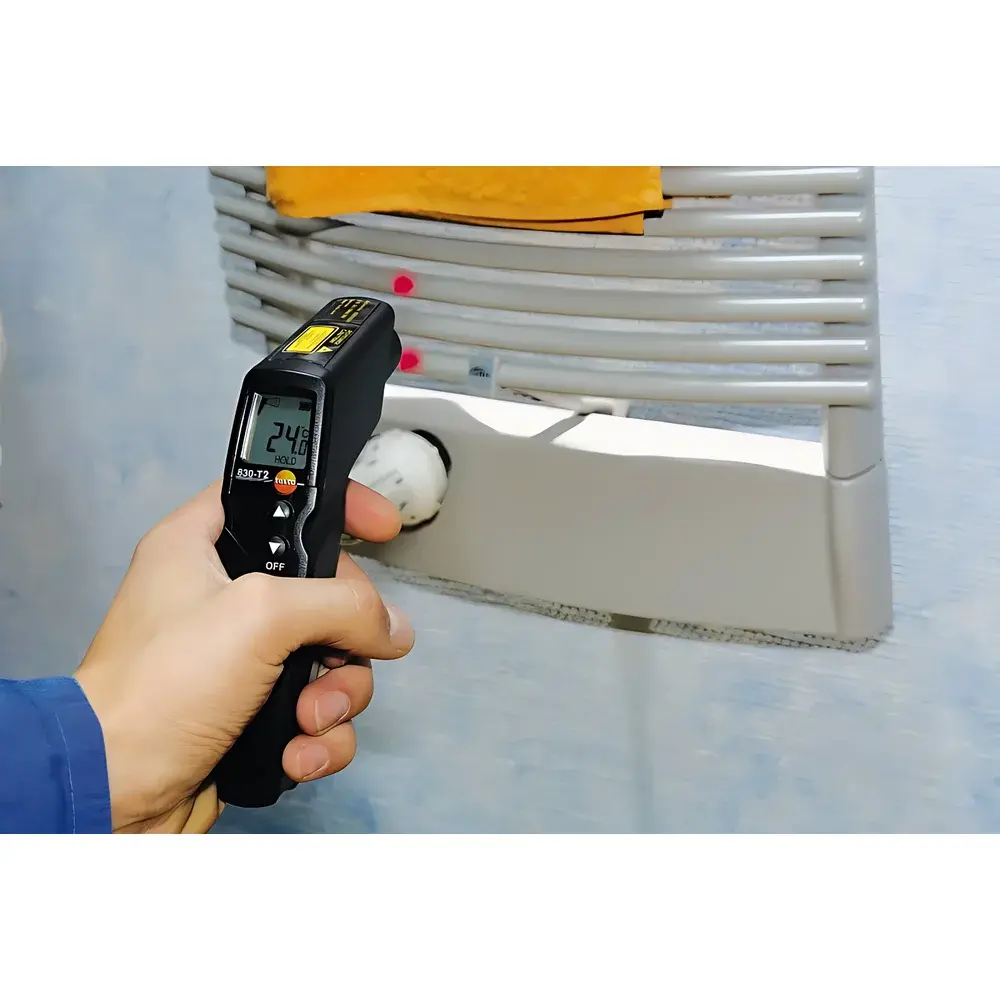
- Building diagnostics: Radiator surface uniformity, underfloor heating loop verification, and thermal bridging identification
FAQ
What is the purpose of the cross-spring surface probe included with the testo 830-T2?
It serves as a high-fidelity contact reference for emissivity correction and validation—particularly essential when measuring low-emissivity metals where infrared readings may deviate significantly without empirical adjustment.
Can the testo 830-T2 measure through glass or plastic covers?
No. Standard infrared thermometers cannot accurately measure through transparent barriers; the device reads the surface temperature of the covering material itself, not the underlying target.
How often should the unit be calibrated?
Testo recommends annual calibration against a traceable blackbody source or fixed-point reference; more frequent verification is advised in high-precision or regulated environments per internal SOPs.
Is the 9 V battery replaceable in the field?
Yes—the battery compartment is accessible via a screwless latch, allowing quick replacement during extended shifts without tools.
Does the testo 830-T2 store measurement history internally?
No. It retains only instantaneous min/max values and current emissivity settings; no persistent memory or timestamped log storage is implemented.