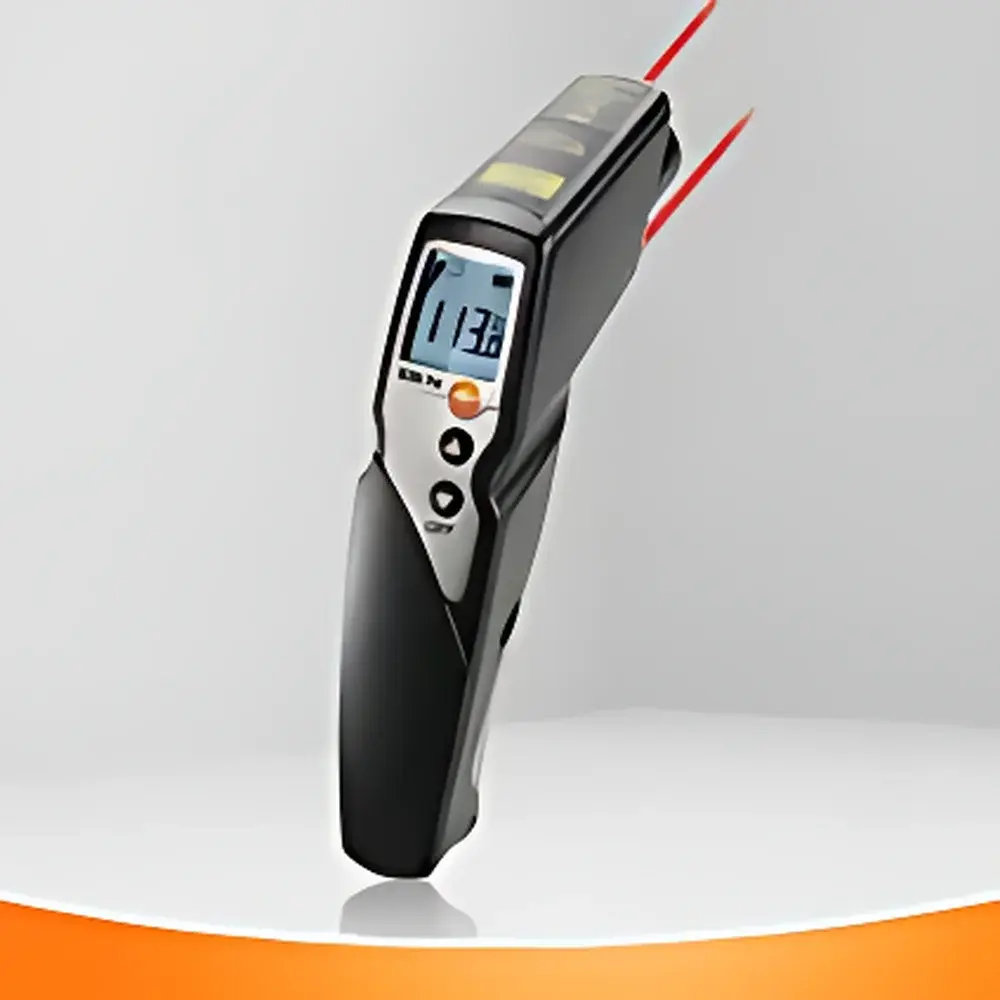
testo 830-T4 Infrared Thermometer
| Brand | testo |
|---|---|
| Origin | Shenzhen, China |
| Manufacturer Type | Authorized Distributor |
| Country of Origin | China |
| Model | testo 830-T4 |
| Instrument Type | Portable |
| Distance-to-Spot Ratio | 30:1 |
| Emissivity Adjustment | Adjustable (0.10–1.00) |
| Laser Aiming | Dual-point |
| Measurement Frequency | 2 Hz |
| IR Temperature Range | –30 to +400 °C |
| IR Accuracy | ±1.5 °C (–20 to 0 °C), ±2 °C (–30 to –20.1 °C), ±1 °C or ±1 % of reading (remaining range) |
| IR Resolution | 0.1 °C |
| Response Time (IR) | 0.5 s |
| Contact Probe Input | Type K thermocouple (–50 to +500 °C, ±0.5 °C + 0.5 %, resolution 0.1 °C, response time 1.75 s) |
| Display | Backlit LCD |
| Operating Temperature | –20 to +50 °C |
| Storage Temperature | –40 to +70 °C |
| Weight | 200 g |
| Dimensions | 190 × 75 × 38 mm |
| Power Supply | 9 V alkaline battery |
| Battery Life | ~15 h |
Overview
The testo 830-T4 Infrared Thermometer is a precision-engineered, handheld non-contact temperature measurement instrument designed for industrial maintenance, HVAC commissioning, food safety verification, and laboratory QA/QC applications. It operates on the principle of infrared radiometry—detecting mid-wave infrared energy emitted from object surfaces and converting it into a calibrated temperature reading using Planck’s radiation law and configurable emissivity compensation. With a 30:1 optical resolution, the device enables accurate surface temperature assessment of small targets at safe working distances—for example, measuring a 36 mm diameter spot from 1 meter away. Its dual-laser targeting system visually defines the exact measurement area between two converging points, eliminating ambiguity in field-of-view alignment. The integrated high-speed signal processor ensures stable, repeatable readings with 0.1 °C resolution across its full IR range (–30 to +400 °C), while real-time emissivity adjustment (0.10–1.00) supports reliable measurements across diverse material surfaces—from polished aluminum to oxidized steel or painted substrates.
Key Features
- Dual-point laser targeting for unambiguous spatial definition of the measurement spot
- 30:1 distance-to-spot ratio enabling precise remote measurement of small or hazardous targets
- Adjustable emissivity (0.10–1.00) with user-defined presets for rapid material-specific configuration
- Simultaneous dual-channel capability: IR surface measurement + optional Type K thermocouple input for comparative or hybrid validation
- HOLD function to freeze and retain the last measured value on display
- Max/Min temperature tracking with automatic recording during continuous monitoring
- Two programmable alarm thresholds with audible and visual alert activation
- Backlit LCD display optimized for low-light environments and one-handed operation
- Rugged ABS housing rated for industrial use; operating temperature range –20 to +50 °C
- Integrated 9 V battery power with ~15 hours of continuous runtime and low-battery indicator
Sample Compatibility & Compliance
The testo 830-T4 is compatible with a broad spectrum of non-reflective, semi-reflective, and coated surfaces encountered in mechanical, electrical, and process environments—including motor windings, bearing housings, ductwork, refrigeration lines, food contact surfaces, and electronic enclosures. For low-emissivity materials (e.g., bare copper or stainless steel), users are advised to apply high-emissivity tape or utilize an optional contact probe for emissivity calibration. The instrument complies with IEC 61326-1 (EMC for industrial environments) and IEC 61010-1 (safety requirements for electrical equipment). While not certified for intrinsic safety, its design meets general-purpose use requirements under ISO/IEC 17025-aligned calibration practices. Traceable factory calibration certificates are supplied with each unit, supporting GLP-compliant recordkeeping and internal audit readiness.
Software & Data Management
The testo 830-T4 operates as a standalone field instrument without proprietary software dependency. All configuration, measurement logging, and alarm settings are managed directly via intuitive button navigation and on-device display. No PC interface or cloud connectivity is included; however, measurement data can be manually transcribed or integrated into external CMMS or LIMS platforms via standardized reporting workflows. The device supports long-term stability verification through periodic comparison against NIST-traceable reference sources. Its firmware architecture permits future functional updates via authorized service centers, ensuring continued alignment with evolving metrological best practices and industry-specific validation protocols (e.g., FDA 21 CFR Part 11 compliance when used within documented SOPs).
Applications
- Preventive maintenance: Monitoring bearing temperatures, electrical connections, and transformer surfaces to detect early-stage thermal anomalies
- HVAC system diagnostics: Verifying duct surface temperatures, coil performance, and insulation integrity without physical contact
- Food processing: Spot-checking surface temperatures of cooked products, chilled storage units, and conveyor belts per HACCP guidelines
- Automotive service: Assessing brake rotor, exhaust manifold, and battery terminal temperatures during diagnostics
- Building envelope inspection: Identifying thermal bridging, moisture ingress, and insulation gaps during energy audits
- Research & education: Supporting physics and materials science labs in emissivity studies and heat transfer experiments
FAQ
What is the minimum measurable spot size at 1 meter distance?
At 1 m distance, the 30:1 optical resolution yields a circular measurement area with a 36 mm diameter.
Can the testo 830-T4 measure through glass or plastic covers?
No—standard transparent barriers block infrared radiation; measurements must be taken directly on the target surface.
How is emissivity determined for unknown materials?
Emissivity can be estimated using a contact probe on the same surface or by applying high-emissivity tape and adjusting until IR and contact readings converge.
Is the device suitable for medical or human body temperature screening?
No—it is not validated or calibrated for clinical thermometry and does not meet regulatory requirements for medical devices.
Does the unit include calibration documentation?
Yes—each device ships with a traceable factory calibration report conforming to ISO/IEC 17025 principles.