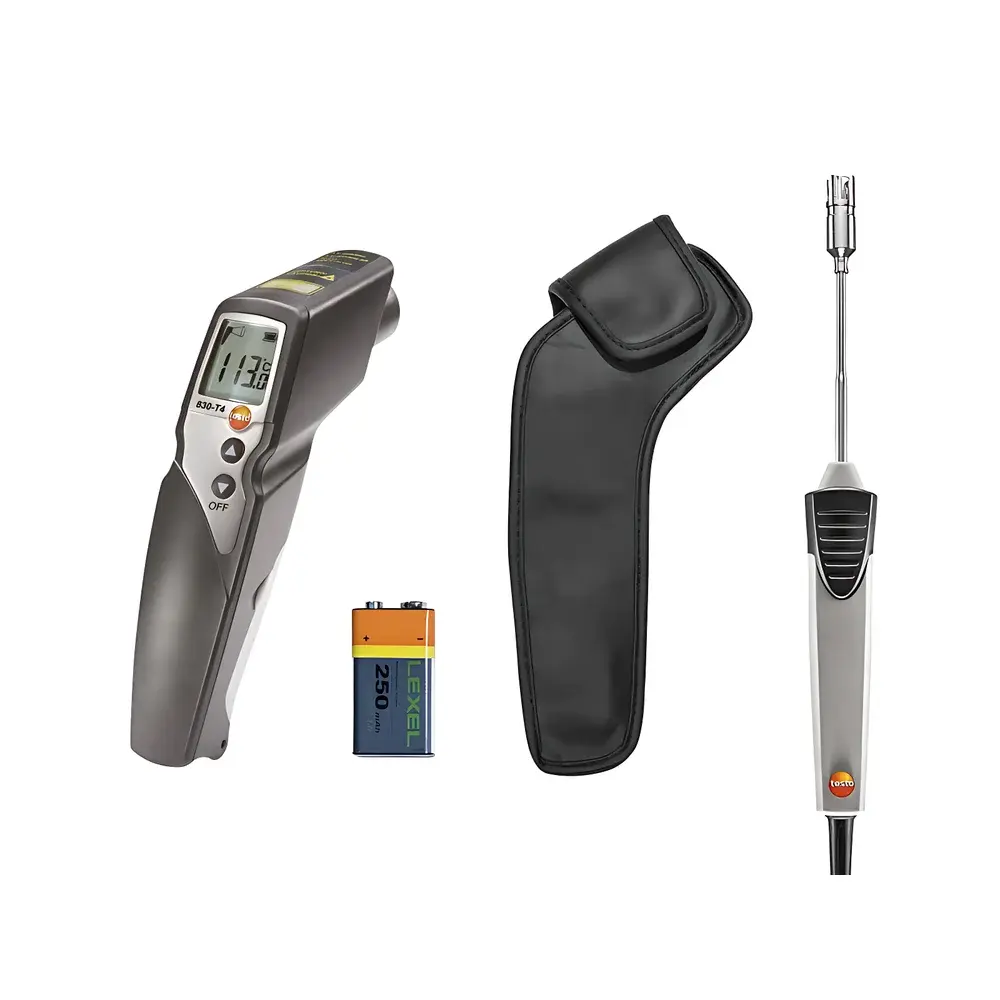
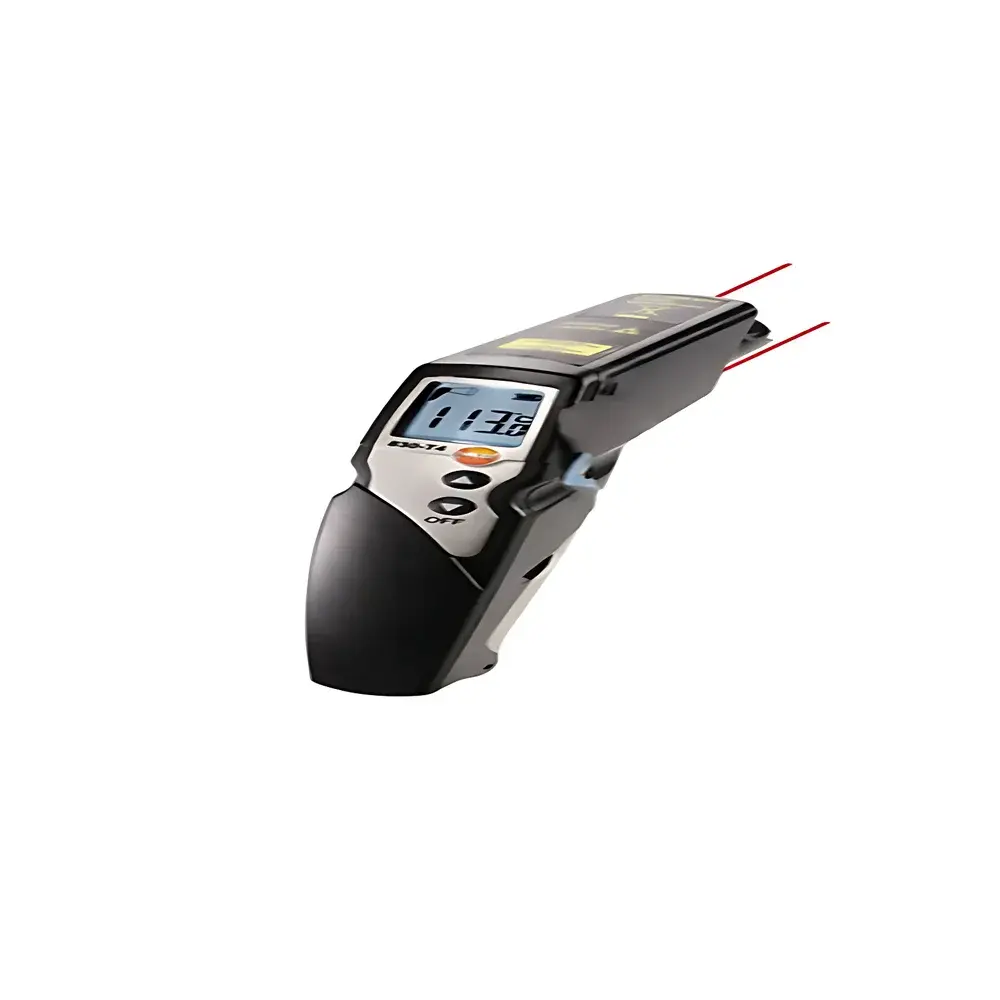
testo 830-T4 Infrared Thermometer Kit with Surface Probe
| Brand | testo |
|---|---|
| Origin | Shenzhen, China |
| Manufacturer Type | Authorized Distributor |
| Product Origin | Domestic (China) |
| Model | 0563 8314 |
| Instrument Type | Portable |
| Distance-to-Spot Ratio | 30:1 |
| IR Temperature Range | -30 to +400 °C |
| IR Accuracy | ±1.5 °C (-20 to 0 °C), ±2 °C (-30 to -20.1 °C), ±1 °C or ±1 % of reading (remaining range) |
| IR Resolution | 0.1 °C |
| IR Response Time | 0.5 s |
| Contact Probe Type | Spring-loaded surface probe (Type K thermocouple, 0602 0393) |
| Contact Range | -50 to +500 °C |
| Contact Accuracy | ±0.5 °C + 0.5 % of reading |
| Contact Resolution | 0.1 °C |
| Contact Response Time | 1.75 s |
| Display | Backlit LCD |
| Laser Aiming | Dual-point |
| Emissivity Adjustment | Adjustable (0.10–1.00) |
| Alarm Function | Two user-defined limits with audible/visual alert |
| Data Hold & Min/Max Tracking | Yes |
| Operating Temperature | -20 to +50 °C |
| Storage Temperature | -40 to +70 °C |
| Dimensions | 190 × 75 × 38 mm |
| Weight | 200 g |
| Power Supply | 9 V battery |
| Battery Life | ~15 h |
Overview
The testo 830-T4 Infrared Thermometer Kit is a dual-mode portable temperature measurement system engineered for industrial maintenance, HVAC commissioning, food safety verification, and laboratory QA/QC workflows. It combines non-contact infrared radiometry with optional contact thermocouple probing—enabling simultaneous comparative measurements to validate emissivity assumptions and improve absolute accuracy on low-emissivity or reflective surfaces. Its optical design employs a 30:1 distance-to-spot (D:S) ratio, allowing precise targeting of small areas from safe working distances—for example, measuring a 36 mm diameter spot at 1 m distance. The instrument operates on the principle of detecting infrared radiation emitted by surfaces within the 8–14 µm spectral band, converting radiant flux into temperature via Planck’s law and calibrated blackbody reference curves. All internal signal processing is performed by a high-resolution digital processor delivering 0.1 °C resolution across both IR and contact channels.
Key Features
- Dual-point laser targeting system for unambiguous identification of measured area boundaries
- Adjustable emissivity (0.10–1.00) with factory-default preset at 0.95 for common organic materials
- Two independently configurable alarm thresholds with simultaneous visual (LED) and audible (beep) notification
- Real-time display of current, minimum, maximum, and hold values—ideal for thermal mapping and transient monitoring
- Integrated support for external Type K thermocouple probes (e.g., spring-loaded surface probe 0602 0393) enabling cross-verification and emissivity calibration
- Backlit LCD with large digits and intuitive icon-based interface—designed for single-hand operation in low-light environments
- Rugged ABS housing rated for field use, with IP54 dust/water resistance and drop-tested mechanical stability
- Fast acquisition rate: up to two IR measurements per second; contact probe updates every 1.75 seconds
Sample Compatibility & Compliance
The testo 830-T4 supports measurement of metallic, painted, oxidized, ceramic, plastic, rubber, and composite surfaces—provided appropriate emissivity values are applied. For low-emissivity targets (<0.4), users are advised to apply high-emissivity tape or use the included spring-loaded surface probe for direct conduction-based readings. The device complies with IEC 61000-4 electromagnetic compatibility standards and meets CE marking requirements under the EU Measuring Instruments Directive (MID) Annex MI-001 for non-automatic weighing instruments and thermal sensors. While not certified to ISO/IEC 17025 as a standalone metrological standard, its factory calibration report (traceable to national standards via DAkkS-accredited laboratories) supports GLP/GMP documentation practices in regulated environments such as pharmaceutical manufacturing and food processing facilities.
Software & Data Management
The testo 830-T4 operates as a stand-alone instrument without mandatory software dependency. However, measurement data—including timestamped min/max/hold values and alarm events—can be manually recorded for audit trails. Though it lacks built-in Bluetooth or USB connectivity, its design aligns with FDA 21 CFR Part 11 principles for manual data integrity: all displayed parameters are immutable during measurement, and no user-editable memory storage exists that could compromise record authenticity. When integrated into quality management systems, operators may document readings alongside process IDs, equipment tags, and environmental conditions using standardized paper or electronic logbooks compliant with ISO 9001:2015 clause 8.5.2.
Applications
- Electrical distribution: hotspot detection on busbars, breakers, transformers, and connections without shutdown
- HVAC/R: duct surface temperature profiling, refrigerant line monitoring, coil efficiency evaluation
- Food service: surface temperature checks of grills, fryers, holding cabinets, and chilled display units per HACCP critical control points
- Mechanical maintenance: bearing, motor, gearbox, and pump casing temperature trending for predictive failure analysis
- Building diagnostics: insulation integrity assessment, moisture-induced thermal bridging detection, window U-value estimation
- Education & training: demonstration of Stefan-Boltzmann law, emissivity dependence, and contact vs. non-contact measurement uncertainty
FAQ
What is the purpose of the dual-laser aiming system?
It defines the exact center and lateral extent of the infrared measurement spot—critical when targeting small components at extended distances.
Can the testo 830-T4 measure through glass or plastic covers?
No. Standard transparent barriers block or attenuate mid-wave IR radiation; measurements must be taken directly on exposed surfaces.
How do I determine the correct emissivity setting for an unknown material?
Use the included spring-loaded surface probe to obtain a reference contact reading, then iteratively adjust the IR emissivity until both values converge within acceptable tolerance.
Is the 9 V battery rechargeable?
No. It uses a standard alkaline or lithium 9 V battery; rechargeable variants are not recommended due to voltage regulation inconsistencies affecting sensor stability.
Does this instrument meet ASTM E1933 or ISO 18434-1 for condition monitoring?
While not formally certified to those standards, its 30:1 optics, ±1 °C accuracy above 0 °C, and dual-mode capability satisfy typical technical requirements outlined in those guidelines for qualitative and semi-quantitative thermal screening.