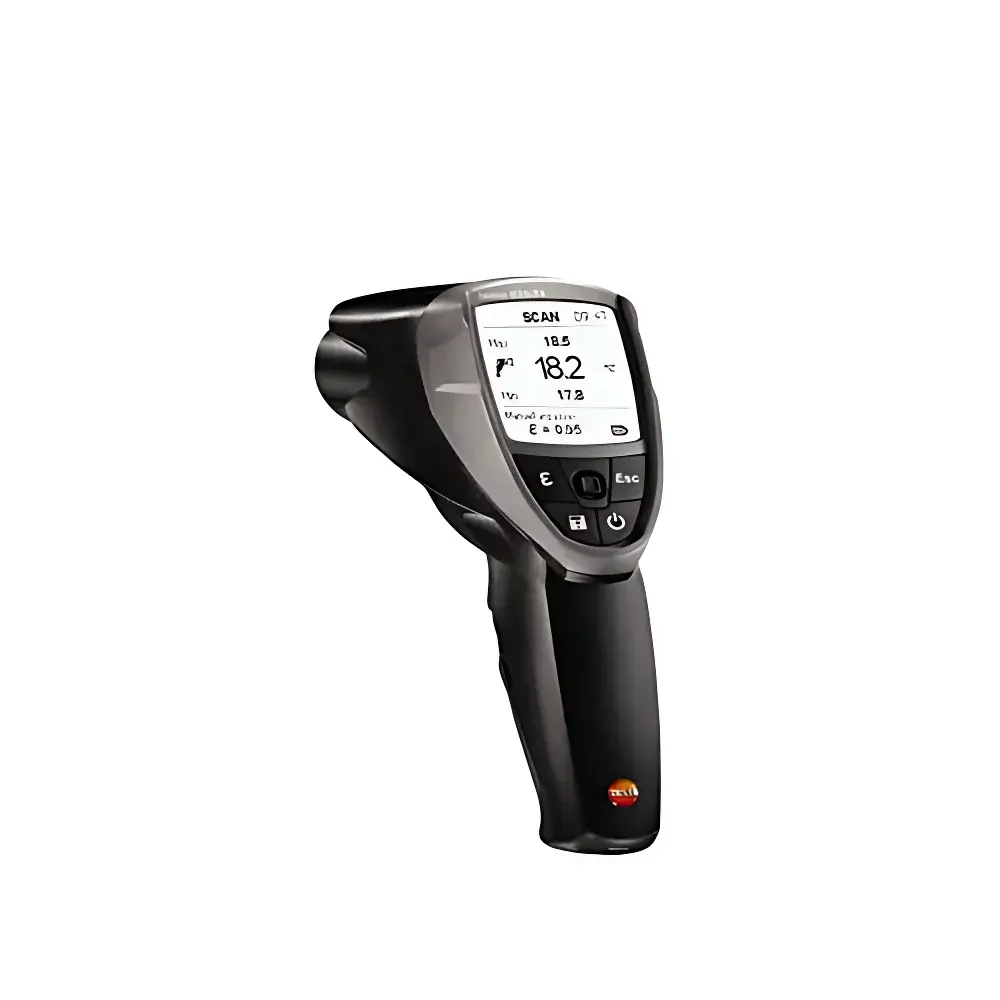
testo 835-T1 Advanced Infrared Thermometer with 4-Point Laser Targeting
| Brand | testo |
|---|---|
| Origin | Germany |
| Model | 0560 8351 |
| Type | Portable Infrared Thermometer |
| IR Temperature Range | –30 to +600 °C |
| IR Accuracy | ±2.5 °C (–30.0 to –20.1 °C), ±1.5 °C (–20.0 to –0.1 °C), ±1.0 °C (0.0 to +99.9 °C), ±1 % of reading (remaining range) |
| Optical Resolution | 50:1 |
| Emissivity Adjustment | 0.10–1.00 (20 preset values stored) |
| Contact Temperature Input | Type K thermocouple (–50 to +600 °C, ±0.5 °C + 0.5 % of reading) |
| Display | Backlit dot-matrix LCD |
| Data Storage | 200 measurement values |
| Interface | USB for PC connectivity |
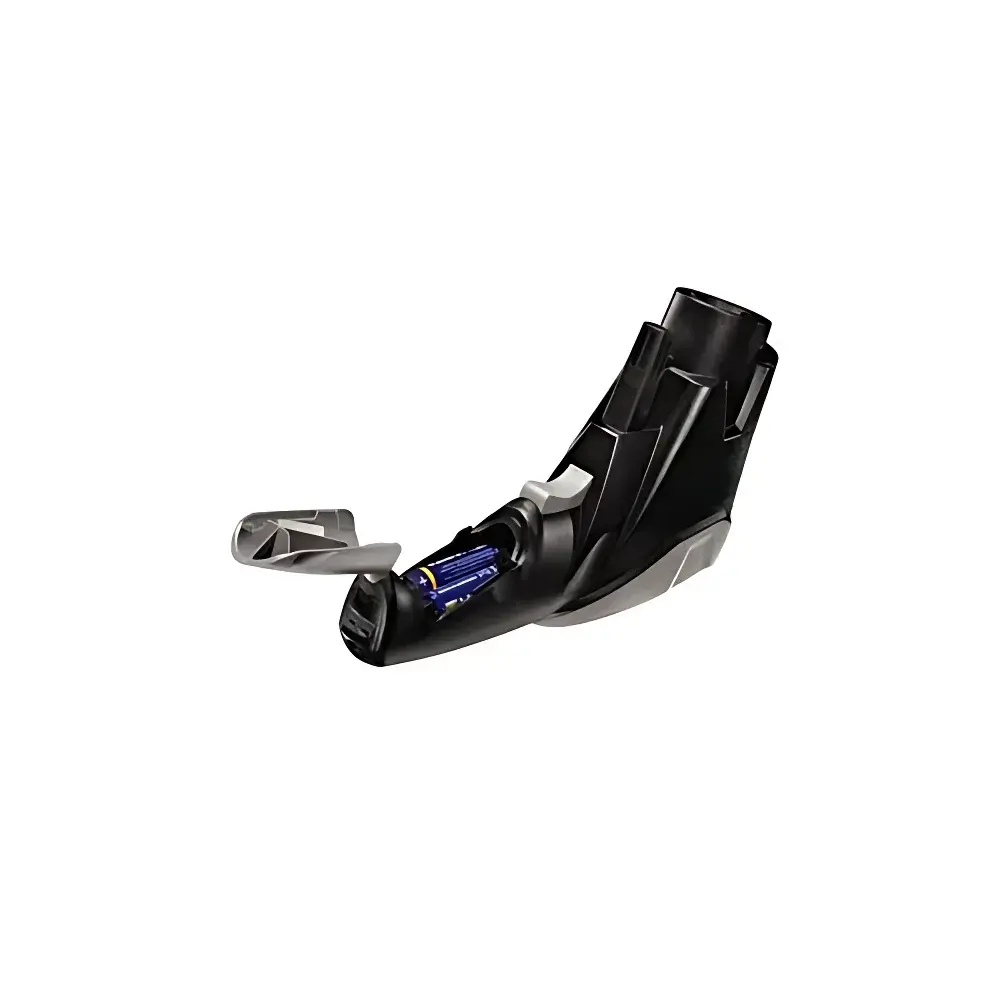
| Power | 3 × AA batteries (25 h typical runtime, laser & backlight off) |
| Weight | 514 g |
| Dimensions | 193 × 166 × 63 mm |
| Operating Temperature | –20 to +50 °C |
| Storage Temperature | –30 to +50 °C |
| Compliance | EN 61326-1:2006 (EMC), CE-marked |
Overview
The testo 835-T1 is a professional-grade portable infrared thermometer engineered for precision non-contact temperature measurement across industrial maintenance, HVAC/R diagnostics, building envelope analysis, and quality assurance applications. Based on calibrated infrared detection at 8–14 µm spectral band, it delivers traceable thermal readings without surface contact—critical for measuring moving parts, electrically live components, or hazardous environments. Its core design prioritizes operational safety and metrological reliability: the integrated 4-point laser targeting system precisely outlines the 50:1 optical measurement spot (e.g., Ø100 mm at 5 m distance), eliminating ambiguity in field-of-view definition. Unlike single-laser units, this quad-laser configuration ensures unambiguous spatial registration of the effective measurement area—even under low-contrast conditions—reducing operator-induced error. The device simultaneously supports dual-mode operation: standalone infrared measurement and optional contact-based thermocouple input via standard Type K interface, enabling cross-validation and emissivity calibration workflows.
Key Features
- 4-point laser targeting system for accurate spatial identification of the 50:1 optical measurement spot
- Dual-sensor capability: Non-contact IR measurement (–30 to +600 °C) plus optional Type K thermocouple input (–50 to +600 °C)
- Adjustable emissivity (0.10–1.00) with 20 pre-stored values accessible via built-in emissivity table
- Backlit dot-matrix display ensuring legibility in low-light or high-glare environments
- On-device data logging: Stores up to 200 measurement records with timestamp, min/max tracking, and user-defined alarm thresholds
- Acoustic and visual threshold alarms triggered when measured values exceed configurable limits
- USB interface for direct connection to Windows PCs; compatible with free testo EasyClimate software for report generation and trend analysis
- Rugged ABS/PC housing rated for field use; operating temperature range from –20 to +50 °C
Sample Compatibility & Compliance
The testo 835-T1 is suitable for measuring surfaces with stable emissivity characteristics—including painted metals, concrete, insulation materials, ductwork, electrical enclosures, and process piping. It is not intended for highly reflective, transparent, or rapidly cooling surfaces without prior emissivity correction. For regulatory alignment, the instrument complies with EN 61326-1:2006 for electromagnetic compatibility in industrial environments and bears CE marking per EU Directive 2014/30/EU. While not validated for FDA 21 CFR Part 11 or ISO/IEC 17025 accredited calibration out-of-the-box, its measurement uncertainty budget (±1.0 °C at mid-range) supports routine verification against NIST-traceable reference sources. Calibration certificates are provided with each unit, documenting as-shipped performance against defined blackbody references.
Software & Data Management
Measurement data is managed via testo EasyClimate—a free Windows desktop application supporting CSV export, graphical time-series plotting, and customizable reporting templates. The software enables batch annotation of measurement locations, grouping by project or asset ID, and overlay of thermocouple and IR readings for comparative analysis. All logged entries include ambient temperature (if recorded via optional probe), emissivity setting, timestamp, and operator notes. Audit-ready functionality includes immutable record timestamps and manual entry logs—supporting GLP-aligned documentation practices where formal electronic records are required. No cloud dependency or subscription model is involved; all processing occurs locally on the user’s workstation.
Applications
- HVAC/R system commissioning and fault diagnosis: identifying refrigerant line anomalies, coil imbalances, duct leakage, and airflow restrictions
- Building science assessments: thermal bridging detection, insulation integrity verification, and moisture-related surface temperature profiling
- Electrical infrastructure inspection: hotspot identification on busbars, connections, switchgear, and transformer surfaces
- Industrial process monitoring: furnace refractory checks, bearing temperature surveillance, and conveyor belt component thermal mapping
- Preventive maintenance programs: establishing baseline thermal signatures and detecting deviations indicative of impending failure
FAQ
What is the significance of the 50:1 optical resolution?
It defines the ratio of distance-to-spot size: at 5 meters, the instrument measures a circular area approximately 100 mm in diameter. This enables safe, accurate measurements of small targets from a practical working distance.
Can emissivity be adjusted in real time during measurement?
Yes—the device allows on-the-fly emissivity adjustment using the rotary control, with immediate update of the displayed temperature value based on the selected ε-value.
Is the included thermocouple interface compatible with third-party Type K probes?
Yes, any standard miniature or general-purpose Type K thermocouple with mini-connector meets mechanical and electrical interface requirements.
Does the device support data export in formats compatible with LIMS or CMMS platforms?
CSV export from EasyClimate permits direct import into most laboratory information management systems (LIMS) and computerized maintenance management systems (CMMS), though no native API or ODBC driver is provided.
How is measurement traceability maintained across calibration intervals?
Each unit ships with a factory calibration certificate referencing blackbody source temperatures at three points (0 °C, 100 °C, and 300 °C); users may perform field verification using certified reference calibrators prior to critical measurements.