
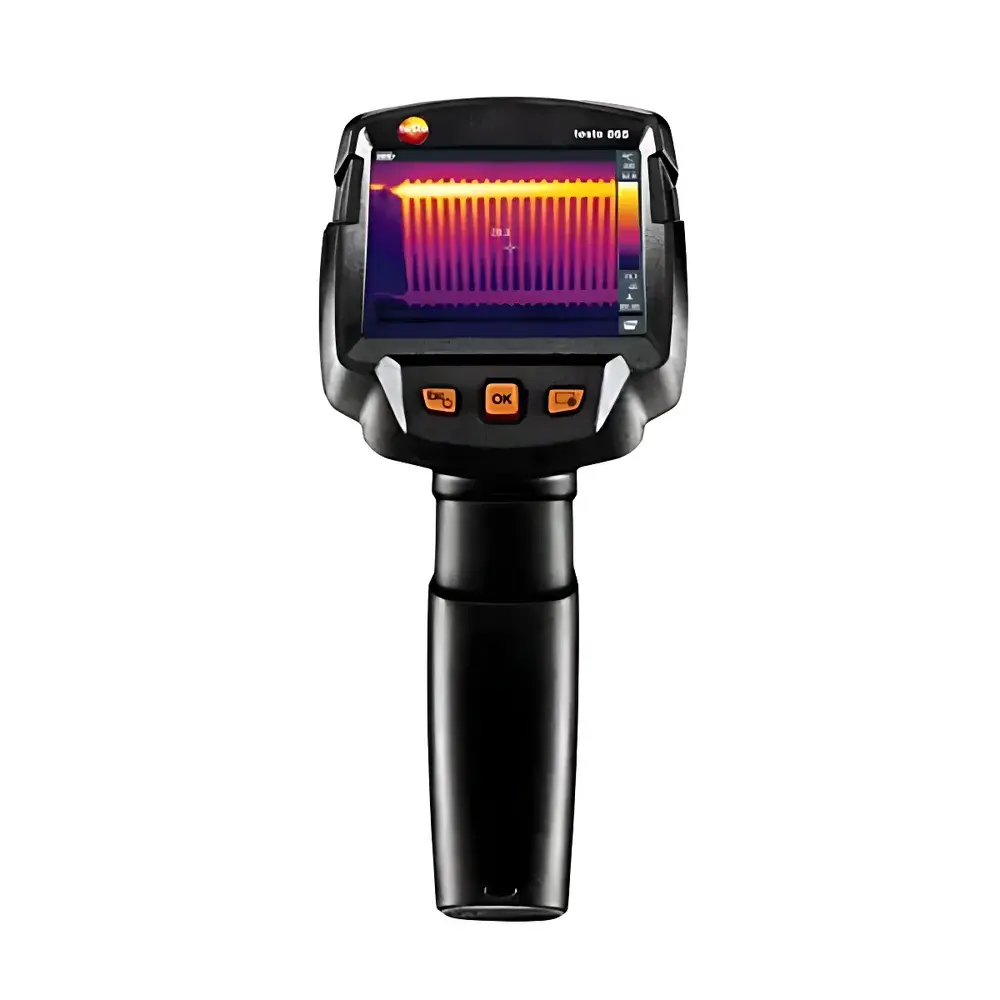
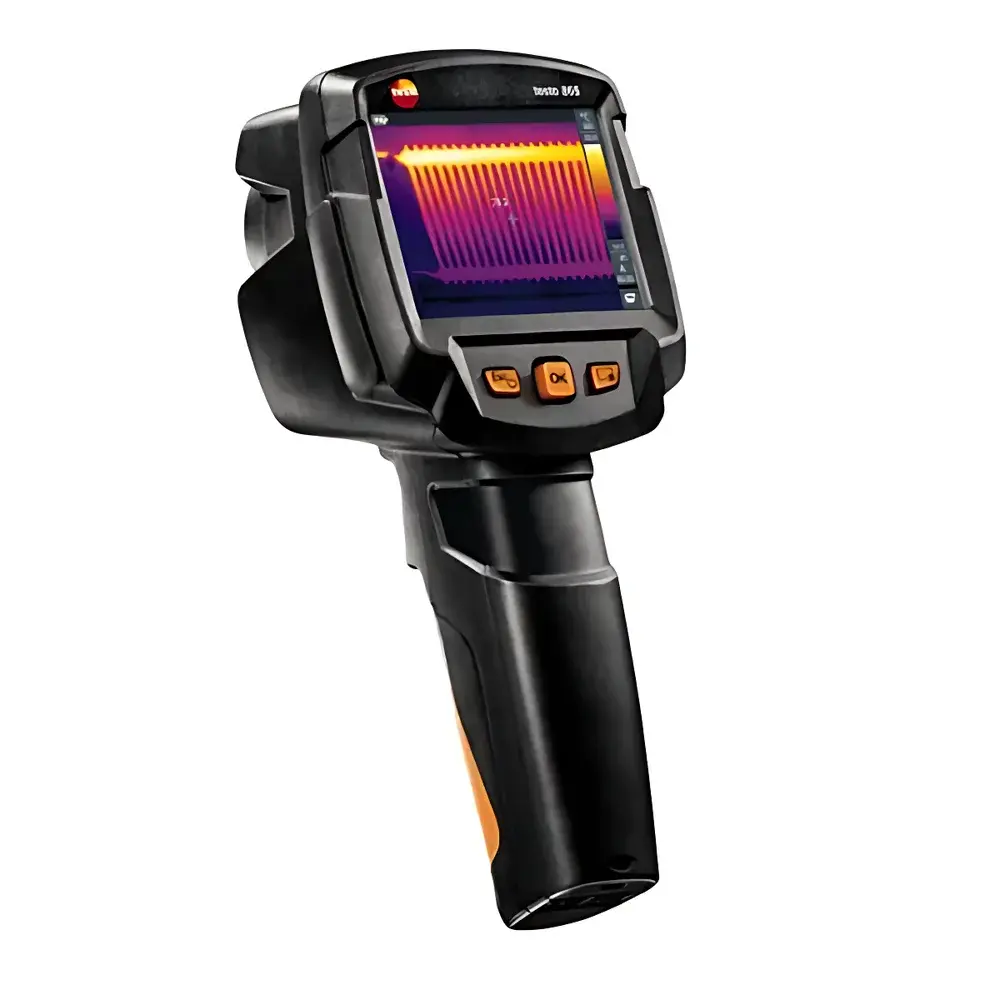
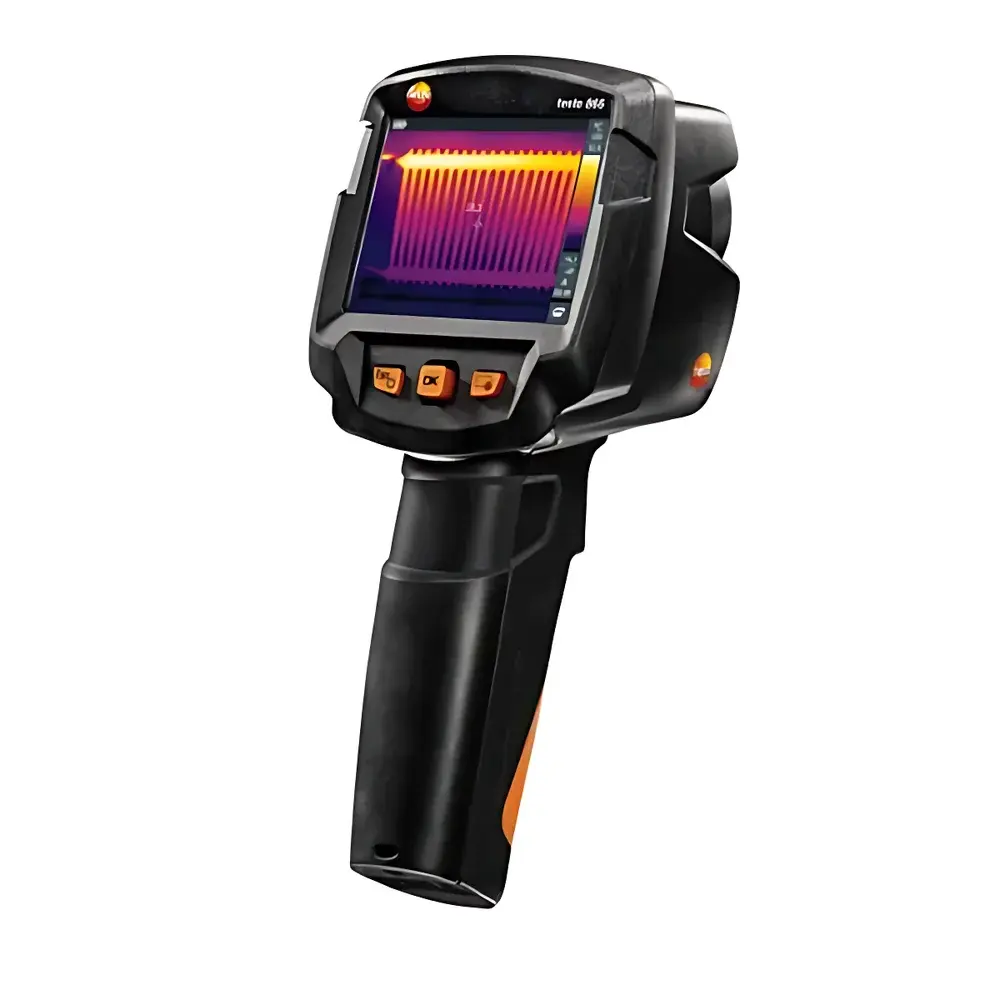
testo 865 Infrared Thermal Imaging Camera (Model 0560 8650)
| Brand | testo |
|---|---|
| Origin | Germany |
| Model | 0560 8650 |
| Detector Type | Uncooled Microbolometer |
| Spectral Range | 7.5–14 µm |
| IR Resolution | 160 × 120 pixels (enhanced to 320 × 240 via testo SuperResolution) |
| Thermal Sensitivity (NETD) | ≤0.12 °C |
| Temperature Range | −20 to +280 °C |
| Accuracy | ±2 °C or ±2 % of reading (whichever is greater) |
| Frame Rate | 9 Hz |
| Field of View | 31° × 23° |
| IFOV | 3.4 mrad (standard), 2.1 mrad (SuperResolution) |
| Minimum Focus Distance | <0.5 m |
| Display | 3.5″ LCD, 320 × 240 pixels |
| Operating Temperature | −15 to +50 °C |
| Storage Temperature | −30 to +60 °C |
| Humidity | 20–80 % RH (non-condensing) |
| IP Rating | IP54 |
| Dimensions | 219 × 96 × 95 mm |
| Weight | 510 g |
| Battery Life | ~4 h |
| Interface | USB 2.0 Micro-B |
| Image Formats | .bmt, .jpg, .bmp, .png, .xls, .csv |
| Internal Memory | 2.8 GB |
| Software | testo IRSoft (Windows 10/8/7) |
Overview
The testo 865 Infrared Thermal Imaging Camera (Model 0560 8650) is a purpose-engineered, uncooled microbolometer-based thermal imager designed for routine thermographic inspection in building diagnostics, electrical maintenance, HVAC commissioning, and industrial preventive maintenance. Operating within the long-wave infrared (LWIR) spectral band (7.5–14 µm), it captures radiated thermal energy emitted by objects and converts it into high-fidelity temperature distribution maps—enabling non-contact, real-time surface temperature assessment without disrupting operational continuity. Its fixed-focus optical system ensures rapid deployment and consistent measurement geometry, while the integrated SuperResolution algorithm digitally enhances native 160 × 120 pixel detector output to an effective 320 × 240 resolution—improving spatial definition for reliable identification of localized anomalies such as thermal bridging, moisture ingress, or electrical hotspots.
Key Features
- Uncooled VOx microbolometer detector with 160 × 120 IR resolution, enhanced to 320 × 240 via testo SuperResolution technology
- Thermal sensitivity (NETD) ≤0.12 °C at 30 °C ambient—supporting detection of subtle thermal gradients critical in building envelope analysis
- Fixed-focus lens with 31° × 23° field of view and <0.5 m minimum focus distance—optimized for close-range inspections in confined spaces
- IFOV (Instantaneous Field of View) warning overlay: dynamically highlights the actual measurement spot size on-screen to prevent misinterpretation due to distance-to-target errors
- ScaleAssist™ automatic palette scaling: intelligently adjusts thermal contrast based on scene emissivity and ambient conditions—particularly beneficial for standardized building thermography per ISO 6781-3 and ASTM C1060
- Built-in hotspot/coldspot auto-detection with real-time marking and delta-T annotation
- IP54-rated ruggedized housing with reinforced PC-ABS casing—suitable for field use in construction sites, utility substations, and mechanical rooms
- Integrated 3.5″ backlit LCD display (320 × 240 pixels) with four selectable color palettes and full-screen thermal imaging mode
Sample Compatibility & Compliance
The testo 865 is calibrated for surface temperature measurement across materials with emissivity values ranging from 0.01 to 1.0—adjustable manually to accommodate reflective surfaces (e.g., polished copper busbars, aluminum cladding). It complies with EU Electromagnetic Compatibility Directive 2014/30/EU and meets essential requirements for CE marking. While not certified for Class I medical or intrinsically safe hazardous area applications, its performance aligns with industry best practices outlined in ISO 18436-7 (Condition Monitoring and Diagnostics of Machines – Thermography), EN 13187 (Thermal Performance of Buildings – Qualitative Detection of Thermal Irregularities), and ASHRAE Guideline 41.1 for HVAC system evaluation. Calibration records are supplied with each unit, traceable to national standards.
Software & Data Management
testo IRSoft—a free, Windows-based analysis platform—is included for post-capture quantitative evaluation. The software supports batch processing, emissivity correction, reflected temperature compensation, isotherm overlays, and customizable report generation compliant with ISO/IEC 17025 documentation requirements. Export formats include JPEG, BMP, PNG, CSV, and Excel (.xls), facilitating integration into CMMS platforms or QA/QC workflows. All thermal images are stored internally (2.8 GB flash memory) in proprietary .bmt format—retaining full radiometric metadata—including time stamp, GPS coordinates (when paired with optional external module), lens parameters, and user-defined annotations. USB 2.0 Micro-B interface enables fast data transfer and firmware updates without requiring additional drivers.
Applications
The testo 865 serves as a primary diagnostic tool for facility managers, HVAC technicians, electrical inspectors, and energy auditors. Typical use cases include: identifying insulation deficiencies and thermal bridges in residential and commercial façades; locating moisture accumulation behind drywall or roofing membranes; detecting overloaded circuits, loose connections, and failing breakers in low-voltage distribution panels; verifying refrigerant charge levels and heat exchanger performance in chiller plants; and validating radiant floor heating uniformity. Its −20 to +280 °C measurement range covers >95 % of routine industrial and building service applications—making it suitable for both cold-chain logistics verification and high-temperature process equipment screening.
FAQ
Is the testo 865 compliant with FDA 21 CFR Part 11 for regulated environments?
No—the device lacks electronic signature capability, audit trail logging, and role-based access control required for Part 11 compliance. It is intended for general-purpose technical diagnostics, not GxP-regulated quality assurance.
Can the testo 865 measure through glass or plastic barriers?
No—infrared radiation in the 7.5–14 µm band is largely absorbed or reflected by standard silicate glass and most polymers. Measurements must be performed on exposed, unobstructed surfaces.
Does the instrument support emissivity correction during live imaging?
Yes—emissivity can be adjusted in real time via on-device menu, and the value is embedded in all saved .bmt files for retrospective correction in IRSoft.
What is the typical calibration interval recommended for field instruments?
testo recommends annual calibration verification against a traceable blackbody source—especially when used for reporting under ISO 50001 or LEED certification protocols.
Is there an optional wide-angle or telephoto lens available for this model?
No—the testo 865 features a fixed 31° × 23° lens only. Lens interchangeability is not supported; users requiring alternate FOVs should consider the testo 871 or 882 series.




