
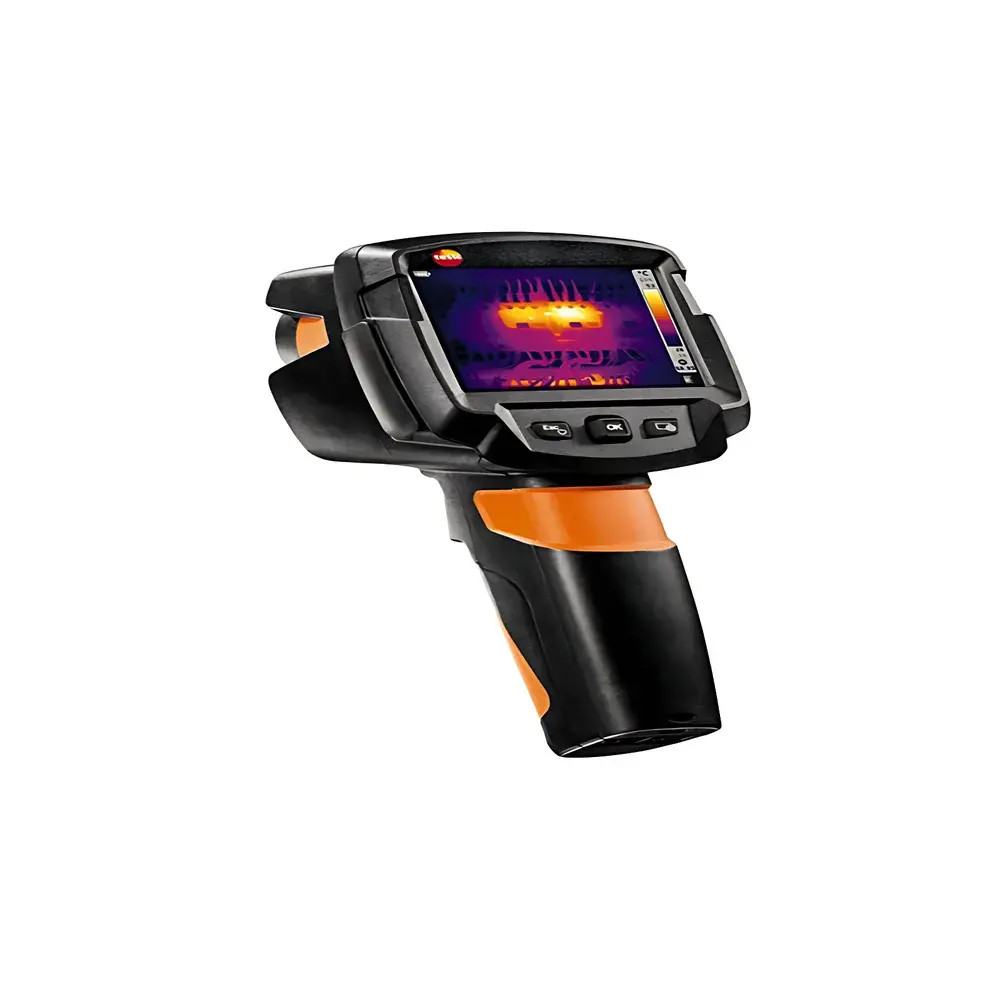
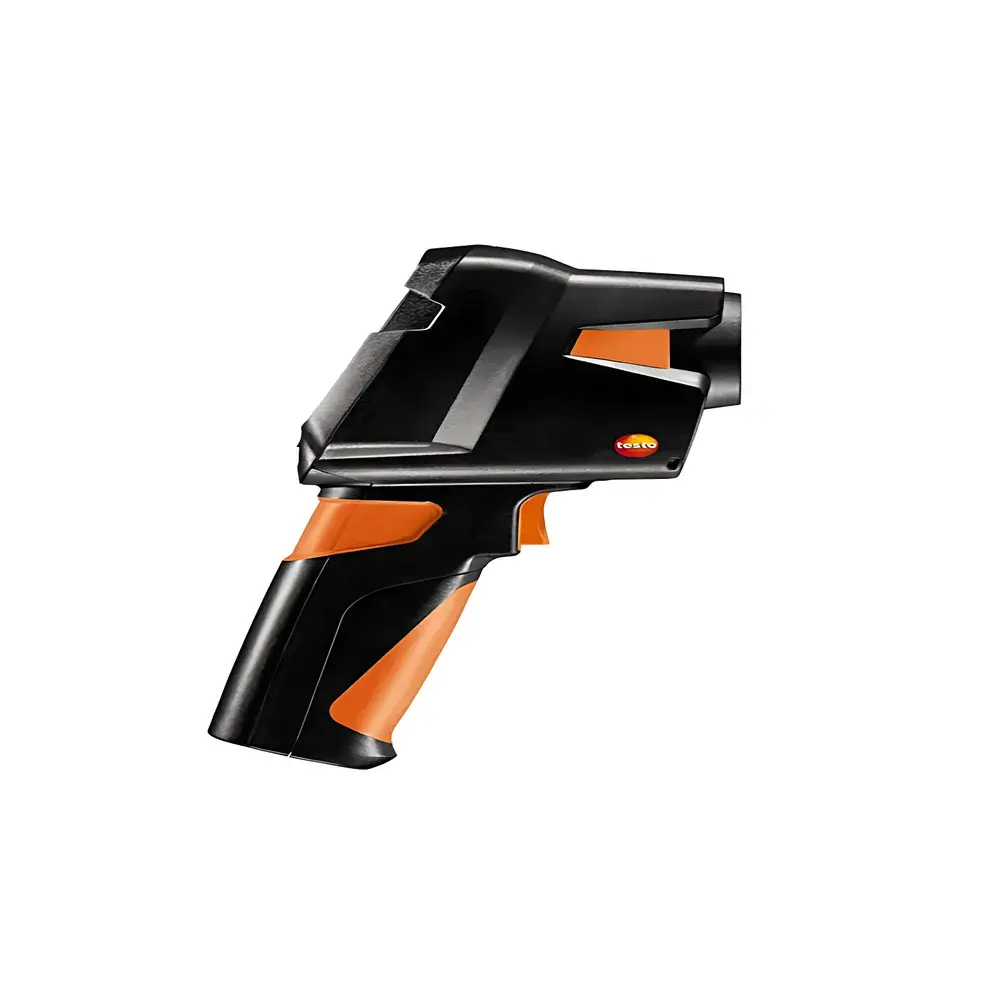
testo 869 Infrared Thermal Imaging Camera
| Brand | testo |
|---|---|
| Origin | Germany |
| Model | 0560 8690 11 |
| Detector Type | Scanning Focal Plane Array |
| Spectral Range | 7.5–14 µm |
| IR Resolution | 160 × 120 pixels |
| Thermal Sensitivity (NETD) | < 0.12 °C @ 30 °C |
| Frame Rate | 9 Hz |
| Temperature Range | −20 to +280 °C |
| Accuracy | ±3 °C or ±3 % of reading (whichever is greater) |
| Field of View | 34° × 26° |
| Minimum Focus Distance | < 0.5 m (fixed focus) |
| IFOV | 3.68 mrad |
| Display | 3.5" LCD, 320 × 240 pixels |
| Operating Temperature | −15 to +50 °C |
| Storage Temperature | −30 to +60 °C |
| Humidity Range | 20–80 % RH (non-condensing) |
| IP Rating | IP54 |
| Dimensions | 219 × 96 × 95 mm |
| Weight | 550 g |
| Battery Life | 4.0 h |
| Internal Memory | 1.6 GB (>2000 images without SuperResolution) |
| Image Formats | .bmt, .jpg, .bmp, .png, .csv, .xls |
| Software Compatibility | Windows XP SP3 through Windows 10, USB 2.0 interface |
Overview
The testo 869 Infrared Thermal Imaging Camera is an entry-level industrial thermal imager engineered for precision, reliability, and field-deployable usability in preventive maintenance, building diagnostics, and electrical infrastructure inspection. Based on uncooled microbolometer technology operating in the long-wave infrared (LWIR) spectral band (7.5–14 µm), the instrument delivers non-contact surface temperature measurements with high spatial fidelity and thermal stability. Its scanning focal plane array detector ensures consistent radiometric performance across its full measurement range (−20 to +280 °C), while the fixed-focus 34° wide-angle lens enables rapid coverage of large surfaces—ideal for identifying thermal anomalies in HVAC ductwork, insulation gaps, electrical panels, and mechanical components without requiring manual focusing.
Key Features
- 160 × 120 pixel infrared resolution (19,200 measurement points) providing clear, actionable thermal imagery for routine diagnostics
- Thermal sensitivity (NETD) < 0.12 °C at 30 °C ambient—capable of resolving subtle thermal gradients critical for early-stage fault detection
- Fixed-focus optical system with 34° × 26° field of view and minimum focus distance < 0.5 m—optimized for handheld operation in confined or cluttered environments
- Radiometric JPEG and proprietary .bmt file formats support embedded temperature data for traceable post-processing
- IP54-rated ruggedized housing certified for operation in industrial environments with dust exposure and incidental water splashing
- Integrated hot/cold spot auto-tracking function—automatically identifies and labels extremum temperature points within the current frame
- 3.5-inch high-contrast LCD display (320 × 240 pixels) with four selectable color palettes and full-screen thermal-only mode
- Onboard memory (1.6 GB) stores >2,000 thermal images without enabling SuperResolution; supports export to .bmp, .png, .csv, and .xls for cross-platform analysis
Sample Compatibility & Compliance
The testo 869 is designed for non-destructive, non-contact surface temperature assessment of solid materials including metals, plastics, concrete, and composite building envelopes. It complies with EU Electromagnetic Compatibility Directive 2004/108/EC and meets essential requirements for CE marking. While not validated for medical or explosive atmospheres, its radiometric calibration traceability aligns with ISO 18434-1 (condition monitoring — thermography) and supports documentation workflows compliant with ISO 55001 asset management standards. Emissivity adjustment (0.01–1.00, 0.01 increments) and reflected apparent temperature compensation allow accurate measurements across diverse surface finishes—from oxidized copper busbars to low-emissivity aluminum cladding.
Software & Data Management
Supplied with testo IRSoft Professional software, the testo 869 enables comprehensive offline analysis on Windows platforms (XP SP3 through Windows 10). The application supports multi-image comparison, isotherm overlays, emissivity mapping, delta-T calculations, and customizable reporting templates. All thermal images retain full radiometric metadata—including timestamp, GPS coordinates (when paired with optional Bluetooth module), lens parameters, and user-defined annotations—ensuring audit-ready documentation. Export functionality satisfies internal QA/QC requirements and integrates with enterprise CMMS platforms via CSV/XLS outputs. The software architecture does not implement FDA 21 CFR Part 11 electronic signature controls but maintains full audit trail capability for GLP-aligned lab and facility maintenance records.
Applications
- Electrical systems: Detection of loose connections, overloaded circuits, and failing breakers via localized heating patterns
- Building science: Identification of thermal bridging, missing insulation, air leakage paths, and moisture-induced thermal anomalies
- Mechanical maintenance: Monitoring bearing temperatures, steam trap functionality, heat exchanger fouling, and refractory integrity
- HVAC commissioning: Verification of duct leakage, coil performance, and airflow distribution using surface temperature differentials
- Industrial process support: Spot-checking of conveyor belt bearings, motor windings, and control cabinet thermal loading during routine rounds
FAQ
Is the testo 869 suitable for quantitative thermography in ISO 18434-1-compliant condition monitoring programs?
Yes—the instrument’s radiometric calibration, documented accuracy specification (±3 °C or ±3 %), and emissivity compensation functionality meet the minimum technical requirements for Level 1 thermographic inspections per ISO 18434-1.
Does the camera support real-time video streaming or external display output?
No—the testo 869 captures still frames only at 9 Hz; it lacks HDMI or analog video output and does not support live thermal video recording.
Can the internal memory be expanded via SD card or other removable media?
No—storage is fixed at 1.6 GB; image transfer occurs exclusively via USB 2.0 connection to a host PC running IRSoft Professional.
What is the calibration interval recommendation for maintaining measurement traceability?
testo recommends biennial factory recalibration against NIST-traceable blackbody sources to ensure continued compliance with stated accuracy specifications.
Is the battery replaceable in the field by the end user?
Yes—the rechargeable Li-ion battery is user-accessible and field-replaceable without tools; spare batteries (testo 0554 9300) are available as accessories.




