
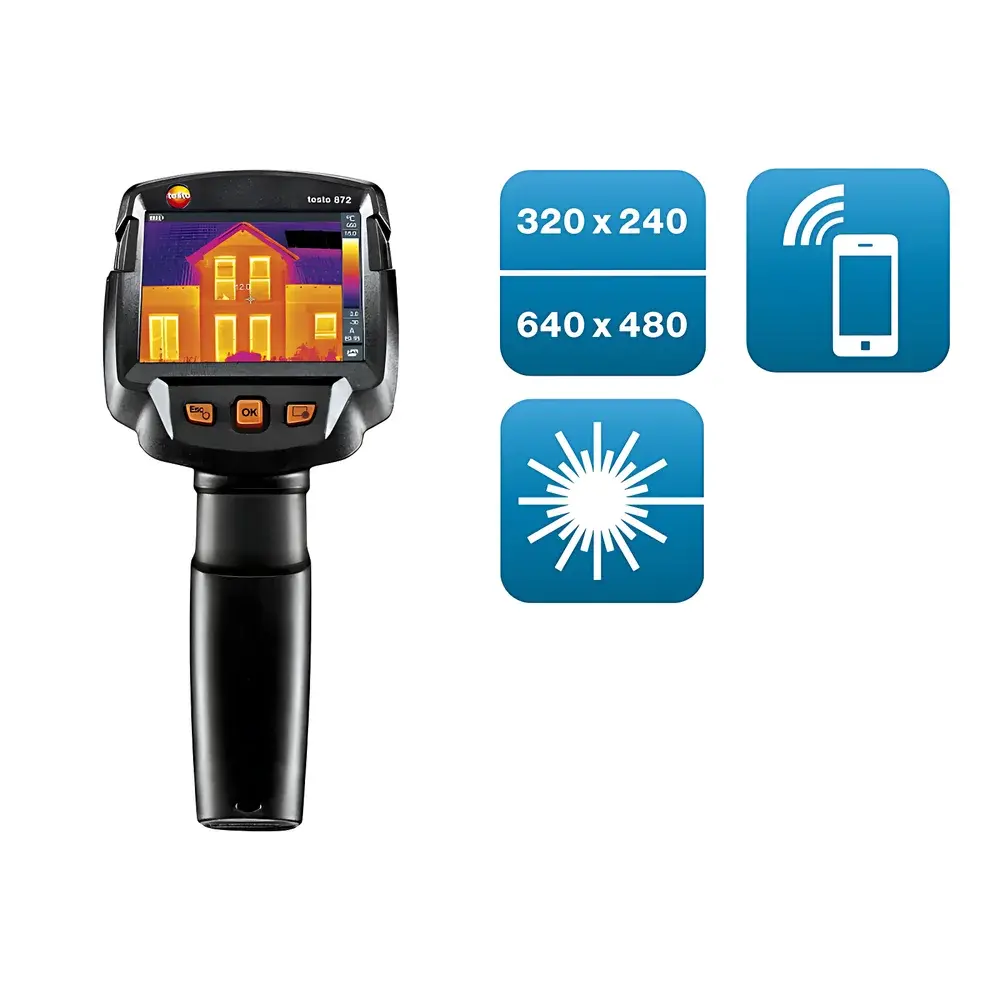
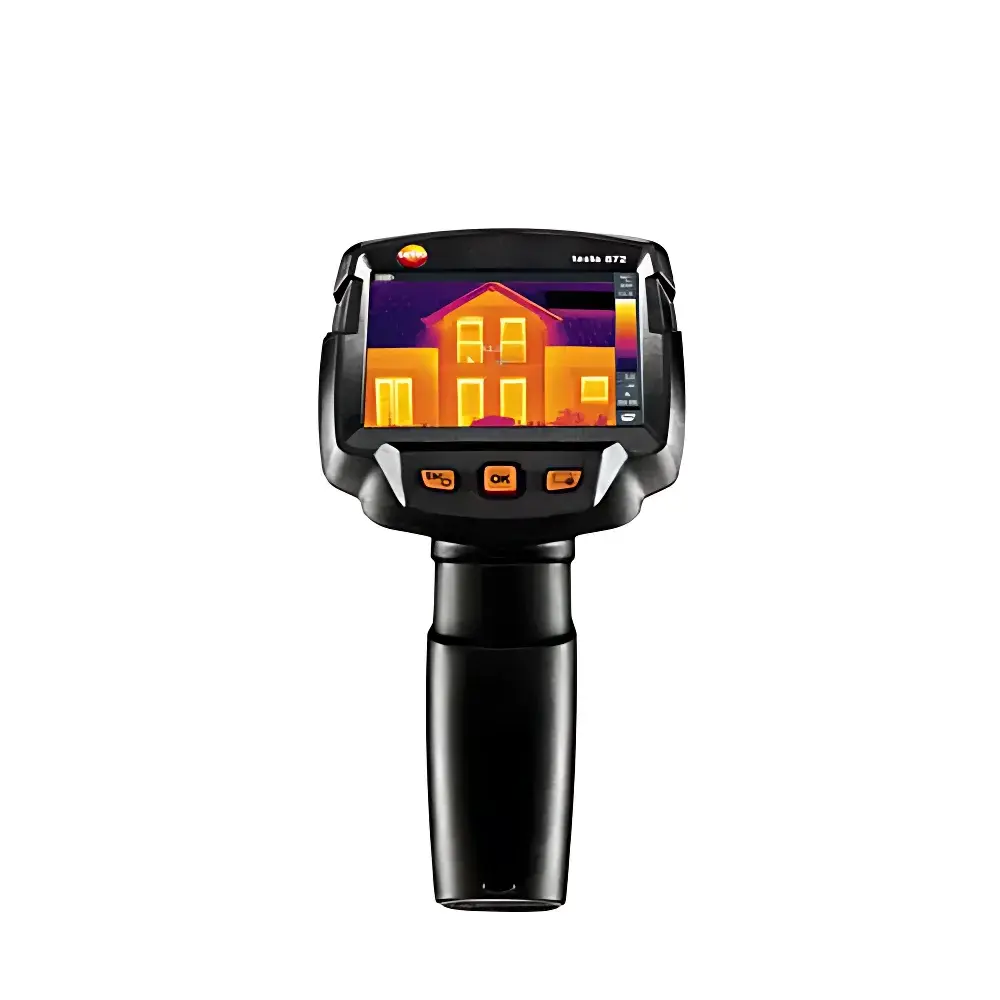
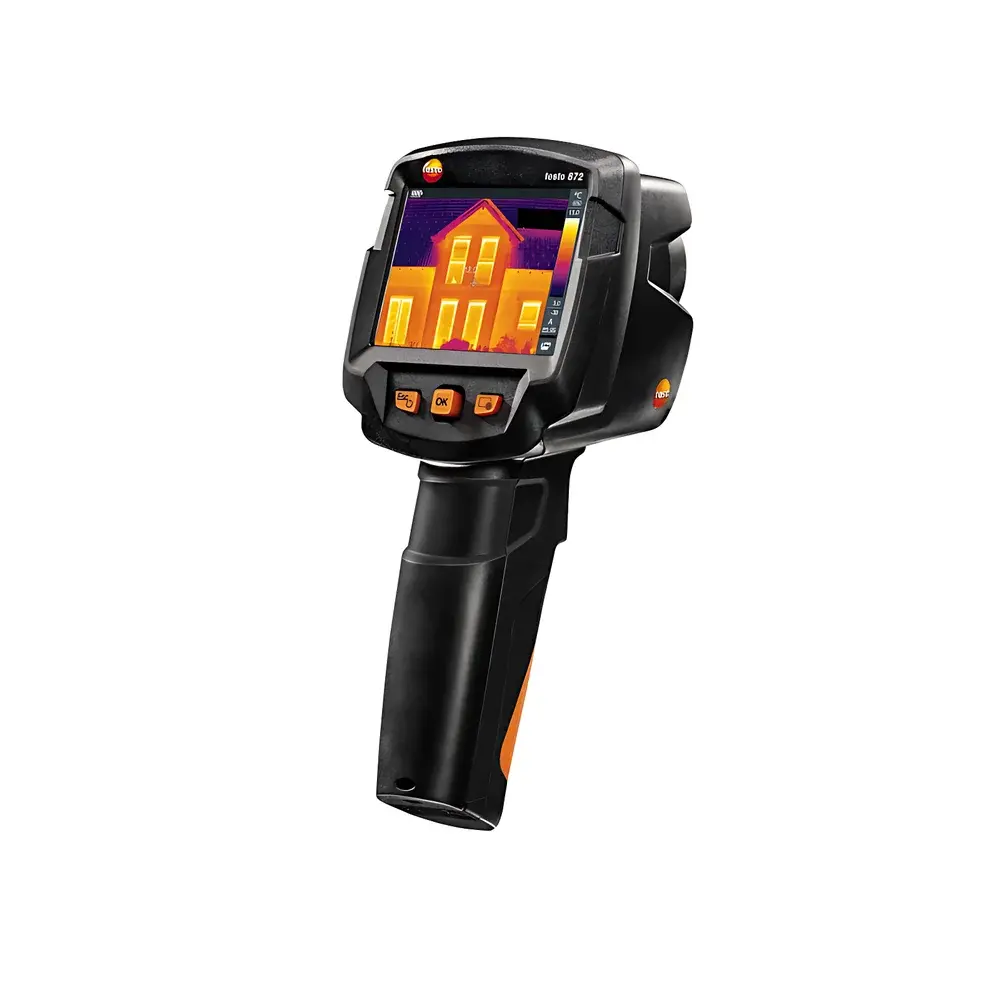
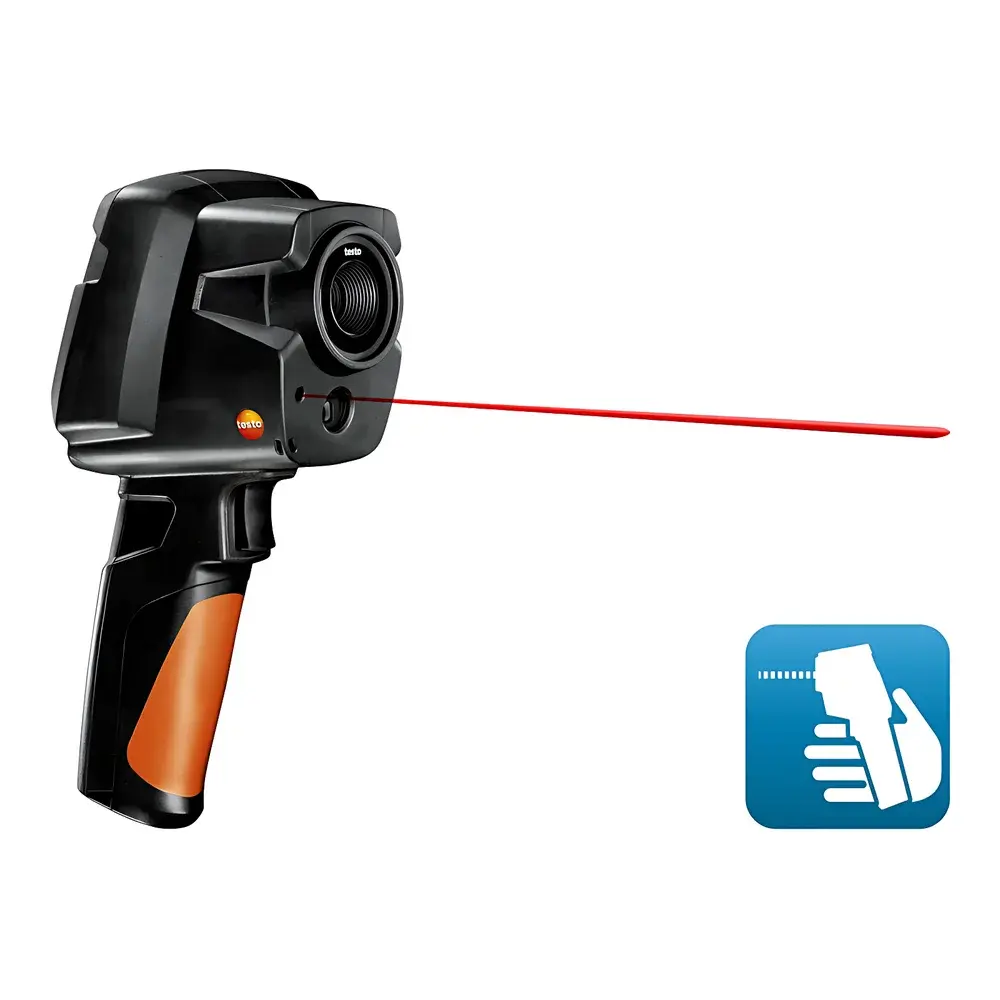
testo 872 Advanced Infrared Thermal Imaging Camera (320 × 240 IR Resolution) with SuperResolution, Bluetooth/Wi-Fi, and Smart Assist Functions
| Brand | testo |
|---|---|
| Origin | Germany |
| Model | 0560 8722 |
| Detector Type | Uncooled Microbolometer Focal Plane Array (FPA) |
| Spectral Range | 7.5–14 µm |
| IR Resolution | 320 × 240 pixels (SuperResolution up to 640 × 480 pixels) |
| Thermal Sensitivity (NETD) | ≤ 0.06 °C |
| Frame Rate | 9 Hz |
| Temperature Range | −30 to +100 °C |
| Accuracy | ±2 °C or ±2 % of reading |
| Measurement Method | Non-contact infrared radiometry |
| Operating Temperature | −15 to +50 °C |
| Storage Temperature | −30 to +60 °C |
| Relative Humidity | 20–80 % RH (non-condensing) |
| IP Rating | IP54 |
| IFOV | 2.3 mrad (standard lens) |
| Field of View | 42° × 30° |
| Minimum Focus Distance | < 0.5 m |
| Visible Light Camera | ≥ 3.1 MP, autofocus, 3.5″ LCD (320 × 240), brightness-adjustable backlight |
| Digital Zoom | 2× / 4× |
| Image Formats | .bmt, .jpg, .bmp, .png, .csv, .xls |
| Internal Memory | 2.8 GB |
| Connectivity | Bluetooth 4.2, Wi-Fi 802.11 b/g/n, USB 2.0 Micro-B |
| Wireless Compatibility | testo 605i (humidity/temperature), testo 770-3 (clamp meter) |
| Software | testo IRsoft (Windows 10/8/7), testo Thermography App (iOS/Android) |
| Compliance | EMC Directive 2014/30/EU, Radio Equipment Directive 2014/53/EU |
| Dimensions | 219 × 96 × 95 mm |
| Weight | 510 g |
Overview
The testo 872 is a professional-grade uncooled microbolometer infrared thermal imaging camera engineered for precision thermographic diagnostics in industrial maintenance, building envelope analysis, and electrical system inspection. It operates on the principle of passive infrared radiometry—detecting emitted long-wave infrared radiation (7.5–14 µm) from object surfaces and converting it into high-fidelity thermal maps. Its core architecture integrates a 320 × 240 pixel focal plane array with testo’s proprietary SuperResolution technology, synthetically enhancing spatial resolution to 640 × 480 pixels without mechanical scanning—enabling reliable identification of sub-millimeter thermal anomalies across complex geometries. With a thermal sensitivity (NETD) of ≤ 0.06 °C and calibrated accuracy of ±2 °C or ±2 % of reading (whichever is greater), the instrument meets the metrological requirements for routine compliance-driven inspections under ISO 18436-7 (condition monitoring), ASTM E1934 (infrared inspection of building envelopes), and IEC 60270 (partial discharge thermography). Its non-refrigerated detector design ensures stable operation across ambient temperatures from −15 °C to +50 °C, eliminating cryogenic dependencies while maintaining repeatability over extended field deployments.
Key Features
- SuperResolution imaging: Real-time pixel interpolation delivering synthetic 640 × 480 thermal resolution from native 320 × 240 sensor data—enhancing edge definition and defect localization without compromising frame rate.
- Smart Assist functions: ε-Assist automatically determines optimal emissivity and reflected temperature compensation (RTC) based on surface geometry and ambient conditions; ScaleAssist dynamically optimizes color scale mapping to maximize contrast for building insulation assessment or electrical hotspot detection.
- Dual-spectrum visualization: Synchronized visible-light imaging (≥3.1 MP) with precise geometric overlay enables accurate annotation, report-ready image fusion, and spatial correlation of thermal gradients with physical structures.
- Wireless ecosystem integration: Native Bluetooth 4.2 and Wi-Fi 802.11 b/g/n support bidirectional communication with testo 605i (humidity/temperature) and testo 770-3 (AC/DC current, voltage, power), embedding environmental and electrical parameters directly into thermal metadata for multi-parameter root-cause analysis.
- IFOV warning indicator: On-screen field-of-view framing displays the instrument’s instantaneous measurement spot size—preventing misinterpretation due to distance-to-target errors per ISO 13154 guidelines.
- Hot/cold spot auto-detection: Algorithm-driven extremum identification flags critical temperature deviations in real time, with configurable thresholds and visual tagging for rapid prioritization during walk-through surveys.
Sample Compatibility & Compliance
The testo 872 is designed for non-destructive, non-contact surface temperature evaluation across heterogeneous materials—including concrete, brick, metal cladding, PVC conduits, and composite insulation systems—without requiring surface preparation or emissivity tape application. Its adjustable emissivity range (0.01–1.00) and RTC compensation accommodate low-emissivity surfaces (e.g., polished aluminum, stainless steel) common in HVAC ductwork and electrical busbars. The device complies with EU electromagnetic compatibility (EMC Directive 2014/30/EU) and radio equipment regulations (RED 2014/53/EU), bearing CE marking for use in EEA, UK, Switzerland, Turkey, Canada, USA, Australia, and New Zealand. Firmware and testo IRsoft software support audit trails, user access control, and electronic signature workflows aligned with GLP/GMP documentation practices and FDA 21 CFR Part 11 requirements for regulated environments.
Software & Data Management
Thermal data acquisition, post-processing, and reporting are supported by two complementary platforms: the cross-platform testo IRsoft desktop application (Windows 10/8/7) and the mobile testo Thermography App (iOS/Android). IRsoft provides advanced analysis tools—including region-of-interest (ROI) statistics, time-series delta-T trending, emissivity correction libraries, and customizable report templates compliant with EN 13187 and ISO/IEC 17020. All thermal images are stored in proprietary .bmt format (preserving full radiometric metadata) alongside export options to JPEG, PNG, BMP, CSV, and Excel for integration into CMMS or BIM workflows. The mobile app enables live streaming, remote parameter adjustment, on-device annotation, and encrypted cloud upload via testo Cloud—facilitating collaborative review and version-controlled archiving. Both platforms enforce secure user authentication and generate immutable log files for traceability in quality audits.
Applications
The testo 872 serves as a primary diagnostic tool in preventive maintenance programs across multiple sectors. In building science, it identifies thermal bridging, moisture accumulation behind façades, insulation voids, and air leakage pathways—supporting energy audits per ISO 52016 and Passive House Institute protocols. For electrical infrastructure, it detects overloaded connections, unbalanced loads, and failing breakers under operational load—aligning with NFPA 70B and IEEE 1482.1 thermographic inspection standards. In mechanical systems, it monitors bearing temperatures, steam trap functionality, refractory integrity, and heat exchanger fouling—enabling predictive interventions before catastrophic failure. Its portability, battery life (4 hours), and IP54-rated enclosure make it suitable for indoor/outdoor use in manufacturing plants, commercial facilities, and municipal infrastructure projects.
FAQ
What is the effective spatial resolution (IFOV) when using SuperResolution?
With SuperResolution enabled, the effective IFOV improves from 2.3 mrad to 1.3 mrad, corresponding to a theoretical spot measurement size of approximately 1.3 mm at 1 m distance.
Can the testo 872 be used for quantitative moisture mapping in walls?
While not a direct moisture meter, the instrument detects evaporative cooling patterns and thermal capacitance anomalies associated with latent moisture—when combined with testo 605i ambient humidity data and validated against ASTM D7954, it supports qualitative moisture risk assessment.
Is firmware update capability available over-the-air?
Yes—firmware updates are delivered via the testo Thermography App or IRsoft, with version history, release notes, and rollback support included in the update package.
Does the device support radiometric video recording?
It records radiometric JPEG sequences (not continuous video streams), preserving full temperature data per frame for retrospective pixel-level analysis in IRsoft.
How is calibration traceability maintained?
Each unit ships with an ISO/IEC 17025-accredited calibration certificate (DAkkS or equivalent national body), valid for 12 months; recalibration services follow DIN EN ISO/IEC 17025 procedures with documented uncertainty budgets.





