
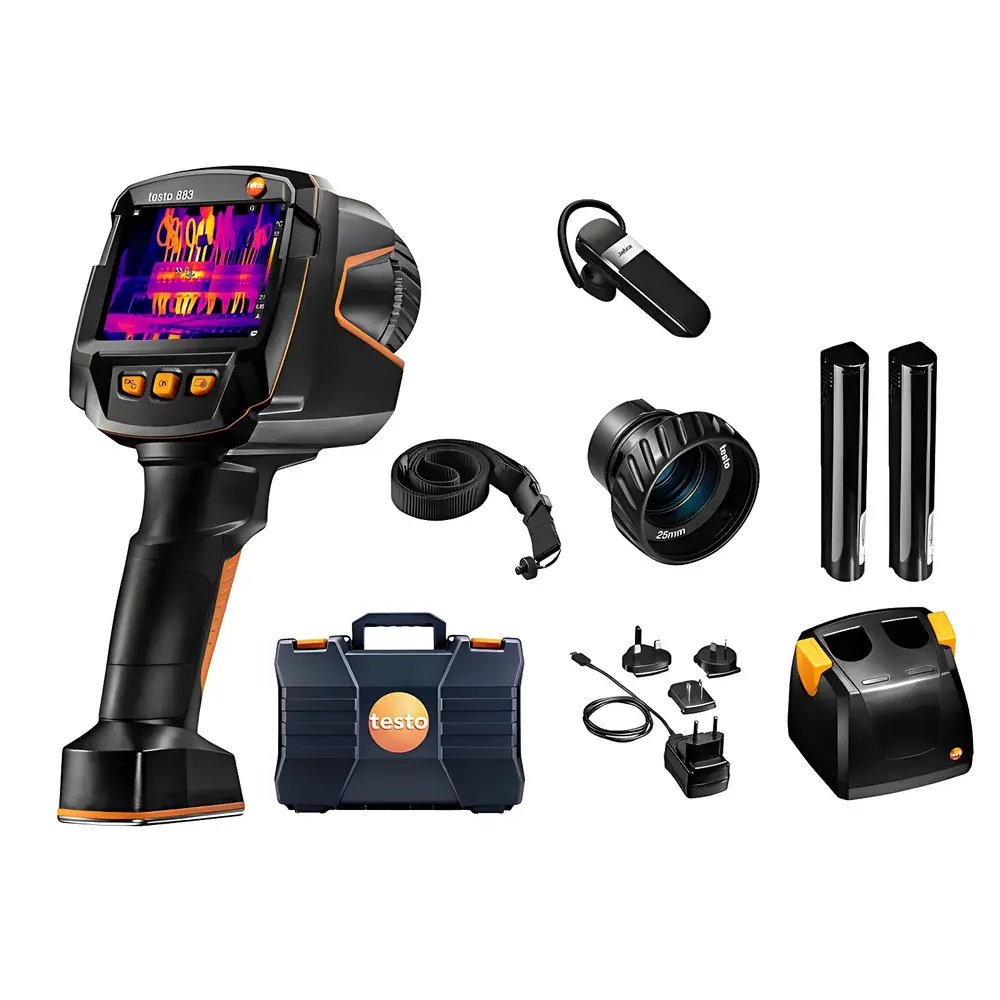
testo 883 Advanced Infrared Thermal Imaging Camera Kit with Dual Lenses and Accessories
| Brand | testo |
|---|---|
| Origin | Germany |
| Model | 0563 8832 |
| Detector Type | Uncooled Scanning Focal Plane Array (FPA) |
| Spectral Range | 7.5–14 µm |
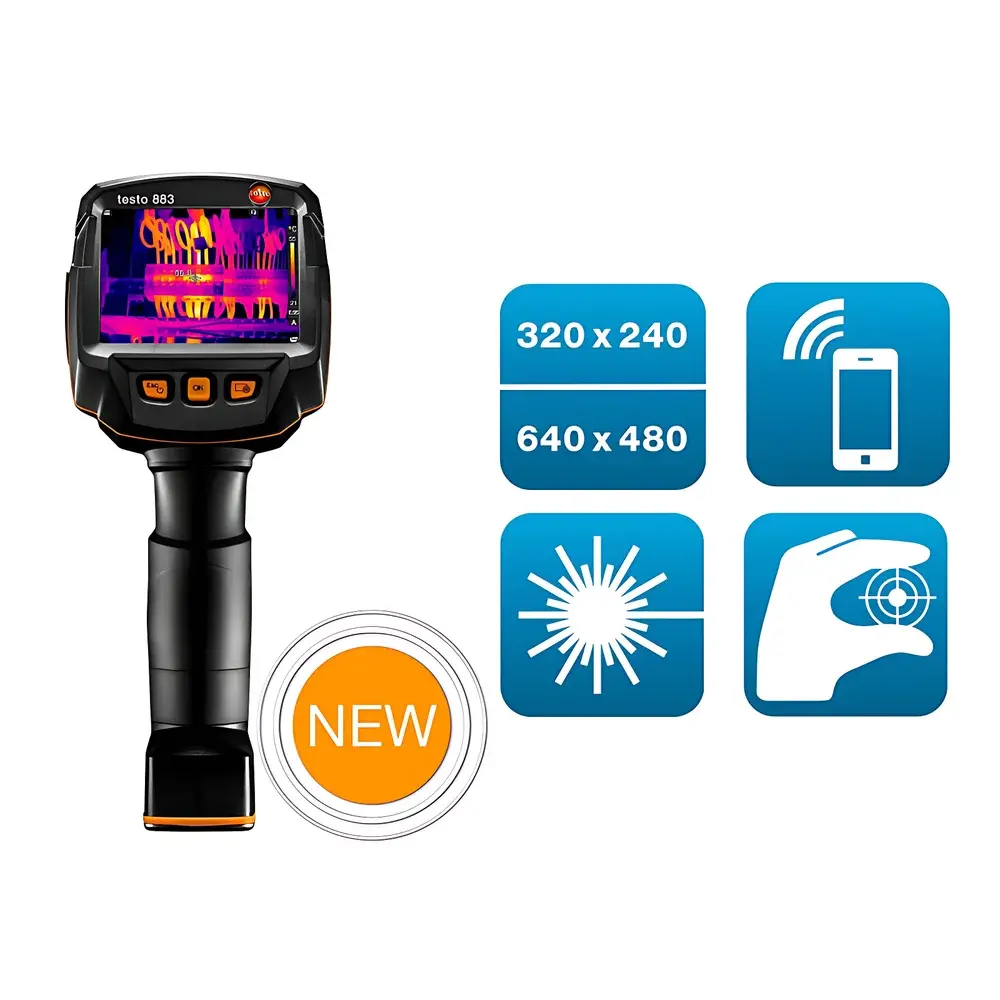
| IR Resolution | 320 × 240 pixels (SuperResolution up to 640 × 480) |
| Thermal Sensitivity (NETD) | < 0.04 °C |
| Field of View | 30° × 23° (standard lens), 12° × 9° (telephoto lens) |
| Spatial Resolution (IFOV) | 1.7 mrad (standard), 0.7 mrad (telephoto) |
| SuperResolution IFOV | 1.1 mrad / 0.4 mrad |
| Frame Rate | 27 Hz (EU-compliant |
| Temperature Range | –30 °C to +650 °C |
| Accuracy | ±2 °C or ±2 % of reading (whichever is greater) |
| Focus | Manual |
| Measurement Method | Non-contact infrared radiometry |
| Operating Temperature | –15 °C to +50 °C |
| Storage Temperature | –30 °C to +60 °C |
| IP Rating | IP54 |
| Battery Life | ≥ 5 hours |
| Weight | 824 g |
| Dimensions | 171 × 95 × 236 mm |
| Display | 3.5" capacitive touch TFT (320 × 240 QVGA), adjustable backlight |
| Image Formats | .bmt, .jpg, .png, .csv, .xls |
| Data Interface | USB-C, Bluetooth 5.0, WLAN (optional module) |
| Software | testo IRSoft (free PC software), testo Thermography App (iOS/Android) |
| Compliance | RED 2014/53/EU, EMC 2014/30/EU, WEEE 2012/19/EU, RoHS 2011/65/EU + 2015/863, REACH 1907/2006 |
Overview
The testo 883 Advanced Infrared Thermal Imaging Camera Kit is a high-performance, uncooled thermal imaging system engineered for precision non-contact temperature measurement and thermographic analysis in industrial maintenance, building diagnostics, electrical infrastructure inspection, and R&D environments. Based on microbolometer focal plane array technology operating in the long-wave infrared (LWIR) spectral band (7.5–14 µm), the instrument detects minute radiant energy differences across surfaces and converts them into high-fidelity thermal images with calibrated radiometric data. Its core architecture features a dual-lens configuration—standard 30° × 23° and telephoto 12° × 9°—enabling versatile field-of-view selection without compromising spatial resolution. The integrated SuperResolution algorithm enhances native 320 × 240 pixel detector output to an effective 640 × 480 pixel thermal image, significantly improving edge definition and small-target detectability while maintaining full radiometric integrity. Designed and manufactured in Germany, the testo 883 complies with EU regulatory frameworks including RED, EMC, WEEE, RoHS, and REACH directives, ensuring electromagnetic compatibility, environmental safety, and traceable conformity for global deployment.
Key Features
- Uncooled microbolometer detector with <0.04 °C NETD thermal sensitivity for reliable detection of subtle thermal anomalies.
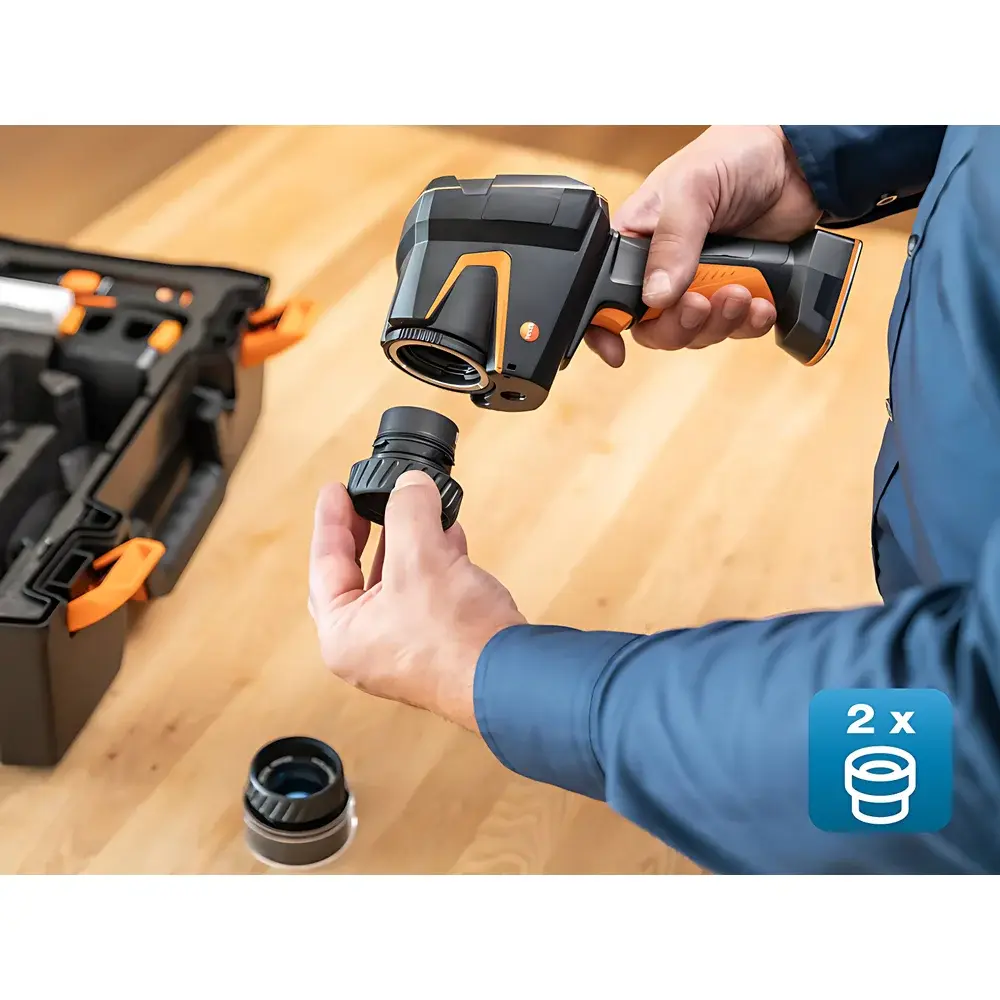
- Dual interchangeable lenses: standard wide-angle (30° × 23°, IFOV 1.7 mrad) and telephoto (12° × 9°, IFOV 0.7 mrad), supporting both broad-area surveys and detailed component-level inspection.
- SuperResolution imaging technology delivering interpolated 640 × 480 thermal images without interpolation artifacts—each pixel retains true radiometric value.
- Capacitive 3.5″ QVGA touchscreen display with three brightness modes (bright/normal/dark) optimized for indoor, outdoor, and low-light working conditions.
- Integrated 5 MP visible-light camera with automatic image fusion (MSX®-style edge enhancement) and geotagging capability via optional GPS module.
- Manual focus system with sub-10 cm minimum focusing distance on standard lens, enabling close-up thermal analysis of PCBs, connectors, or insulation gaps.
- Robust IP54-rated housing, drop-tested to 2 m, and operational across –15 °C to +50 °C ambient temperatures—suitable for demanding field environments.
- Built-in laser pointer and measurement spot marker for precise targeting and documentation of measurement locations during live inspection.
Sample Compatibility & Compliance
The testo 883 is compatible with a broad range of emissivity-adjusted surfaces—including oxidized metals, painted substrates, concrete, insulation materials, and composite assemblies—via user-configurable ε-values (0.01–1.00) and reflective temperature compensation. Its radiometric calibration is traceable to national standards and verified per ISO/IEC 17025-accredited procedures, with each unit supplied with a factory calibration certificate. Regulatory compliance extends to electromagnetic compatibility (EMC Directive 2014/30/EU), radio equipment (RED 2014/53/EU), and hazardous substance restrictions (RoHS II 2011/65/EU + Amendment 2015/863). For applications requiring audit-ready documentation, the device supports GLP/GMP-aligned workflows when used with testo IRSoft’s secure reporting engine, including time-stamped measurement logs, user-defined templates, and digital signature fields compliant with FDA 21 CFR Part 11 requirements where enabled by enterprise license.
Software & Data Management
Data acquisition and post-processing are fully supported through two complementary platforms: testo IRSoft (Windows desktop application) and the testo Thermography mobile app (iOS/Android). IRSoft provides advanced analysis tools—including multi-point temperature tracking, ΔT differential mapping, isotherm overlays, area min/max statistics, and customizable alarm thresholds—as well as automated report generation in PDF, Excel, and CSV formats. All measurements retain full radiometric metadata (emissivity, reflected temperature, humidity, ambient conditions) and can be batch-processed with version-controlled templates. The mobile app enables real-time streaming, annotation via voice memos (Bluetooth headset compatible), and direct cloud synchronization via optional WLAN module. Internal 2.8 GB flash memory stores up to 10,000 thermal images; data export is supported via USB-C or wireless transfer protocols. Firmware updates and regional radio authorization documents (e.g., FCC ID, IC, RCM) are centrally managed via testo’s secure download portal.
Applications
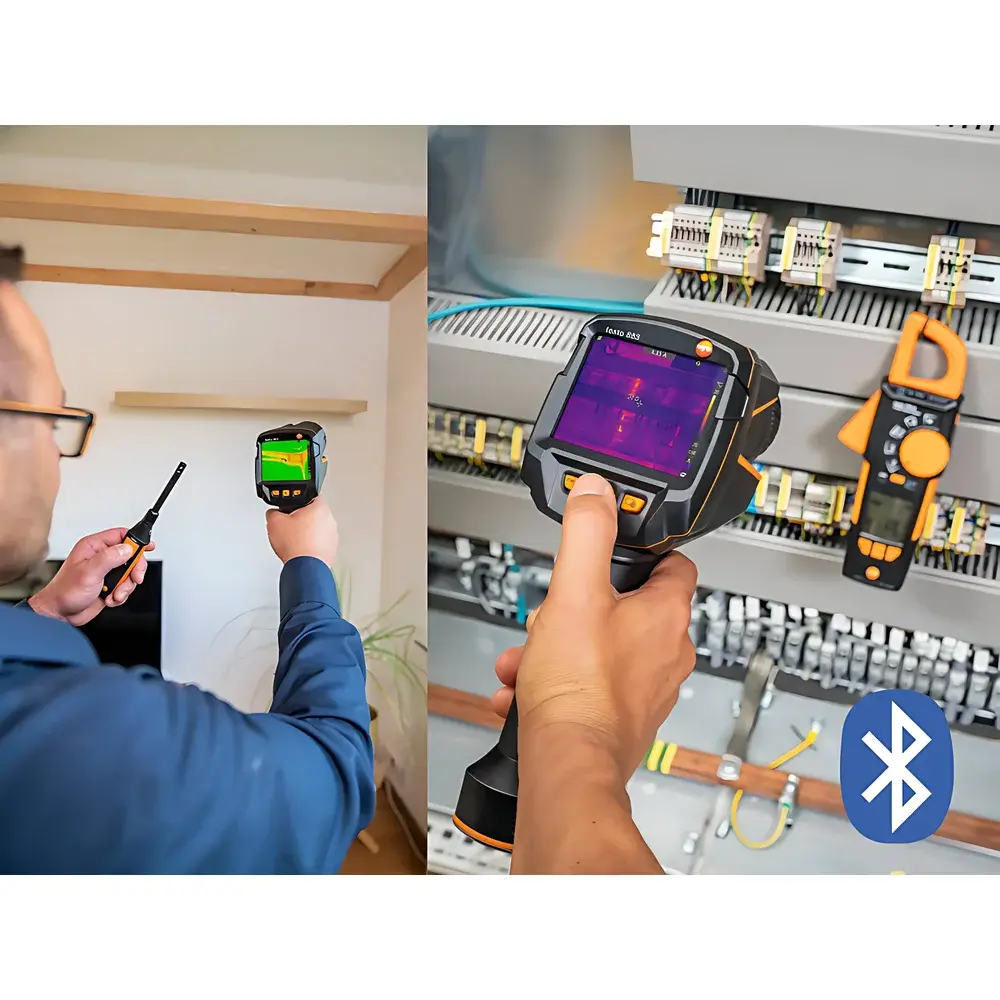
The testo 883 serves critical roles across multiple technical domains: predictive maintenance teams use it to identify overheated motor windings, loose connections, and failing bearings before catastrophic failure; building science professionals assess thermal bridging, moisture infiltration, and HVAC duct leakage per ASTM C1060 and ISO 6781-3 standards; energy auditors quantify envelope inefficiencies aligned with ASHRAE Guideline 12-2020; and electronics engineers perform thermal profiling of PCBs and power converters under load. Its portability, battery endurance (>5 h), and ruggedized design make it suitable for rooftop inspections, substation patrols, and confined-space assessments. Optional accessories—including testo 605i Bluetooth hygrometer, testo 770-3 clamp meter, and external humidity sensor modules—enable correlated multi-parameter logging for comprehensive condition monitoring.
FAQ
What is the difference between native resolution and SuperResolution mode?
Native resolution is 320 × 240 pixels from the physical detector; SuperResolution applies proprietary pixel interpolation and motion-based frame averaging to produce a 640 × 480 thermal image with enhanced detail while preserving absolute temperature accuracy per pixel.
Does the testo 883 meet FDA 21 CFR Part 11 requirements?
Out-of-the-box functionality supports audit trails and electronic signatures when deployed with testo IRSoft Enterprise Edition and configured in validated environments; full Part 11 compliance requires site-specific validation per organizational SOPs.
Can the device operate outside the European Union at full frame rate?
Frame rate is limited to 9 Hz in non-EU jurisdictions due to regional radio spectrum regulations; 27 Hz operation is permitted only within EU, EFTA, and territories recognizing RED harmonized standards.
Is the calibration certificate NIST-traceable?
Calibration is performed against reference blackbodies accredited to DIN EN ISO/IEC 17025; NIST traceability is available upon request with additional certification documentation.
What accessories are required for wireless data transmission?
The built-in Bluetooth 5.0 interface supports direct pairing with smartphones and peripheral sensors; optional WLAN module (testo 883-WLAN) is required for local network streaming and cloud upload capabilities.




