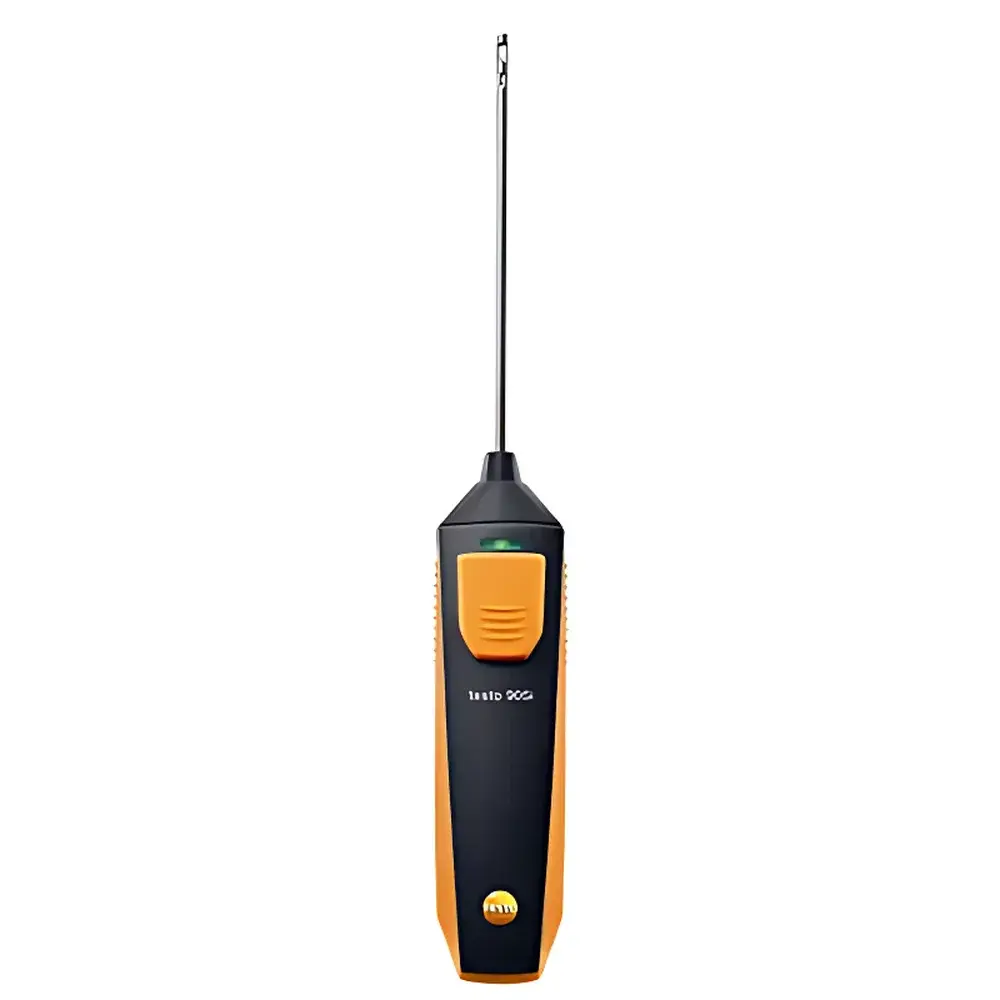
testo 905-T1 Compact Penetration Thermometer with Integrated K-Type Thermocouple
| Brand | testo |
|---|---|
| Origin | Germany |
| Model | 0560 9055 |
| Temperature Measurement Principle | K-Type Thermocouple |
| Measurement Method | Contact |
| Temperature Range | −50 to +350 °C (short-term up to +500 °C) |
| Resolution | 0.1 °C |
| Accuracy | ±1 °C (−50 to +99.9 °C), ±1 % of reading (remaining range) |
| Stability | ±1 °C (−50 to +99.9 °C), ±1 % of reading (remaining range) |
| Response Time t₉₉ | 10 s (in water) |
| Weight | 80 g |
| Dimensions (L×W×H) | 270 × 40 × 70 mm |
| Operating Temperature | 0 to +40 °C |
| Storage Temperature | −20 to +70 °C |
| Probe Sheath Length | 200 mm |
| Probe Tip Length | 4 mm |
| Probe Rod Diameter | 3 mm |
| Display | Single-line LCD |
| Housing Material | ABS |
| Power Supply | 3 × AAA batteries |
| Battery Life | Up to 1000 h |
| CE Marking | 2014/30/EU |
Overview
The testo 905-T1 is a compact, handheld penetration thermometer engineered for high-reliability contact temperature measurement across demanding industrial, laboratory, and quality assurance environments. It employs a permanently integrated Type K thermocouple sensor—compliant with IEC 60584-1—ensuring traceable thermal response and long-term stability under repeated thermal cycling. Unlike resistance-based sensors (e.g., Pt100 or NTC), the K-type thermocouple offers inherently fast transient response and wide operational range without self-heating artifacts, making it especially suitable for dynamic measurements in liquids, semi-solids, air streams, and ducted HVAC systems. Its calibrated measurement span of −50 °C to +350 °C—with certified short-term tolerance up to +500 °C for ≤120 seconds—meets critical process validation requirements in food safety (HACCP), pharmaceutical manufacturing (EU GMP Annex 15), and chemical reaction monitoring where brief exposure to elevated temperatures occurs.
Key Features
- Integrated, non-removable K-type thermocouple probe with 200 mm stainless steel sheath (diameter: 3 mm; tip length: 4 mm) optimized for rapid thermal equilibration in aqueous and viscous media
- High-resolution LCD display with 0.1 °C readability and 180° rotatable screen for ergonomic viewing at multiple angles—critical for overhead ducts, deep vessels, or confined workspaces
- Verified t₉₉ response time of ≤10 seconds in water (per DIN EN 60584-2), enabling real-time tracking of thermal transitions during sterilization, pasteurization, or batch heating cycles
- Rugged ABS housing (IP54-rated against dust and water splashes) with compact dimensions (270 × 40 × 70 mm) and low mass (80 g) for extended handheld use without operator fatigue
- Long-duration power management: 3 × AAA alkaline cells deliver up to 1000 hours of continuous operation, reducing maintenance intervals and supporting unattended logging scenarios
- Compliance with electromagnetic compatibility directive 2014/30/EU and conformity to essential requirements of the Measuring Instruments Directive (MID) for non-automatic weighing instruments and thermal sensors
Sample Compatibility & Compliance
The testo 905-T1 is validated for direct insertion into homogeneous and heterogeneous samples including aqueous solutions, oils, syrups, doughs, powders, granules, and ambient or forced-air environments. Its slender 3 mm-diameter probe minimizes sample disturbance and enables accurate point measurements in narrow tubing, small reaction vials, and narrow ventilation ducts. For regulated applications, the instrument supports documentation integrity per FDA 21 CFR Part 11 when used with testo’s optional data logging accessories (e.g., testo 174 series loggers with audit-trail-capable firmware). Calibration certificates traceable to national standards (e.g., PTB, NIST) are available upon request. The device conforms to ISO/IEC 17025–accredited calibration practices and is routinely deployed in laboratories operating under GLP and ISO 17025 quality systems.
Software & Data Management
While the testo 905-T1 operates as a standalone field instrument, its measurement values can be transferred via optional Bluetooth-enabled interfaces (e.g., testo Breeze app) for time-stamped export to CSV or PDF reports. When paired with testo’s ComSoft Professional software suite, users gain access to configurable alarm thresholds, statistical process control (SPC) charts, and automated compliance reporting aligned with ISO 9001, HACCP, and EU Regulation (EC) No. 852/2004. All recorded data include metadata such as operator ID, location tag, ambient conditions, and probe identification—supporting full traceability required for internal audits and regulatory inspections.
Applications
- Food processing: Core temperature verification during cooking, chilling, and holding phases (per USDA FSIS and EC 852/2004)
- Pharmaceutical QC: Sterilization cycle validation, lyophilizer shelf temperature mapping, and environmental monitoring in cleanrooms
- Chemical R&D: Reaction exotherm profiling, catalyst bed temperature sampling, and distillation column monitoring
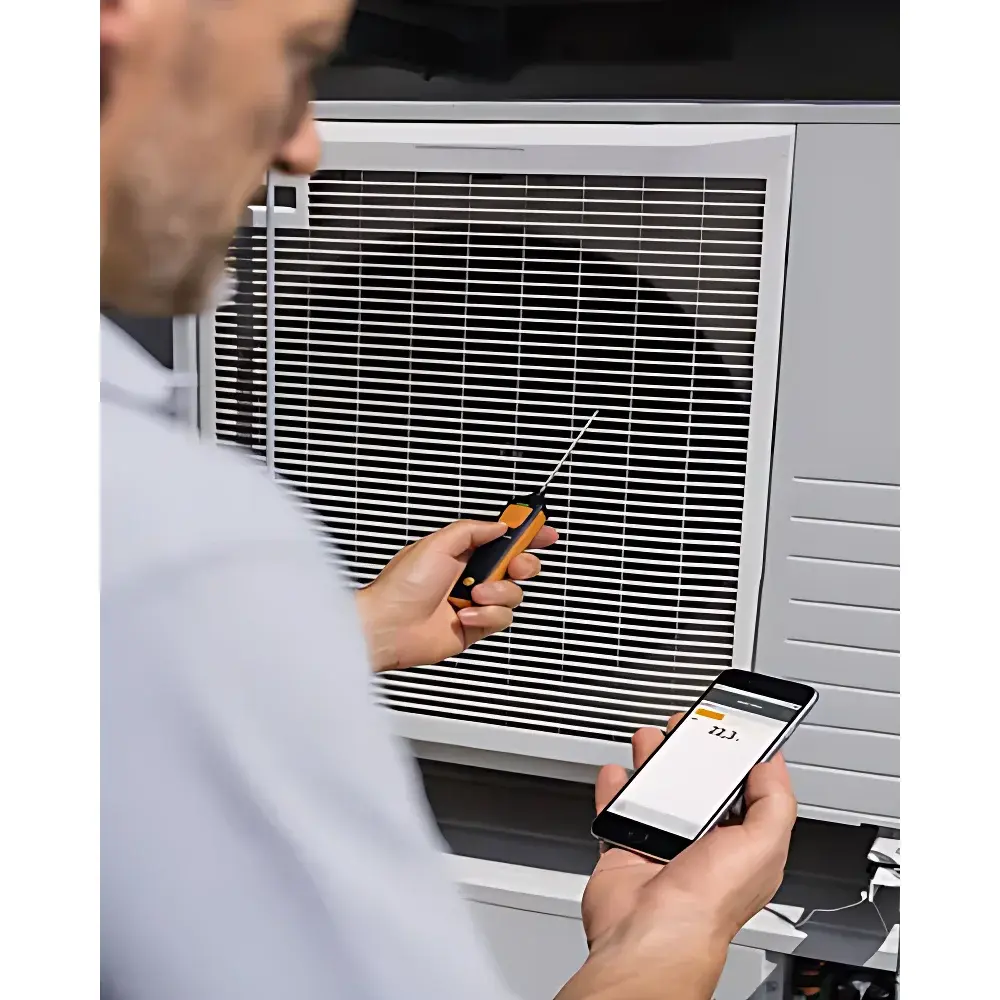
- HVAC commissioning: Air temperature profiling in supply/return ducts, coil surface checks, and thermal comfort surveys (ASHRAE 55)
- Education & training labs: Demonstrating thermocouple physics, heat transfer kinetics, and metrological uncertainty concepts
FAQ
What is the maximum allowable immersion depth for the probe?
The 200 mm stainless steel sheath permits full immersion up to the handle interface; however, prolonged exposure above +350 °C is not recommended beyond 2 minutes to preserve thermocouple wire integrity and calibration stability.
Can the testo 905-T1 be recalibrated in-house?
Field recalibration is not supported due to the permanently sealed thermocouple junction. Users must send the unit to an accredited testo service center or third-party lab with ISO/IEC 17025 accreditation for adjustment and certificate issuance.
Is the device suitable for measuring surface temperature?
No—it is designed exclusively for penetration or immersion measurement. Surface temperature requires infrared or thermistor-based contact probes with flat sensing elements.
Does the LCD display support backlighting for low-light environments?
No; the monochrome LCD relies on ambient light. For dark environments, supplemental illumination is advised to ensure legibility.
How is measurement uncertainty determined for this instrument?
Total uncertainty incorporates probe repeatability (±0.2 °C), linearity deviation (±0.3 °C), reference standard drift (±0.1 °C), and environmental influence (±0.2 °C), resulting in a typical expanded uncertainty (k=2) of ±0.8 °C at 25 °C per ISO/IEC Guide 98-3.