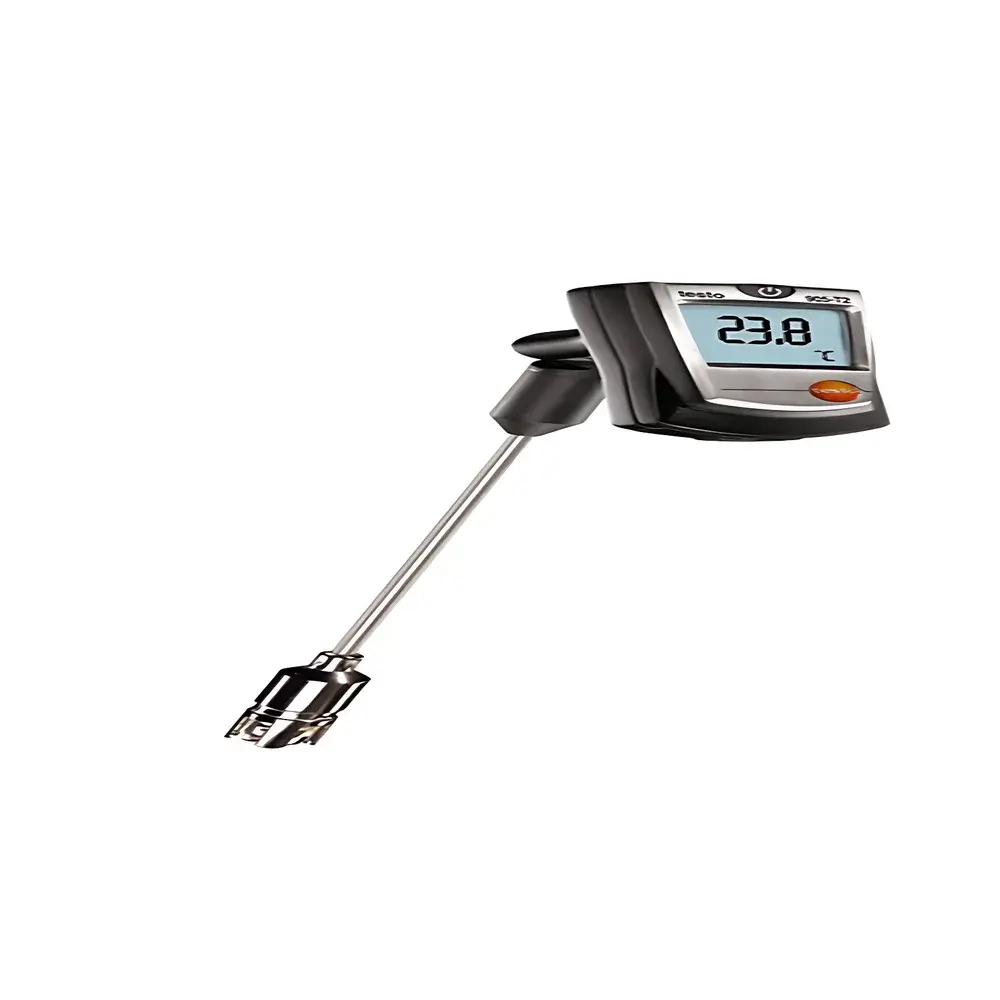
testo 905-T2 Surface Contact Thermometer
| Brand | testo |
|---|---|
| Origin | Germany |
| Model | 0560 9056 |
| Temperature Measurement Principle | K-type Thermocouple |
| Measurement Method | Contact |
| Temperature Range | -50 to +350 °C (short-term up to +500 °C) |
| Resolution | 0.1 °C |
| Accuracy | ±(1 °C ±1 % of reading) |
| Stability | ±(1 °C ±1 % of reading) |
| Response Time (t₉₉) | 5 s |
| Weight | 80 g |
| Dimensions (L×W×H) | 220 × 40 × 70 mm |
| Operating Temperature | 0 to +40 °C |
| Storage Temperature | -20 to +70 °C |
| Probe Sheath Length | 150 mm |
| Probe Tip Length | 40 mm |
| Probe Stem Diameter | 3 mm |
| Probe Head Diameter | 12 mm |
| Display | Single-line LCD |
| Battery | 3 × AAA (rechargeable) |
| Battery Life | ~1000 h |
| Auto Power-off | After 10 min idle |
| Housing Material | ABS |
| Color | Black |
| Compliance | CE 2004/108/EC |
Overview
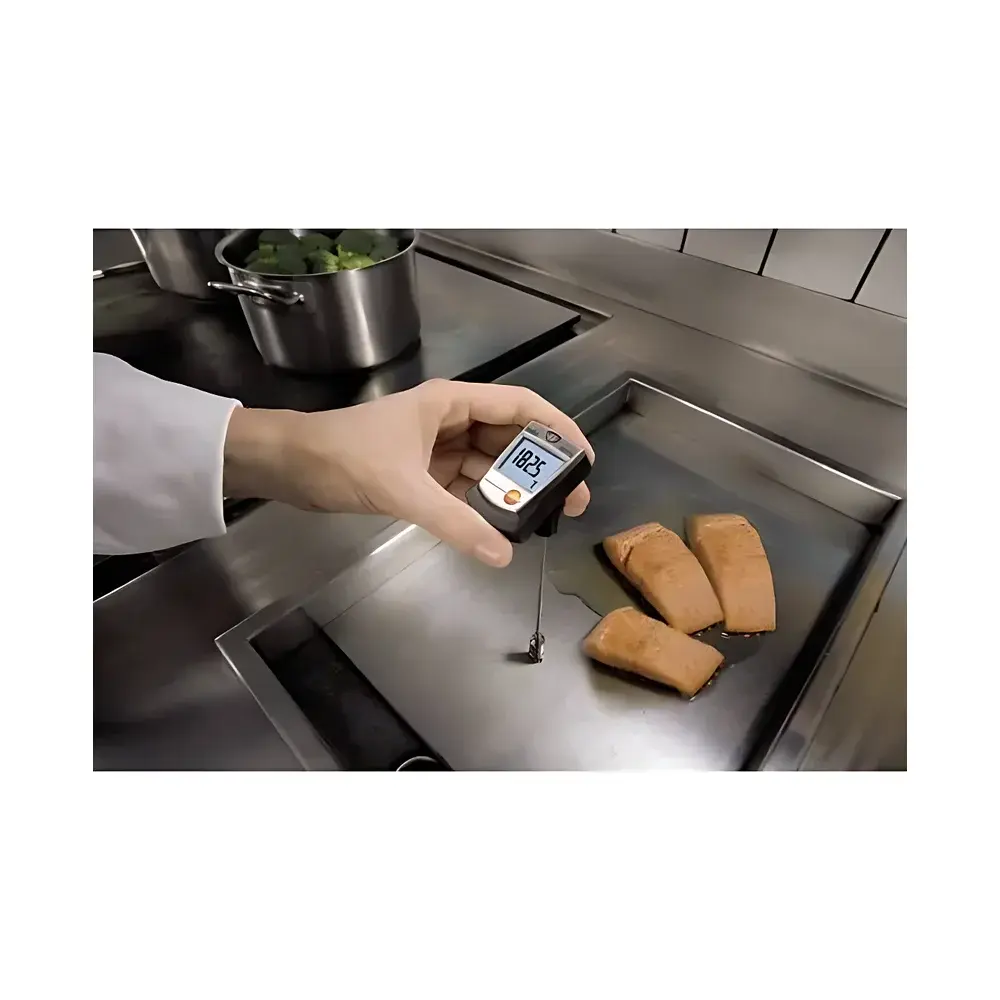
The testo 905-T2 Surface Contact Thermometer is a compact, high-reliability handheld instrument engineered for precise and repeatable surface temperature measurement in industrial, HVAC/R, maintenance, and quality assurance environments. It operates on the Seebeck principle using a certified K-type thermocouple sensor integrated into a spring-loaded cross-jaw probe—designed specifically to maintain consistent thermal contact across non-planar, curved, or textured surfaces where conventional flat-surface probes fail to achieve representative readings. Unlike passive infrared thermometers, the testo 905-T2 delivers true contact-based thermal equilibrium measurements with minimal thermal mass interference, ensuring traceable accuracy under real-world field conditions. Its extended short-term range up to +500 °C (for durations ≤120 s) supports transient thermal diagnostics in boiler inspections, ductwork commissioning, refrigerant line verification, and electrical panel hotspot validation—without requiring sensor replacement or recalibration.
Key Features
- Spring-loaded cross-jaw K-type thermocouple probe ensures uniform pressure and optimal thermal coupling on irregular surfaces—including corrugated metal, finned heat exchangers, pipe weld seams, and insulated duct joints.
- High-resolution 0.1 °C LCD display with 180° rotatable orientation enables ergonomic viewing from multiple angles—even in confined or overhead locations.
- Fast t₉₉ response time of 5 seconds allows rapid sequential measurements across multiple points without operator fatigue or workflow interruption.
- Rugged ABS housing (IP54-rated against dust and water splashes), black matte finish, and lightweight 80 g construction support daily field use in demanding mechanical and building service applications.
- Energy-efficient design with auto power-off after 10 minutes of inactivity and up to 1000 hours of operation per full battery charge (3 × AAA rechargeable cells).
- Compliant with EU Electromagnetic Compatibility Directive 2004/108/EC; CE-marked for conformity with essential health and safety requirements.
Sample Compatibility & Compliance
The testo 905-T2 is validated for direct contact measurement on metallic, ceramic, polymer-coated, and oxidized surfaces typical in HVAC system components (e.g., condenser coils, evaporator fins, compressor casings), refrigeration piping, steam traps, electrical enclosures, and thermal insulation interfaces. Its probe geometry eliminates air-gap errors common with rigid-tip thermometers on uneven substrates. While not intrinsically safe for hazardous areas, the device meets general-purpose industrial safety standards for non-explosive environments. Calibration traceability aligns with ISO/IEC 17025-accredited laboratories; users may perform field verification using NIST-traceable dry-block calibrators or ice-point reference baths. The instrument does not require software-based calibration adjustment—accuracy remains stable per stated specification throughout its operational lifetime under normal handling conditions.
Software & Data Management
The testo 905-T2 is a standalone, firmware-embedded measurement tool with no Bluetooth, USB, or cloud connectivity. All data acquisition, display processing, and power management occur internally via a low-power microcontroller architecture. No proprietary software, drivers, or PC interface is required—making it ideal for auditable, paper-based reporting workflows compliant with ISO 9001, ISO 14001, and ASHRAE Guideline 12–2020. For organizations implementing electronic recordkeeping, manual entry of logged values into validated LIMS or CMMS platforms satisfies FDA 21 CFR Part 11 requirements when paired with documented operator training and procedural controls. The absence of firmware updates or external communication pathways simplifies GxP-aligned validation protocols and reduces cybersecurity exposure in regulated facilities.
Applications
- HVAC/R commissioning and preventive maintenance: surface temperature profiling of chillers, air handlers, duct linings, and refrigerant lines to verify thermal performance and detect insulation degradation.
- Building envelope diagnostics: quantifying thermal bridging at window frames, curtain wall junctions, and roof penetrations per ASTM C1060 and ISO 6946 methodologies.
- Electrical infrastructure monitoring: identifying abnormal heating at busbar connections, breaker terminals, and transformer housings per NFPA 70B and IEEE 1410 guidelines.
- Industrial process support: verifying curing temperatures on painted surfaces, adhesive bond integrity checks, and post-weld heat treatment verification on stainless steel piping.
- Educational and vocational training labs: teaching fundamental thermocouple theory, contact measurement uncertainty, and surface emissivity-independent temperature assessment principles.
FAQ
What is the maximum allowable surface temperature for continuous measurement?
Continuous operation is rated from –50 °C to +350 °C. Exposure above +350 °C must be limited to ≤2 minutes to preserve probe longevity and measurement stability.
Can the probe be replaced independently?
Yes—the K-type cross-jaw probe (testo part no. 0600 9760) is a field-replaceable component with standardized mini-connector interface.
Is the device suitable for food-grade surface monitoring?
While the probe tip is stainless steel and chemically inert, the testo 905-T2 is not certified to EC 1935/2004 or FDA 21 CFR 170–189 for direct food contact; it is intended for equipment and environmental surface assessment only.
Does the instrument support data logging?
No—this is a real-time readout-only device with no internal memory or timestamping capability.
How is measurement uncertainty calculated per ISO/IEC 17025?
Total expanded uncertainty (k=2) combines probe calibration uncertainty (±0.5 °C), instrument electronics contribution (±0.3 °C), and application-specific factors (contact resistance, surface emissivity effects), yielding a typical reported value of ±1.2 °C at 100 °C.