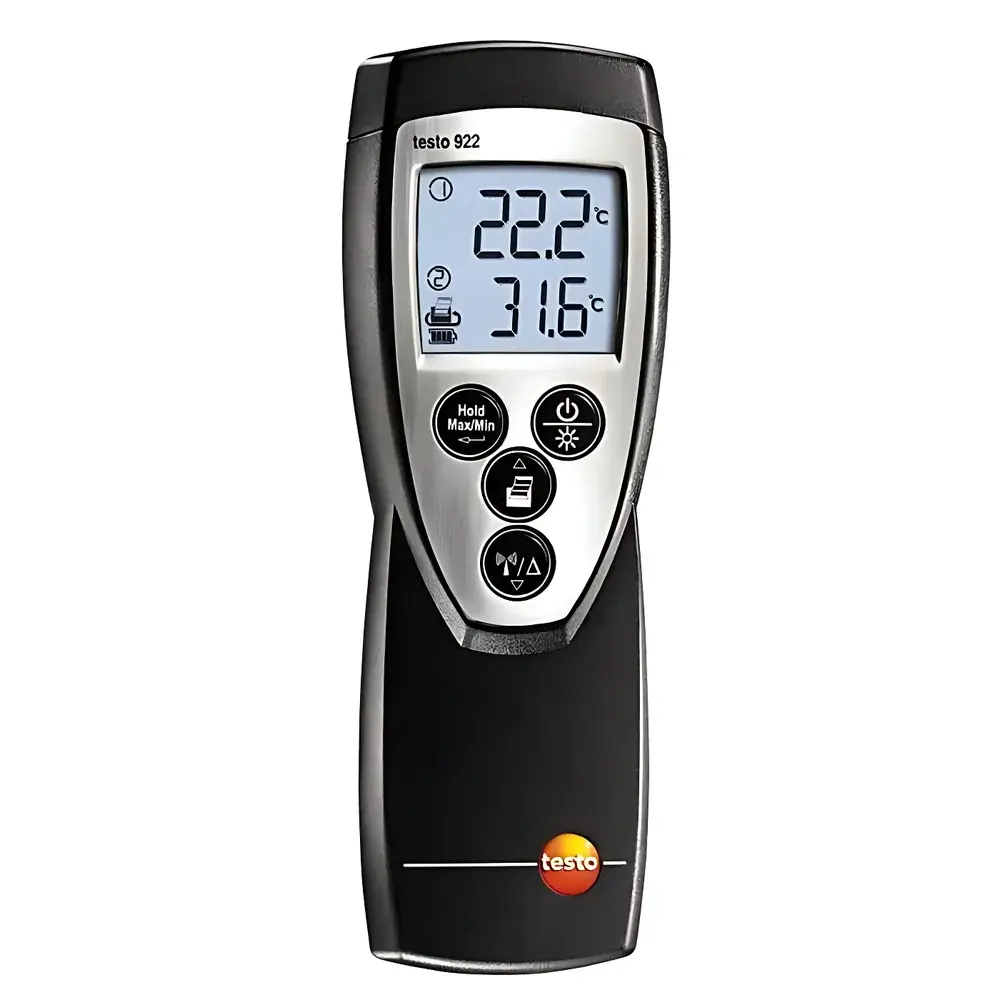
testo 922 Dual-Channel Thermocouple Thermometer
| Brand | testo |
|---|---|
| Origin | Germany |
| Model | 0560 9221 |
| Temperature Measurement Principle | Thermocouple (Type K) |
| Measurement Method | Contact |
| Temperature Range | -50 to +1000 °C |
| Resolution | 0.1 °C (-50 to +199.9 °C), 1 °C (remaining range) |
| Accuracy | ±(0.5 °C + 0.3 % of reading) (-40 to +900 °C), ±(0.7 °C + 0.5 % of reading) (remaining range) |
| Stability | Same as accuracy specification |
| Operating Environment | -20 to +50 °C |
| Weight | 171 g |
| Dimensions | 182 × 64 × 40 mm |
| Power Supply | 9 V battery |
| Battery Life | 200 h (probe connected, backlight off), 68 h (probe connected, backlight on) |
| IP Rating | IP65 |
| Housing Material | ABS |
Overview
The testo 922 Dual-Channel Thermocouple Thermometer is an industrial-grade, handheld temperature measurement instrument engineered for precision, reliability, and field-deployable versatility in HVAC, process maintenance, and technical service applications. Built upon the established thermoelectric principle of Type K (NiCr–Ni) thermocouples, the device delivers direct, real-time contact temperature readings with high reproducibility across an extended operational range from –50 °C to +1000 °C. Its dual-channel architecture enables simultaneous acquisition from two independent probes—supporting comparative measurements such as differential temperature (ΔT), parallel monitoring of supply/return lines, or inlet/outlet profiling in heating, ventilation, and refrigeration systems. Designed and manufactured in Germany, the instrument adheres to stringent quality control protocols aligned with ISO 9001 and conforms to EN 61000-6-2 (immunity) and EN 61000-6-3 (emission) standards for electromagnetic compatibility.
Key Features
- Dual-channel input supporting two Type K thermocouple probes concurrently, with automatic ΔT calculation and display within ≤2 seconds
- High-resolution readout: 0.1 °C resolution in the low-range segment (–50 to +199.9 °C); 1 °C resolution above +200 °C
- Traceable accuracy specification: ±(0.5 °C + 0.3 % of reading) between –40 °C and +900 °C; ±(0.7 °C + 0.5 % of reading) outside that span
- IP65-rated rugged housing constructed from impact-resistant ABS polymer, providing full protection against dust ingress and water jets
- Integrated data-holding function and continuous min/max tracking—ideal for transient thermal event capture during system commissioning or fault diagnosis
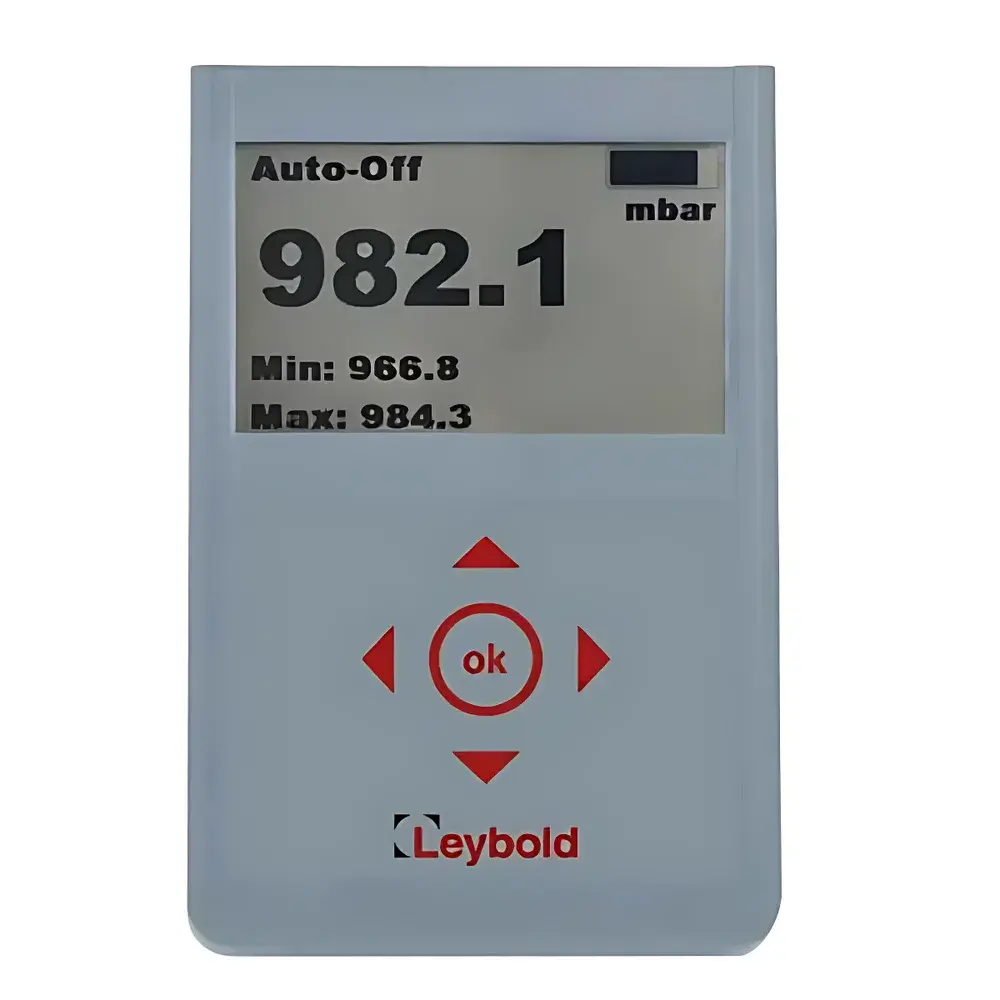
- Backlit LCD display with intuitive icon-driven interface optimized for use under variable ambient lighting conditions
- Extended battery life: up to 200 hours with backlight disabled and probes connected; powered by a standard 9 V alkaline battery
Sample Compatibility & Compliance
The testo 922 interfaces exclusively with standardized Type K thermocouple probes—ensuring broad compatibility with testo’s extensive portfolio of industrial, surface, immersion, air, and high-temperature probes (e.g., flexible cable probes, needle probes, surface thermocouples). All probe connections comply with IEC 60584-1 for thermocouple EMF characteristics and reference junction compensation accuracy. The instrument itself meets CE marking requirements and fulfills essential health and safety provisions under the EU Low Voltage Directive (2014/35/EU) and EMC Directive (2014/30/EU). While not certified for intrinsic safety in hazardous areas, its design supports routine use in non-explosive environments common to commercial HVAC, boiler rooms, chilled water plants, and industrial maintenance workflows.
Software & Data Management
The testo 922 operates as a standalone field instrument without mandatory software dependency. However, when paired with optional accessories—including the testo IR printer (model 0554 0010)—it supports on-site thermal documentation via infrared thermal paper printing. The printer enables time-stamped, auto-cycling output at user-defined intervals (e.g., every 30 seconds or 5 minutes), generating traceable hardcopy records suitable for internal QA logs or client handover reports. Though the base unit does not feature Bluetooth or USB connectivity, its stable analog signal conditioning and consistent calibration drift performance (<0.1 °C/year typical) support long-term compliance with GLP-aligned measurement practices where periodic verification against NIST-traceable references is performed.
Applications
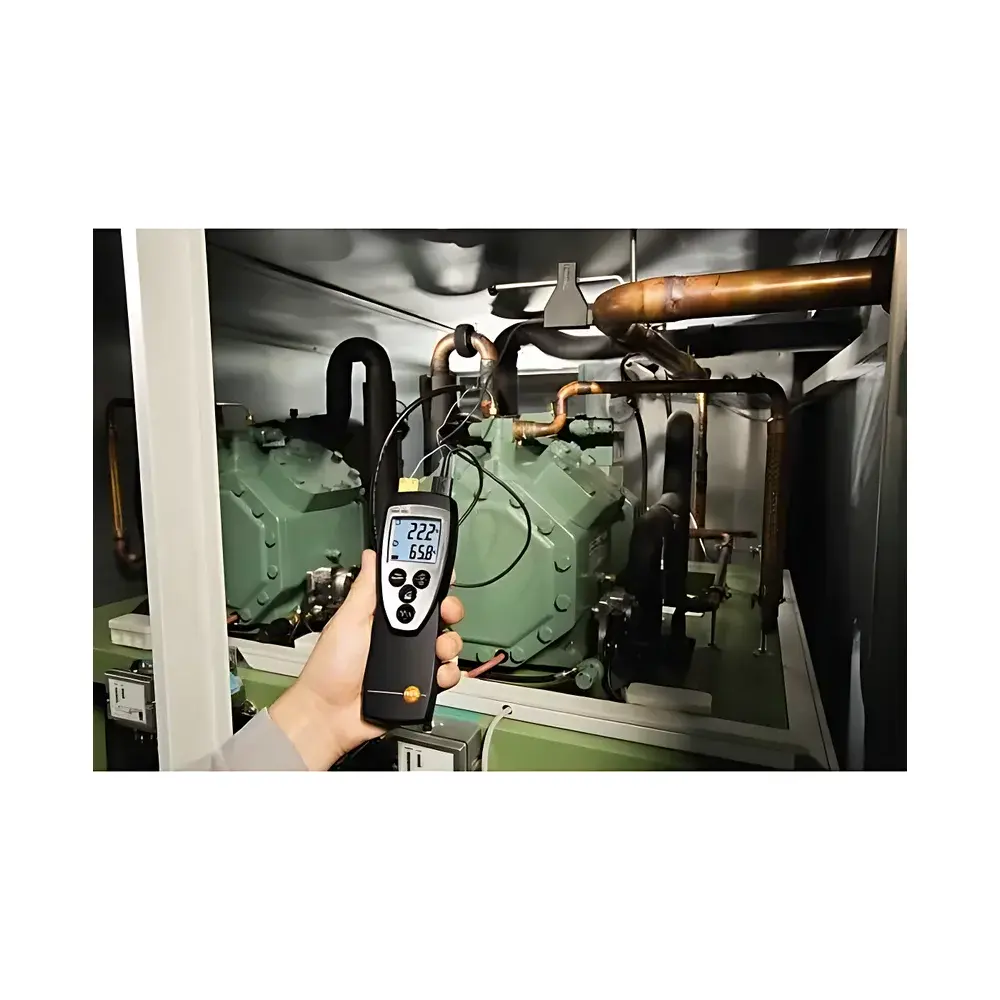
- HVAC system commissioning and balancing: simultaneous measurement of supply/return air or water temperatures to calculate system ΔT and verify heat exchanger efficiency
- Boiler and furnace inspection: surface temperature mapping of flue gas ducts, refractory linings, and burner zones using high-temp K-type probes
- Refrigeration circuit analysis: evaporator/condenser coil temperature differentials, superheat/subcooling verification
- Industrial process monitoring: validation of sterilization cycles, drying oven uniformity, and thermal soak profiles in manufacturing settings
- Energy auditing: identification of thermal bridging, insulation gaps, and duct leakage through comparative surface temperature surveys
FAQ
What thermocouple types are supported by the testo 922?
Only Type K (chromel–alumel) thermocouples are compatible. The instrument applies cold-junction compensation internally and does not support other thermocouple types (e.g., J, T, S) without external signal conditioning.
Can the testo 922 be calibrated in the field?
No—calibration requires traceable reference sources and must be performed by an accredited laboratory or authorized testo service center. The device includes no user-accessible calibration adjustment functions.
Is the testo 922 suitable for food safety applications?
It meets general-purpose temperature measurement requirements but lacks features required for HACCP-critical environments (e.g., automatic data logging with audit trail, FDA 21 CFR Part 11 compliance). For food processing, consider testo’s Saveris or Smart Probe series instead.
Does the instrument retain min/max values after power-off?
No—the min/max memory is volatile and resets upon battery removal or complete power cycle. Values must be manually recorded or printed before shutdown.
What is the maximum allowable probe cable length?
For optimal noise immunity and accuracy, total thermocouple loop resistance should remain below 100 Ω. With standard 28 AWG extension cables, this corresponds to approximately 50 m per channel under typical site conditions.