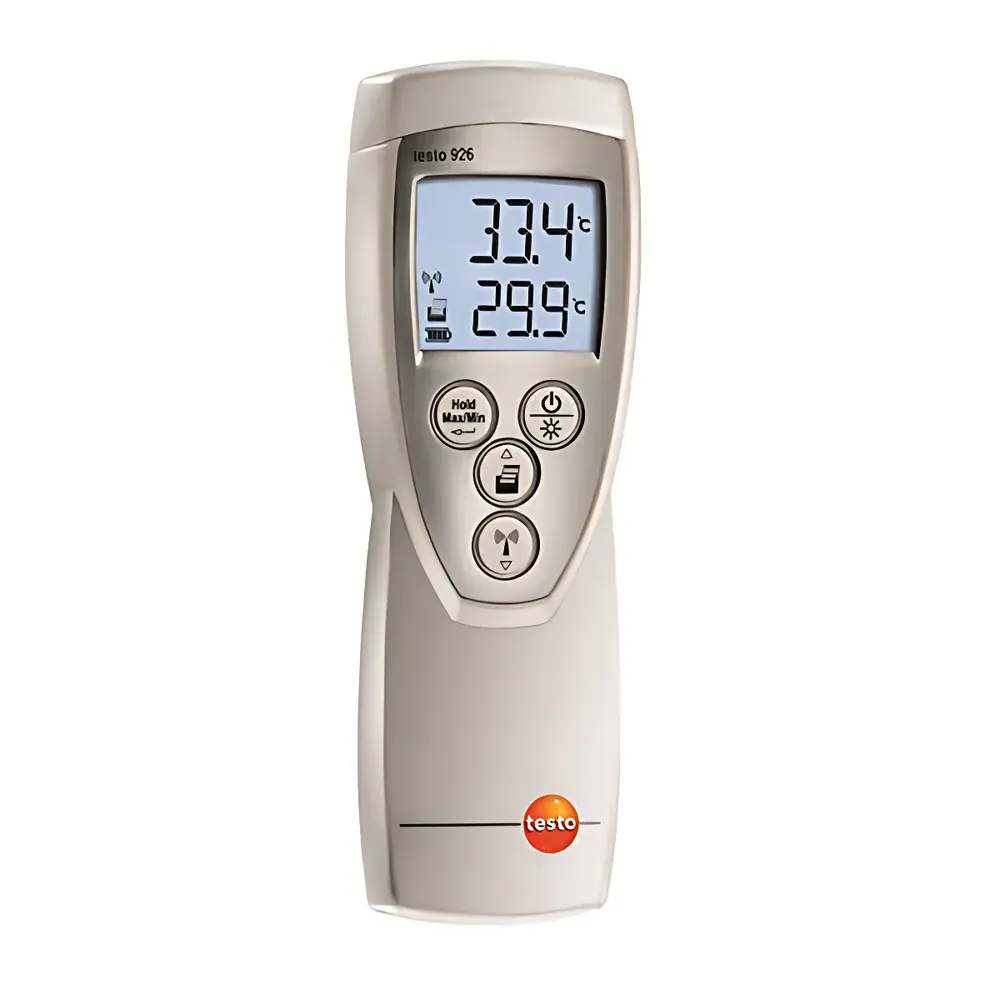
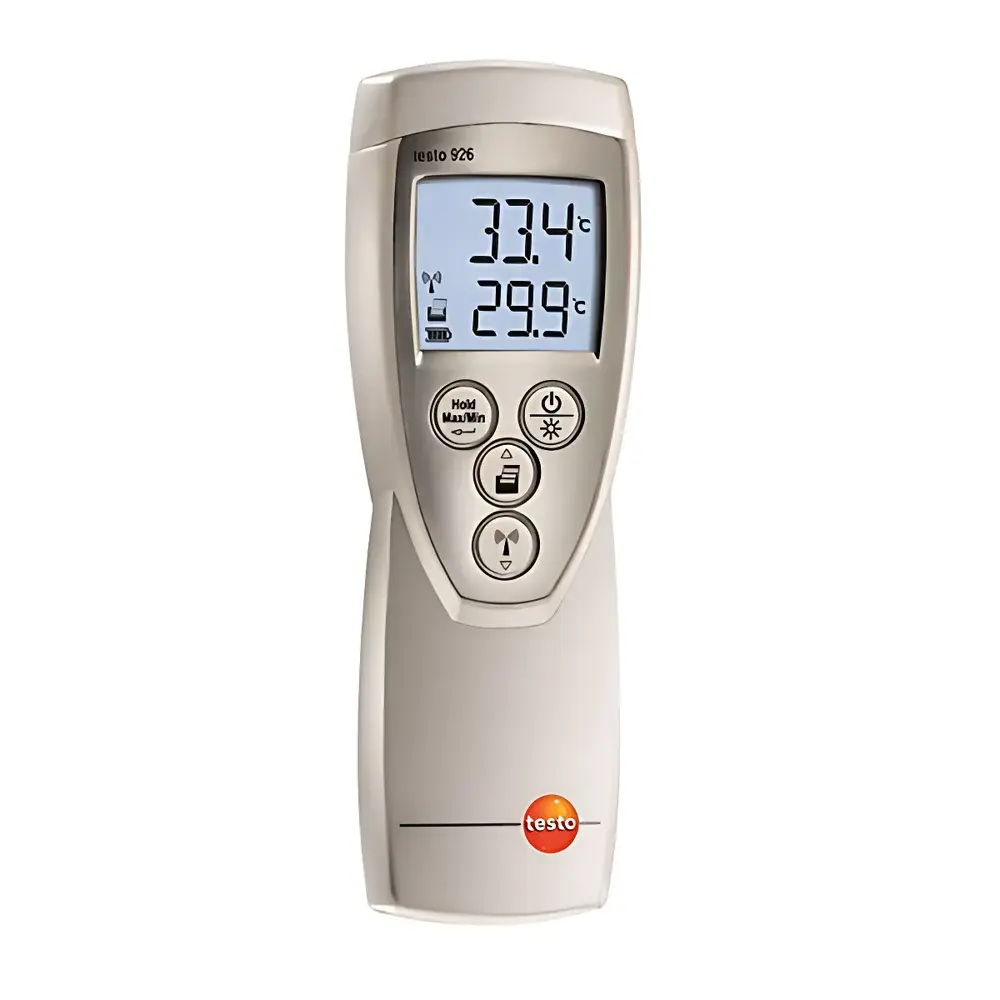
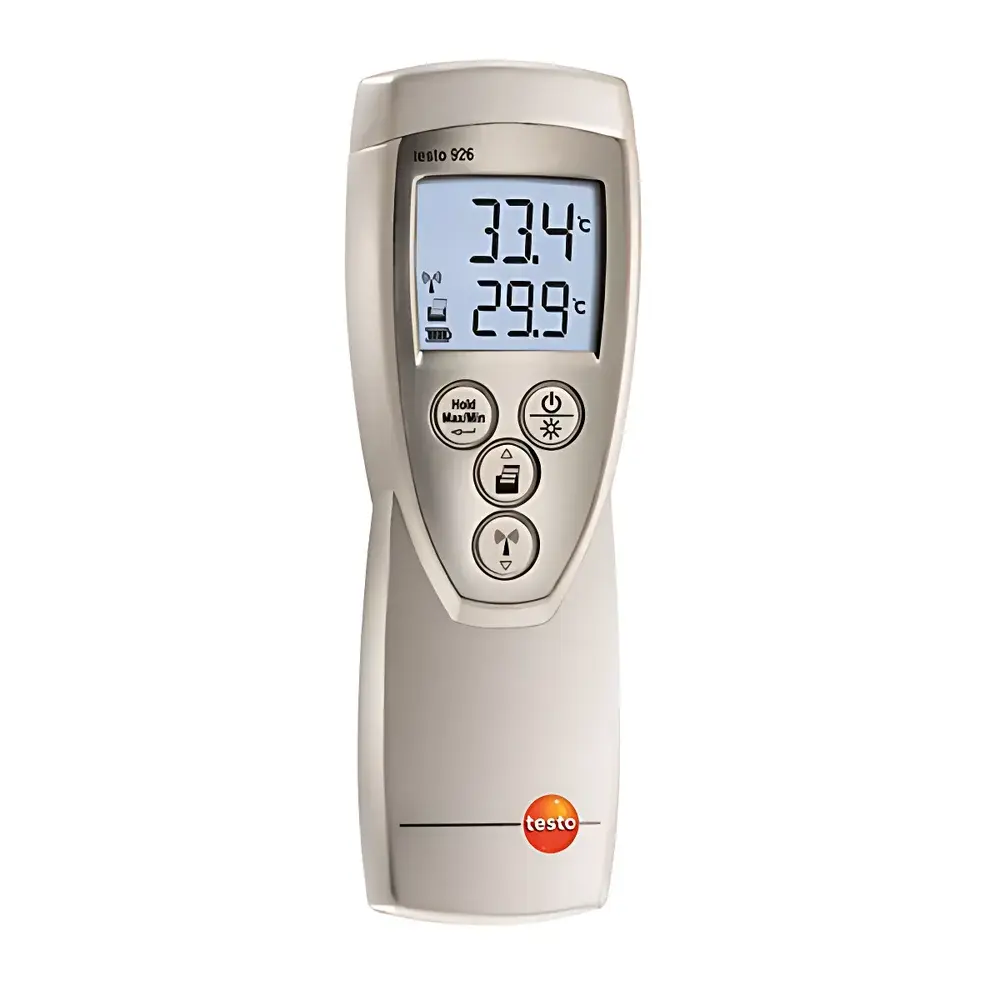
testo 926 Professional Handheld Thermometer (Model 0560 9261)
| Brand | testo |
|---|---|
| Origin | Germany |
| Model | 0560 9261 |
| Temperature Measurement Principle | Thermocouple (Type T & K) |
| Measurement Method | Contact |
| Temperature Range | -50 to +400 °C |
| Resolution | 0.1 °C (-50 to +199.9 °C), 1 °C (remaining range) |
| Accuracy | ±0.3 °C (-20 to +70 °C) |
| Stability | ±0.3 °C (-20 to +70 °C) |
| Operating Temperature | -20 to +50 °C |
| Storage Temperature | -40 to +70 °C |
| IP Rating | IP65 (with optional protective sleeve) |
| Dimensions | 177 × 64 × 40 mm |
| Weight | 182 g (incl. 9 V battery) |
| Battery Life | 200 h (backlight off), 68 h (backlight on) |
| Compliance | EN 13485, HACCP-ready |
| Data Logging | Max/Min auto-capture, user-defined alarm thresholds with audible alert |
Overview
The testo 926 Professional Handheld Thermometer (Model 0560 9261) is a precision-engineered contact temperature measurement instrument designed for rigorous use in food safety, catering, industrial process monitoring, and quality assurance environments. Built upon thermocouple-based sensing technology—supporting both Type T (copper-constantan) and Type K (nickel-chromium/nickel-alumel) probes—the device delivers traceable, repeatable temperature readings across an extended operational range of -50 °C to +400 °C. Its architecture prioritizes metrological integrity, ergonomic field deployment, and regulatory alignment—particularly for applications governed by Hazard Analysis and Critical Control Point (HACCP) protocols and the European standard EN 13485 for medical device quality management systems. The instrument operates exclusively with external thermocouple probes, ensuring flexibility, probe interchangeability, and application-specific sensor selection without internal sensor drift or calibration drift concerns.
Key Features
- Single-channel thermocouple input compatible with Type T and Type K probes—enabling broad material and environmental adaptability
- User-configurable high/low temperature limits with audible alarm activation upon threshold breach
- Automatic max/min value capture and retention—eliminating manual logging errors during time-sensitive inspections
- Rugged ABS housing rated IP65 when used with optional protective sleeve—resistant to dust ingress, water jets, and mechanical impact; washable under running water
- High-contrast LCD display with backlight for low-light conditions (e.g., refrigerated storage, ovens, or dimly lit production lines)
- Fast response time of 0.5 seconds (typical) for dynamic thermal profiling in moving food streams or transient process conditions
- Integrated 9 V battery power with up to 200 hours of continuous operation (backlight off) and built-in battery status indicator
Sample Compatibility & Compliance
The testo 926 is not a standalone sensor but a calibrated readout unit requiring connection to certified thermocouple probes—including fine-wire food probes for core temperature verification, insulated oven probes for high-temperature baking validation, deep-freeze probes for cold chain auditing, and non-marking micro-probes for delicate product surfaces. All probe-to-instrument interfaces comply with IEC 60584-1 for thermocouple reference functions. The device meets EN 13485:2016 requirements for measurement equipment used in quality management systems related to medical devices—and its design supports HACCP prerequisite programs per Codex Alimentarius guidelines. While not inherently 21 CFR Part 11 compliant as a stand-alone unit, audit trails and calibration records (supplied with each unit) are structured to support GLP/GMP documentation workflows when integrated into validated laboratory or production QA systems.
Software & Data Management
The testo 926 operates as a self-contained, firmware-driven measurement terminal with no onboard memory or USB connectivity. Data handling is optimized for real-time decision-making rather than long-term archival: maximum and minimum values are retained until manually reset; alarm events trigger immediate auditory feedback but do not generate timestamped logs. For traceable reporting, users may pair the instrument with the optional testo 425 infrared printer (sold separately), enabling on-site generation of thermal compliance receipts—including date/time stamp, measured value, probe ID (if encoded), and operator identifier (manually entered). Calibration certificates provided with each unit include NIST-traceable reference data and uncertainty budgets aligned with ISO/IEC 17025 principles.
Applications
- Food service: Core temperature verification of cooked meats, chilled ready-to-eat meals, and frozen goods per FDA Food Code and EU Regulation (EC) No 852/2004
- Catering & hospitality: Routine checks of hot-holding cabinets (>63 °C), cold storage units (<8 °C), and blast chillers
- Pharmaceutical manufacturing: Environmental monitoring of cleanroom pass-throughs, stability chambers, and cold chain staging areas
- Mechanical maintenance: Surface temperature assessment of motors, bearings, steam traps, and HVAC ductwork
- Research & development labs: Quick-response validation of thermal profiles during prototype testing or method development
FAQ
Does the testo 926 include a built-in temperature sensor?
No—the instrument requires connection to an external thermocouple probe to function. It contains no integrated sensing element.
Can the testo 926 store measurement history or export data via Bluetooth or USB?
No—it does not feature internal memory, wireless communication, or digital export capabilities. Data capture is limited to live display, max/min hold, and audible alarms.
Is the testo 926 suitable for use in wet or outdoor environments?
Yes—when equipped with the optional protective sleeve, the unit achieves IP65 ingress protection, permitting safe operation in humid kitchens, refrigerated warehouses, and rain-exposed loading docks.
What calibration documentation is included with the device?
Each unit ships with a factory calibration certificate listing reference points, uncertainties, and traceability to national standards; full recalibration services are available through authorized testo calibration centers.
How often should the testo 926 be recalibrated in routine food safety use?
Per HACCP best practices, users should perform daily field verification using a known reference (e.g., ice bath or calibrated dry-block), with formal recalibration recommended annually—or more frequently if subjected to mechanical shock, extreme thermal cycling, or regulatory audit requirements.