
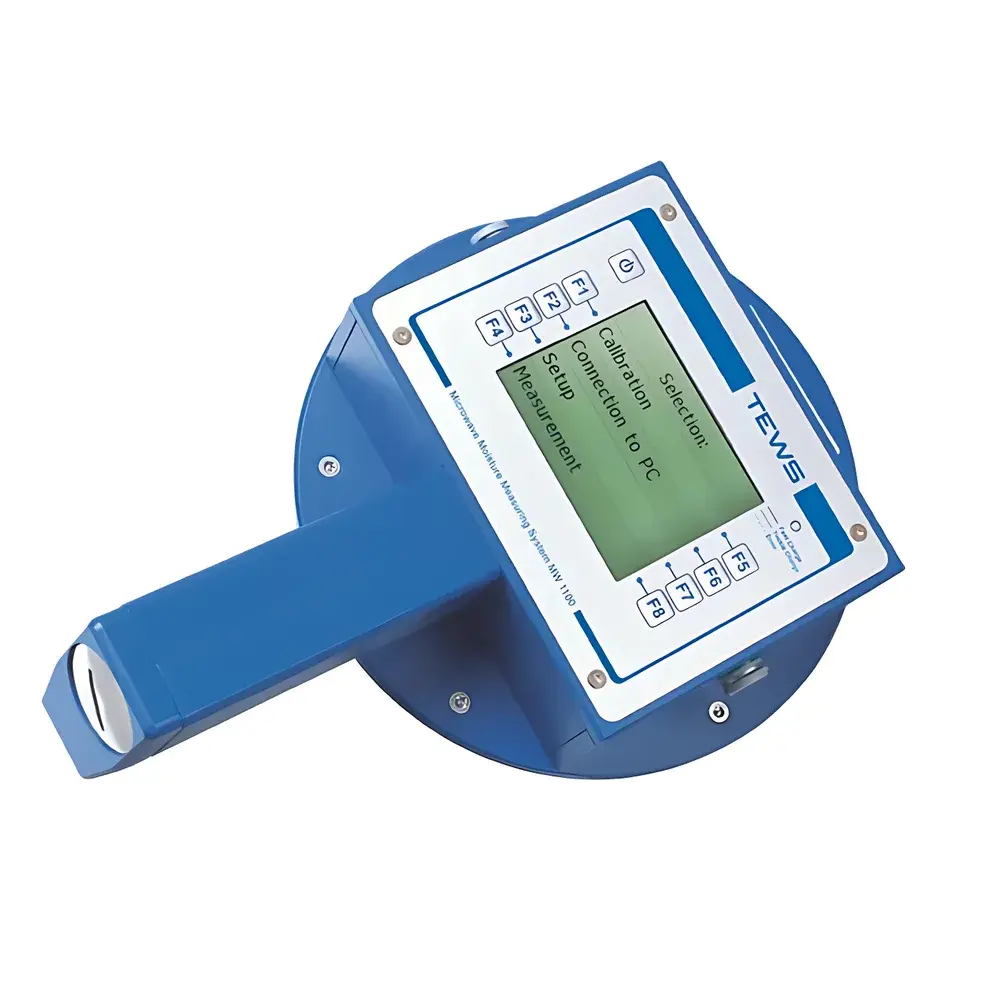
TEWS MW 1100 Portable Microwave Moisture Analyzer
| Brand | TEWS |
|---|---|
| Origin | Germany |
| Model | MW 1100 |
| Sample Temperature Range | 5–60 °C |
| Ambient Temperature Range | 0–40 °C |
| Measurement Time | < 1 s |
| Repeatability | ±0.5% typical standard deviation (material-dependent) |
| Display | 3.5-inch backlit graphical LCD |
| Data Storage | EEPROM, up to 250 measurements |
| Memory Slots | 25 product-specific calibration profiles |
| Power Supply | NiMH rechargeable battery |
| Battery Life | ~5 h (median usage, fully charged) |
| Protection Rating | IP20 |
| Interface | USB |
| Software | TEWS Moisture View Lite © |
Overview
The TEWS MW 1100 Portable Microwave Moisture Analyzer is a handheld, non-destructive measurement system engineered for rapid, in-situ moisture quantification across bulk solids and semi-solid materials. It operates on the principle of microwave dielectric spectroscopy—measuring the attenuation and phase shift of low-power microwave energy (typically in the 2.45 GHz ISM band) as it interacts with polar water molecules within the sample matrix. Unlike traditional loss-on-drying or Karl Fischer titration methods, the MW 1100 delivers real-time, contact-based readings without sample preparation, heating, or chemical reagents. Its flat-bottomed circular sensor head ensures consistent electromagnetic coupling and minimizes air-gap artifacts, enabling high reproducibility across heterogeneous surfaces such as granules, pellets, powders, flakes, and compressed tablets. Designed for field-deployable operation in industrial environments—including production lines, warehouse receiving bays, and QC laboratories—the instrument meets the functional requirements of ISO 712 (cereal and cereal products), ASTM D4748 (microwave moisture testing of soils and aggregates), and supports traceable process monitoring under GLP-compliant workflows.
Key Features
- Sub-second measurement cycle (<1 s per reading), optimized for high-throughput inspection tasks
- Integrated infrared temperature sensor (5–60 °C range) for automatic thermal compensation during moisture calculation
- 25 pre-programmable product-specific calibration profiles, supporting multi-material workflows without manual recalibration
- 3.5-inch backlit graphical LCD with intuitive icon-driven interface and real-time numeric + bar-graph display
- Robust mechanical architecture with IP20-rated enclosure suitable for controlled indoor industrial settings
- Onboard EEPROM storage for 250 full measurement records, including timestamp, product ID, moisture value, and surface temperature
- Rechargeable NiMH battery providing ~5 hours of continuous operation at median usage intensity
Sample Compatibility & Compliance
The MW 1100 is validated for use with non-metallic, low-conductivity materials where microwave penetration depth exceeds nominal sample thickness (e.g., grains, feedstuffs, tobacco, coffee beans, pharmaceutical excipients, polymer granules, and dried foodstuffs). It is not intended for metallic, highly saline, or ferromagnetic substrates due to signal reflection and dielectric saturation effects. The instrument complies with CE marking requirements under the EU Electromagnetic Compatibility Directive 2014/30/EU and Low Voltage Directive 2014/35/EU. While not certified for hazardous area use (ATEX/IECEx), its battery-powered design eliminates grounding risks in static-sensitive environments. Calibration traceability follows manufacturer-established protocols aligned with ISO/IEC 17025 principles; users are advised to perform periodic verification using NIST-traceable reference standards.
Software & Data Management
Data export and configuration management are enabled via USB connection to Windows-based systems running TEWS Moisture View Lite © software. This application provides secure bidirectional communication: downloading stored measurements with metadata (date/time, product code, moisture %, surface temp), uploading new calibration profiles, and generating CSV-formatted reports compatible with LIMS integration. Audit trail functionality includes user-defined session logging and modification timestamps. Though the firmware does not implement FDA 21 CFR Part 11 electronic signature controls, the software supports manual documentation practices required under GMP Annex 11 and ISO 9001:2015 clause 7.5.3 for record retention and change control.
Applications
- Real-time moisture verification during raw material receipt (e.g., incoming grain lots, resin pellets, herbal extracts)
- In-line quality gate checks prior to packaging or further processing steps
- Batch release testing in pharmaceutical solid-dosage manufacturing (excipient drying validation)
- Field-based agricultural moisture assessment for harvest timing and storage readiness
- Process troubleshooting support—identifying localized drying inconsistencies or hygroscopic uptake post-processing
- Supplier qualification audits requiring portable, operator-independent measurement capability
FAQ
What types of materials can be measured with the MW 1100?
The instrument is suitable for homogeneous or moderately heterogeneous non-conductive solids with moisture content between 0.5% and 25% w/w, including cereals, feed, plastics, pharmaceutical powders, and dried botanicals.
Does the MW 1100 require daily calibration verification?
While factory calibration remains stable over time, TEWS recommends verifying performance weekly using certified reference standards matching your primary material type.
Can the MW 1100 operate in cold storage environments?
Ambient operation is limited to 0–40 °C; however, short-term exposure (≤15 min) at temperatures down to –10 °C is permissible if the unit is acclimatized before measurement.
Is the infrared temperature sensor used for moisture correction?
Yes—surface temperature data feeds into the dielectric model to compensate for permittivity drift, improving accuracy across the 5–60 °C sample temperature range.
How is measurement repeatability defined for this instrument?
Repeatability is expressed as the typical standard deviation of 10 consecutive measurements on a uniform sample under constant environmental conditions, averaging ±0.5% (material-dependent).




