
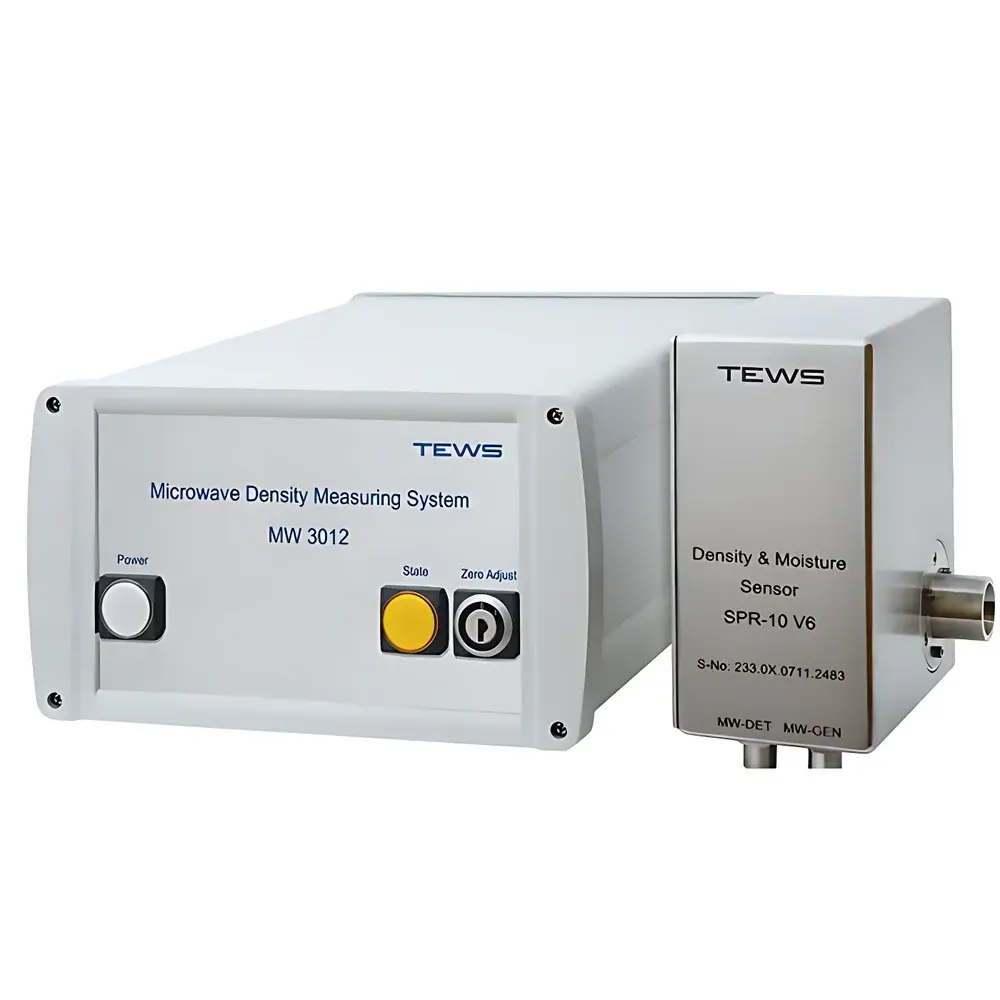
TEWS MW 3012 High-Speed Microwave Moisture and Density Measurement System
| Brand | TEWS |
|---|---|
| Origin | Germany |
| Model | MW 3012 |
| Power Supply | 110–230 V AC, 50–60 Hz |
| Operating Temperature | 0–40 °C |
| Analog Input | Product Temperature |
| Analog Output | Measured Values |
| Digital I/O | Control & Status Signals |
| Communication Interfaces | RS-232/RS-485 Serial, Ethernet (10/100BASE-T), CAN 2.0A/B, LAN |
| Max Sampling Rate | 40,000 readings/s |
| Application Scope | In-line moisture & density measurement of fast-moving discrete or continuous materials (e.g., cigarettes, yarns, tablets, capsules, filter rods) |
Overview
The TEWS MW 3012 High-Speed Microwave Moisture and Density Measurement System is an industrial-grade, non-contact microwave transmission analyzer engineered for real-time, dual-parameter quantification of moisture content and bulk density in dynamic production environments. Unlike conventional loss-on-drying or near-infrared (NIR) methods, the MW 3012 employs high-frequency microwave transmission (typically in the 1–10 GHz range) through the material stream, where attenuation and phase shift are correlated to dielectric properties—primarily governed by water’s high relative permittivity (~80 at 20 °C) and density-dependent mass attenuation coefficient. This physical principle enables simultaneous, calibration-stable determination without sample preparation, consumables, or radiation safety licensing. Designed for integration into high-speed manufacturing lines—including cigarette-making machines, filter rod forming units, pharmaceutical tablet presses, and textile spinning frames—the system delivers sub-millisecond temporal resolution and robust immunity to ambient dust, vibration, and thermal drift.
Key Features
- True dual-parameter output: Synchronized moisture (% w/w) and density (g/cm³ or kg/m³) derived from a single microwave transmission path
- Ultra-high sampling capability: Up to 40,000 calibrated measurements per second via analog output channel, supporting closed-loop weight control at line speeds exceeding 1,200 m/min
- Industrial interface flexibility: Native support for RS-232/RS-485 serial protocols, IEEE 802.3-compliant Ethernet (TCP/IP), CAN 2.0A/B for PLC synchronization, and isolated digital I/O for machine-state triggering and alarm signaling
- Environmental resilience: IP65-rated enclosure; operational within 0–40 °C ambient range and 10–90% non-condensing RH; designed for continuous duty in Class A2 cleanroom-adjacent or ISO 14644-1 Grade 8 production zones
- Modular calibration architecture: Factory-traceable reference standards for tobacco, cellulose acetate, polymer capsules, and pharmaceutical excipients; user-configurable multi-point linearization tables stored in non-volatile memory
Sample Compatibility & Compliance
The MW 3012 is validated for use with discrete items (e.g., individual cigarettes, tablets, capsules) and continuous webs/filaments (e.g., spun yarns, paper strips, filter tow). Its measurement geometry accommodates products with cross-sectional dimensions from 1 mm to 50 mm and dielectric loss tangents (tan δ) between 0.005 and 0.5—covering most organic matrices encountered in tobacco, pharma, food, and textile industries. The system complies with EN 61000-6-2 (immunity) and EN 61000-6-4 (emission) for industrial environments. While not a medical device, its output data meets ALCOA+ principles when integrated into GMP-compliant infrastructure; audit trails, electronic signatures, and change control logs can be implemented via external SCADA or MES platforms adhering to FDA 21 CFR Part 11 requirements.
Software & Data Management
The MW 3012 operates as a deterministic edge sensor—no embedded OS or local GUI. Configuration, diagnostics, and real-time monitoring are performed via TEWS’ proprietary PC-based Engineering Tool (ET-MW), which runs on Windows 10/11 and supports OPC UA client connectivity. All measurement data streams are timestamped with microsecond precision using IEEE 1588 PTP (Precision Time Protocol) over Ethernet. Raw analog outputs (0–10 V or 4–20 mA) carry fully linearized, temperature-compensated values; digital registers accessible via Modbus TCP include statistical buffers (min/max/mean/std dev over configurable windows), diagnostic flags (e.g., signal-to-noise ratio, path obstruction warning), and firmware revision identifiers. Data export formats include CSV, HDF5, and XML for traceability in LIMS or quality analytics platforms.
Applications
- Cigarette manufacturing: Real-time weight and moisture profiling of individual rods on high-speed makers (e.g., PROTOS, GD series); feedback to servo-controlled tobacco dosing and paper tension systems
- Filter rod production: Quantitative assessment of capsule placement integrity, multi-segment filter density gradients, and glycerol distribution uniformity in acetate tow
- Pharmaceutical solid dosage: In-process verification of tablet/capsule mass consistency during high-speed compression or encapsulation; compatible with PAT (Process Analytical Technology) frameworks per ICH Q8/Q9
- Technical textiles: Online moisture monitoring of synthetic or blended yarns during winding, warping, or heat-setting—enabling adaptive humidity conditioning control
- Food processing: Continuous validation of moisture homogeneity in extruded snacks, cereal bars, or dried fruit streams where NIR suffers from surface-only sensitivity
FAQ
Does the MW 3012 require periodic recalibration with physical reference samples?
No—microwave transmission response is inherently stable over time due to absence of optical components or consumable reagents. However, annual verification against NIST-traceable moisture standards (e.g., ASTM D4442 for wood, USP <921> for pharmaceuticals) is recommended for audit readiness.
Can the system distinguish between free water and bound water?
Not directly—the MW 3012 reports total dielectrically active water. Differentiation requires complementary techniques (e.g., TD-NMR or DSC) or multivariate modeling using auxiliary process variables.
Is explosion-proof certification available for solvent-rich environments?
Standard units carry CE marking for Zone 2/22 (EN 60079-0). ATEX/IECEx-certified variants (II 2G Ex db IIB T4 Gb / II 2D Ex tb IIIC T135°C Db) are available upon request with modified housing and intrinsically safe interface modules.
What is the minimum detectable moisture change under typical operating conditions?
Resolution depends on material thickness and base permittivity, but typical detection limits range from ±0.03% w/w for 2-mm-thick cigarettes to ±0.15% w/w for 10-mm-diameter filter rods—validated per ISO 12099:2017 Annex B protocols.
How is temperature compensation implemented?
An integrated Pt100 sensor monitors product surface temperature upstream of the measurement zone; compensation algorithms apply material-specific thermal coefficients stored in the calibration database, eliminating need for external thermocouple wiring.
Related Products





