
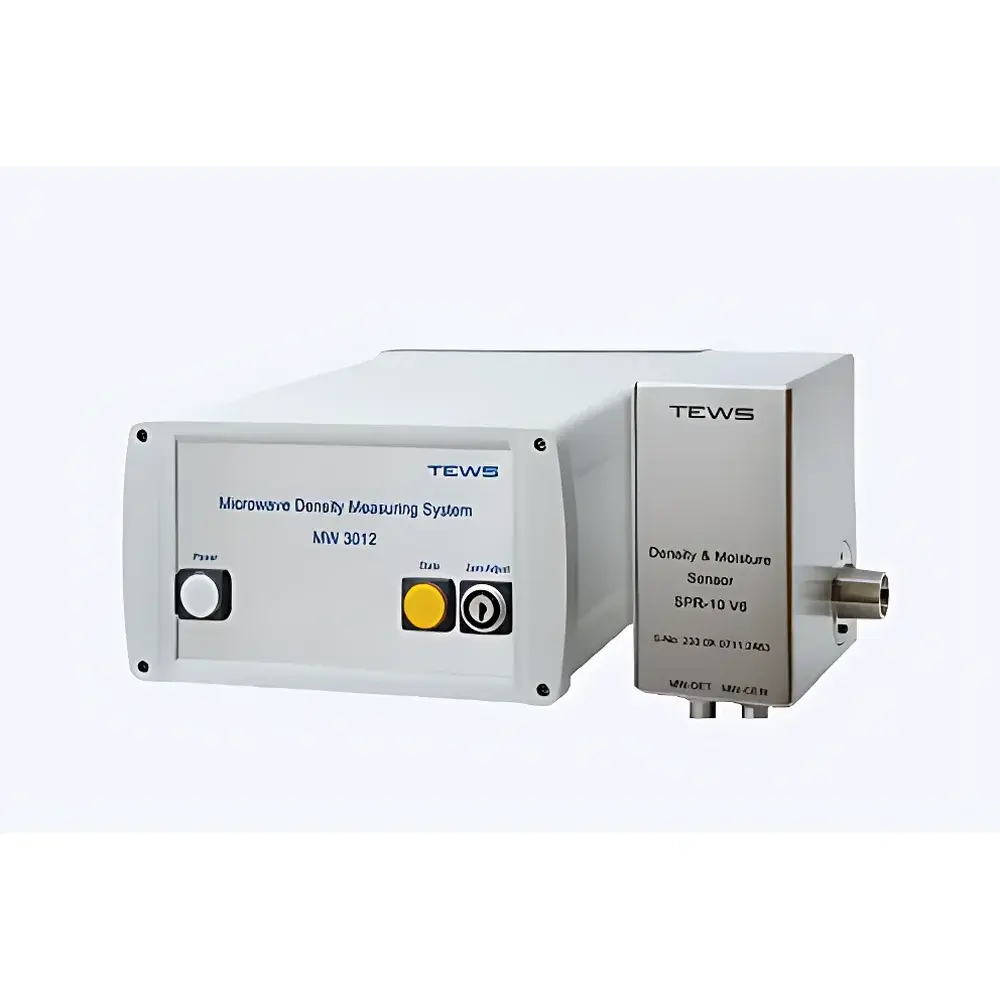
TEWS MW3012 High-Speed Online Microwave Moisture and Density Analyzer
| Brand | TEWS |
|---|---|
| Origin | Germany |
| Model | MW3012 |
| Measurement Principle | Microwave Absorption Spectroscopy (2.45 GHz) |
| Moisture Range | 10 ppm – 20 wt% |
| Sampling Rate | Up to 40,000 measurements per second |
| Response Time | < 1 ms |
| Sample Types | Powders, granules, tablets, capsules, fibers, films, sheets, yarns, cigarettes |
| Output | Simultaneous moisture content (%) and bulk density (g/cm³) |
| Compliance | CE, RoHS, ISO/IEC 17025 compatible workflows |
| Interface | RS-485, Ethernet (TCP/IP), 4–20 mA analog output |
| Operating Temperature | 0–50 °C |
| Enclosure Rating | IP65 |
Overview
The TEWS MW3012 is a high-speed, non-contact online microwave moisture and density analyzer engineered for real-time, in-line process monitoring of solid materials in both laboratory and industrial environments. Utilizing dual-parameter microwave absorption spectroscopy at 2.45 GHz, the system measures dielectric permittivity and loss factor changes induced by water molecules—enabling simultaneous quantification of moisture content (10 ppm to 20 wt%) and bulk density (g/cm³) without physical contact or sample preparation. Unlike near-infrared (NIR) or Karl Fischer titration methods, microwave measurement is insensitive to surface color, opacity, or particle size distribution, delivering robust performance across heterogeneous, fast-moving product streams—including pharmaceutical tablets on high-speed blister lines, textile yarns traversing at >30 m/s, or cigarette rods moving at line speeds exceeding 1000 m/min. Its sub-millisecond response time (≤1 ms) and sustained data acquisition rate of up to 40,000 readings per second ensure statistical confidence in dynamic process conditions, making it suitable for closed-loop feedback control integration in GMP-compliant manufacturing.
Key Features
- True real-time analysis: No sampling, no calibration drift, no consumables—designed for continuous 24/7 operation.
- Dual-output capability: Synchronized moisture % (wt) and bulk density (g/cm³) derived from a single microwave interrogation event.
- Non-invasive measurement: Operates through standard industrial conveyor belts, stainless-steel chutes, or polymer-lined hoppers—no beam interruption or material handling required.
- High-speed motion tolerance: Optimized antenna geometry and signal processing architecture support accurate measurement on products moving at velocities up to 1200 m/min.
- Rugged industrial design: IP65-rated housing, operating temperature range 0–50 °C, and electromagnetic interference (EMI) shielding compliant with EN 61326-1 for factory floor deployment.
- Modular connectivity: Native support for RS-485 Modbus RTU, Ethernet TCP/IP (with OPC UA optional), and isolated 4–20 mA analog outputs for PLC/DCS integration.
Sample Compatibility & Compliance
The MW3012 accommodates a broad spectrum of solid-phase materials—ranging from fine pharmaceutical powders (e.g., lactose, microcrystalline cellulose) and compressed dosage forms (tablets, capsules) to industrial fibers, extruded polymer sheets, tobacco rods, and agri-food granules. Its microwave-based methodology eliminates dependence on optical transparency or spectral reference libraries, ensuring consistent accuracy regardless of surface finish, coating, or geometric irregularity. The system supports trace-level moisture detection down to 10 ppm, meeting analytical requirements for low-moisture APIs per ICH Q5C and USP <921>. While not a standalone regulatory-certified device, its output data structure, audit trail logging (via optional software module), and hardware traceability align with GLP and GMP documentation expectations under FDA 21 CFR Part 11 when deployed with validated configuration and change control procedures.
Software & Data Management
The MW3012 operates with TEWS ControlSuite v3.x—a Windows-based configuration and visualization platform supporting real-time waveform display, statistical process monitoring (SPC), trend analysis, and alarm threshold management. Raw sensor data (moisture, density, signal-to-noise ratio, temperature-compensated permittivity) are timestamped and stored in .csv or SQLite format, with optional export to LIMS or MES via ODBC or REST API. The software includes built-in calibration validation tools, including reference material drift tracking and multi-point verification routines traceable to NIST-traceable moisture standards. Audit trail functionality records all parameter modifications, user logins, and firmware updates—supporting compliance readiness for internal quality audits and regulatory inspections.
Applications
- Pharmaceutical manufacturing: Real-time moisture surveillance during fluid-bed drying, roller compaction, and tablet coating—reducing over-drying energy costs and preventing delamination or capping.
- Food & feed processing: In-line monitoring of cereal flakes, pet food kibbles, and powdered dairy blends to maintain shelf-life stability and prevent microbial proliferation.
- Textile & nonwovens: Continuous moisture profiling of spunbond polypropylene webs pre- and post-calendering to optimize bonding efficiency and tensile uniformity.
- Tobacco industry: On-machine measurement of cut filler and cigarette rod moisture during high-speed packaging—critical for burn rate consistency and regulatory tar yield reporting.
- Chemical & polymer production: Verification of desiccant dryer performance for hygroscopic resins (e.g., PA6, PET) prior to extrusion or injection molding.
FAQ
Does the MW3012 require periodic recalibration using reference standards?
Yes—while the system exhibits long-term stability, TEWS recommends quarterly verification using traceable moisture reference materials (e.g., certified anhydrous sodium sulfate or polyethylene glycol standards) to confirm measurement accuracy within specification limits.
Can the MW3012 be installed directly above a vibrating feeder or rotary valve?
Yes, provided mechanical vibration amplitude remains below 0.5 mm peak-to-peak at frequencies <100 Hz; optional anti-vibration mounting kits are available upon request.
Is the 2.45 GHz microwave emission safe for operators and adjacent electronics?
Yes—the system complies with ICNIRP 2020 exposure limits; maximum radiated power is <10 mW/cm² at 30 cm distance, well below occupational safety thresholds—and EMI testing confirms compatibility with nearby PLCs and vision systems.
How is temperature compensation handled during rapid ambient fluctuations?
An integrated Pt100 sensor monitors local probe head temperature; real-time dielectric model correction is applied using empirically derived thermal coefficients specific to each material class.
What is the minimum measurable sample thickness for reliable density determination?
For optimal signal penetration and reflection separation, a minimum thickness of 3 mm is recommended for low-density materials (<0.3 g/cm³); for denser solids (>1.2 g/cm³), 1.5 mm suffices.






