
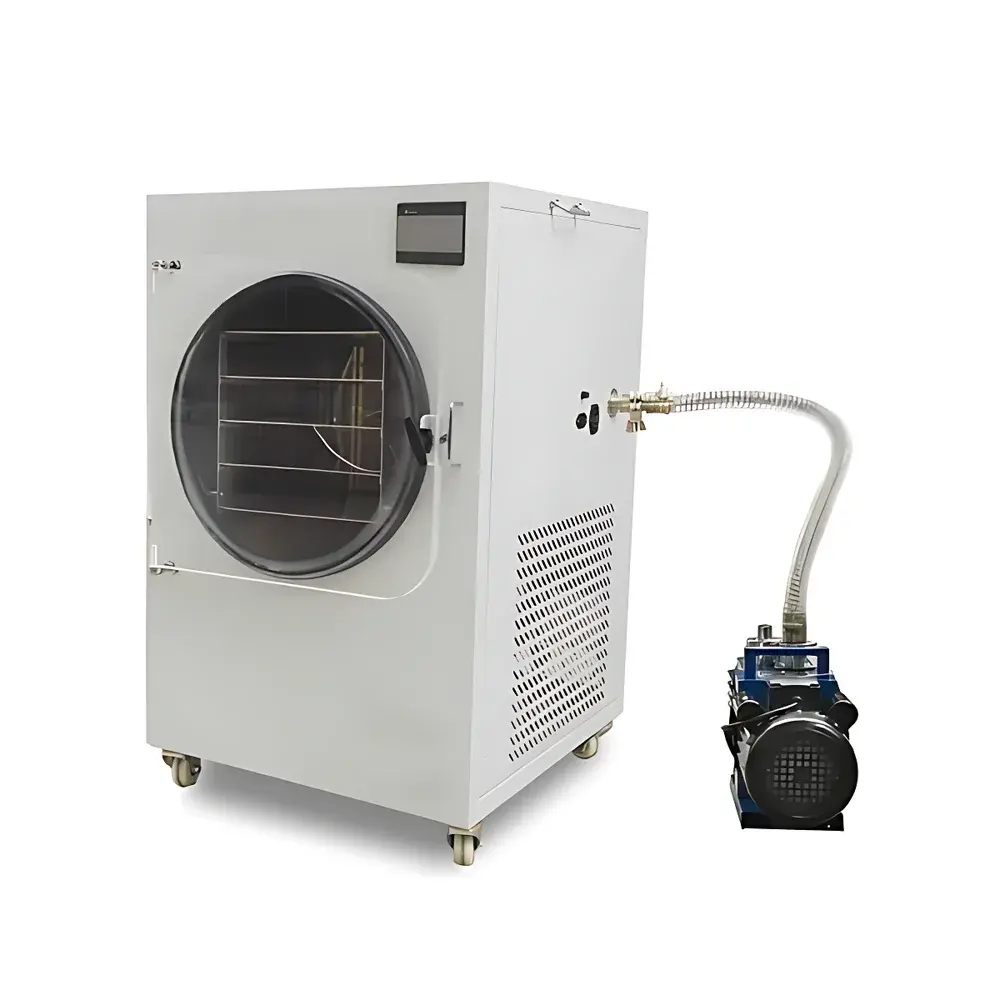
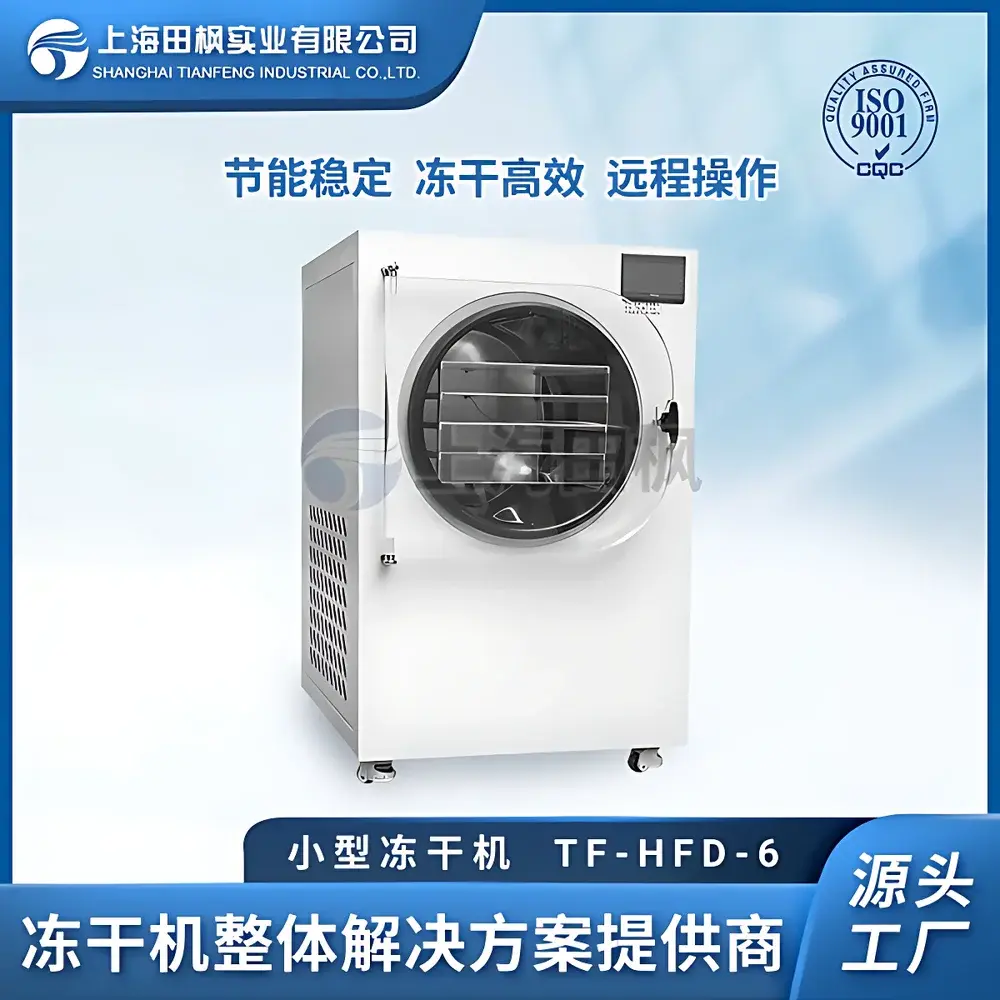
TF-Feng TF-HFD-6 Laboratory Benchtop Freeze Dryer
| Brand | TF-Feng |
|---|---|
| Origin | Shanghai, China |
| Manufacturer Type | Direct Manufacturer |
| Product Category | Domestic |
| Model | TF-HFD-6 |
| Instrument Type | Standard Shelf-Type Freeze Dryer |
| Application Scope | Laboratory R&D and Small-Batch Processing |
| Freeze-Drying Area | 0.6 m² |
| Ultimate Vacuum | ≤10 Pa (at no-load) |
| Condenser Temperature | ≤−40 °C |
| Water Capture Capacity | 10 kg/24 h |
| Chamber Dimensions (W×D×H) | 710 mm × 850 mm × 1080 mm (excluding door panel and handles) |
| Shelf Size | 330 mm × 440 mm × 4 shelves |
| Power Supply | 220 V, 50 Hz |
| Rated Power | 2300 W |
| Control System | Touchscreen with Real-Time Shelf Temperature & Process Curve Display |
| Defrost Function | One-Touch Automatic Defrost |
| Construction | SUS304 Stainless Steel Interior & Trays |
| Viewing Window | Transparent Acrylic Door |
| Compliance | Designed for GLP-aligned laboratory workflows |
| Energy Efficiency | Low operating current, optimized thermal management |
Overview
The TF-Feng TF-HFD-6 is a compact, benchtop-scale shelf-type freeze dryer engineered for precision lyophilization in academic research laboratories, pharmaceutical development units, and natural product processing facilities. It operates on the fundamental principles of sublimation under deep vacuum: frozen samples are subjected to controlled low-pressure conditions while heat is carefully applied to enable direct phase transition from ice to vapor—bypassing the liquid state entirely. This preserves thermolabile compounds, structural integrity, and biological activity far more effectively than conventional air-drying or spray-drying methods. With a validated freeze-drying area of 0.6 m² and a condenser capable of maintaining ≤−40 °C, the system supports reproducible batch processing of diverse sample types—including marine biologics (e.g., sea cucumber, abalone), botanicals (herbs, flowers, fruits), and functional food matrices—without cross-contamination or manual handling during primary drying.
Key Features
- Patented in-situ freezing architecture eliminates sample transfer between freezing and drying stages, reducing contamination risk and operator variability.
- Four stainless steel (SUS304) shelves, each sized 330 mm × 440 mm, ensure uniform heat distribution and mechanical stability during long-duration cycles.
- Integrated touchscreen HMI enables real-time monitoring and dynamic adjustment of shelf temperature, chamber pressure, and condenser status; all process parameters are timestamped and logged.
- Transparent acrylic front door allows unobstructed visual observation of ice sublimation, cake formation, and endpoint detection without compromising vacuum integrity.
- Imported critical components—including vacuum pump interface valves, refrigeration compressors, and PID-controlled heating elements—deliver low acoustic noise (<58 dB(A)) and high thermal efficiency.
- One-touch automatic defrost function accelerates maintenance intervals and prevents frost accumulation-induced thermal lag or condenser overload.
- Over-temperature safety cutoff and vacuum interlock mechanisms comply with IEC 61000-6-2 EMC standards and support ISO/IEC 17025-compliant validation protocols.
Sample Compatibility & Compliance
The TF-HFD-6 accommodates vials, trays, and open dishes within its 0.6 m² active drying zone. Its ≤10 Pa ultimate vacuum performance meets ASTM F2476–22 requirements for residual moisture quantification in lyophilized reference standards. The system’s stainless steel construction adheres to FDA-recommended material specifications for equipment contacting GMP-regulated substances. While not certified as 21 CFR Part 11-compliant out-of-the-box, its data logging architecture supports audit-trail-ready configuration when integrated with validated third-party software platforms used in QC/QA environments. All electrical subsystems conform to GB/T 14048.1–2012 (equivalent to IEC 60947-1) for low-voltage switchgear safety.
Software & Data Management
Process data—including shelf temperature (±0.3 °C accuracy), chamber pressure (capacitance manometer, ±5% full scale), and condenser temperature—is acquired at 1-second intervals and stored internally for ≥30 days. Export options include CSV via USB 2.0 port for post-processing in MATLAB, OriginLab, or JMP. The embedded control firmware supports user-defined multi-step programs (up to 99 segments per cycle), with adjustable ramp rates, hold durations, and pressure modulation logic. Optional Ethernet connectivity enables remote supervision via Modbus TCP in networked lab infrastructures aligned with Industry 4.0 instrumentation frameworks.
Applications
- Stabilization of heat-sensitive proteins, enzymes, and monoclonal antibodies during pre-formulation studies.
- Preservation of microbial cultures, probiotics, and vaccine candidates requiring long-term viability retention.
- Dehydration of botanical extracts and traditional Chinese medicinal herbs without degradation of volatile terpenoids or polyphenolic antioxidants.
- Preparation of calibration standards for LC-MS and ICP-MS analysis where matrix consistency and water content control are critical.
- Small-batch pilot production of functional food powders (e.g., matcha, goji berry, spirulina) with retained color, flavor, and antioxidant capacity.
FAQ
What is the maximum batch volume this unit can handle per cycle?
Based on 0.6 m² shelf area and typical loading density (10–15 mm depth), the TF-HFD-6 supports up to 8–12 L of aqueous solution per run—assuming ~10% solids content and standard freezing kinetics.
Does the system support programmable shelf temperature control during primary and secondary drying?
Yes. Each of the four shelves is independently monitored and heated via calibrated cartridge heaters, enabling gradient-based drying profiles and isothermal holds per ASTM E2572–20 guidelines.
Is validation documentation (IQ/OQ/PQ templates) available?
TF-Feng provides standard factory test reports (FAT) and dimensional/mechanical verification records. Custom IQ/OQ protocols can be developed in collaboration with qualified third-party validation partners.
Can the unit operate continuously for extended cycles (e.g., >48 hours)?
Yes—its dual-stage refrigeration circuit and reinforced condenser coil design allow uninterrupted operation across multi-day cycles, provided ambient room temperature remains ≤25 °C and relative humidity <60%.
What maintenance intervals are recommended for optimal performance?
Vacuum pump oil replacement every 500 operating hours; condenser cleaning every 20 cycles; O-ring inspection and lubrication quarterly; full system calibration annually per ISO/IEC 17025 traceable standards.



