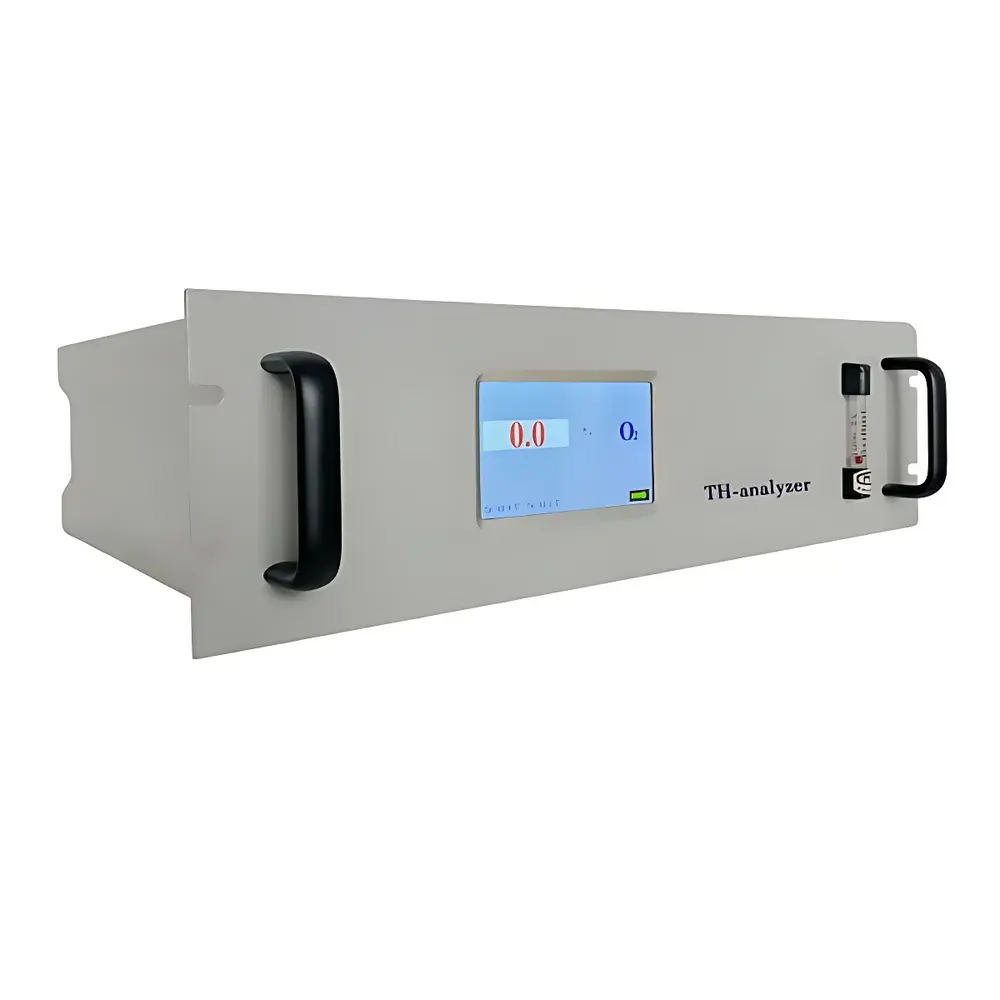

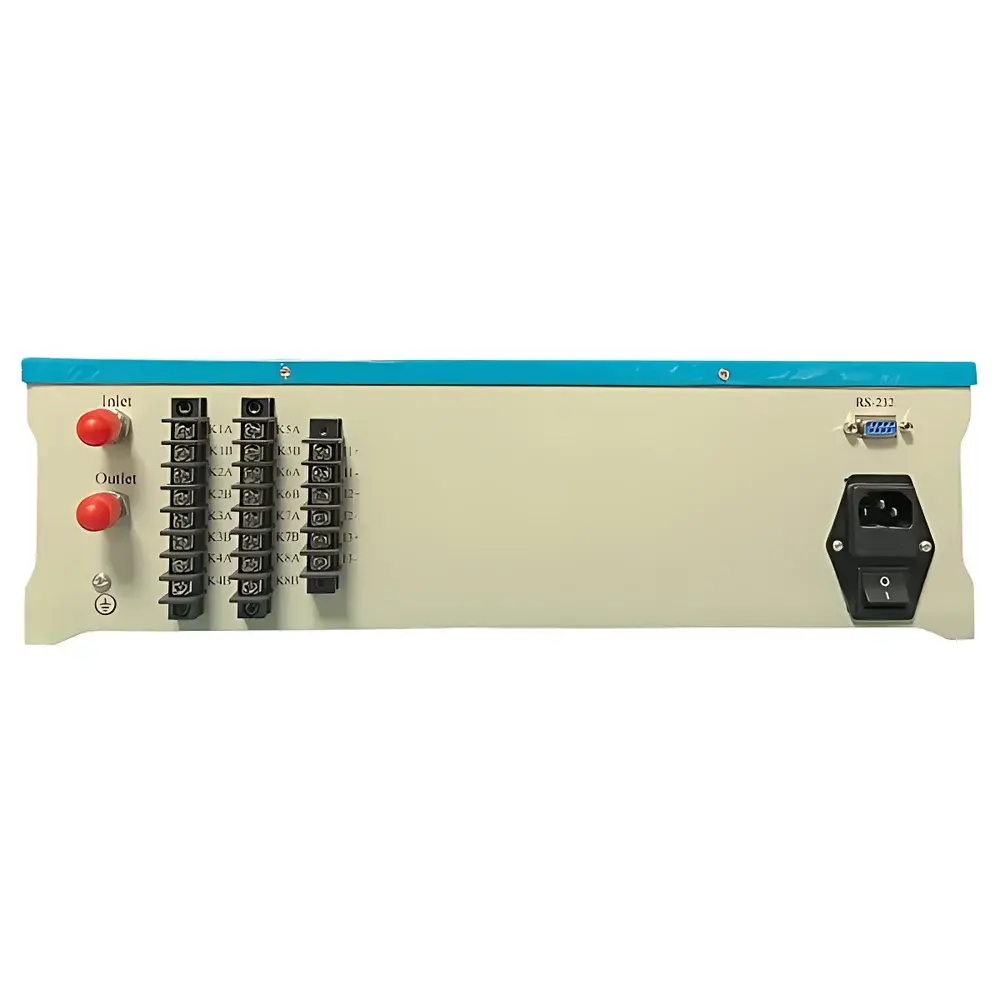
TH-analyzer EZGAS7000-O Paramagnetic Oxygen Analyzer
| Brand | TH-analyzer |
|---|---|
| Origin | Beijing, China |
| Manufacturer Type | Original Equipment Manufacturer (OEM) |
| Product Type | Domestic Industrial Oxygen Analyzer |
| Model | EZGAS7000-O |
| Measuring Principle | Paramagnetic Pressure Detection |
| Typical Ranges | 0–5%, 0–10%, 0–21%, 0–100%, 90–100% O₂ (v/v) |
| Linearity Error | ±2% FS |
| Stability | ±2% FS over 7 days |
| Repeatability | ≤1% FS |
| Response Time (T₉₀) | ≤35 s |
| Operating Temperature | 5–45 °C |
| Sample Flow Rate | 0.5 L/min |
| Reference Gas Flow | ~10 mL/min |
| Power Supply | 220 V AC, 50 Hz |
| Analog Output | 4–20 mA (isolated) |
| Digital Interface | RS485 (Modbus RTU protocol) |
Overview
The TH-analyzer EZGAS7000-O is a high-reliability paramagnetic oxygen analyzer engineered for continuous, real-time measurement of oxygen concentration in industrial process streams and laboratory gas systems. It leverages the intrinsic paramagnetic property of molecular oxygen—its strong magnetic susceptibility relative to most background gases—to deliver stable, interference-resistant quantification without consumables or catalytic elements. Unlike electrochemical or zirconia-based sensors, the EZGAS7000-O employs a micro-flow differential pressure detection principle: when an oxygen-containing sample passes through a precisely configured magnetic field, O₂ molecules are drawn toward the field’s high-intensity region, generating a measurable pressure differential proportional to O₂ partial pressure. This physical principle ensures inherent specificity to oxygen, eliminating drift from electrode aging or thermal degradation. The instrument is designed for unattended operation in demanding environments, including those with trace corrosive components (e.g., H₂S, SO₂), moderate vibration, and fluctuating ambient temperatures.
Key Features
- Paramagnetic sensing core with no moving parts, consumables, or catalytic surfaces—ensuring long-term calibration stability and >10-year operational life under typical conditions.
- Proven immunity to cross-interference from NH₃, CO, CO₂, H₂, CH₄, and N₂—critical for accuracy in complex process gas matrices such as syngas, flue gas, and fermentation off-gas.
- Corrosion-tolerant flow path construction compatible with sample streams containing low-to-moderate concentrations of acidic or sulfur-bearing species (e.g., <5 ppm H₂S).
- Robust mechanical architecture with shock- and vibration-insensitive sensor housing—validated per IEC 60068-2-6 for industrial mounting on piping manifolds or skids.
- Dual-output configuration: isolated 4–20 mA analog signal (HART-compatible wiring) plus Modbus RTU over RS485 for integration into DCS, PLC, or SCADA systems.
- Field-configurable range selection via software interface; supports five standard full-scale ranges (0–5%, 0–10%, 0–21%, 0–100%, 90–100% O₂) to optimize signal-to-noise ratio for application-specific requirements.
Sample Compatibility & Compliance
The EZGAS7000-O is intended for use with dry, particle-free gas samples. For wet or particulate-laden streams, external conditioning (e.g., coalescing filter, Peltier chiller, or permeation dryer) is recommended upstream of the analyzer inlet. The unit complies with CE marking requirements for electromagnetic compatibility (EN 61326-1) and low-voltage safety (EN 61010-1). While not certified for hazardous areas (e.g., ATEX/IECEx), it may be installed in Zone 2/Class I Div 2 locations when housed in appropriate enclosures. Its measurement methodology aligns with fundamental principles referenced in ISO 10725 (gas analysis—performance criteria) and ASTM D3176 (ultimate analysis of coal and coke), supporting traceable QA/QC protocols in regulated environments. No internal calibration gas is required; zero and span verification can be performed using certified N₂ (for zero) and air or specialty O₂ mixtures (for span).
Software & Data Management
Configuration, diagnostics, and data logging are managed via a Windows-based PC utility communicating over RS485. The software provides real-time display of O₂ concentration, sensor status, temperature, flow confirmation, and diagnostic flags (e.g., low reference flow, pressure fault). All configuration changes—including range selection, damping time, alarm thresholds, and output scaling—are timestamped and stored locally in non-volatile memory. Audit trails are exportable as CSV files for GLP/GMP documentation. Although the device does not implement FDA 21 CFR Part 11-compliant electronic signatures, its deterministic firmware behavior, hardware write-protection for calibration coefficients, and immutable event logging support validation under ISO/IEC 17025 and pharmaceutical quality systems when deployed with procedural controls.
Applications
- Fertilizer and petrochemical plants: monitoring O₂ in ammonia synthesis purge gas, air separation unit (ASU) product lines, and catalytic reformer off-gas.
- Cement kiln and blast furnace control: optimizing combustion efficiency by measuring residual O₂ in flue gas at ESP outlet or preheater exit.
- Medical gas production facilities: verifying O₂ purity in bulk liquid oxygen vaporization systems and pipeline distribution networks (per ISO 8573-1 Class 2 requirements).
- Bioreactor and fermentation monitoring: tracking dissolved O₂ indirectly via headspace analysis during aerobic microbial cultivation.
- Research laboratories: quantitative gas blending verification, inert atmosphere validation (e.g., gloveboxes), and kinetic studies involving oxidative reactions.
FAQ
Does the EZGAS7000-O require periodic replacement of sensing elements?
No. The paramagnetic sensor contains no consumable components, catalysts, or electrolytes. With proper sample conditioning, mean time between failures exceeds 120,000 operating hours.
Can it measure oxygen in high-CO₂ biogas streams?
Yes. The analyzer exhibits negligible cross-sensitivity to CO₂, making it suitable for landfill gas, anaerobic digester effluent, and beverage carbonation line monitoring.
Is temperature compensation automatic?
Yes. An integrated Pt100 RTD measures sample gas temperature in real time and applies dynamic correction to the pressure-differential signal per NIST-traceable paramagnetic response models.
What maintenance is required?
Annual verification of zero/span response and inspection of inlet filter and reference gas orifice; no routine sensor cleaning or recalibration is needed if operated within specified environmental and sample quality limits.
How is calibration traceability established?
Calibration is performed using NIST-traceable gas standards; factory calibration certificates include uncertainty budgets per ISO/IEC 17025 Annex A. End users may perform field verification using accredited secondary standards.
Related Products