
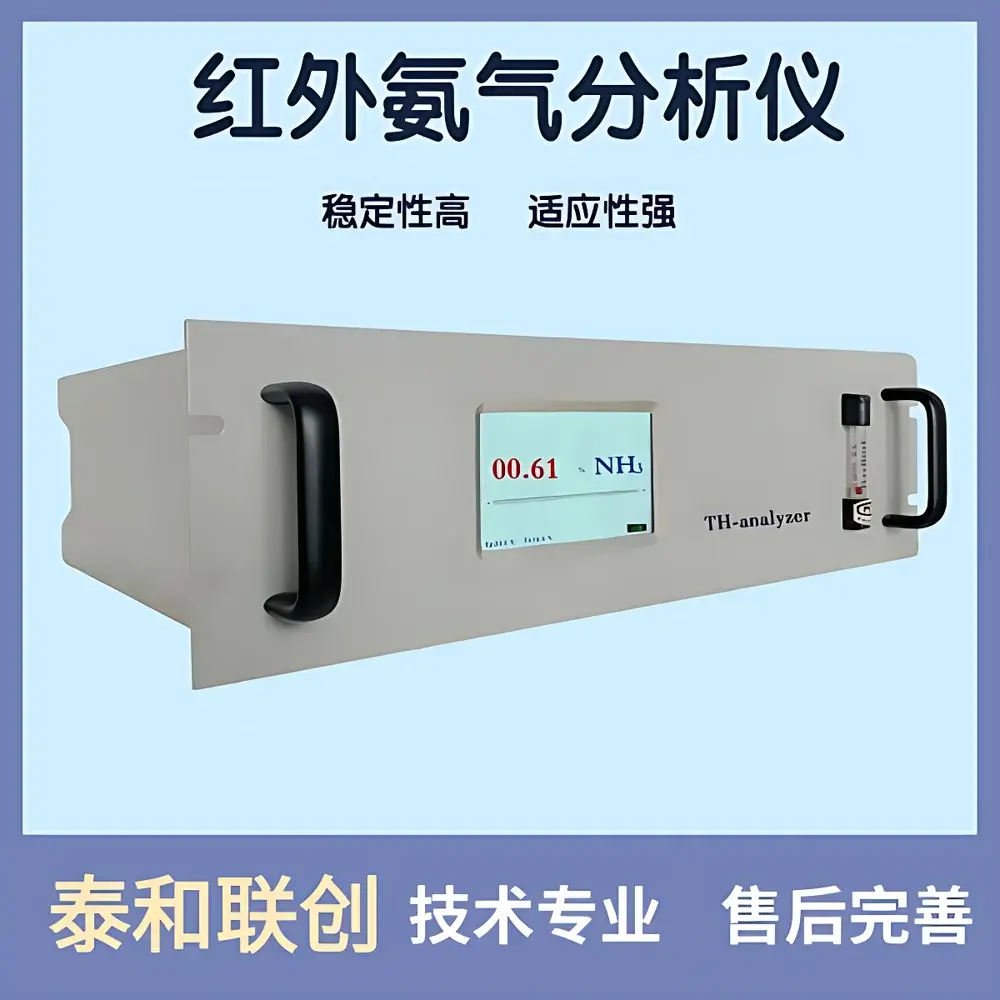
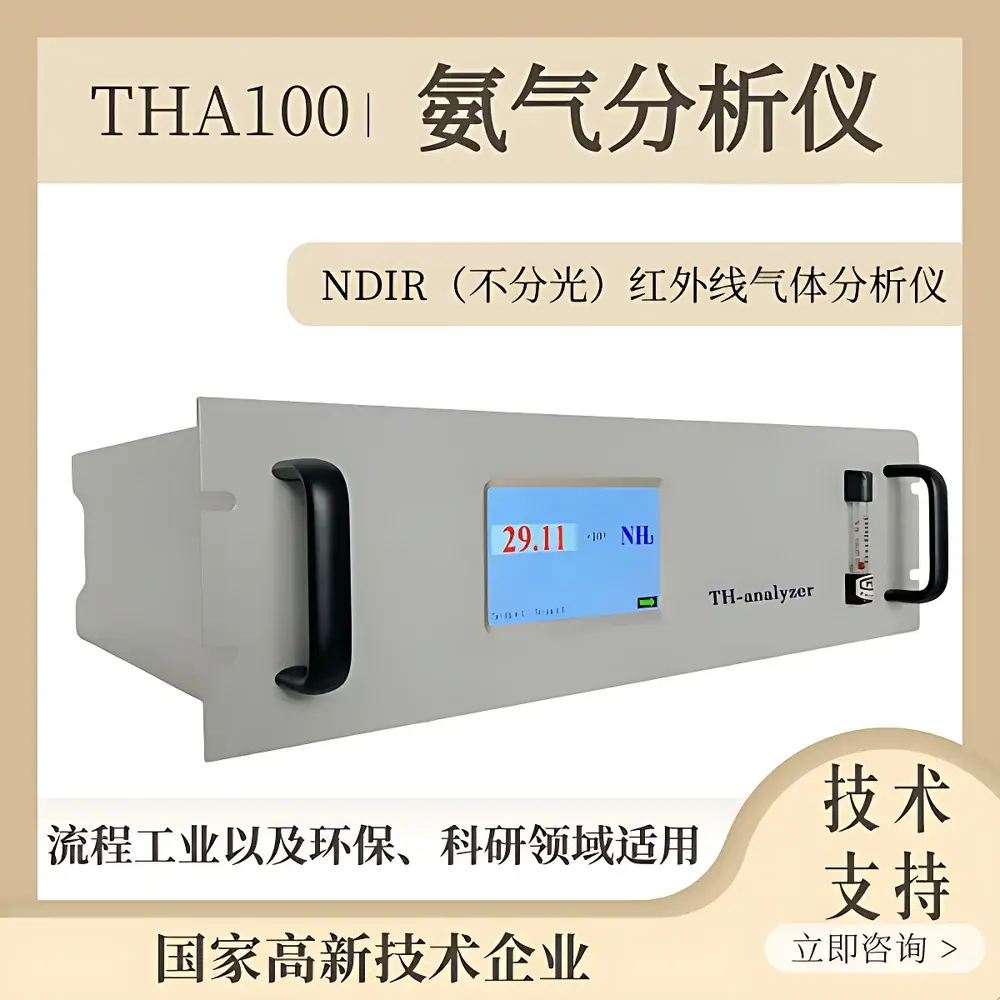
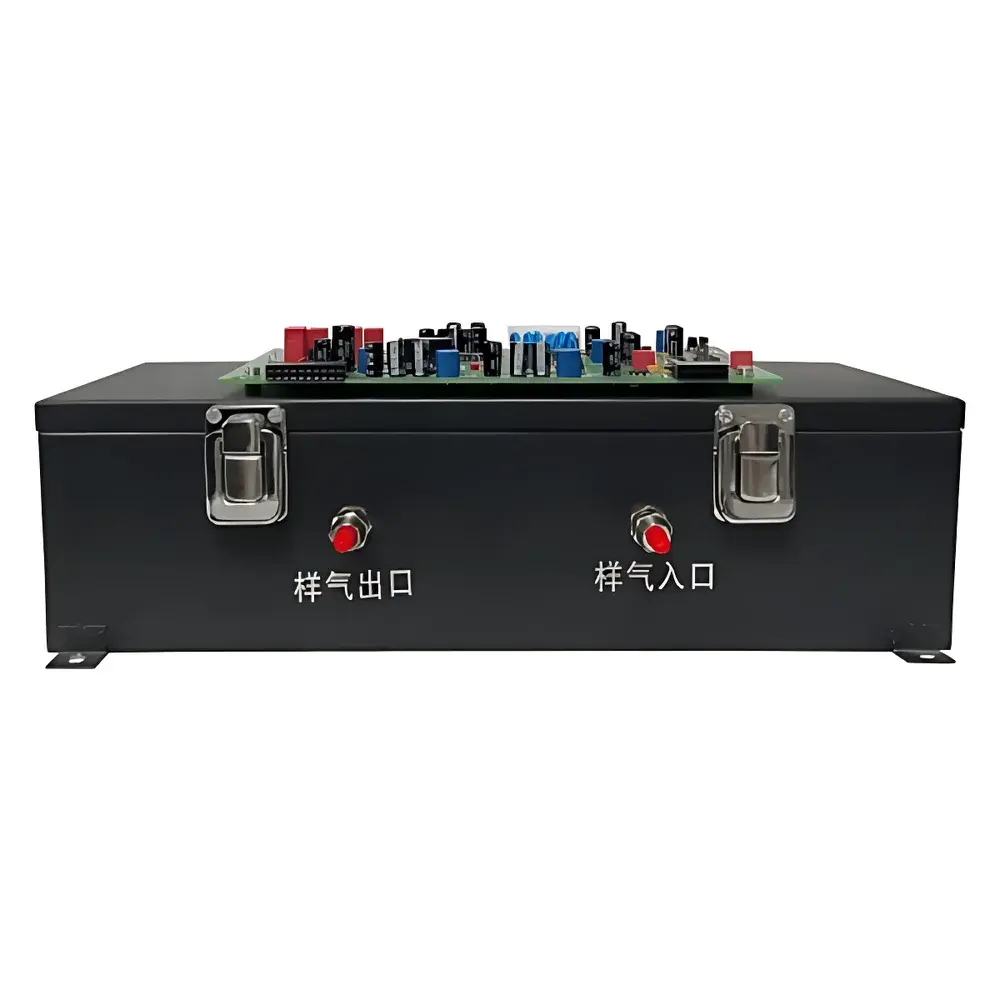
TH-analyzer THA100 Online Infrared Ammonia Analyzer
| Brand | TH-analyzer |
|---|---|
| Origin | Beijing, China |
| Manufacturer Type | Manufacturer |
| Product Type | Online Gas Analyzer |
| Model | THA100 |
| Detection Principle | NDIR (Non-Dispersive Infrared) |
| Measured Gas | NH₃ |
| Range | 0–300 ppm and 0–100% vol |
| Operating Temperature | 5–45 °C |
| Stability | ±2% FS / 7 days |
| Repeatability | ±1% FS |
| Linearity Error | ±2% FS |
| Response Time (T90) | ≤25 s |
| Temperature Drift | ±2% FS (5–45 °C) |
| Interference Error | ±2% FS |
| Output | 4–20 mA analog, 8 relay outputs |
| Display | Color LCD with touch interface |
| Optional Configuration | Dual-gas IR + O₂ sensor (electrochemical or zirconia) |
Overview
The TH-analyzer THA100 Online Infrared Ammonia Analyzer is an industrial-grade, continuous-emission monitoring (CEM) instrument engineered for real-time quantification of ammonia (NH₃) concentration in process streams and ambient exhaust gases. It operates on the principle of Non-Dispersive Infrared (NDIR) spectroscopy—leveraging the characteristic fundamental absorption band of NH₃ near 2.2 µm. By applying the Lambert–Beer law, the analyzer correlates infrared attenuation at this wavelength to gas concentration with high specificity and minimal cross-sensitivity. Unlike filter-based or tunable diode laser (TDLAS) systems, the THA100 employs a robust MEMS-based pulsed infrared source coupled with a dual-channel pyroelectric detector architecture. This design ensures stable baseline performance under dynamic thermal and pressure conditions commonly encountered in cement kilns, fertilizer synthesis loops, metallurgical off-gas ducts, and municipal wastewater treatment biogas lines.
Key Features
- True online operation with continuous sampling and real-time output—no manual calibration or periodic intervention required
- Configurable multi-component capability: single-gas NH₃ mode; dual-gas NH₃ + CO/CO₂/CH₄ mode; or triple-gas NH₃ + O₂ + one additional IR-active gas
- Integrated O₂ measurement option using either electrochemical or zirconia-based sensor modules—enabling stoichiometric combustion analysis and NOₓ correction
- MEMS infrared source with high-frequency electronic modulation—optimized for pyroelectric detector response and immune to mechanical vibration
- Dual-channel reference/sample detection path—compensates for optical aging, dust accumulation, and source intensity drift
- Active temperature stabilization (±0.1 °C control) and barometric pressure compensation—minimizing environmental influence per ISO 12039 and EPA Method 3A specifications
- Galvanically isolated 4–20 mA analog outputs with HART protocol support and eight programmable SPDT relay outputs for alarm, purge control, or interlock signaling
- Industrial-grade color TFT-LCD with capacitive touch interface—supporting multilingual menus (English, Spanish, German), real-time trend plots, and diagnostic logs
Sample Compatibility & Compliance
The THA100 is designed for direct in-situ or extractive sampling of hot, humid, and particulate-laden gas matrices typical of industrial flue gas, syngas, and fermentation off-gas. Sample conditioning is recommended for applications exceeding 80% RH or containing >5 mg/m³ condensable aerosols. The analyzer complies with electromagnetic compatibility requirements per IEC 61326-1 (industrial environment) and meets safety standards IEC 61010-1 for measurement/control equipment. Its measurement methodology aligns with ASTM D6348–21 (standard test method for determination of gaseous compounds by GC/FTIR) and supports traceability to NIST-traceable NH₃ calibration standards. For regulated emissions reporting, the system supports audit-ready data logging compliant with EPA 40 CFR Part 60 PS-18 and EU EN 15267-3 for QAL1 certification.
Software & Data Management
Firmware includes embedded data logger with 32 MB non-volatile memory—storing up to 12 months of 1-minute averaged concentration values, diagnostics, and calibration events. Communication interfaces include RS-485 (Modbus RTU), Ethernet (TCP/IP), and optional Wi-Fi module for remote configuration via web-based GUI. All user actions—including zero/span adjustments, relay threshold edits, and firmware updates—are time-stamped and logged with operator ID (role-based access control). Audit trail functionality satisfies FDA 21 CFR Part 11 requirements when deployed in GLP/GMP environments. Export formats include CSV and XML for integration into SCADA, DCS, or cloud-based IIoT platforms (e.g., Siemens MindSphere, PTC ThingWorx).
Applications
- Continuous monitoring of NH₃ slip in selective catalytic reduction (SCR) and selective non-catalytic reduction (SNCR) systems for power plant and incinerator flue gas
- In-line concentration control during Haber–Bosch ammonia synthesis and urea production processes
- Biogas quality assurance in anaerobic digestion facilities—tracking NH₃ inhibition thresholds for downstream CHP engines
- CEMS integration for regulatory compliance reporting in municipal wastewater treatment plants and livestock waste management systems
- Research-grade gas composition profiling in catalysis laboratories and atmospheric simulation chambers
- Leak detection and boundary monitoring in refrigeration and cold storage facilities using NH₃ as refrigerant
FAQ
What is the minimum detectable concentration (MDL) for NH₃ under standard conditions?
The THA100 achieves an MDL of 0.5 ppm (at 0–300 ppm range) based on signal-to-noise ratio ≥3:1 over 60 seconds, verified per ISO 11352 guidelines.
Can the analyzer operate unattended for extended periods in outdoor enclosures?
Yes—when installed in NEMA 4X or IP66-rated climate-controlled housings with purge air, the THA100 maintains specification compliance across its full operating temperature range without recalibration for up to 90 days.
Is third-party verification available for regulatory compliance applications?
TH-analyzer provides factory calibration certificates traceable to NIST standards; QAL1 certification support and TÜV-tested configuration packages are available upon request.
How does the dual-channel detector mitigate interference from water vapor or CO₂?
One channel measures at the NH₃ absorption peak (2.2 µm), while the second monitors a nearby reference wavelength where NH₃ exhibits negligible absorption but H₂O and CO₂ show similar spectral behavior—enabling real-time compensation via differential signal processing.
What maintenance intervals are recommended for field deployment?
Optical window cleaning every 6 months; annual verification of zero/span response; no consumables or moving parts require replacement—design life exceeds 10 years under continuous operation.
Related Products







