
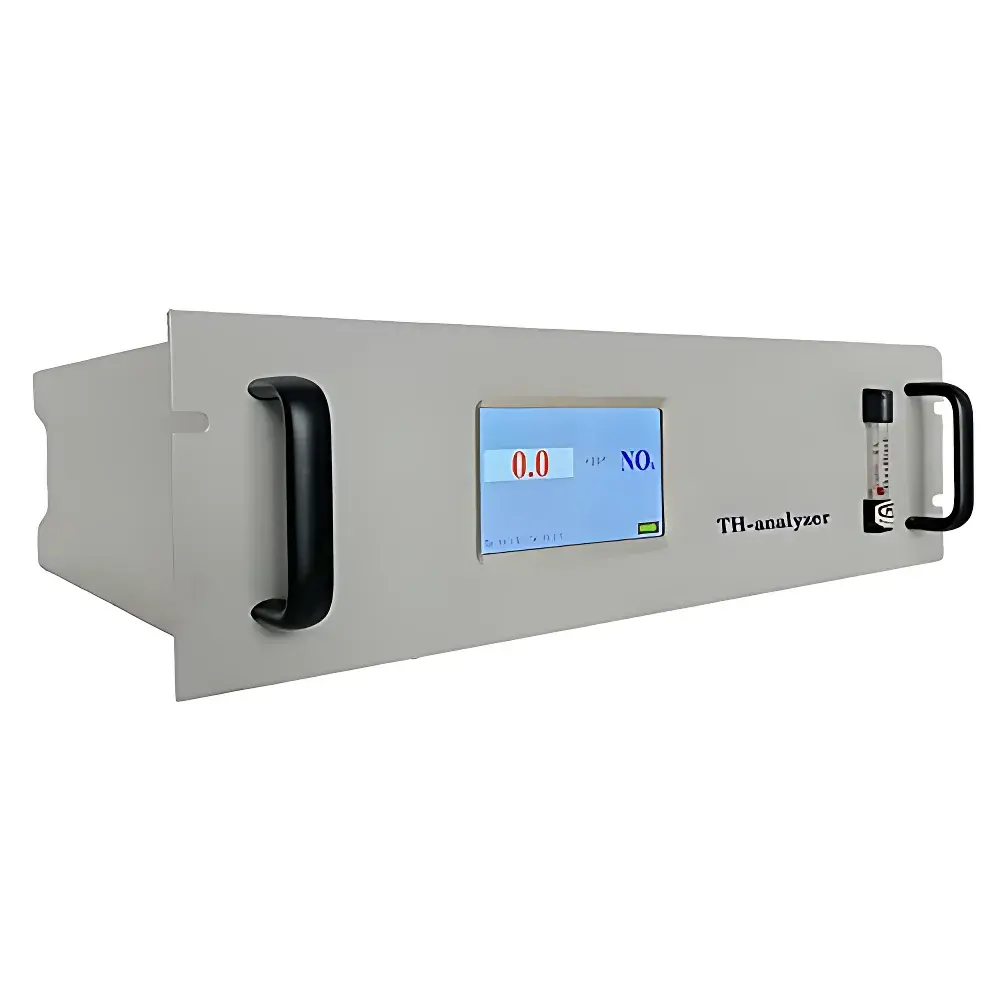
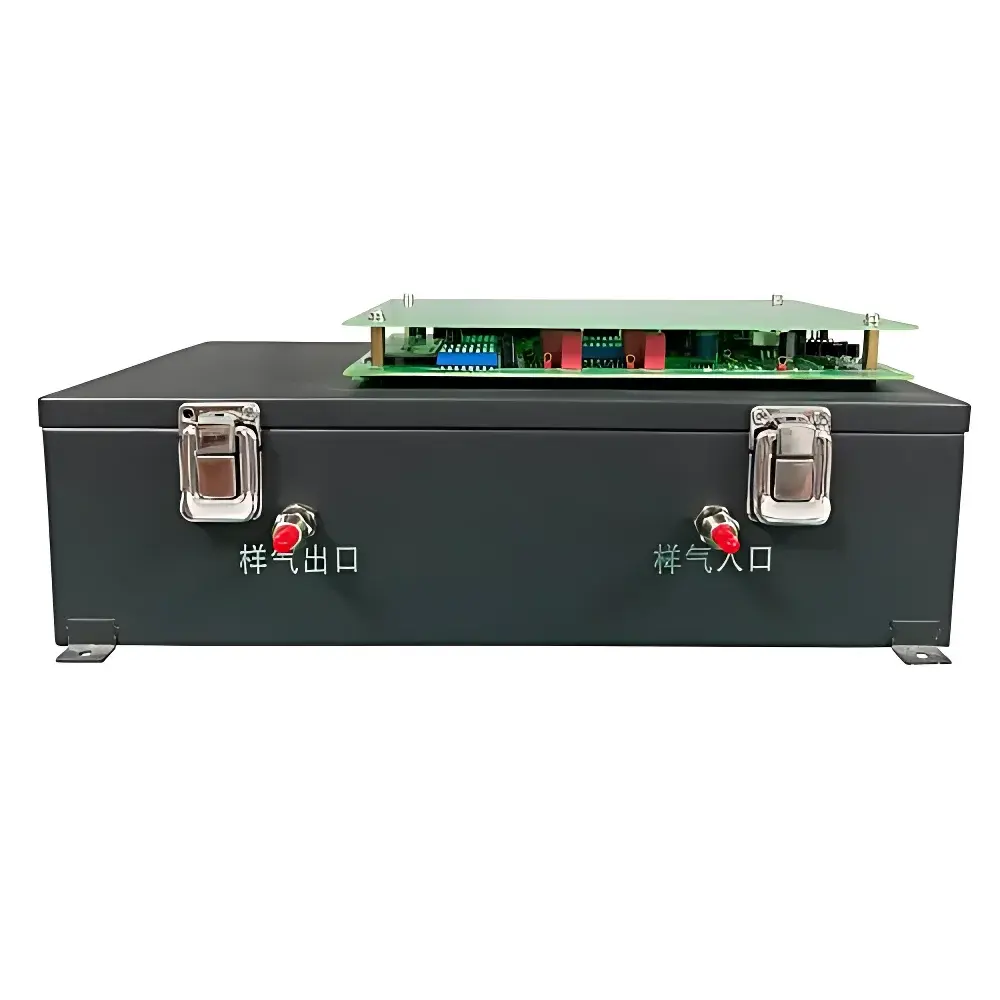
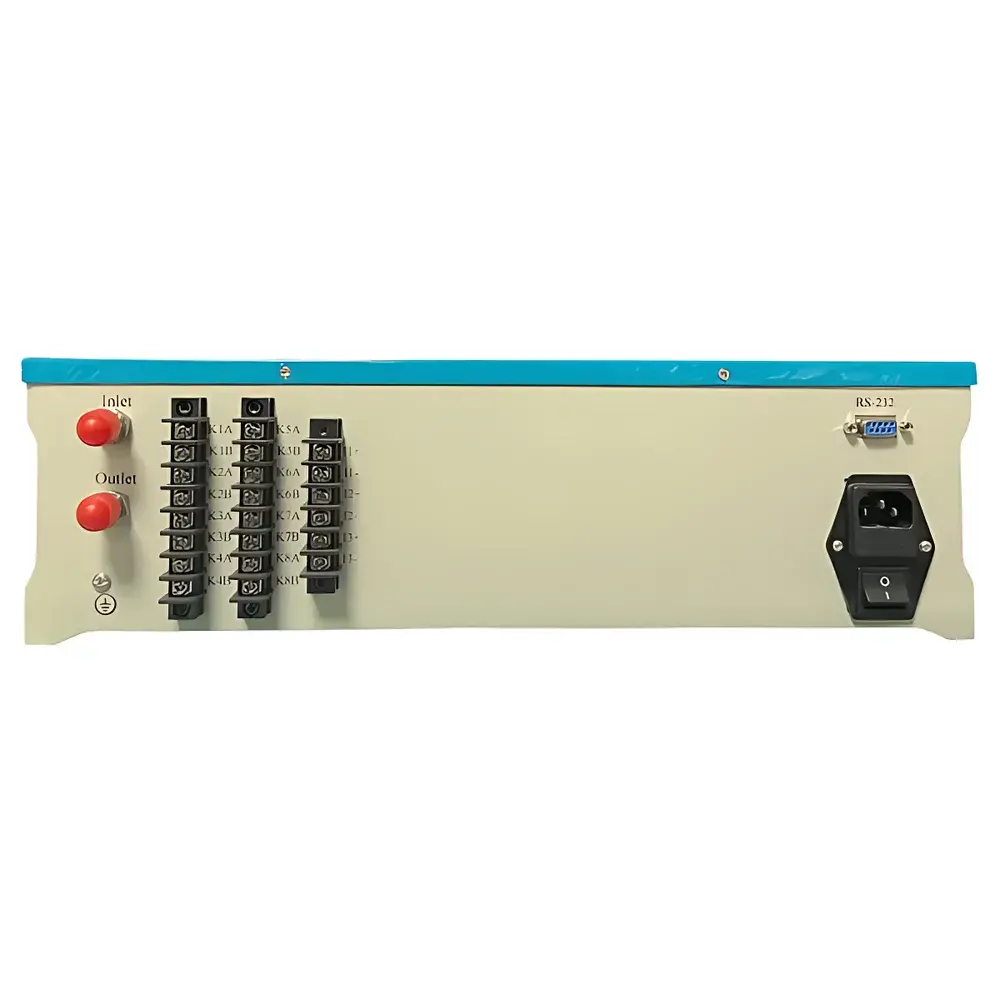
TH-analyzer THA100NO NDIR Infrared Nitric Oxide (NO) Gas Analyzer
| Brand | TH-analyzer |
|---|---|
| Origin | Beijing, China |
| Manufacturer Type | Direct Manufacturer |
| Model | THA100NO |
| Instrument Principle | Non-Dispersive Infrared (NDIR) Absorption |
| Type | Online Fixed-Mount Analyzer |
| Response Time (T90) | ≤25 s |
| Repeatability | ±1% FS |
| Measurement Range (NO) | 0–500 mg/m³ or 0–50% vol |
| Operating Temperature | 5–45 °C |
| Zero/Full-Scale Stability | ±2% FS / 7 days |
| Linearity Error | ±2% FS |
| Temperature Drift | ±2% FS (5–45 °C) |
| Interference Error | ±2% FS |
| Pressure Compensation | Yes |
| Output | 4–20 mA analog, 8 isolated relay outputs |
| Display | Color LCD with capacitive touch interface |
| Multi-Gas Capability | Up to 3 components (e.g., NO + optional O₂ + one additional IR-active gas) |
| Optical Core | MEMS-based pulsed infrared source, dual-channel pyroelectric detector |
| Environmental Compliance | Designed for continuous operation in industrial CEMS and laboratory-grade monitoring environments |
Overview
The TH-analyzer THA100NO is a fixed-mount, online non-dispersive infrared (NDIR) gas analyzer engineered for the precise, real-time quantification of nitric oxide (NO) in complex industrial and environmental gas streams. It operates on the fundamental principle of molecular infrared absorption spectroscopy: NO exhibits a distinct and stable vibrational-rotational absorption band near 5.3 µm — a spectral region selectively targeted by the instrument’s optimized optical path and detection architecture. By applying the Lambert–Beer law, the analyzer correlates the attenuation of infrared radiation at this characteristic wavelength with the volumetric concentration of NO in the sampled gas matrix. Unlike dispersive spectrometers, the THA100NO employs a broadband MEMS infrared source coupled with a dual-channel pyroelectric detector system — enabling high signal-to-noise ratio, inherent baseline stability, and immunity to optical misalignment. Its design prioritizes long-term operational reliability under fluctuating ambient conditions, making it suitable for unattended deployment in stack monitoring (CEMS), process control loops, and research-grade gas-phase reaction studies.
Key Features
- MEMS-based pulsed infrared source with high-frequency modulation — optimized for thermal detector response and minimizing drift from source aging
- Dual-channel reference/sample detection architecture — actively compensates for source intensity fluctuations and optical contamination
- Integrated temperature-controlled optical bench — maintains thermal equilibrium across critical optical components to suppress thermal-induced zero shift
- Automatic atmospheric pressure compensation — corrects for barometric variations using an onboard absolute pressure sensor, ensuring accuracy across elevation ranges
- Isolated 4–20 mA analog output with HART-compatible digital overlay — supports integration into DCS, PLC, and SCADA systems without grounding loop interference
- Eight electrically isolated relay outputs — configurable for alarm thresholds, maintenance alerts, or external device triggering (e.g., scrubber activation)
- Capacitive touchscreen interface with color LCD — intuitive navigation, real-time trend visualization, and multilingual UI support (English default)
- Multi-component capability — supports simultaneous analysis of NO plus up to two additional gases (e.g., O₂ via electrochemical cell, CO or CO₂ via secondary IR channels)
Sample Compatibility & Compliance
The THA100NO is designed for continuous sampling of dry, non-corrosive, particle-free gas streams typical of flue gas, synthesis gas, and laboratory exhaust lines. Sample conditioning — including particulate filtration (≤1 µm), moisture removal (dew point < 5 °C), and optional heated sample line (up to 180 °C) — is recommended for high-humidity or condensable applications. The analyzer complies with key international performance standards relevant to continuous emission monitoring systems, including EN 15267-3 (QAL1 certification framework), ISO 12039 (for NO measurement in stationary sources), and EPA Method 7E (for extractive NOx analyzers). Its hardware architecture and firmware logic support audit-ready data integrity: all calibration events, zero/span adjustments, and configuration changes are time-stamped and logged with user ID attribution — facilitating GLP/GMP-aligned recordkeeping and 21 CFR Part 11-compliant electronic signatures when integrated with validated data acquisition software.
Software & Data Management
The THA100NO embeds a real-time Linux-based operating system with dual-mode communication: Modbus RTU over RS-485 and Ethernet TCP/IP (Modbus TCP). Local configuration and diagnostics are accessible via the front-panel touchscreen or remotely through a web-based interface (HTTPS-enabled, role-based access control). All measurement data — including raw detector voltages, compensated concentration values, diagnostic flags, and environmental parameters (temperature, pressure, flow status) — are timestamped at 1-second resolution and buffered internally for ≥30 days. Export options include CSV via USB host port or scheduled FTP push to secure servers. Optional cloud connectivity enables remote health monitoring, predictive maintenance alerts (e.g., source degradation trend analysis), and centralized fleet management for multi-unit deployments. Firmware updates are performed securely via signed binary packages with SHA-256 verification.
Applications
- Continuous Emission Monitoring Systems (CEMS) for NOx reporting in coal-fired power plants, waste incinerators, and cement kilns — meeting EU IED and U.S. EPA requirements
- In-line process analytics for ammonia oxidation reactors (Ostwald process), nitric acid production, and selective catalytic reduction (SCR) efficiency verification
- Environmental air quality stations measuring urban NO concentrations per WHO and EU Air Quality Directive guidelines
- Research laboratories conducting combustion kinetics, catalytic surface studies, or atmospheric chemistry simulations requiring sub-second response and ppm-level precision
- Biomedical gas mixing systems where trace NO delivery must be verified prior to patient administration (ISO 8573-1 Class 2 compressed air compatibility)
FAQ
What is the minimum detectable NO concentration for the THA100NO?
The lower limit of detection (LOD) is application-dependent but typically achieves ≤2 mg/m³ (≈1.5 ppmv) under standard conditions (0 °C, 101.325 kPa, dry gas) with 1-meter optical path length and optimized signal averaging.
Can the THA100NO measure NO in the presence of high CO₂ or water vapor?
Yes — its narrowband optical filtering and dual-channel differential detection minimize cross-sensitivity to CO₂ (absorption at 4.26 µm) and H₂O (broadband absorption); residual interference is further corrected via built-in compensation algorithms calibrated against certified gas mixtures.
Is field calibration supported without external gas standards?
Zero calibration can be performed using certified zero air; span calibration requires traceable NO standard gas. An optional integrated zero-air generator (membrane-based) is available for fully automated zero cycles.
Does the THA100NO support explosion-proof installation?
The base unit is rated for general-purpose indoor use (IP54). For hazardous areas (Zone 1/21), it must be installed in an ATEX/IECEx-certified purge enclosure or used with an intrinsically safe barrier kit — both configurations are factory-tested and documented.
How often is preventive maintenance required?
Under typical industrial conditions, optical window cleaning and detector gain verification are recommended every 6 months; MEMS source lifetime exceeds 5 years at nominal duty cycle. Full QAL2 verification per EN 14181 is advised annually.







