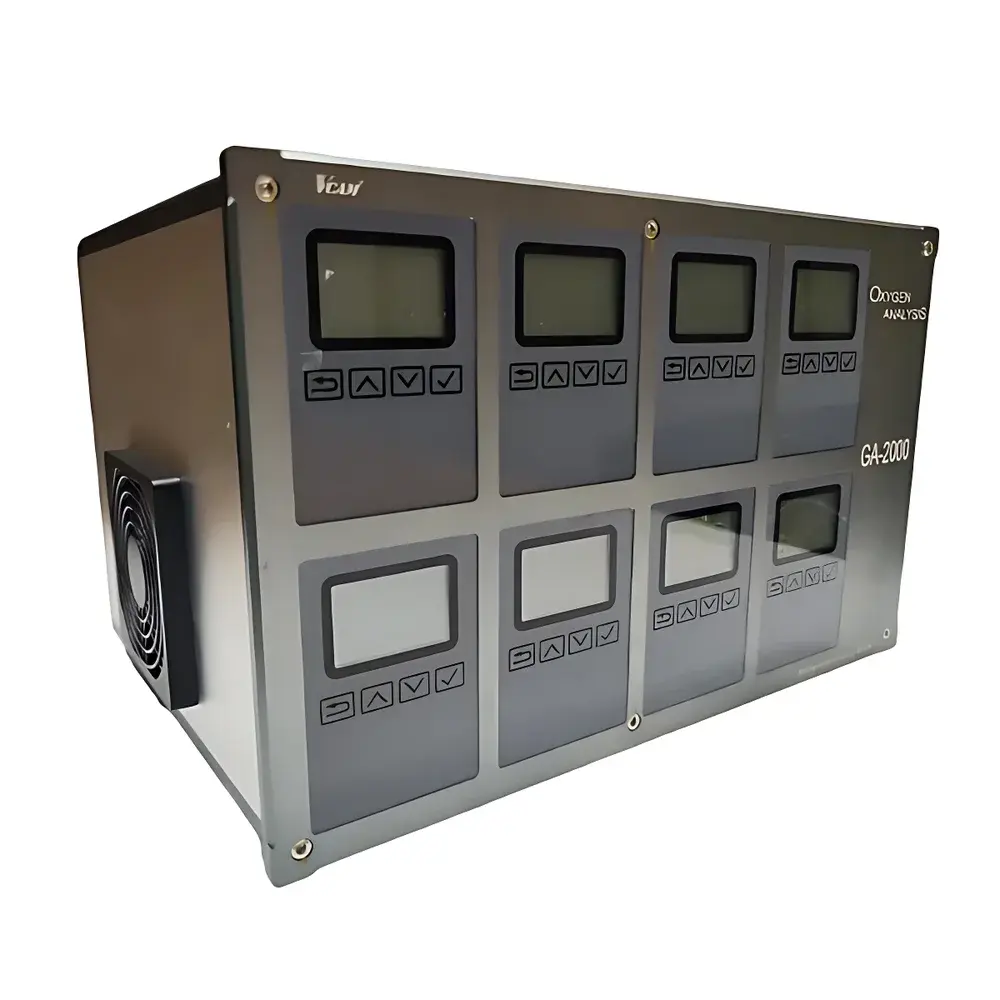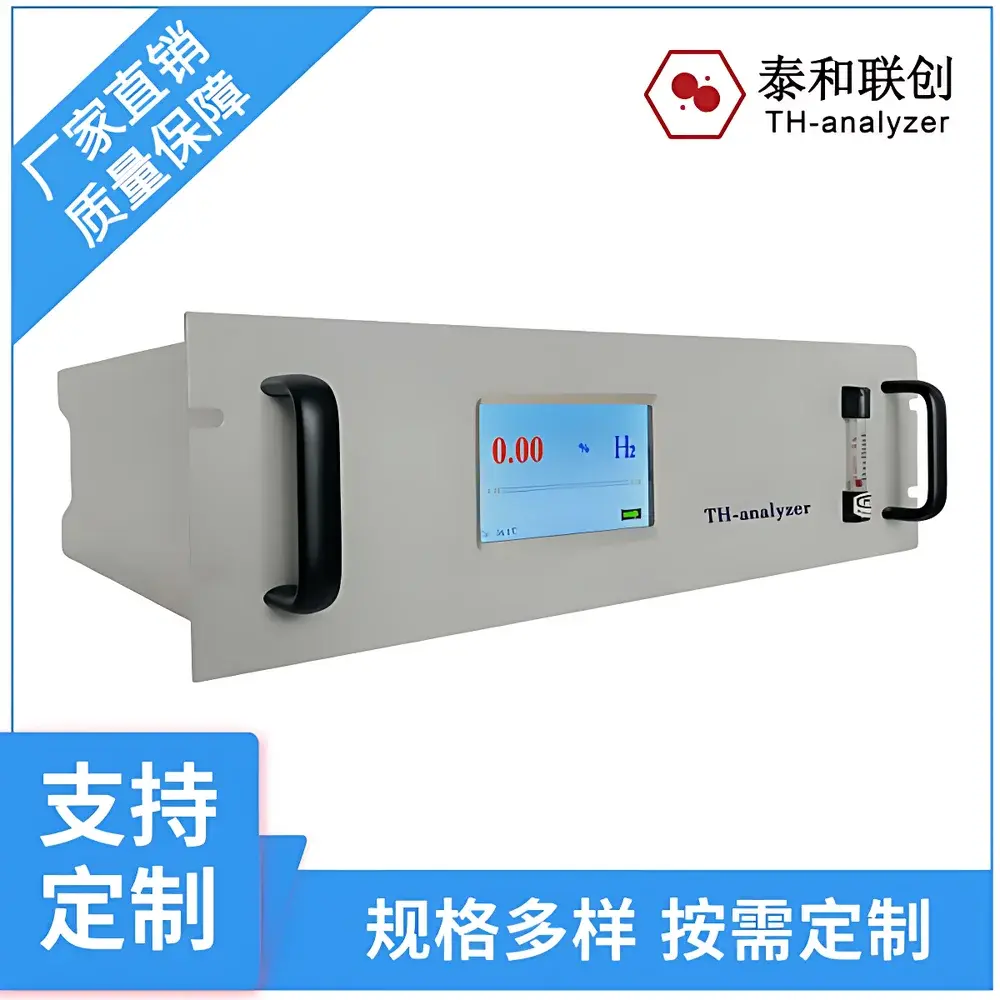
TH-analyzer THA100R Hydrogen Analyzer
| Brand | TH-analyzer |
|---|---|
| Origin | Beijing, China |
| Manufacturer Type | OEM Manufacturer |
| Region of Manufacture | Domestic (China) |
| Model | THA100R |
| Measurement Principle | Thermal Conductivity Detection |
| Measuring Range | H₂ 0–100% vol |
| Standard H₂ Ranges | 0–1%, 0–10%, 35–75%, 40–80%, 75–100%, 98–100% |
| Operating Ambient Temperature | 5–45 °C |
| Stability | ±2% FS / 7 days |
| Repeatability | ±1% FS |
| Linearity Deviation | ±2% FS |
| Response Time (T₉₀) | ≤30 s |
| Output | Isolated 4–20 mA current loop |
| Digital Outputs | 8 relay (switching) outputs |
| Display | Color LCD with touch interface |
| Enclosure | 483 mm (19″) rack-mount chassis |
| Certification | Non-explosion-proof (not for hazardous areas) |
| Pressure Compensation | Built-in atmospheric pressure compensation |
| Temperature Control | Precision thermostatic regulation of sensor block |
Overview
The TH-analyzer THA100R Hydrogen Analyzer is a fixed-process thermal conductivity gas analyzer engineered for continuous, real-time quantification of hydrogen (H₂) and argon (Ar) concentrations in industrial gas streams. It operates on the fundamental physical principle that binary or multi-component gas mixtures exhibit bulk thermal conductivity values directly dependent on the composition and individual thermal conductivities of constituent gases. Hydrogen—possessing the highest thermal conductivity among common industrial gases (~0.18 W/m·K at 25 °C)—produces a pronounced and measurable change in the thermal resistance of a heated sensing element when present in varying proportions. The THA100R implements a precision Wheatstone bridge configuration with glass-encapsulated thermistor-based thermal conductivity sensors, ensuring long-term chemical inertness against corrosive process environments, including those containing ammonia, chlorine, or acidic trace impurities. Its core architecture integrates active temperature stabilization of the sensor block and real-time atmospheric pressure compensation—both critical for minimizing environmental drift in non-controlled plant settings. Designed for integration into distributed control systems (DCS) and programmable logic controllers (PLC), the THA100R meets the operational rigor required in continuous-process industries where measurement integrity, repeatability, and functional safety are governed by ISO 5167, IEC 61511, and internal QA/QC protocols.
Key Features
- Glass-encapsulated thermal conductivity sensor elements—resistant to chemical attack from NH₃, HCl, H₂S, and other aggressive process gases
- Innovative low-drift thermal bridge design achieving ±2% full-scale stability over 7 days without recalibration
- Active thermostatic control of sensor block (±0.1 °C) to eliminate ambient temperature-induced measurement variance
- Integrated barometric pressure compensation algorithm, dynamically correcting for local atmospheric fluctuations
- Galvanically isolated 4–20 mA analog output compliant with NAMUR NE43 standards and 8 SPDT relay outputs (rated 250 VAC/3 A)
- 19-inch rack-mount chassis (483 mm width) conforming to EIA-310-D mechanical specifications for panel integration
- Industrial-grade color TFT-LCD with capacitive touch interface supporting multilingual menu navigation and real-time trend visualization
Sample Compatibility & Compliance
The THA100R is validated for use with dry, non-condensing gas matrices—including synthesis gas (syngas), reformer off-gas, purge streams, and inert carrier gases—provided particulate loading remains below 1 µm and dew point is maintained at least 10 °C below operating temperature. It is not rated for use in classified hazardous locations (e.g., Zone 0/1 or Div. 1) and must be installed in ventilated, non-explosive atmospheres per IEC 60079-0 general requirements. While not certified to ATEX or IECEx, its electrical isolation and intrinsic signal conditioning support safe deployment upstream or downstream of explosion-proof barriers. The analyzer complies with electromagnetic compatibility (EMC) requirements per IEC 61326-1 (industrial environment) and safety standards per IEC 61010-1. Data logging and configuration changes are auditable under GLP-aligned workflows, though full 21 CFR Part 11 compliance requires supplementary IT validation of host SCADA or DCS systems.
Software & Data Management
The embedded firmware supports Modbus RTU (RS-485) and optional Modbus TCP/IP communication protocols for bidirectional data exchange with supervisory systems. Configuration, calibration history, alarm logs, and diagnostic status are accessible via the front-panel interface or remote terminal emulation (Telnet). All parameter modifications are timestamped and user-logged; however, role-based access control (RBAC) and electronic signature functionality require integration with external asset management platforms. Raw sensor voltage, compensated conductivity values, and final concentration outputs are available at 1 Hz resolution. No proprietary cloud service or vendor-hosted platform is involved—the device operates as a deterministic edge instrument with zero external dependencies.
Applications
- Hydrogen monitoring in ammonia synthesis loops (e.g., purge gas analysis pre-PSA, complying with ISO 8573-1 Class 2 purity verification)
- Real-time H₂ tracking in nuclear power plant containment building atmospheres per IEEE 383 and EPRI guidelines
- Argon concentration verification in air separation unit (ASU) crude argon and refined product streams
- Combustion gas analysis in laboratory-scale burner rigs and fuel cell test benches
- High-blast furnace gas (BFG) characterization for coke oven gas blending optimization
- On-site purity verification of electrolytic or PSA-generated hydrogen prior to pipeline injection or cylinder filling
FAQ
What gas interferences affect THA100R measurement accuracy?
Helium (He) and methane (CH₄) produce thermal conductivity overlaps with H₂ and may require matrix-specific calibration or pre-separation if present above 0.5% vol. CO₂ and N₂ show minimal cross-sensitivity and are typically compensated via factory linearization.
Is field calibration possible without specialized equipment?
Yes—zero calibration using certified nitrogen (N₂) or argon (Ar) and span calibration using certified H₂/N₂ mixtures can be performed via front-panel prompts. No external PC or software license is required.
Can the THA100R operate continuously at 45 °C ambient temperature?
Yes—its thermal management system maintains sensor stability up to the upper limit of the specified 5–45 °C operating range, provided installation allows ≥100 mm rear clearance for convection cooling.
Does the analyzer support custom range switching during operation?
Yes—users may select between six predefined H₂ ranges (e.g., 0–1%, 98–100%) via touchscreen or Modbus register write; range transitions are executed with <5 s settling time and no hardware reconfiguration.
What maintenance intervals are recommended for sustained accuracy?
Sensor verification every 6 months using traceable standard gases is advised; filter replacement (part no. TH-FIL-01) every 12 months in dusty environments; no routine sensor replacement is required under normal operating conditions.
Related Products