
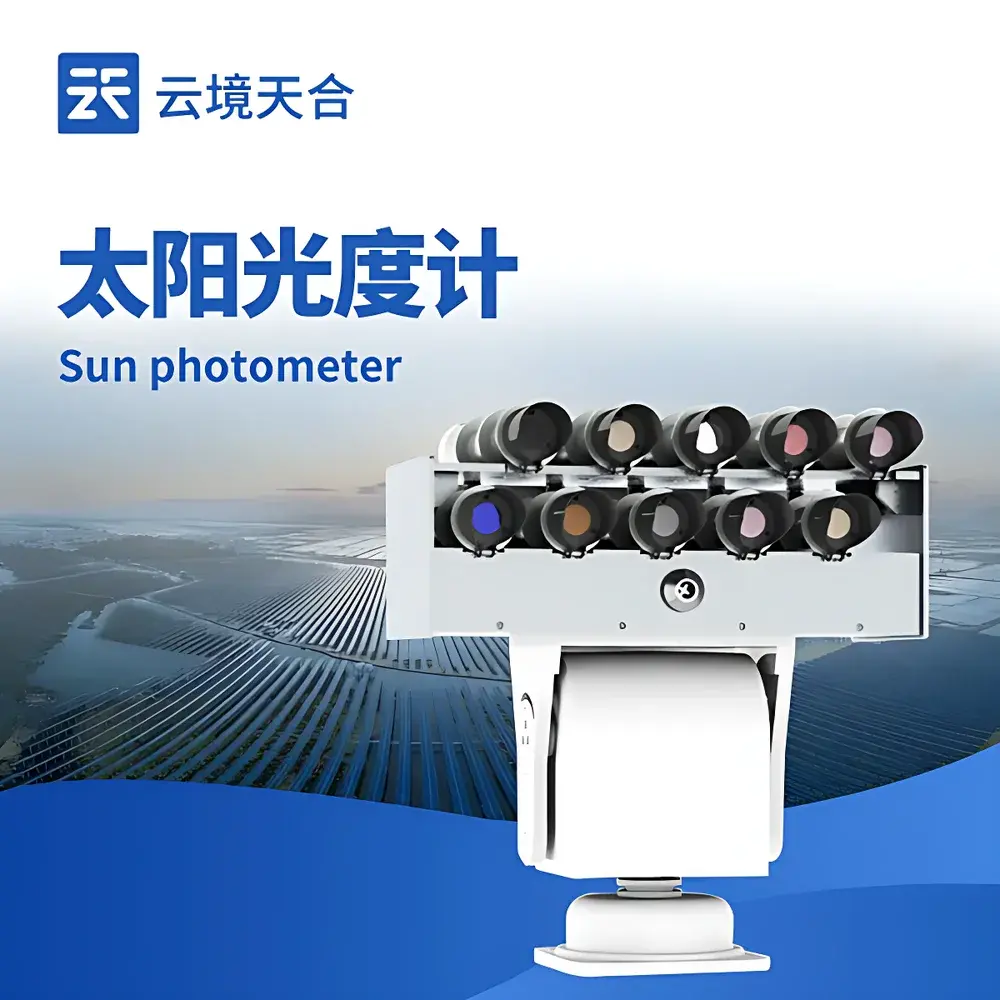
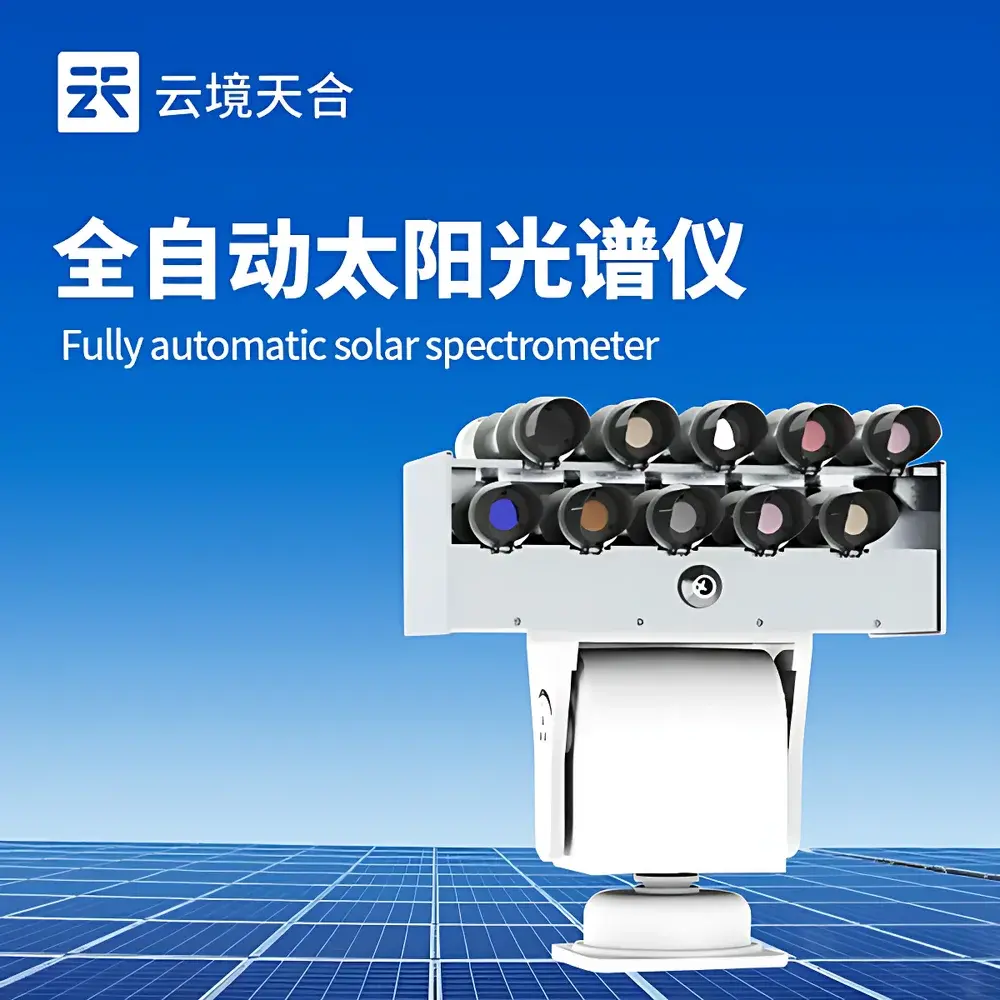
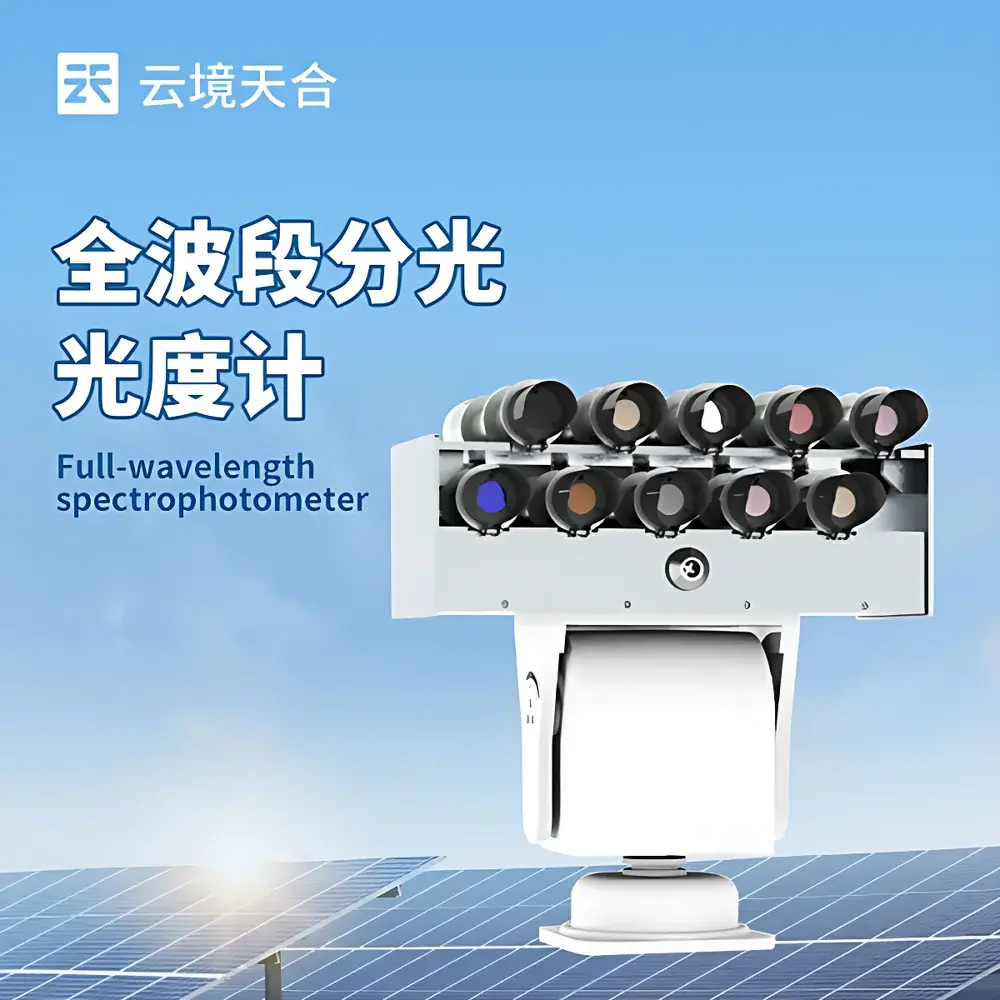
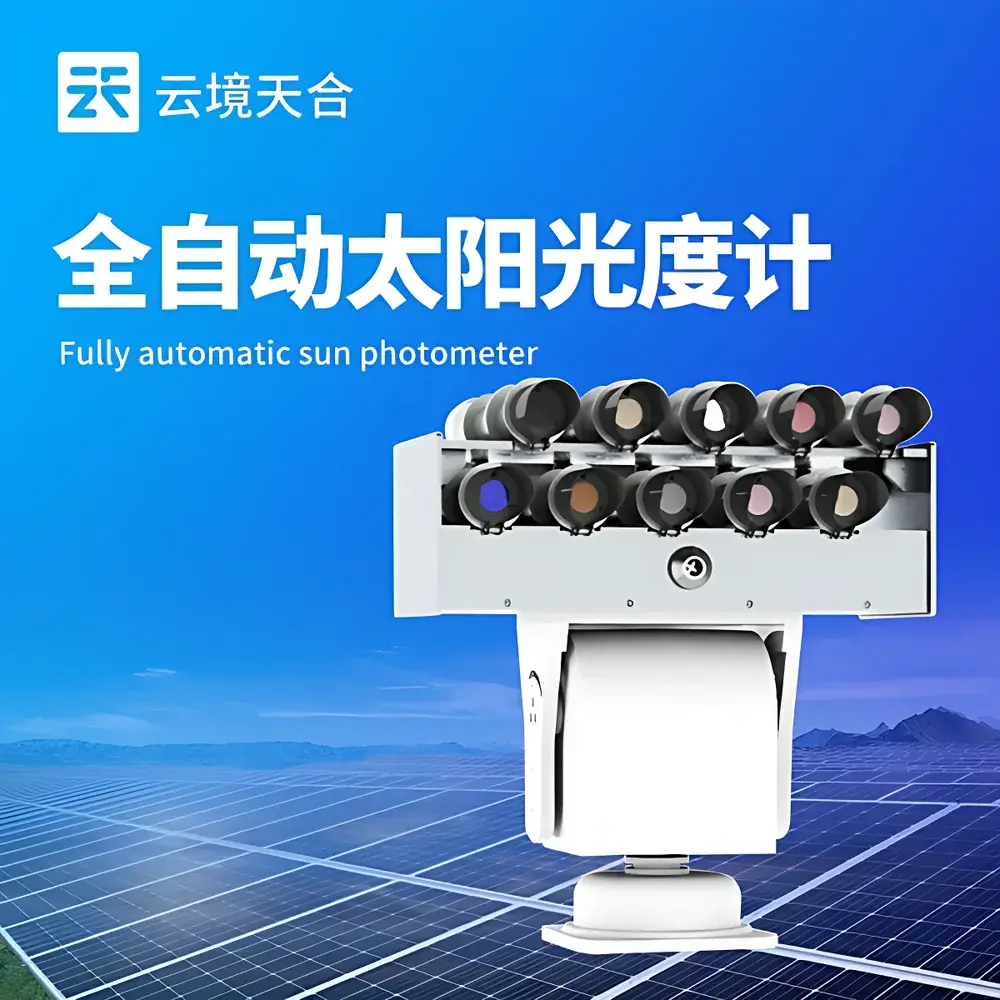
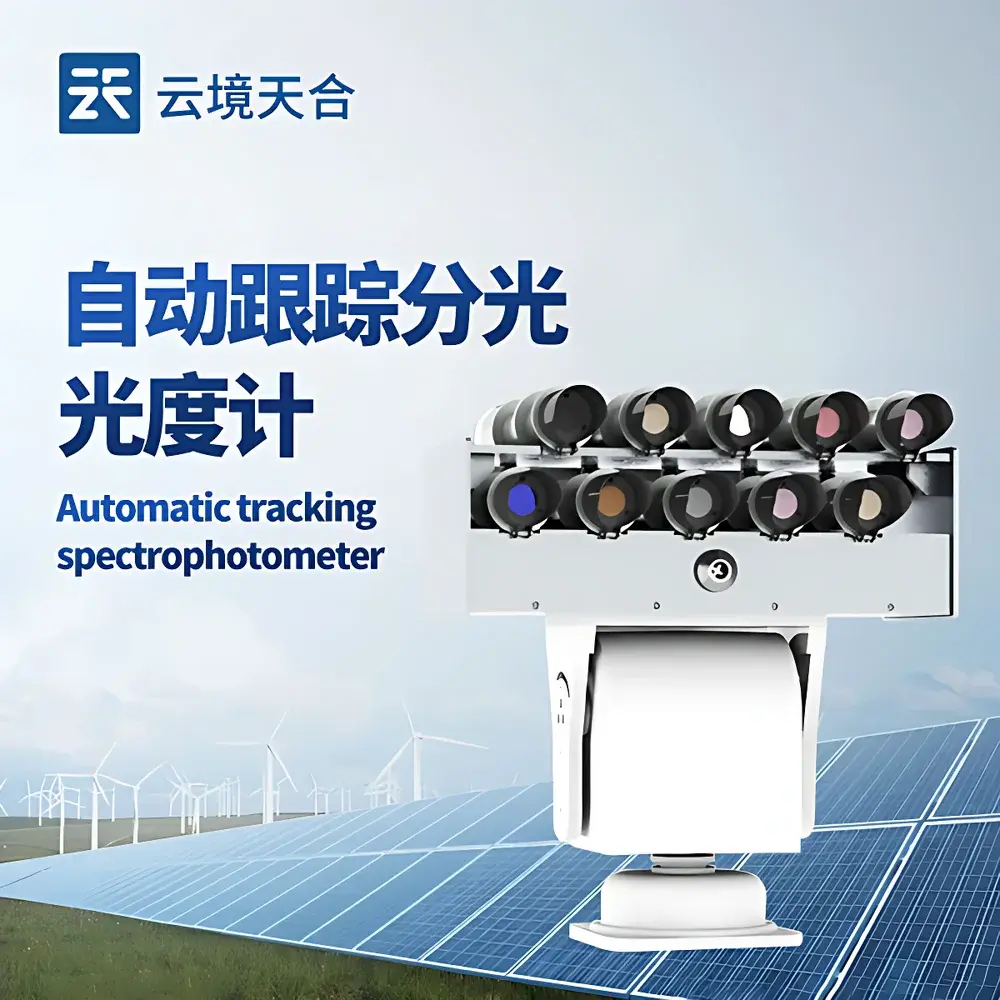
TH-GD1 Sun Photometer | Tianhe Environmental Monitoring Instruments
| Brand | Tianhe (Shandong Tianhe Instrument Co., Ltd.) |
|---|---|
| Origin | Shandong, China |
| Manufacturer Type | OEM/ODM Manufacturer |
| Model | TH-GD1 |
| Spectral Range | 280–3000 nm |
| Filter Channels | 10 discrete bands (340, 380, 440, 500, 670, 870, 940, 1020, 1640 nm + UV-A broadband 280–300 nm) |
| FWHM | 2 nm @ 340 nm |
| Field of View | ≤1.3° (full angle) |
| Tracking Accuracy | <0.1° (active sun-sensor mode) |
| Data Resolution | 1 s minimum integration time |
| Calibration Uncertainty | <2% (traceable to national meteorological standards per JJG 458-1996) |
| Power Supply | DC 12 V (with auto-switching green power management module) or AC 220 V |
| Operating Temperature | −40 °C to +55 °C (low-temp variant) |
| IP Rating | IP66 |
| Weight | 6 kg |
| Dimensions | 235 × 181 × 310 mm (W×D×H) |
| Communication | RS485 (Modbus RTU), 4G LTE, Bluetooth 5.0 |
| Onboard GNSS | Integrated high-precision GPS/GNSS module for time synchronization and georeferencing |
| Payload Capacity | 17 kg |
| Azimuth/Elevation Range | 0–350° / 0–120° |
| Max Tracking Speed | 4.5°/s |
| Torque | 12 N·m |
Overview
The TH-GD1 Sun Photometer is a field-deployable, multi-spectral radiometric instrument engineered for quantitative solar irradiance measurement across atmospheric science, renewable energy resource assessment, and climate monitoring applications. It operates on the principle of direct-beam spectral extinction measurement using calibrated interference filter photodiodes and thermopile detectors, enabling high-fidelity characterization of aerosol optical depth (AOD), water vapor column, ozone concentration, and surface albedo under clear-sky conditions. Unlike broadband pyranometers, the TH-GD1 isolates narrowband solar irradiance at ten spectrally defined wavelengths—from ultraviolet (280–300 nm) through visible and near-infrared (up to 1640 nm)—to support inversion algorithms compliant with AERONET Level 1.5 and CEOS calibration protocols. Its design emphasizes long-term unattended operation in remote or harsh environments, with autonomous solar tracking, real-time data telemetry, and on-device spectral responsivity verification.
Key Features
- Multi-band spectral radiometry: Simultaneous acquisition of direct-normal irradiance (DNI) at 10 discrete wavelengths (280, 340, 380, 440, 500, 670, 870, 940, 1020, and 1640 nm), supporting aerosol microphysical property retrieval and atmospheric constituent profiling.
- Intelligent dual-mode solar tracking: Equipped with a globally adaptive azimuth-elevation tracker featuring both active (sun-sensor feedback) and passive (GPS/time-based ephemeris calculation) modes—validated for operational use between ±60° latitude and rated for −40 °C to +55 °C ambient conditions.
- Onboard metrological traceability: Implements automated in-field sensitivity correction routines aligned with JJG 458-1996 (Chinese national standard for total radiation sensors), reducing dependency on biennial off-site recalibration while maintaining data continuity for PV performance modeling and solar forecasting.
- Integrated environmental telemetry: Embedded 32-bit MCU processor with synchronized GPS time-stamping, 4G LTE uplink, and Bluetooth 5.0 local interface—enabling secure transmission of raw spectral irradiance values, solar geometry parameters (zenith/azimuth angles), and system diagnostics to cloud platforms or edge devices.
- Robust power architecture: Dual-input power management supports seamless transition between DC 12 V (e.g., solar-charged battery banks) and AC 220 V mains, incorporating low-quiescent-current regulation and overvoltage/ESD protection for extended field deployment.
- Modular mechanical design: IP66-rated enclosure with optimized single-person mounting bracket, precision-machined optical housing, and vibration-damped gimbal assembly—ensuring optical alignment stability during wind-induced motion or thermal cycling.
Sample Compatibility & Compliance
The TH-GD1 is designed for outdoor, ground-based deployment in solar radiation monitoring networks—including national meteorological observatories, photovoltaic power plant performance validation sites, and university atmospheric research stations. Its spectral response characteristics comply with ISO 9060:2018 classification for “spectrally selective” radiometers and meets functional requirements outlined in ASTM G173-03 (Standard Tables for Reference Solar Spectral Irradiances). While not certified to IEC 61724-1:2021 for PV system monitoring per se, its DNI and spectral irradiance outputs are compatible with performance ratio (PR) and yield loss analysis workflows used in commercial solar asset management. Data integrity adheres to GLP-aligned logging practices, including timestamped audit trails, firmware version tracking, and sensor health diagnostics—all accessible via Modbus RTU register mapping or RESTful API endpoints.
Software & Data Management
The TH-GD1 supports three-tier software interoperability: (1) Local configuration and real-time visualization via Windows-compatible desktop application with spectral overlay plotting and AOD time-series export; (2) Cloud-based analytics platform delivering automated QA/QC flagging, intercomparison reports against reference stations, and machine-learning–assisted anomaly detection; (3) Mobile application (iOS/Android) for field technicians to perform remote diagnostics, firmware updates, and manual calibration initiation. All data streams conform to CF Standard Names and NetCDF-4/HDF5 container formats, ensuring compatibility with NASA’s Giovanni, ESA’s Climate Change Initiative repositories, and open-source tools such as PyAERONET and libRadtran. Audit logs retain full traceability per FDA 21 CFR Part 11 principles where applicable in regulated utility-scale solar monitoring contexts.
Applications
- Long-term solar resource assessment for utility-scale photovoltaic site selection and bankability studies
- Aerosol optical depth (AOD) and Angström exponent derivation for air quality modeling and satellite validation
- Atmospheric water vapor and column ozone estimation using differential absorption techniques at 940 nm and 340 nm
- Calibration transfer and cross-validation of broadband pyranometers and pyrheliometers
- Real-time input for numerical weather prediction (NWP) models and intra-hour solar irradiance forecasting systems
- Educational deployment in atmospheric physics laboratories for hands-on radiative transfer experimentation
FAQ
Is the TH-GD1 compatible with AERONET data submission protocols?
Yes—the instrument’s spectral bandpasses, angular response, and data formatting align with AERONET Level 1.5 requirements when configured with appropriate metadata headers and time-synchronization via GPS PPS signal.
Does it require annual recalibration?
Per JJG 458-1996, biennial laboratory recalibration is recommended; however, the built-in self-correction algorithm enables continuous drift compensation using stable reference channels (e.g., 870/1020 nm ratio), extending effective calibration intervals under controlled deployment conditions.
Can it operate without external GPS signal?
Yes—passive tracking mode uses onboard RTC and ephemeris tables for sun position calculation; accuracy degrades slightly (<0.5°) but remains sufficient for most resource assessment tasks in GPS-denied environments.
What spectral data products are generated?
Instantaneous and integrated irradiance values (W·m⁻²) per channel, plus derived solar geometry (zenith/azimuth), AOD (at 500 nm), precipitable water vapor (PWV), and normalized difference vegetation index (NDVI)-compatible reflectance ratios.
Is MODBUS register documentation publicly available?
Yes—full register map, including diagnostic codes, sensor status flags, and raw ADC counts, is provided in the technical manual and accessible via RS485 or Modbus TCP gateway configurations.
Related Products







