
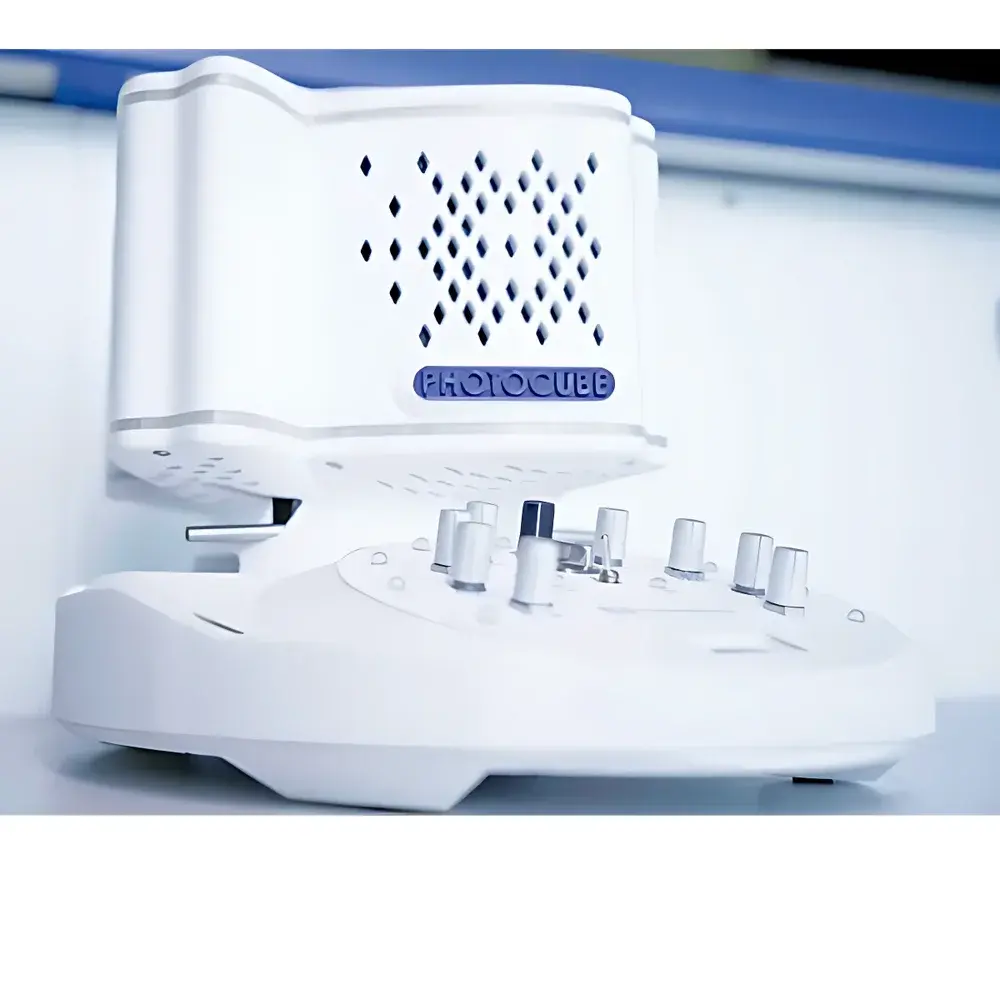
ThalesNano PhotoCube Advanced Multispectral Photochemical Reactor
| Brand | ThalesNano |
|---|---|
| Origin | Hungary |
| Model | PhotoCube |
| Temperature Range | 20–80 °C |
| Reaction Mode | Batch & Flow |
| Batch Volumes | 4 mL & 25 mL (glass) |
| Flow Loop Volume | 5–25 mL |
| Loop Material Options | FEP or PFA |
| Wavelengths | 365, 395, 457, 500, 523, 595, 623 nm + White LED |
| Max LED Power per Channel | 128 W |
| User-Configurable Parameters | Wavelength Selection, Irradiance Intensity, Stirring Speed, Temperature Setpoint & Feedback Control |
| Safety Features | Interlocked Light Shielding, UV/Visible Radiation Containment |
Overview
The ThalesNano PhotoCube Advanced Multispectral Photochemical Reactor is an engineered platform for precision-controlled photochemical synthesis and catalysis. Based on solid-state LED illumination and thermally regulated reaction environments, the PhotoCube operates on the principle of photon-driven molecular activation—enabling selective bond formation, radical generation, and redox-neutral transformations under mild conditions. Unlike conventional mercury-lamp-based systems, it delivers stable, narrow-band irradiation across eight discrete spectral channels (365–623 nm + broadband white), eliminating spectral overlap and enabling wavelength-specific mechanistic studies. Its dual-mode architecture supports both batch and continuous flow operation within a single footprint—making it uniquely suited for reaction screening, kinetic profiling, scalability assessment, and process intensification in academic, pharmaceutical, and fine chemical laboratories.
Key Features
- Eight independently addressable high-power LED channels (365, 395, 457, 500, 523, 595, 623 nm + white), each rated up to 128 W optical output with calibrated irradiance control
- Integrated temperature regulation from 20 °C to 80 °C with real-time PID feedback and optional external chiller coupling
- Modular reactor interface supporting interchangeable glass vials (4 mL and 25 mL) for batch work and chemically inert fluoropolymer flow loops (5–25 mL volume, FEP or PFA tubing)
- Software-defined experimental protocols—including simultaneous multi-wavelength irradiation, time-resolved intensity ramping, and synchronized stirring speed modulation
- Comprehensive hardware safety architecture: interlocked light enclosure, automatic beam shutoff upon lid opening, and Class 3R/3B laser safety compliance per IEC 60825-1
- Compact benchtop design (W × D × H: 320 × 410 × 280 mm) with low power consumption and minimal heat dissipation
Sample Compatibility & Compliance
The PhotoCube accommodates a broad range of photosensitive substrates—including aryl halides, diazonium salts, metal complexes (e.g., Ir(ppy)₃, Ru(bpy)₃²⁺), and organic photocatalysts—without degradation of optical components or thermal runaway. All wetted parts comply with USP Class VI and FDA 21 CFR 177.1550 standards for fluoropolymer materials. The system meets ISO/IEC 17025 requirements for method validation in analytical development labs and supports GLP/GMP-aligned workflows through audit-trail-enabled software logging. It is routinely deployed in support of ICH Q5, Q7, and Q11 guidelines for photostability testing and catalytic route development.
Software & Data Management
Control is executed via ThalesNano’s proprietary PhotoCube Control Suite—a Windows-based application featuring intuitive drag-and-drop protocol builder, real-time irradiance monitoring (mW/cm²), and timestamped parameter logging. All experimental metadata—including wavelength selection, cumulative photon dose (Einstein/mL), temperature profiles, and stir rate—are exported in CSV or HDF5 format for integration with LIMS or ELN platforms. The software adheres to FDA 21 CFR Part 11 requirements, offering electronic signatures, role-based access control, and immutable audit trails. Remote operation via Ethernet or USB is supported, enabling unattended overnight runs with automated shutdown on deviation.
Applications
- Photoredox C–H functionalization (e.g., Minisci-type alkylation, decarboxylative couplings)
- Visible-light-mediated asymmetric catalysis using chiral iridium or ruthenium complexes
- Photoinduced [2+2] cycloadditions and Norrish-type fragmentations
- Flow-assisted photopolymerization and nanoparticle synthesis
- Photostability assessment per ICH Q1B guidelines for API candidates
- Teaching laboratory modules on quantum yield determination and action spectroscopy
FAQ
Can the PhotoCube be used for scale-up studies beyond lab-scale screening?
Yes—the identical photonic and thermal parameters used in 5 mL flow loops are directly transferable to ThalesNano’s larger-scale PhotoFlow systems (up to 500 mL/h throughput), ensuring seamless linear scale-up without re-optimization.
Is calibration traceable to NIST or other national metrology institutes?
Each LED channel undergoes factory calibration using NIST-traceable spectroradiometers; calibration certificates are supplied with every unit and can be renewed annually.
Does the system support custom wavelength combinations or user-loaded spectra?
While discrete LEDs define the available bands, the software allows arbitrary mixing of up to four wavelengths simultaneously with independent intensity weighting—enabling empirical spectral tuning for complex photocatalytic systems.
How is light uniformity ensured across the reaction zone?
Optical path geometry, collimation optics, and reflective chamber lining ensure >92% irradiance homogeneity (measured per ASTM E2919) over the full active volume of both batch vials and flow loops.
What maintenance is required for long-term operational reliability?
No consumables or lamp replacements are needed; LED lifetime exceeds 20,000 hours at rated power. Annual verification of thermal sensor accuracy and irradiance output is recommended per ISO/IEC 17025 internal quality procedures.



