
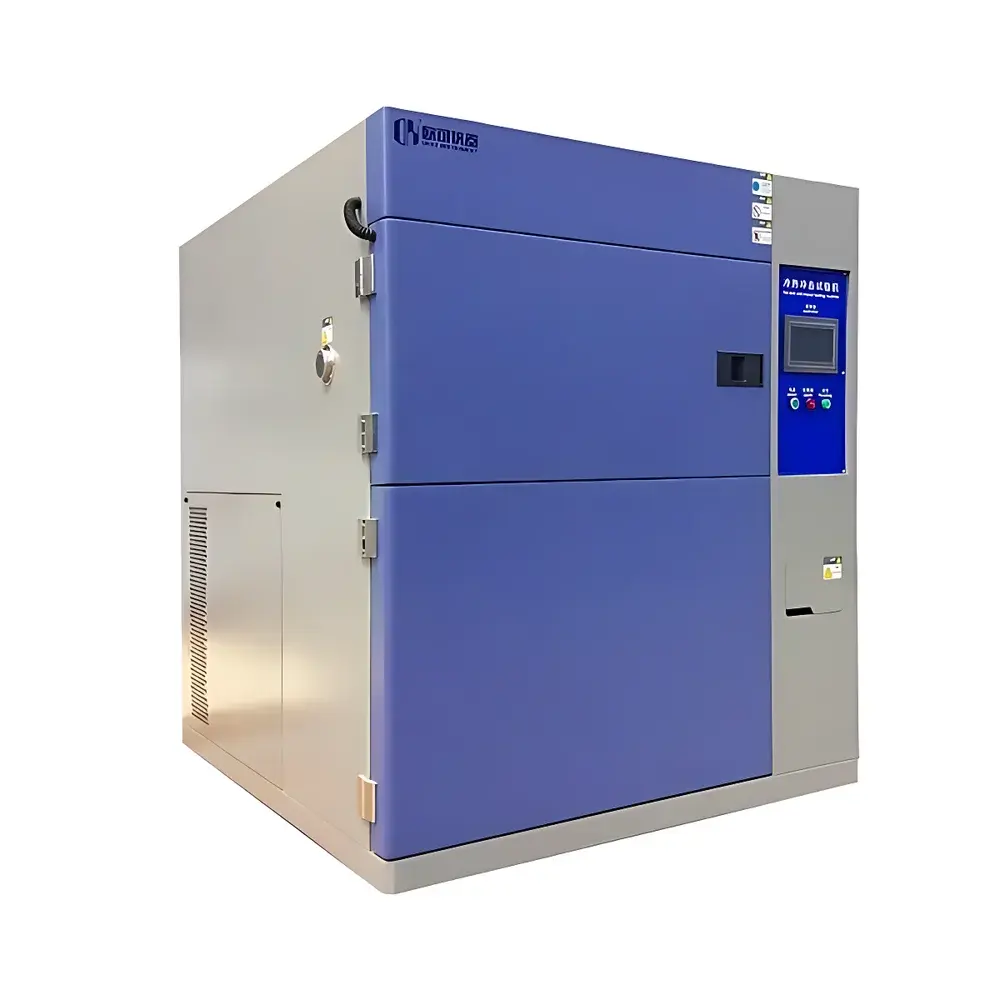
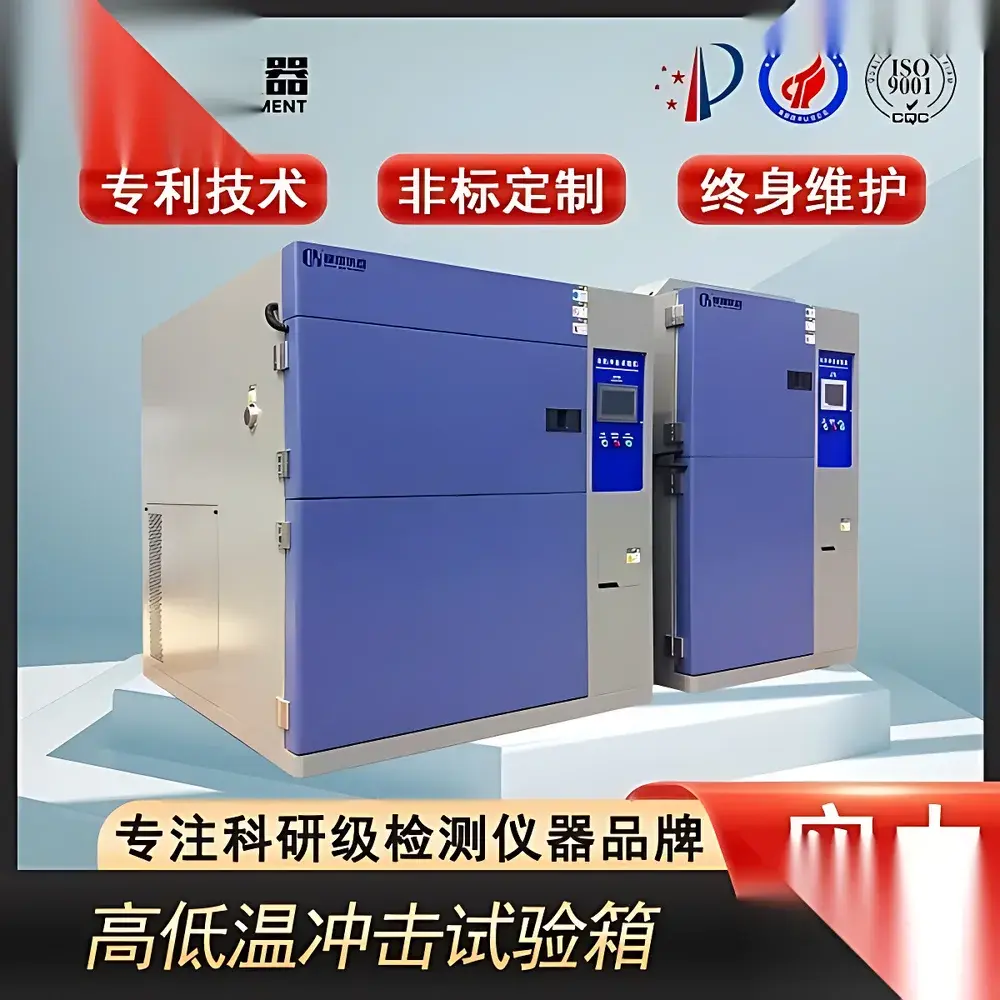
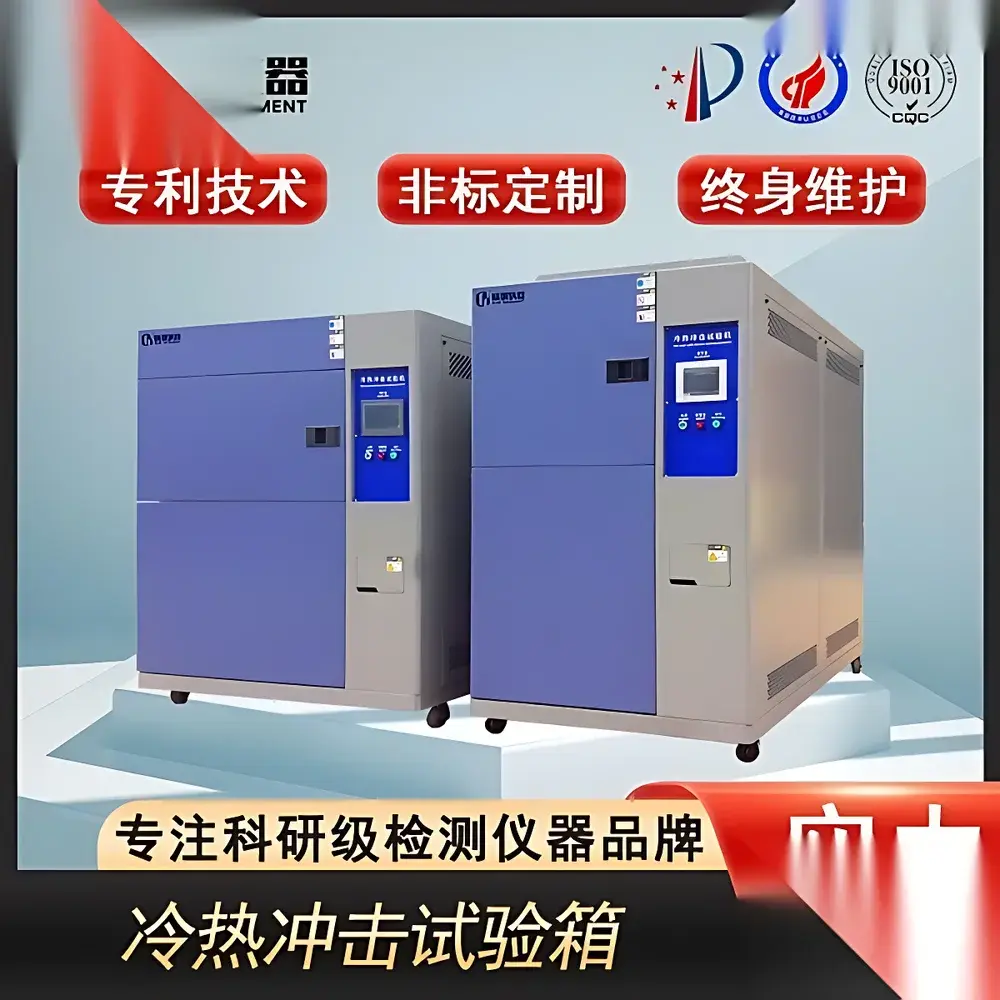
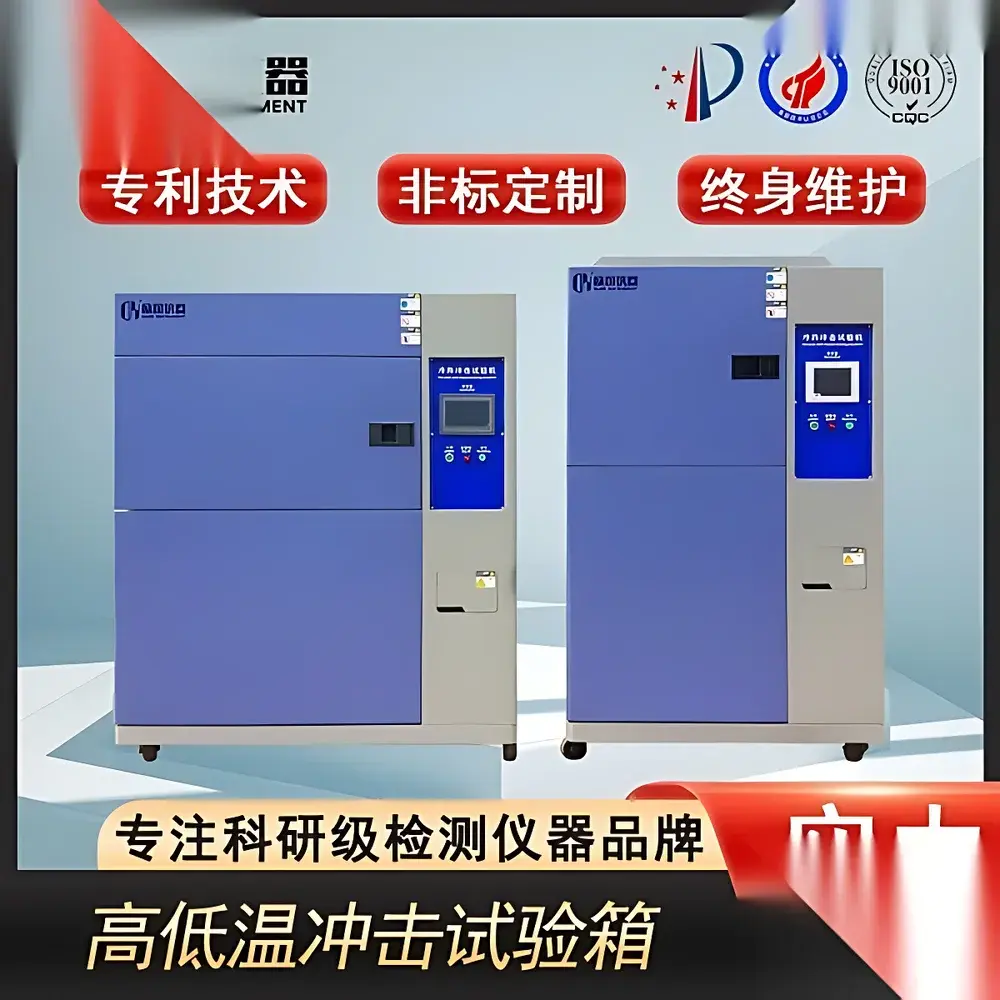
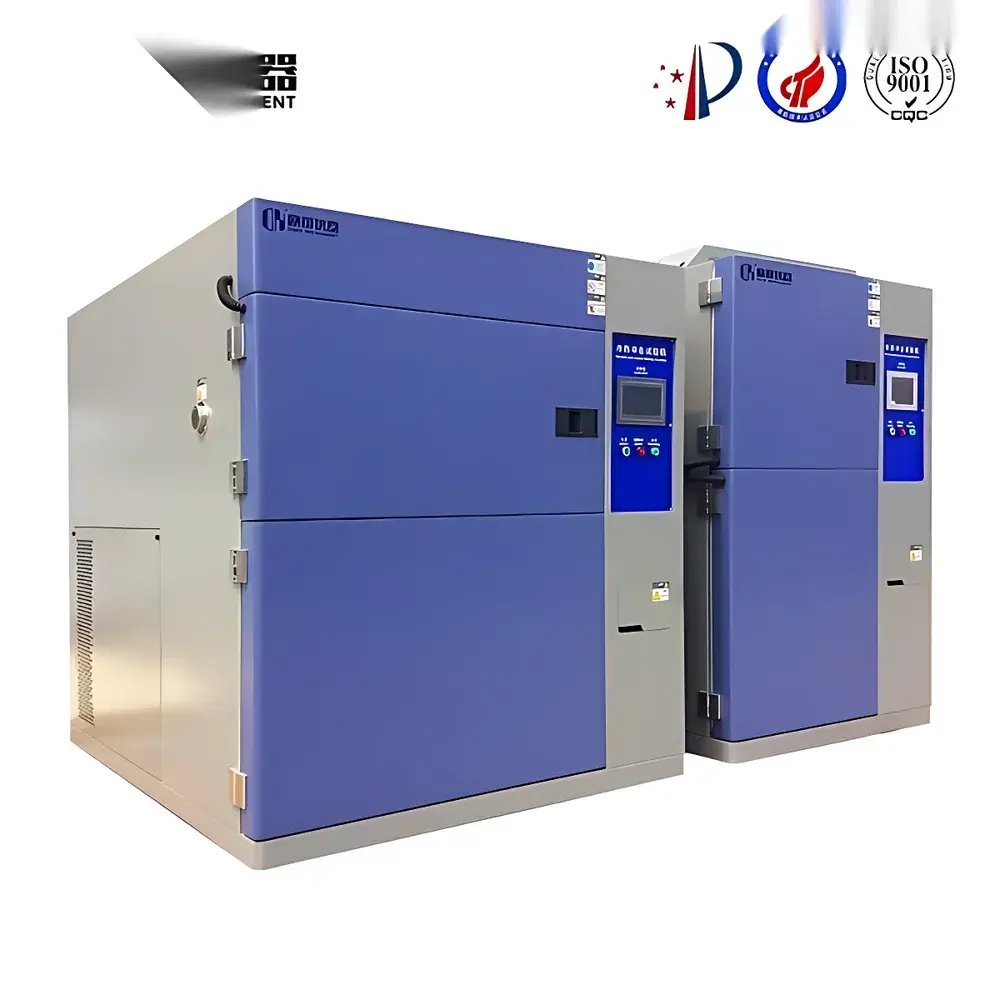
Thermal Shock Test Chamber – BTSC Series with Dual-Zone Rapid Temperature Transition
| Key | Temperature Range: -70°C to +150°C |
|---|---|
| Humidity Range | 20–98% RH |
| Temp. Uniformity | ±1.5°C |
| Temp. Stability | ±0.5°C |
| Humidity Uniformity | ±3% RH |
| Humidity Stability | ±2% RH |
| Heating Rate | ~3°C/min (avg.) |
| Cooling Rate | ~1°C/min (avg.) |
| Internal Dimensions | 50 × 60 × 50 cm (W×H×D) |
| External Dimensions | 102 × 147 × 108 cm (W×H×D) |
| Construction | SUS304 Stainless Steel Interior |
| Insulation | Rigid Polyurethane Foam + Glass Wool |
| Refrigeration System | Dual-Stage Cascade (R404A/R23) |
| Control System | TEMI Programmable PID+SSR Microprocessor Controller |
| Compressor Type | Hermetic or Semi-Hermetic (Imported OEM Units) |
| Critical Components | Sporlan Expansion Valves & Filters, Castel Solenoid Valves, Alco Oil Separators, Ranco Pressure Controls |
| Cooling Method | Air-Cooled or Water-Cooled (Optional for High-Capacity Units) |
| Defrost Mode | Automatic & Manual Cycles |
Overview
The BTSC Series Thermal Shock Test Chamber is an engineered environmental stress screening (ESS) system designed for rapid, repeatable, and highly controlled transitions between extreme high- and low-temperature conditions. Based on the Balanced Temperature and Humidity Control System (BTSC), it employs dual-zone cascade refrigeration architecture—separately conditioned hot and cold reservoirs—to achieve precise thermal shock profiles without mechanical movement of test specimens. This configuration eliminates thermal lag associated with single-chamber shuttle mechanisms and ensures superior temperature fidelity during transition phases. The chamber conforms to core requirements of MIL-STD-810H Method 503.5 (Temperature Shock), IEC 60068-2-14 (Change of Temperature), and JEDEC JESD22-A104D, supporting qualification testing for aerospace components, automotive electronics, semiconductor packaging, and high-reliability PCB assemblies.
Key Features
- Dual-zone cascade refrigeration system utilizing environmentally compliant R404A (high-stage) and R23 (low-stage) refrigerants, enabling stable operation down to –70°C and up to +150°C without cross-contamination or pressure imbalance.
- High-efficiency forced-air circulation with multi-wing centrifugal fans in both hot and cold zones, delivering uniform airflow distribution across the test space and minimizing thermal gradients (±1.5°C uniformity).
- SUS304 stainless steel interior chamber with mirror-finish surface, corrosion-resistant and non-outgassing—compatible with cleanroom and ISO Class 5–8 environments.
- Robust thermal insulation comprising rigid polyurethane foam (≥100 mm thickness) and layered glass wool, achieving low heat leakage and stable chamber wall temperatures under dynamic load.
- TEMI-series programmable controller with PID+SSR output logic, supporting multi-segment ramp-soak profiles, real-time deviation alarms, and automatic safety shutdown upon sensor fault or over-limit condition.
- Redundant defrost management: both automatic timed cycles and manual override capability ensure uninterrupted long-duration testing under high-humidity conditions (20–98% RH).
- Imported critical refrigeration components—including Sporlan thermostatic expansion valves and dryers, Castel solenoid valves, Alco oil separators, and Ranco high/low pressure switches—guarantee system longevity and service interval consistency.
Sample Compatibility & Compliance
The BTSC chamber accommodates standard test specimens up to 150 L volume (50 × 60 × 50 cm internal cavity), suitable for printed circuit boards, molded plastic housings, battery modules, optical sensors, and hybrid microelectronic assemblies. Its construction and control architecture support compliance with GLP/GMP documentation workflows when integrated with optional audit-trail-enabled data loggers. While not inherently 21 CFR Part 11 compliant out-of-the-box, the TEMI controller supports external validation packages for regulated pharmaceutical or medical device qualification (e.g., IQ/OQ/PQ). The system meets structural and safety provisions of EN 61000-6-2 (immunity) and EN 61000-6-4 (emissions), and its refrigerant selection aligns with EU F-Gas Regulation (No. 517/2014) phase-down schedules.
Software & Data Management
Standard configuration includes USB-based data export (CSV format) and RS-485 Modbus RTU communication for integration into centralized MES or LabVantage systems. Optional Ethernet-enabled firmware upgrade enables remote monitoring via web browser interface, with configurable email/SNMP alerts for temperature deviation, door-open events, or compressor fault states. All logged parameters—including chamber setpoint, actual temperature/humidity, SSR duty cycle, and alarm history—are time-stamped with millisecond resolution. For validated environments, third-party software validation kits are available to support FDA-compliant electronic record retention per 21 CFR Part 11 Annex 11 requirements.
Applications
- Accelerated life testing of solder joints and wire bonds under repeated thermal cycling stress.
- Qualification of conformal coatings and encapsulants for moisture resistance and interfacial adhesion stability.
- Reliability screening of MEMS devices subjected to transient thermal gradients exceeding 10°C/s.
- Material compatibility assessment of polymer-based gaskets, seals, and thermal interface materials (TIMs).
- Pre-conditioning of lithium-ion battery cells prior to electrochemical performance evaluation at extreme ambient conditions.
- Validation of hermetic seal integrity in ceramic and metal-ceramic package designs per MIL-STD-883 Method 1014.
FAQ
What is the typical transition time between –40°C and +85°C?
Transition time depends on specimen mass and thermal mass loading; for an unloaded chamber, median transfer time between these setpoints is ≤15 seconds for air-to-air configurations and ≤30 seconds for liquid-immersion variants.
Can this chamber operate continuously at 98% RH without condensation on controls or sensors?
Yes—the chamber features heated observation windows, dew-point-controlled humidity delivery, and isolated sensor compartments to prevent condensation-related drift or failure during sustained high-RH operation.
Is calibration traceability available to NIST or equivalent national metrology institutes?
Factory calibration certificates include as-found/as-left data with uncertainty budgets referenced to NIST-traceable standards; on-site calibration services with full ISO/IEC 17025 accreditation are available upon request.
Does the system support custom thermal shock profiles defined by user-specified dwell times and ramp rates?
Yes—the TEMI controller allows up to 99 programmable segments per profile, including variable ramp rates (0.1–10°C/min), soak durations (0.1–9999 min), and loop counts with conditional branching logic.
What maintenance intervals are recommended for the refrigeration system?
Compressor oil analysis and filter replacement every 2,000 operating hours; full refrigerant purity verification and system leak check every 12 months—documentation templates aligned with ISO 55001 asset management standards are provided.



