
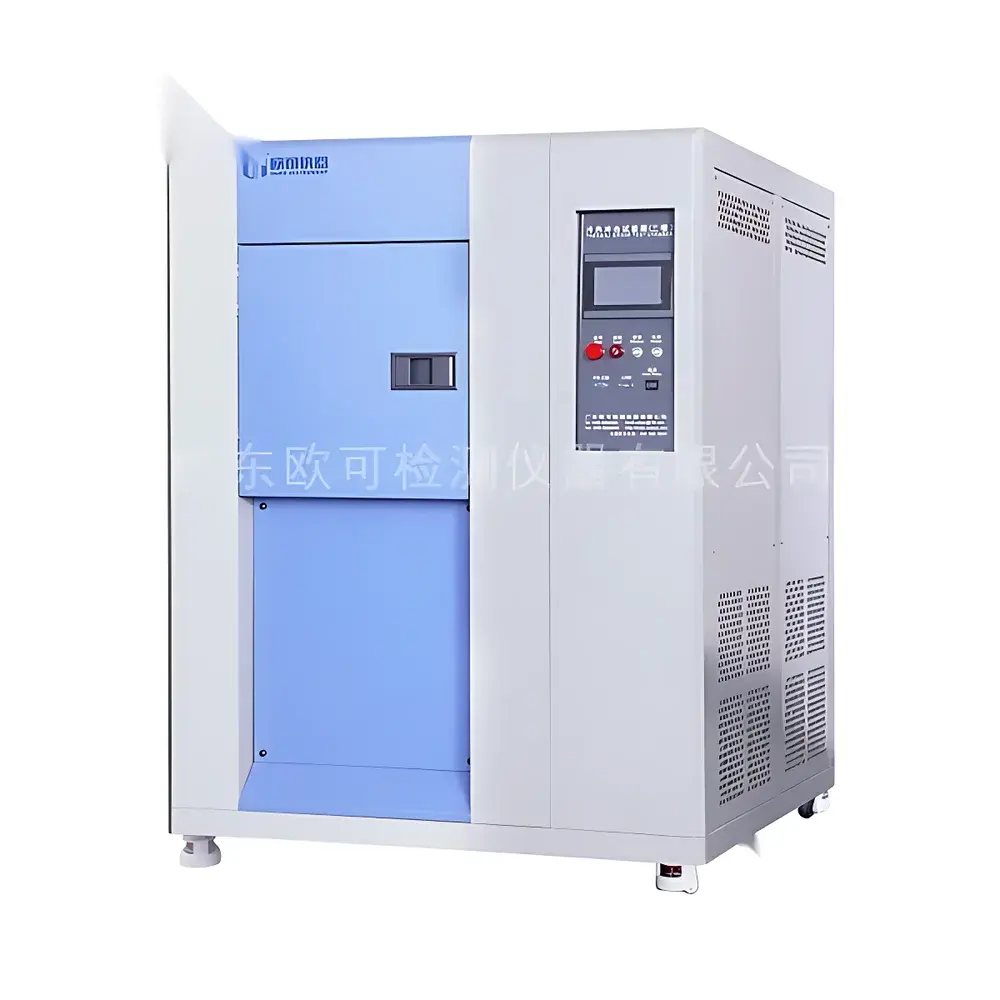
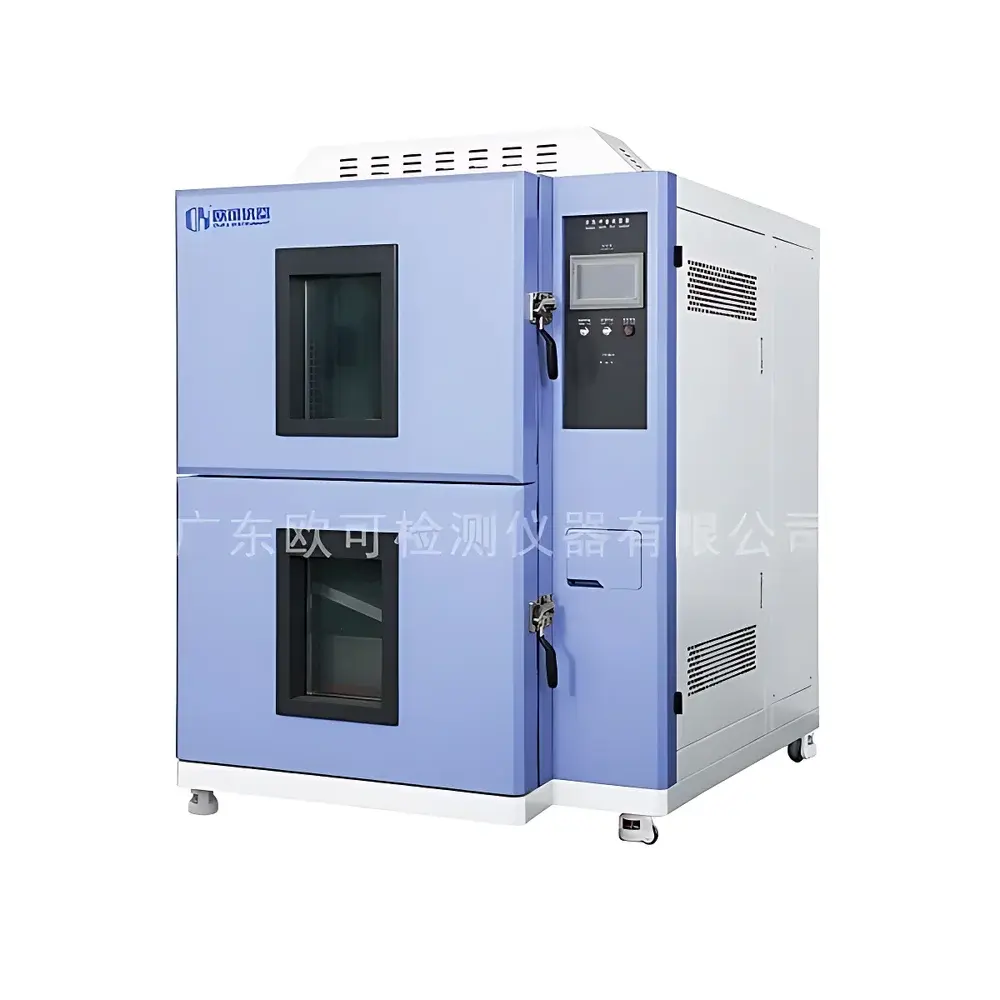
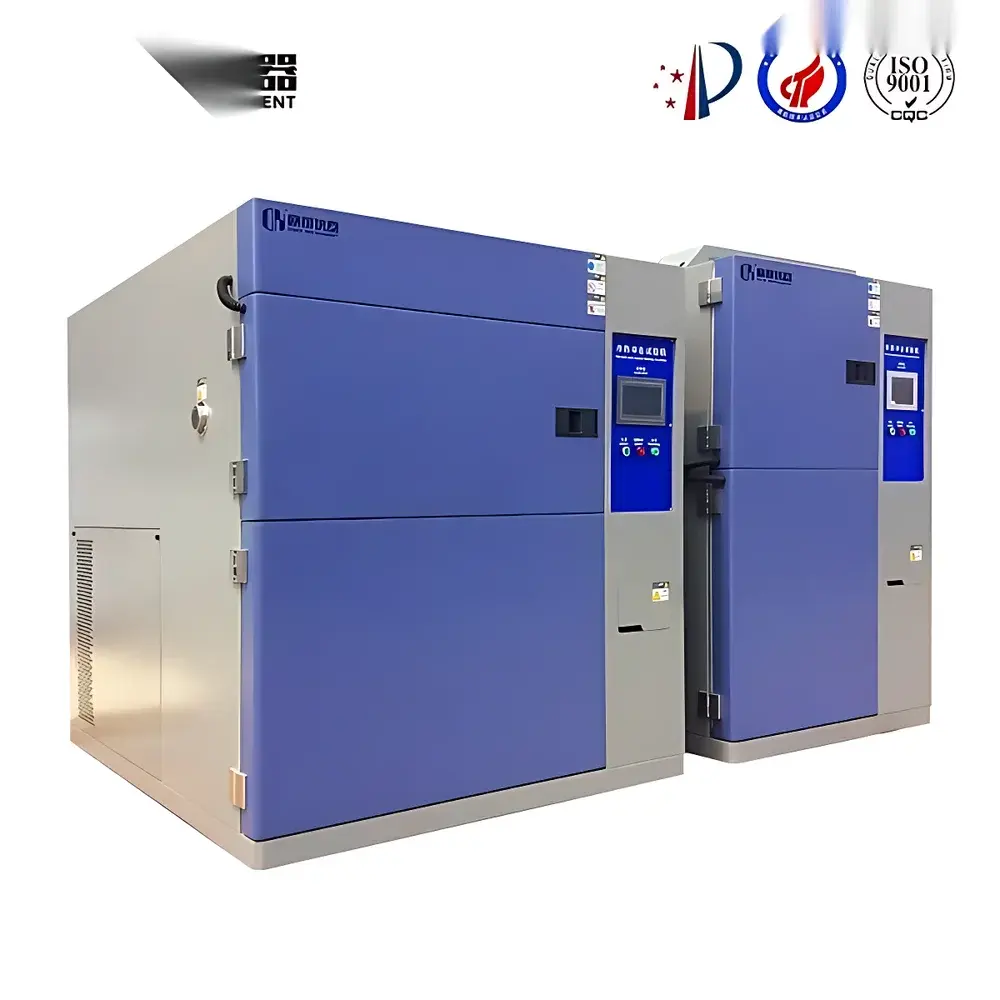
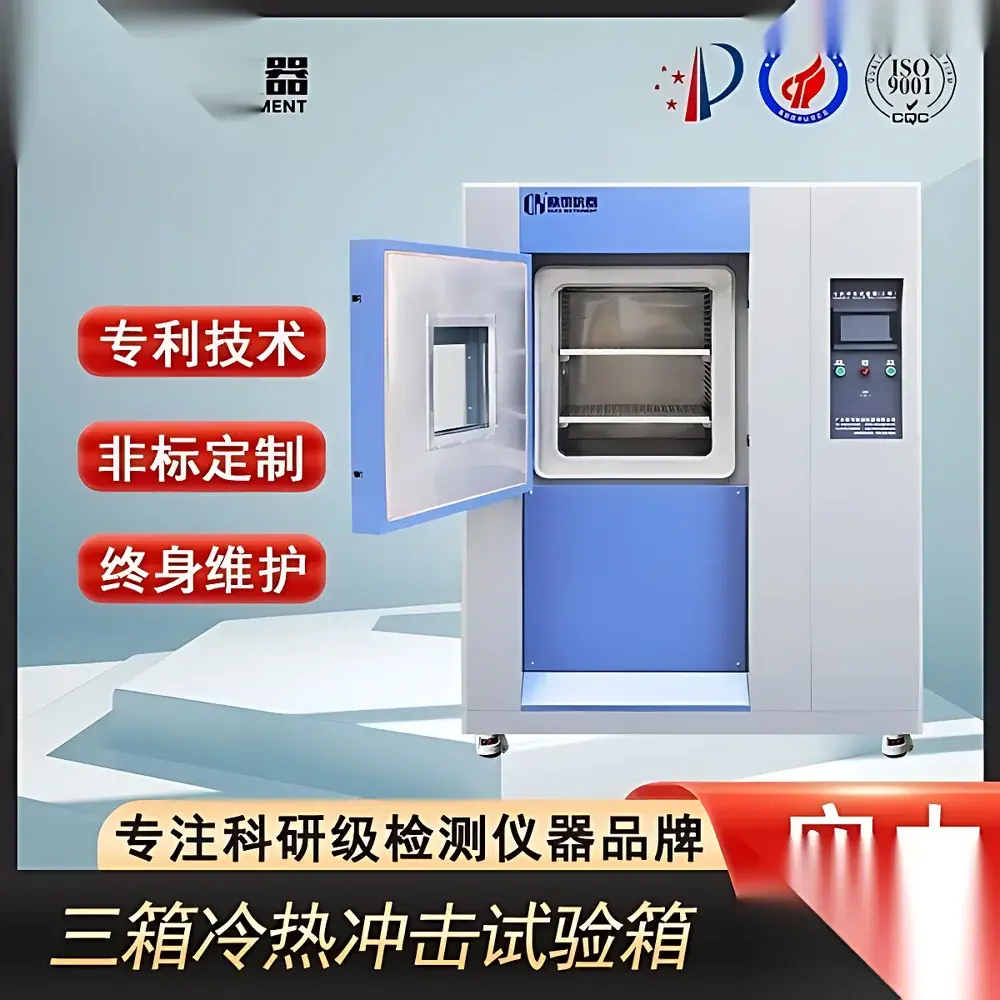
Thermal Shock Test Chamber – Dual-Chamber Rapid Transition Environmental Test System
| Brand | OEM |
|---|---|
| Chamber Dimensions (W×D×H) | 460×460×460 mm / 560×660×560 mm / 680×680×650 mm / 800×800×760 mm |
| Specimen Tray Size | 360×360 mm / 460×560 mm / 600×600 mm / 700×700 mm |
| Temperature Range | High-Temp Zone: Ambient to +150 °C |
| Low-Temp Zone | Ambient to −65 °C |
| Average Ramp Rate | 1.5 °C/min |
| Temperature Uniformity | ±0.5 °C |
| Temperature Deviation | ±2 °C |
| Transfer Time | <15 s (optional <10 s) |
| Temperature Recovery Time | <5 min |
| Compliance | GB/T 2423.1, GB/T 2423.2, GB/T 2423.22, GJB 150.5, GJB 360.7, GJB 367.2, SJ/T 10186, SJ/T 10187 |
Overview
The Thermal Shock Test Chamber – Dual-Chamber Rapid Transition Environmental Test System is an engineered solution for accelerated reliability assessment of electronic components, aerospace assemblies, automotive ECUs, and polymer-based materials subjected to extreme thermal cycling. Based on the two-box (hot/cold chamber) architecture, this system implements rapid pneumatic or mechanical specimen transfer between thermally isolated zones—enabling precise, repeatable thermal shock profiles per international environmental stress screening (ESS) and qualification test standards. Unlike single-chamber ramp-and-soak systems, the dual-zone design eliminates thermal inertia limitations, delivering sub-15-second transfer times and full temperature recovery within five minutes. The system operates on the principle of abrupt thermal gradient exposure: specimens experience near-instantaneous transition from +150 °C to −65 °C (or vice versa), inducing thermo-mechanical strain at material interfaces, solder joints, conformal coatings, and laminate substrates. This facilitates early detection of delamination, cracking, intermetallic growth, and coefficient-of-thermal-expansion (CTE) mismatch failures—critical for high-reliability product development and production lot validation.
Key Features
- Dual independent chamber configuration with fully isolated hot (+150 °C max) and cold (−65 °C min) zones, minimizing cross-contamination and enabling true step-function thermal transitions
- High-efficiency refrigeration system utilizing industrial-grade hermetic compressors and cascade cooling circuitry for stable low-temperature maintenance and rapid cooldown
- Pneumatically actuated transfer mechanism with position-sensing feedback, achieving <15 s specimen transfer time (customizable to <10 s for MIL-STD-883 Class H applications)
- Optimized airflow distribution via tangential blower arrays and baffle-guided recirculation, ensuring ±0.5 °C temperature uniformity across the working volume per IEC 60068-3-5
- Intuitive 7-inch TFT-LCD controller with multi-segment programmable profile capability (up to 99 cycles, 99 segments), real-time data logging, and USB export functionality
- Robust stainless-steel interior construction with insulated double-wall panels, reinforced door gaskets, and over-temperature/over-pressure safety interlocks
- Designed for unattended 24/7 operation under GLP-compliant laboratory conditions, including redundant thermal monitoring and automatic fault shutdown
Sample Compatibility & Compliance
This thermal shock chamber accommodates a broad range of sample geometries—from PCB assemblies and semiconductor packages (QFN, BGA, CSP) to molded plastic housings, battery modules, and optical sensor subassemblies. Standard specimen tray sizes (360×360 mm to 700×700 mm) support both single-unit validation and batch-level stress screening. The system is fully compliant with key national and defense standards governing thermal shock testing, including GB/T 2423.22 (equivalent to IEC 60068-2-14), GJB 150.5A (military environmental engineering), GJB 360.7 (electronic component testing), and GJB 367.2 (equipment environmental test methods). It also aligns with SJ/T 10186 (two-chamber temperature change test equipment specification) and supports traceable execution of temperature profiles required for AEC-Q200, IPC-9701, and JEDEC JESD22-A106B qualification protocols.
Software & Data Management
The embedded controller firmware supports audit-ready data integrity through timestamped cycle logging, parameter lockout modes, and password-protected profile editing. All test records—including chamber setpoints, actual temperatures, transfer timestamps, and alarm events—are stored internally and exportable in CSV format for post-test analysis. While no PC-based software suite is bundled, the unit provides RS-485 Modbus RTU and optional Ethernet/IP interfaces for integration into centralized test management platforms (e.g., TestStand, LabVIEW, or custom MES systems). For regulated environments, users may implement external 21 CFR Part 11-compliant electronic signatures and audit trails via third-party validation packages. Calibration certificates (traceable to NIM or NIST-equivalent references) are available upon request, covering temperature sensors, controllers, and transfer timing mechanisms.
Applications
- Qualification testing of avionics hardware per DO-160 Section 4 (Temperature Variation) and MIL-STD-810H Method 503.5
- Solder joint reliability assessment in automotive electronics using JEDEC JESD22-A104D and IPC-9701-A
- Failure mode acceleration for encapsulated MEMS devices, LED packages, and power modules
- Process validation of conformal coating adhesion and thermal interface material (TIM) performance
- Environmental stress screening (ESS) in high-mix manufacturing lines requiring rapid throughput and statistical process control (SPC) compatibility
- Research into CTE-induced fatigue in heterogeneous material stacks (e.g., SiC/GaN-on-Si, ceramic-to-metal seals)
FAQ
What is the minimum specimen weight this chamber can handle without affecting thermal recovery time?
The system maintains specified recovery performance for loads up to 25 kg distributed evenly on the tray. For heavier or thermally massive samples (>40 kg), optional pre-conditioning protocols and extended stabilization periods are recommended.
Does the unit include calibration documentation per ISO/IEC 17025 requirements?
Factory calibration reports (traceable to national metrology institutes) are provided. Full ISO/IEC 17025-accredited calibration requires engagement with an accredited third-party lab; we supply mounting points and sensor access ports to facilitate field verification.
Can the controller log temperature data at intervals shorter than 1 second?
Standard logging resolution is 1 Hz. High-frequency acquisition (10 Hz) is supported via optional analog output modules connected to external DAQ systems.
Is nitrogen purge integration available for moisture-sensitive testing?
Yes—dual inert gas inlets (N₂ or dry air) with mass flow controllers and O₂ monitors can be factory-installed to maintain dew point ≤ −40 °C during cold-phase operation.
How is compliance with GJB 150.5 verified during installation qualification (IQ)?
We provide IQ/OQ documentation templates aligned with GJB 150.1A, including thermal mapping procedures, transfer time validation protocols, and uncertainty budgets for all critical measurements.



