
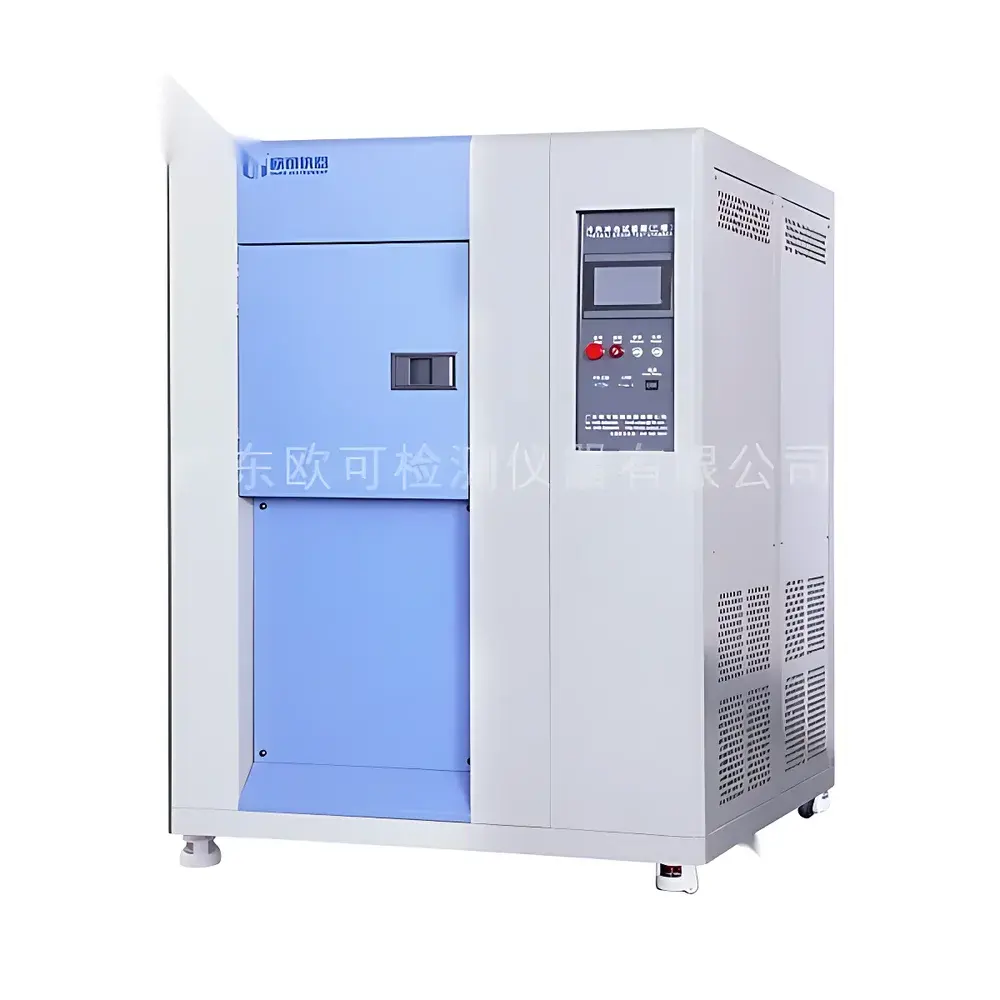
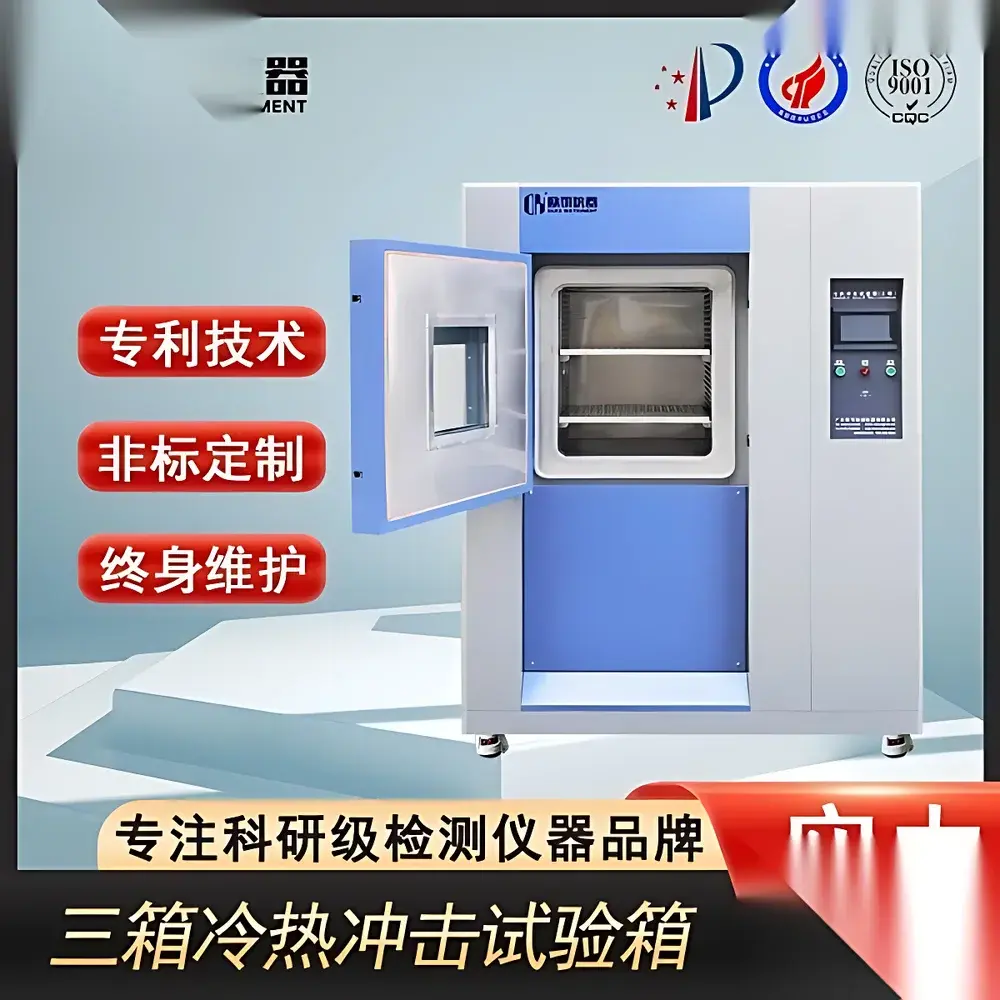
Thermal Shock Test Chamber – Dual-Compartment Rapid Temperature Transition Chamber
| Key | Temperature Range: -40 to 100°C |
|---|---|
| Humidity Range | 20–98% RH |
| Temperature Uniformity | ±1°C |
| Humidity Uniformity | ±5% RH |
| Door Configuration | Dual-front & rear access doors |
| Heating Load Capacity | Customizable per user specification |
| Cooling System | Air-cooled, single-stage compressor (for -20°C base) / dual-stage compressor (for -40°C to -70°C operation) |
| Ramp Rates | ~4.0°C/min (heating), ~1.0°C/min (cooling) |
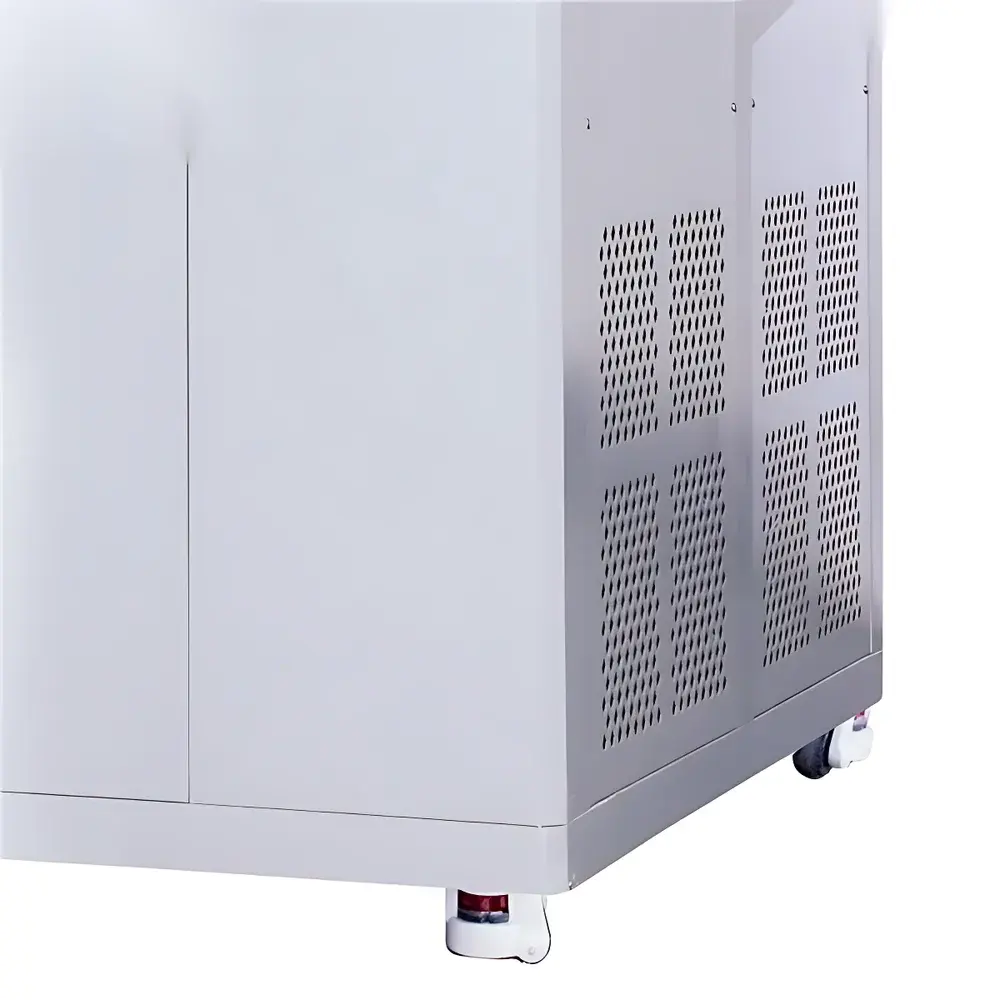
| Construction | Interior and exterior walls in brushed SUS304 stainless steel |
| Viewing Window | Low-condensation coated electrothermal glass |
| Control System | PLC-based programmable controller with color touchscreen HMI |
| Compliance | Designed to support IEC 60068-2-14, MIL-STD-810H Method 503.5, JESD22-A104, and JEDEC J-STD-020 for lead-free solder process validation |
Overview
The Thermal Shock Test Chamber – Dual-Compartment Rapid Temperature Transition Chamber is an engineered environmental stress screening (ESS) system designed to evaluate material and component reliability under extreme, rapid thermal transitions. Based on the two-box (hot/cold chamber) principle, it physically separates high- and low-temperature zones and transfers test specimens via a pneumatic or servo-driven lift mechanism—enabling true thermal shock profiles with minimal dwell time and negligible thermal inertia interference. This architecture ensures compliance with standardized thermal shock protocols requiring defined transition times (<15 s between chambers) and stable soak conditions (±0.5°C stability over ≥10 min). The chamber supports both air-to-air thermal shock testing and optional humidity-controlled shock cycles (20–98% RH), making it suitable for evaluating moisture-sensitive optoelectronic assemblies and advanced packaging technologies subjected to reflow, drop, or field-service thermal excursions.
Key Features
- Dual-compartment architecture with independent hot (+100°C) and cold (-40°C) zones, minimizing cross-contamination and enabling precise dwell control in each environment
- Brushed SUS304 stainless steel interior and exterior construction—resistant to corrosion, non-outgassing, and compatible with cleanroom-grade maintenance protocols
- Electrothermally heated, low-condensation viewing window with anti-fog coating—ensuring uninterrupted visual monitoring of specimen behavior during transient thermal events
- PLC-driven control system with color touchscreen HMI, supporting multi-step profile programming, real-time data logging, alarm history, and password-protected parameter locking
- Customizable sample fixture design—including adjustable-angle LCD-mounting brackets and thermocouple-integrated mounting plates—for flat-panel display (FPD) and flexible OLED substrate alignment
- Energy-optimized operation mode for 0°C low-temperature shock testing, reducing compressor cycling and power consumption without compromising thermal reproducibility
- Aluminum reference load validation protocol (per IEC 60068-3-10)—using calibrated aluminum mass blocks instead of polymer surrogates—to verify thermal mass handling capability and airflow distribution integrity
Sample Compatibility & Compliance
This chamber is validated for use with planar optoelectronic devices including TFT-LCD panels, OLED modules, LTPS backplanes, LED edge-lit light guides, and thin-film encapsulated flexible displays. Its humidity-capable configuration meets requirements for accelerated aging of moisture-barrier layers in organic electronics. The system supports test execution per internationally recognized standards: IEC 60068-2-14 (Change of temperature), MIL-STD-810H Method 503.5 (Temperature Shock), JESD22-A104 (Temperature Cycling), and JEDEC J-STD-020 (Moisture Sensitivity Level classification for surface-mount devices). Sensor placement follows ISO/IEC 17025-compliant practice—temperature and humidity probes mounted directly within the test zone (not in air ducts), ensuring metrological traceability of exposure conditions.
Software & Data Management
The integrated control software provides full audit trail functionality compliant with GLP and GMP environments, including user login tracking, parameter change logs, calibration event timestamps, and electronic signature support. Optional RS-485/RS-232 interfaces enable integration into centralized laboratory information management systems (LIMS) or MES platforms. Data export formats include CSV and XML; trend graphs are auto-generated for soak stability, ramp fidelity, and inter-zone transition timing. For regulated industries, optional 21 CFR Part 11-compliant packages include electronic signature workflows, role-based access control, and immutable record archiving.
Applications
- Qualification of solder joint integrity in lead-free (Pb-free) assembly processes, including tin whisker growth assessment per IPC-TM-650 2.6.22
- Reliability screening of encapsulation adhesion strength in micro-LED and QD-OLED displays under repeated thermal expansion mismatch
- Validation of CTE (coefficient of thermal expansion) mismatch mitigation strategies in hybrid glass-metal sensor housings
- Accelerated life testing of polymer-based optical films, diffusers, and polarizers exposed to automotive or aerospace thermal envelopes
- Failure mode analysis of thin-film transistor (TFT) gate dielectric cracking under thermal fatigue loading
FAQ
What is the maximum allowable thermal transition time between chambers?
The standard mechanical transfer mechanism achieves ≤10 seconds for specimens up to 15 kg. Optional high-speed lift systems reduce this to ≤5 seconds upon request.
Can the chamber perform humidity-controlled thermal shock cycles?
Yes—when equipped with the optional humidification module, it maintains 20–98% RH in the high-temperature zone while executing shock profiles per JESD22-A110.
Is third-party calibration certification available?
NIST-traceable calibration reports with uncertainty budgets are provided at installation and can be renewed annually per ISO/IEC 17025 requirements.
What safety interlocks are implemented?
The system includes dual redundant overtemperature protection, refrigerant high/low pressure cutoffs, phase failure detection, door position sensing, and emergency stop circuitry meeting EN 60204-1.
Are custom test fixtures included in the base configuration?
Standard configurations include adjustable-angle stainless steel fixtures. Application-specific fixtures (e.g., vacuum chucks for glass substrates or thermal interface material compression stages) are available as engineering options.



