
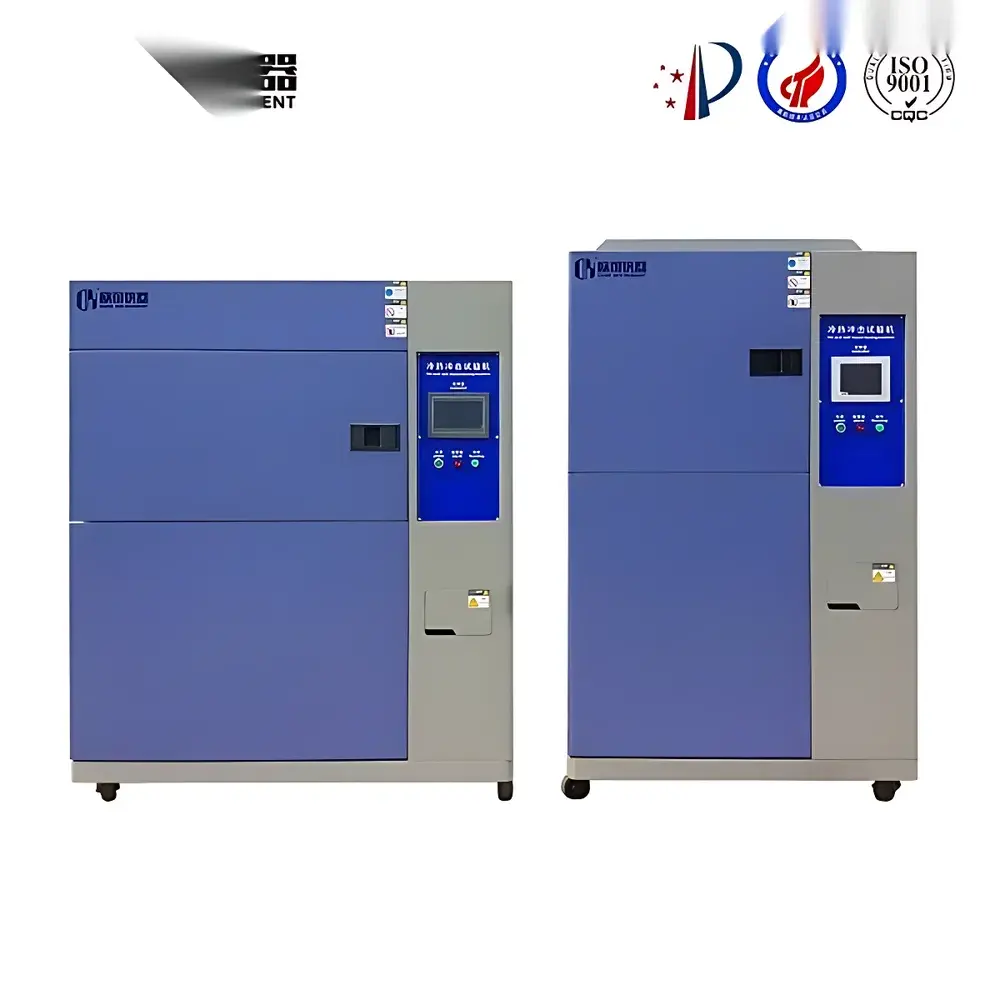
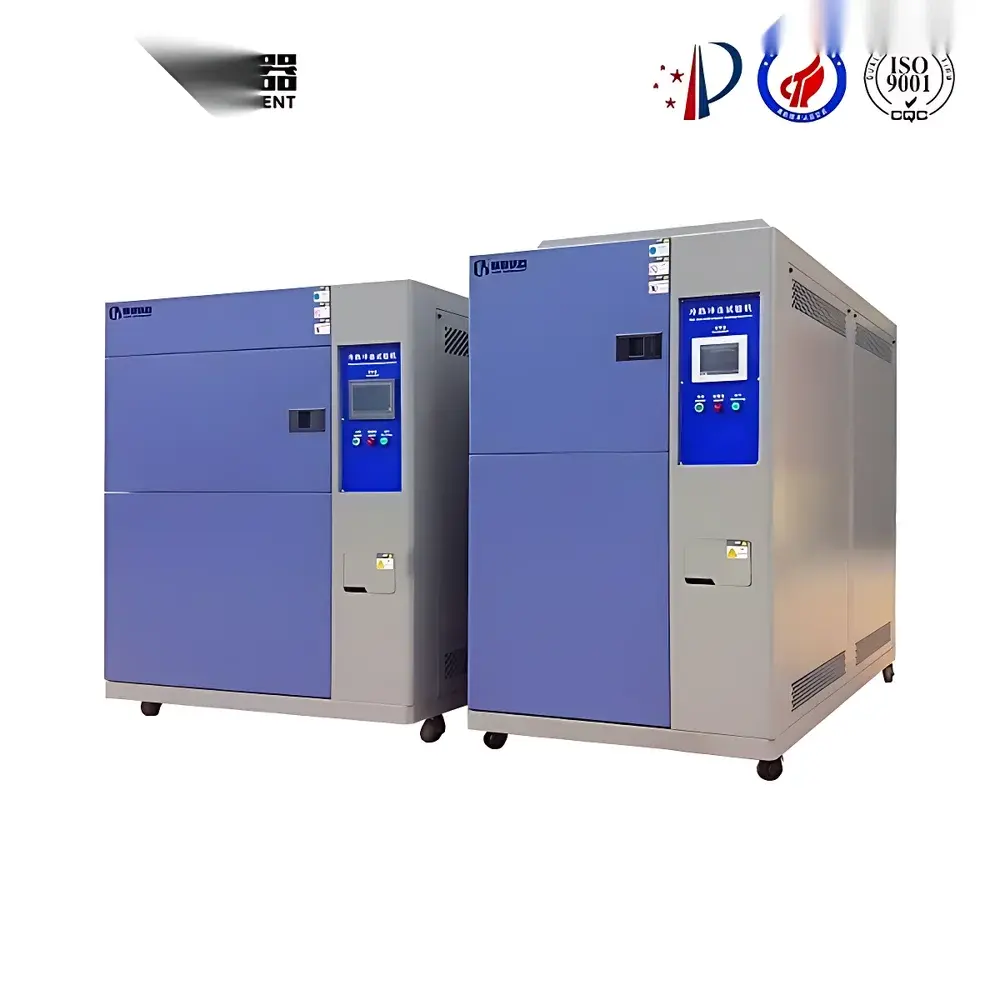
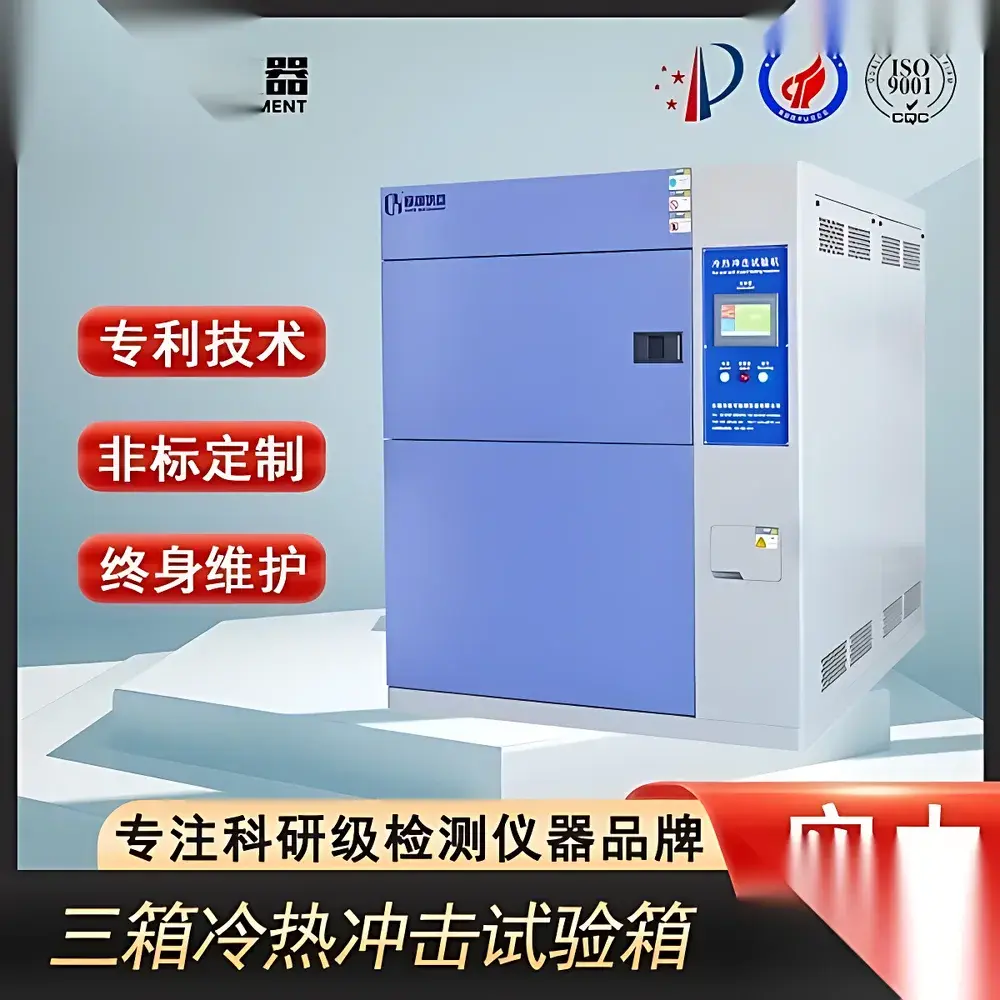
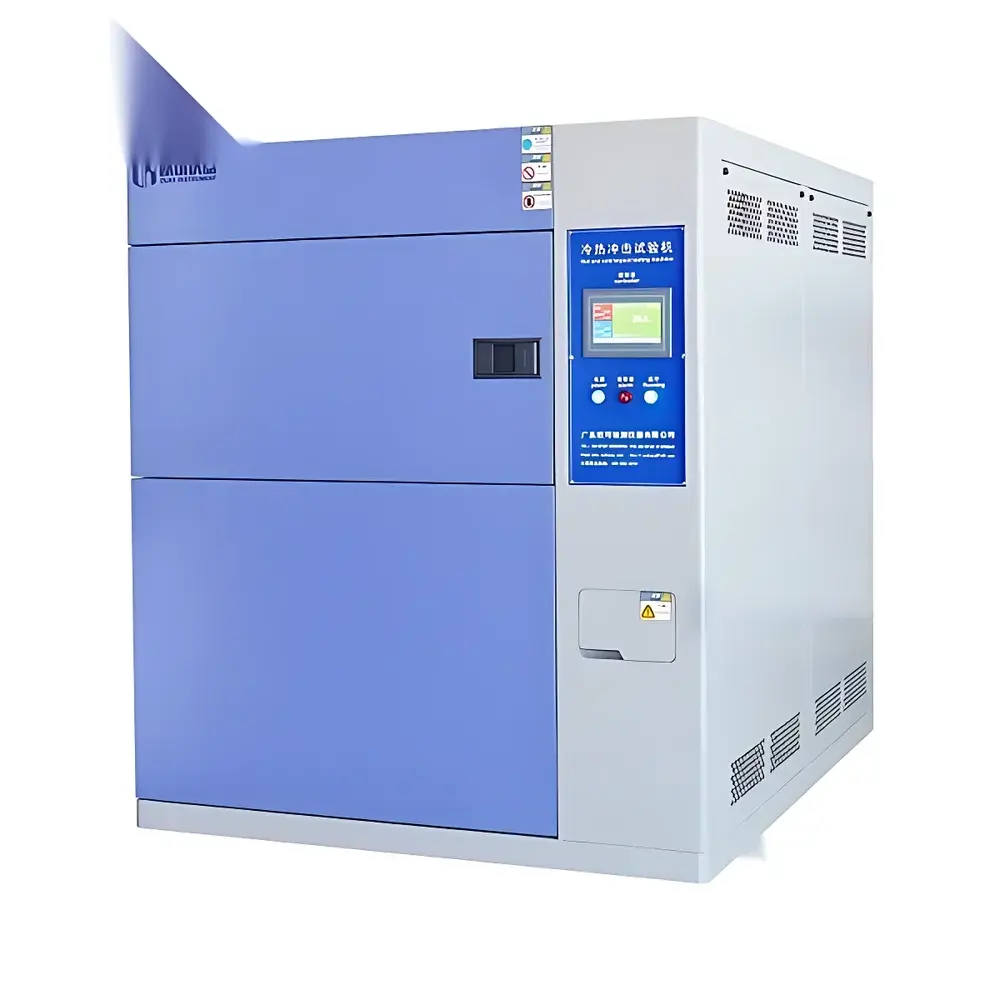
Thermal Shock Test Chamber – Dual- or Tri-Zone Configuration
| Brand | Other Brands |
|---|---|
| Origin | Imported |
| Manufacturer Type | Authorized Distributor |
| Price | USD 11,200 (FOB) |
| Temperature Range | −65 °C to +180 °C |
| Transition Time (Typical) | ≤15 s between chambers |
| Shock Cycle Count | 1–9999 programmable |
| Dwell Time per Zone | 0.1–999.9 h |
| Data Logging Interval | 3 s to 1 h |
| Storage Capacity | 120 days @ 60 s sampling |
| Compliance | GB/T 2423.1–2008 (Test A), GB/T 2423.2–2008 (Test B), GB/T 10592–2008, GJB 150.3–1986, GJB 360A–1996 Method 107 |
Overview
The Thermal Shock Test Chamber is an engineered environmental test system designed to evaluate material and component reliability under rapid, repetitive thermal transitions between extreme temperature extremes. Based on the principle of accelerated thermal stress induction—where specimens undergo controlled, high-rate temperature shifts between independently conditioned hot and cold zones—the chamber simulates real-world thermal fatigue conditions encountered in aerospace, automotive electronics, semiconductor packaging, and defense applications. Unlike conventional temperature cycling chambers, this dual- or tri-zone configuration eliminates thermal inertia by physically isolating high- and low-temperature reservoirs and transferring test samples via pneumatic or mechanical shuttle mechanisms. This architecture ensures repeatable transition times (typically ≤15 seconds), precise dwell control, and minimal thermal overshoot—critical for assessing microcrack propagation, interfacial delamination, solder joint integrity, and coefficient-of-thermal-expansion (CTE) mismatch effects.
Key Features
- Modular chamber architecture supporting both dual-zone (hot/cold) and tri-zone (hot/ambient/cold) configurations for flexible test protocol implementation.
- Intelligent dual-compressor refrigeration system: high-capacity cascade refrigeration unit for rapid cooling (−65 °C), paired with precision-controlled low-load compressor for stable high-temperature maintenance (+180 °C); energy-optimized via dynamic load balancing.
- High-uniformity air circulation: stainless-steel extended-shaft circulation motor coupled with high-efficiency aluminum alloy multi-blade centrifugal impeller; positive-pressure discharge design ensures ≥90% volumetric airflow coverage across test space.
- Advanced temperature regulation: PID + PWM + SSR hybrid control algorithm delivering ±0.3 °C temperature stability during dwell phases and ±1.0 °C accuracy over full range.
- Integrated data acquisition: built-in USB 2.0 port for direct data export (temperature/time logs, cycle history, alarm events); RS-232C interface enables bidirectional communication with external SCADA or LIMS systems.
- Configurable logging resolution: sampling interval adjustable from 3 seconds to 1 hour; onboard memory supports up to 120 days of continuous data at 60-second intervals.
- Comprehensive operational diagnostics: real-time status display with graphical temperature curves; fault-code mapping with contextual troubleshooting guidance for common anomalies (e.g., refrigerant pressure deviation, door seal breach, heater open-circuit).
- Optional remote monitoring package: web-enabled Ethernet interface supporting secure HTTP/HTTPS access for live parameter viewing, alarm notification, and remote cycle initiation—compliant with TLS 1.2 encryption standards.
Sample Compatibility & Compliance
This chamber accommodates standard test specimens up to 500 mm × 500 mm × 500 mm (W×D×H) and supports fixtures for PCB assemblies, molded plastic housings, hermetic packages, and metal castings. All structural components—including interior chamber walls, sample trays, and airflow ducts—are constructed from SUS304 stainless steel with passivated surface finish to prevent corrosion under repeated condensation cycles. The system conforms to international environmental testing standards including IEC 60068-2-14 (Test N: Change of Temperature), MIL-STD-810H Method 503.5, and the referenced Chinese national and military standards (GB/T 2423.1–2008, GB/T 2423.2–2008, GJB 150.3–1986, GJB 360A–1996 Method 107). Calibration traceability follows ISO/IEC 17025 requirements, with optional NIST-traceable certificate available upon request.
Software & Data Management
The embedded controller runs a deterministic real-time OS with non-volatile flash memory for firmware and configuration persistence. Data files are stored in CSV format with ISO 8601 timestamping, compatible with MATLAB, Python pandas, and industry-standard statistical process control (SPC) tools. Audit trail functionality records all user-initiated actions—including parameter changes, cycle starts/stops, and manual overrides—with timestamps and operator IDs. For regulated environments, optional 21 CFR Part 11-compliant software add-on provides electronic signatures, role-based access control, and immutable archive generation—fully aligned with GLP and GMP documentation requirements.
Applications
- Qualification testing of avionics modules per DO-160 Section 4 (Temperature Variation).
- Reliability screening of automotive ECUs exposed to under-hood thermal transients.
- Failure analysis of wafer-level chip-scale packages (CSP) and fan-out wafer-level packages (FOWLP).
- Validation of conformal coating adhesion and thermal cycling endurance in medical device enclosures.
- Accelerated life testing of lithium-ion battery cells and module housings under extreme thermal shock profiles.
- Material compatibility assessment for adhesive bonds, potting compounds, and thermal interface materials (TIMs).
FAQ
What is the typical temperature transition time between hot and cold zones?
Transition time is ≤15 seconds for standard configurations (measured from −40 °C to +125 °C or vice versa), verified per IEC 60068-2-14 Annex A.
Can the chamber operate in single-zone mode for standard temperature cycling?
Yes—user-selectable operation modes include thermal shock, step cycling, ramp-and-soak, and static temperature hold.
Is calibration certification included with shipment?
Factory calibration report is provided; ISO/IEC 17025-accredited calibration with NIST-traceable standards is available as an optional service.
How is condensation managed during low-temperature exposure?
The system integrates automatic defrost sequencing (programmable frequency and duration) and a heated observation window with anti-fog coating to maintain visibility without compromising chamber integrity.
What safety protections are implemented?
Dual independent over-temperature cutouts, refrigerant high-pressure shutdown, door interlock switch, and ground-fault circuit interrupter (GFCI) protection are standard across all models.
Related Products



