
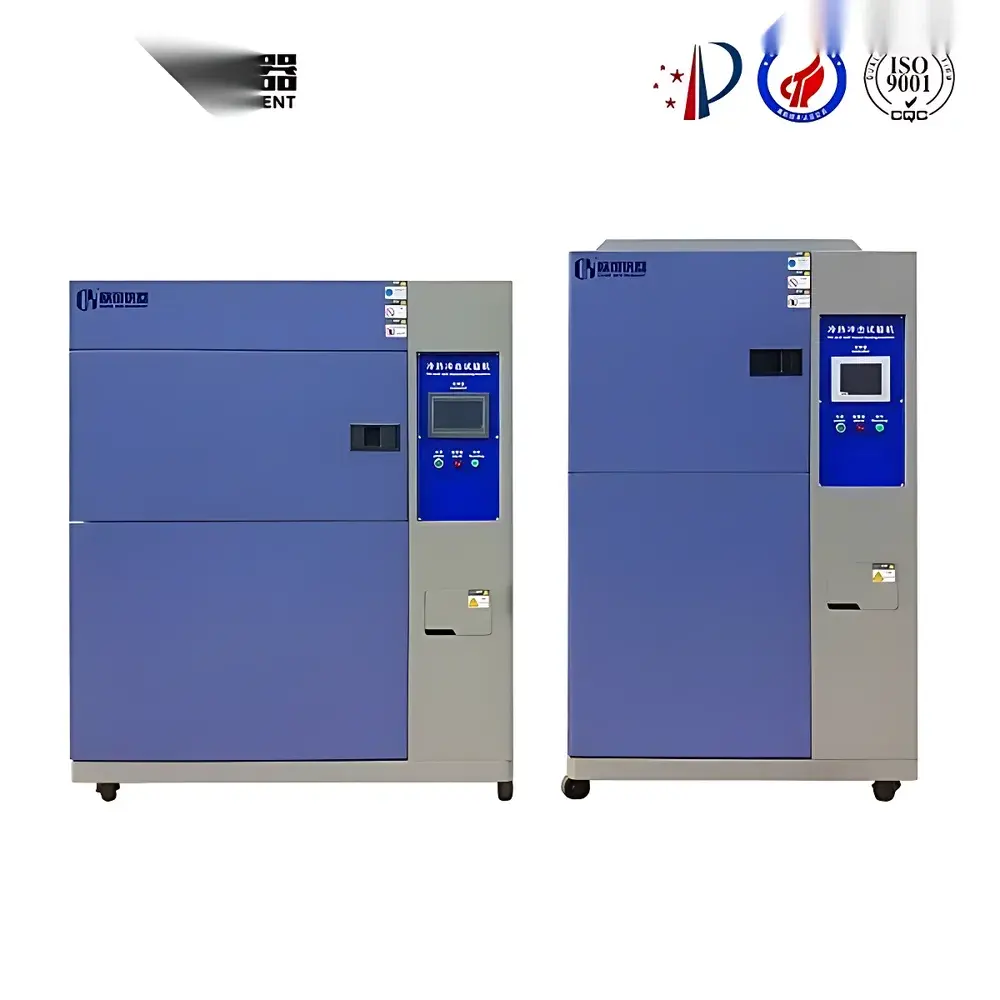
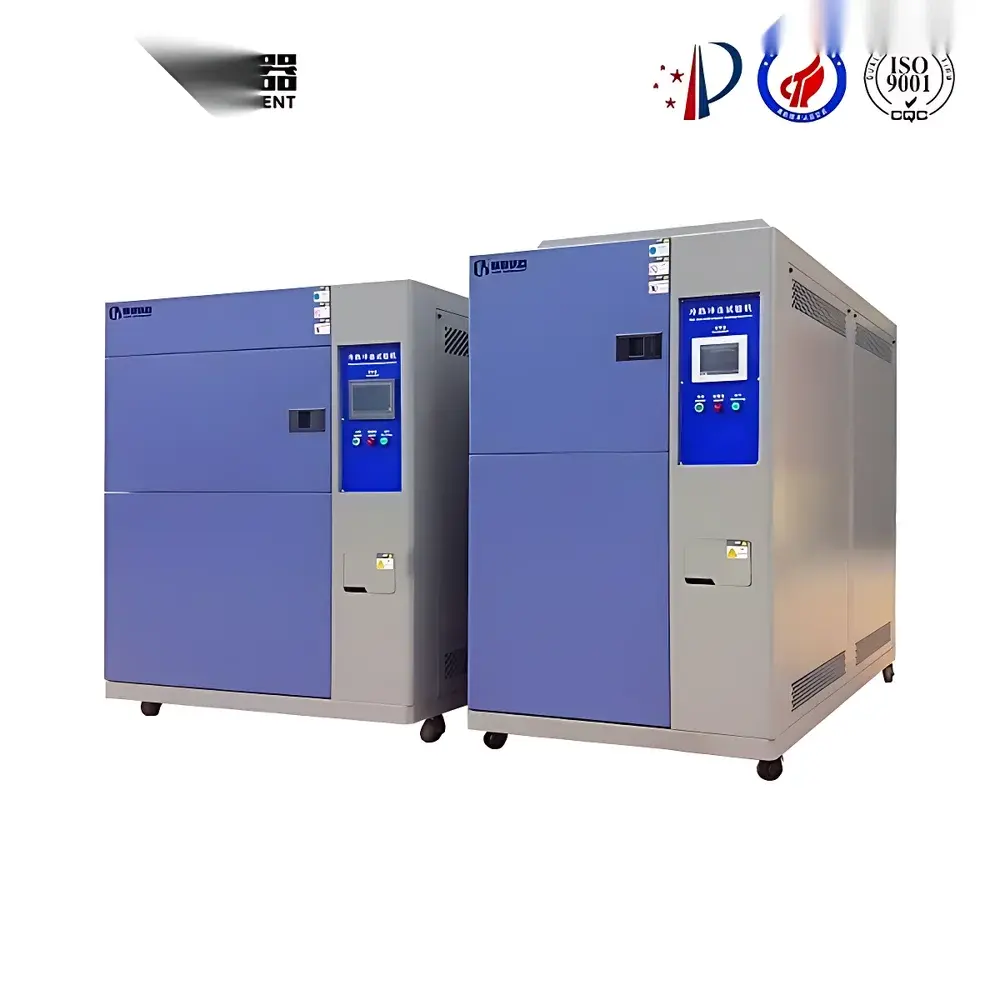
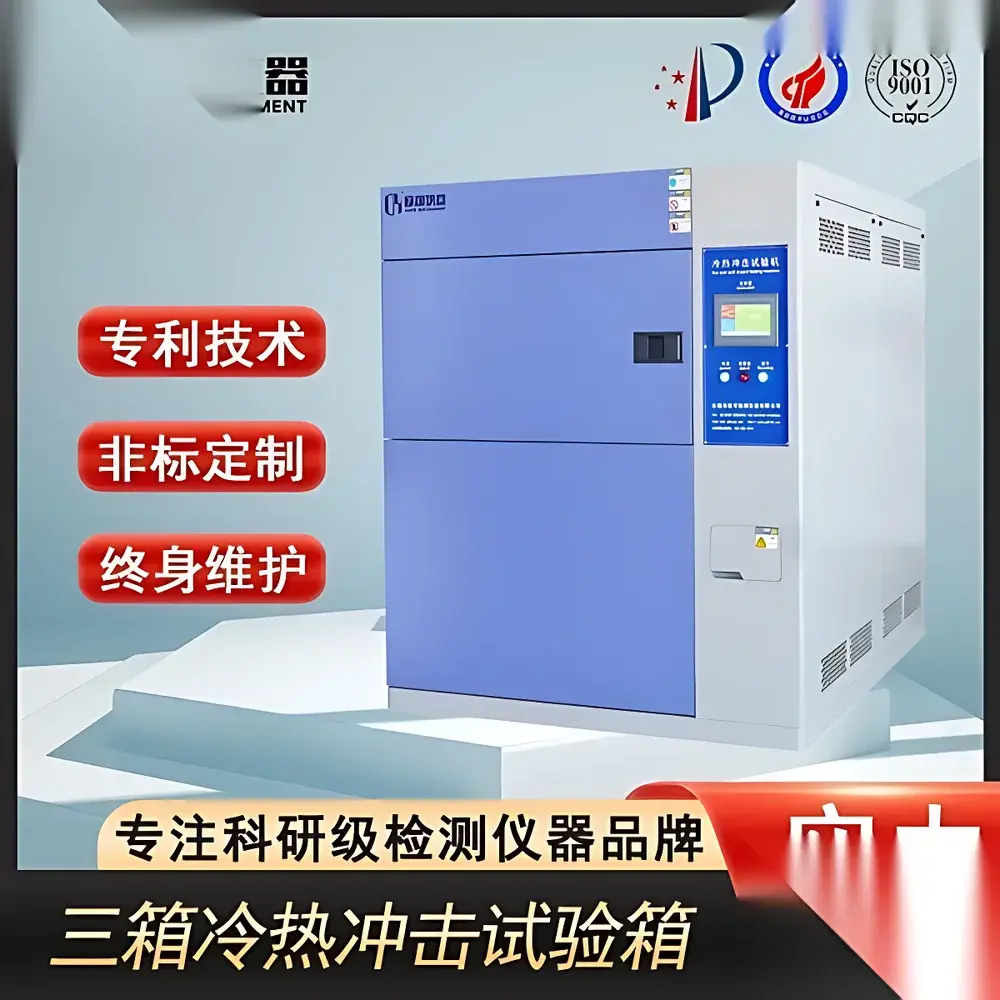
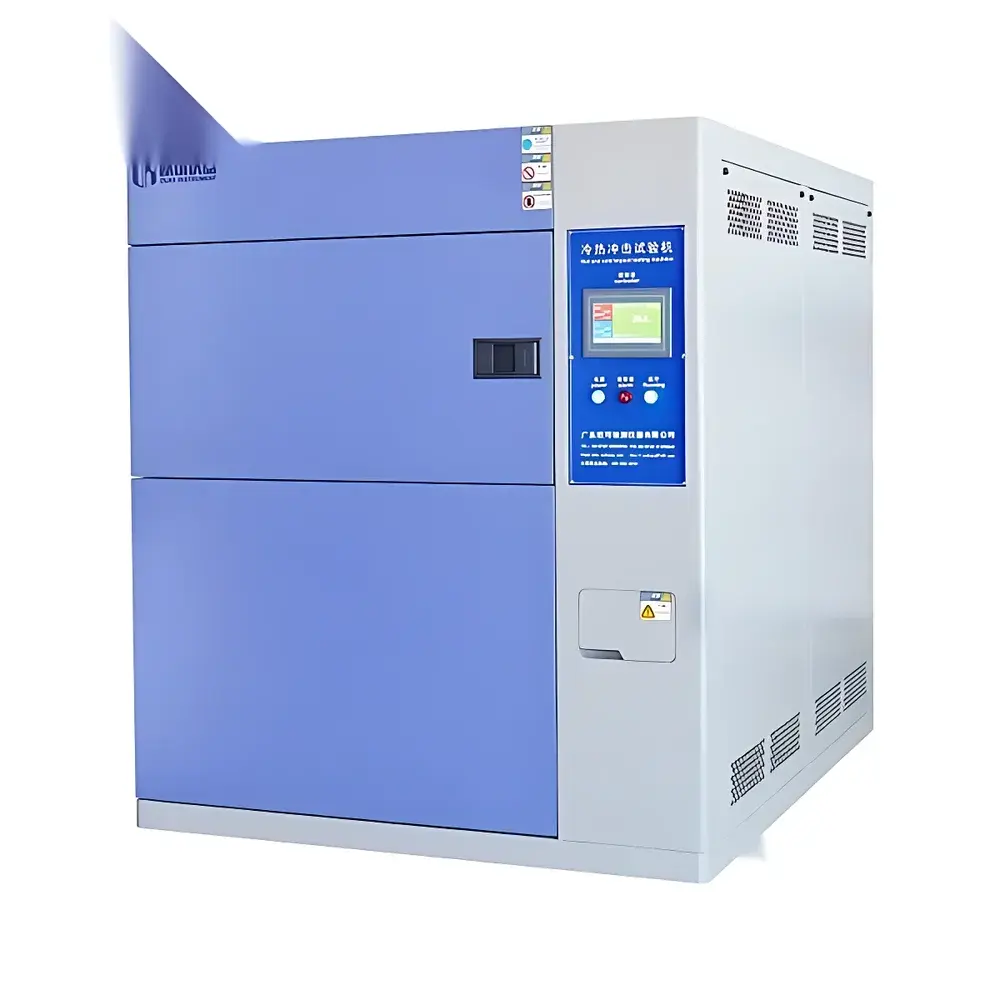
Thermal Shock Test Chamber – Dual- or Tri-Zone Rapid Temperature Transition Environmental Test System
| Brand | OEM / Custom-Built |
|---|---|
| Origin | Imported |
| Manufacturer Type | Authorized Distributor |
| Compliance | GB/T 2423.1–2008 (Test A), GB/T 2423.2–2008 (Test B), GB/T 10592–2008, GJB 150.3–1986, GJB 360A–1996 Method 107 |
| Cooling Medium | Eco-Friendly R404A/R23 Cascade Refrigerant |
| Control Interface | LCD Touchscreen with Dialog-Based UI |
| Construction | Stainless Steel + Pre-Painted Galvanized Steel Panels |
| Air Circulation | Horizontal Centrifugal Forced-Air System with Vertical Heat Exchange |
| Safety Features | Over-Temperature/Over-Current Protection, Power-Fail Memory, Real-Time Fault Logging & Diagnostic Guidance |
| Refrigeration Architecture | Dual-Stage Cascade Cryogenic System with Zone-Specific Compressor Optimization |
Overview
The Thermal Shock Test Chamber is an engineered environmental test system designed to evaluate material and component resilience under rapid, repetitive transitions between extreme high- and low-temperature conditions. Operating on the principle of accelerated thermal stress induction, it subjects test specimens to controlled, high-rate temperature shifts—typically exceeding 10 °C/s in transfer time—within sealed, insulated chambers. This methodology replicates real-world operational extremes encountered in aerospace electronics, automotive powertrain assemblies, semiconductor packaging, and military-grade electronic enclosures. Unlike standard thermal cycling chambers, this system implements either dual-zone (hot/cold) or tri-zone (hot/ambient/cold) configurations, enabling true zero-transfer-time shock exposure via mechanical specimen shuttle or air-flush mechanisms. Its architecture adheres to fundamental thermodynamic constraints while maintaining traceable thermal uniformity (±2.0 °C across working volume per IEC 60068-2-14) and stability (±0.5 °C at setpoint).
Key Features
- Modular panel construction using stainless steel inner walls and pre-painted galvanized steel outer cladding—ensuring structural rigidity, corrosion resistance, and long-term dimensional stability in laboratory environments.
- Horizontal centrifugal forced-air circulation combined with vertical heat exchange pathways—eliminating thermal stratification and achieving ≥90% volumetric uniformity (per ISO 16750-4 Annex C verification protocol).
- Intelligent LCD touchscreen controller with dialog-based navigation—supporting multi-step programmable profiles, real-time graphing, and user-accessible calibration offset adjustment without service intervention.
- Dual-stage cascade refrigeration system utilizing French-sourced hermetic compressors—optimized for sustained operation across −65 °C to +150 °C nominal ranges; employs R404A (high-temp stage) and R23 (low-temp stage) refrigerants compliant with EU F-Gas Regulation (EU) No 517/2014.
- Integrated safety architecture including over-temperature cutoff, phase-failure detection, refrigerant pressure monitoring, and non-volatile power-loss memory—retaining last valid profile and fault history after mains interruption.
- Real-time diagnostic interface displaying root-cause failure codes (e.g., “E07: Condenser Airflow Obstruction”, “E12: Chamber Sensor Drift”) with stepwise remediation instructions aligned with IEC 61000-4-11 immunity requirements.
Sample Compatibility & Compliance
This chamber accommodates specimens up to 1,200 mm × 1,000 mm × 1,000 mm (W×D×H) in dual-zone configuration and supports both rack-mounted PCB subassemblies and full-enclosure avionics units. Internal volume scalability is achieved through bolt-together insulated panels—enabling field-expansion without structural retrofitting. All thermal profiles comply with internationally recognized qualification standards: GB/T 2423.1–2008 (Cold Testing), GB/T 2423.2–2008 (Dry Heat), GB/T 10592–2008 (Temperature Gradient Limits), GJB 150.3A–2009 (MIL-STD-810G equivalent for temperature shock), and GJB 360B–2009 Method 107 (Shock Duration & Transition Time Validation). Traceable calibration certificates (NIST-traceable Pt100 sensors) are provided with each unit shipment.
Software & Data Management
The embedded controller logs timestamped temperature data at 1 Hz resolution, storing ≥30 days of continuous acquisition internally. Export options include CSV via USB 2.0 port or Ethernet-enabled remote retrieval (Modbus TCP). Audit trail functionality meets GLP/GMP documentation prerequisites—recording operator ID, parameter changes, and calibration events with immutable timestamps. Optional PC-based software (sold separately) adds statistical process control (SPC) overlays, Weibull reliability modeling inputs, and automated report generation conforming to ISO/IEC 17025 clause 7.8.2.
Applications
- Qualification testing of solder joint integrity in lead-free PCB assemblies per IPC-J-STD-020D.
- Validation of thermal interface material (TIM) performance degradation under repeated expansion/contraction cycles.
- Accelerated life testing of MEMS sensors exposed to automotive under-hood thermal transients.
- Verification of hermetic seal reliability in medical implant housings per ISO 10993-12.
- Pre-shipment screening of lithium-ion battery modules prior to EV integration (UN 38.3 T4 compliance support).
FAQ
What is the typical temperature transition time between zones?
Standard dual-zone systems achieve ≤15 seconds transfer from +150 °C to −65 °C for 5 kg aluminum mass loads; tri-zone variants maintain ≤5 seconds dwell stabilization post-transfer.
Does the system support custom test profiles beyond published standards?
Yes—users may define up to 99 segmented ramp/soak sequences with independent rate limits (0.1–30 °C/min), dwell durations (0.1–999.9 min), and loop counts (1–999 cycles).
Is third-party calibration certification included?
A factory-issued calibration report with uncertainty values (k=2) for all chamber sensors is supplied; optional UKAS-accredited calibration is available upon request.
Can the chamber be integrated into a centralized lab monitoring network?
Standard Ethernet (RJ45) and RS-485 interfaces support integration with LabVantage, Siemens Desigo, or custom SCADA platforms using Modbus RTU/TCP or HTTP API protocols.



