
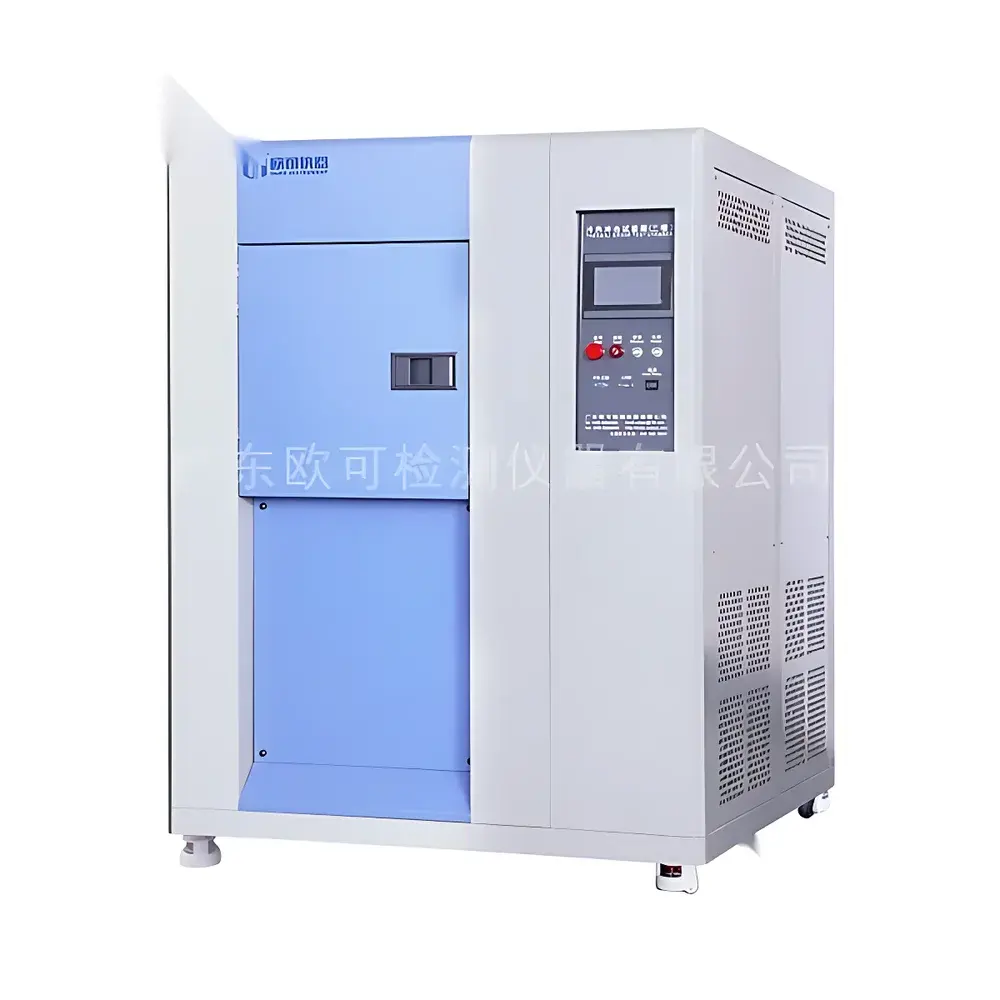
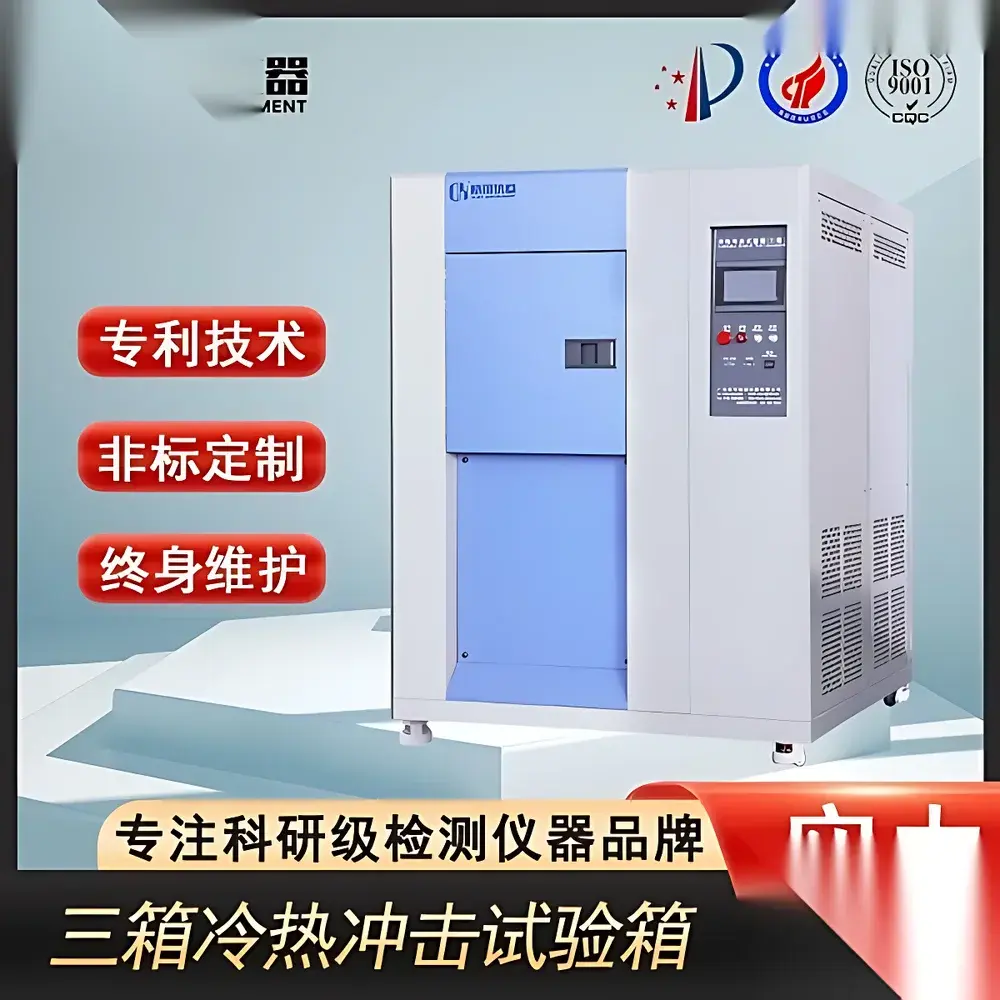
Thermal Shock Test Chamber – Generic Brand Model TS-XX Series
| Brand | Other Brands |
|---|---|
| Origin | Imported |
| Manufacturer Type | Authorized Distributor |
| Pricing | USD 11,200 (FOB) |
| Compliance | GB/T 2423.1–2023, GB/T 2423.2–2023, GB/T 10592–2008, GJB 150.3A–2009 |
| Display | 7″ TFT True-Color LCD Touch Interface |
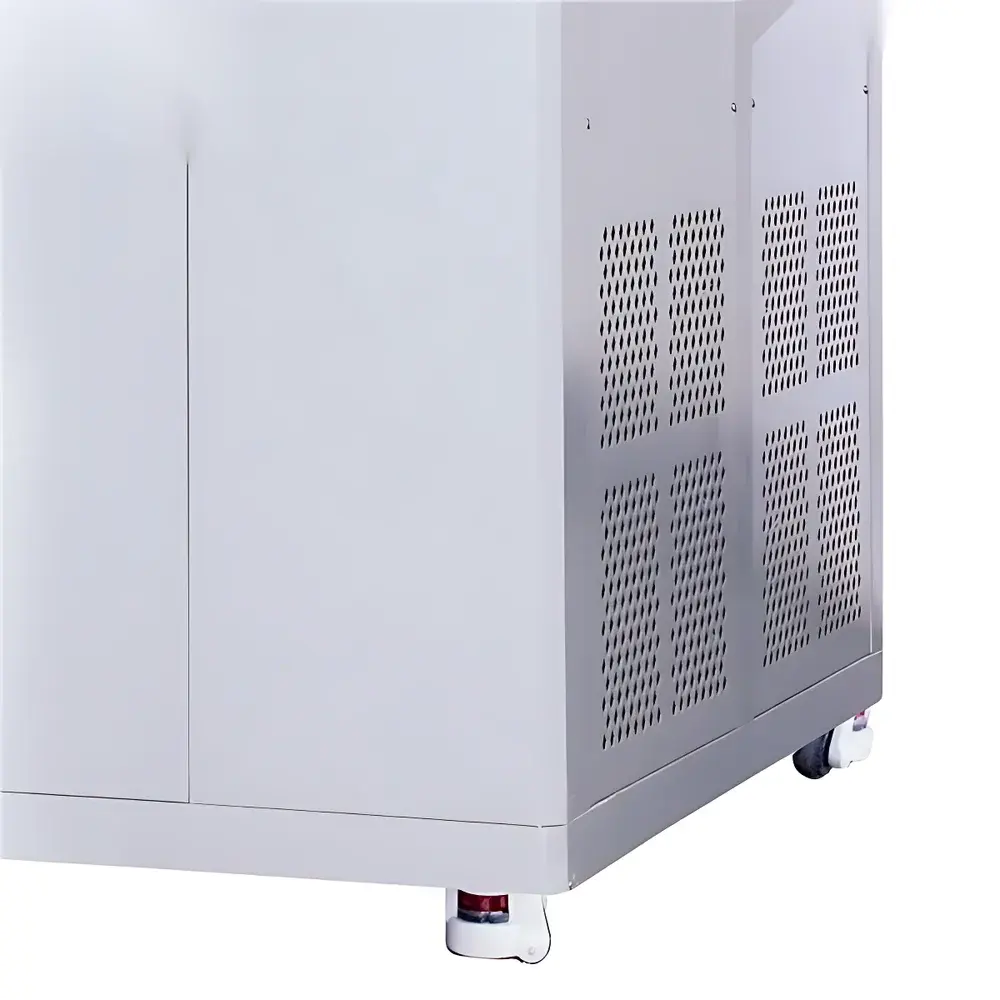
| Refrigeration System | Dual-Stage Cascade with German Semi-Hermetic Compressors |
| Cooling Tower Requirement | External 10 m³/h Water-Cooled Tower (User-Supplied) |
| Airflow Design | Positive-Pressure Uniform Air Distribution Duct |
| Defrost Method | Intelligent Automatic Defrost Cycle |
| Safety Features | Multi-Level Over-Temperature, Over-Pressure, Phase Failure, and Refrigerant Leak Alarms with Diagnostic Code Display |
| Construction | Stainless Steel Inner Chamber, Insulated Sandwich Panels with Polyurethane Foam (≥150 mm Thickness) |
Overview
The Thermal Shock Test Chamber (Model TS-XX Series) is an engineered environmental simulation system designed to evaluate the structural integrity and functional reliability of materials and assemblies under rapid, extreme temperature transitions. It operates on the principle of two-zone or three-zone thermal shock—where test specimens are mechanically transferred between independently controlled high-temperature and low-temperature chambers—or via single-chamber air-shock methodology using high-velocity, conditioned airflow. This enables precise replication of thermal stress conditions encountered during operational lifecycle events such as aerospace component re-entry, automotive under-hood cycling, or electronic device power-on/off transients. The chamber conforms to internationally recognized test standards including GB/T 2423.1 (cold), GB/T 2423.2 (dry heat), GB/T 10592 (temperature gradient and uniformity requirements), and GJB 150.3A (military-grade thermal shock protocols). Its core function is not merely temperature exposure, but quantification of thermally induced failure modes—including interfacial delamination, solder joint fracture, sealant cracking, coefficient-of-thermal-expansion (CTE) mismatch strain, and reversible/irreversible property shifts in polymers, composites, and metallic alloys.
Key Features
- 7-inch true-color TFT LCD touch interface with intuitive icon-based navigation, real-time trend plotting, and multi-language support (English, Chinese, Spanish)—designed for ISO/IEC 17025-compliant lab environments requiring audit-ready operator interaction logs.
- Dual-stage cascade refrigeration architecture utilizing imported German semi-hermetic compressors, enabling stable operation down to –65 °C in the low-temperature zone and up to +150 °C in the high-temperature zone, with transition times ≤ 15 seconds between extremes (typical for 3-zone configuration).
- Positive-pressure air distribution duct system with computational fluid dynamics (CFD)-optimized vanes ensures chamber uniformity within ±0.5 °C at any designated setpoint across the working volume (per GB/T 10592–2008 Class B specification).
- Modular refrigeration unit design allows field-replaceable compressor modules, condenser banks, and expansion valve assemblies—reducing mean time to repair (MTTR) and supporting long-term serviceability without full-system downtime.
- Automated defrost sequence triggered by evaporator coil temperature differential thresholds and runtime algorithms; reduces frost accumulation without interrupting test cycles or compromising thermal stability.
- Comprehensive safety architecture including dual independent over-temperature cutouts, refrigerant pressure transducers with alarm hysteresis, phase-monitoring relays, door interlock switches, and integrated fault-code diagnostics displayed directly on the HMI with step-by-step remediation guidance.
Sample Compatibility & Compliance
This chamber accommodates a broad range of specimen geometries—from PCB subassemblies and encapsulated sensors to automotive brake calipers and aerospace fasteners—within standard internal dimensions (customizable upon request). Chamber interior is constructed from SUS304 stainless steel with electropolished finish to resist corrosion from condensate and outgassing byproducts. Insulation consists of high-density polyurethane foam (≥150 mm thickness, closed-cell structure, λ ≤ 0.022 W/m·K) bonded to aluminum-clad structural panels. All electrical components meet IP54 ingress protection rating. The system supports traceable calibration per ISO/IEC 17025 requirements and includes provisions for third-party validation of temperature mapping (per ICH Q5C and ASTM E2297). Data integrity complies with FDA 21 CFR Part 11 when paired with optional compliant software packages—supporting electronic signatures, audit trails, and role-based access control.
Software & Data Management
Embedded controller firmware provides local data logging at user-defined intervals (1–60 sec resolution), storing ≥10,000 hours of timestamped temperature, humidity (if equipped), alarm, and cycle-phase data internally. Optional PC-based software enables remote monitoring via Ethernet (TCP/IP), real-time graphing, export to CSV/PDF, and automated report generation aligned with GLP/GMP documentation templates. All logged parameters include measurement uncertainty estimates derived from sensor calibration certificates. Software supports test program sequencing (up to 99 segments per profile), conditional branching (e.g., “hold until ΔT < 0.3 °C”), and pass/fail logic evaluation against user-defined acceptance criteria—critical for quality control release testing in regulated industries.
Applications
- Electronics: Qualification of solder joint reliability in lead-free assemblies per JEDEC JESD22-A104.
- Aerospace: Validation of composite layup adhesion and thermal cycling endurance per SAE AMS2750 and RTCA DO-160 Section 4.11.
- Automotive: Testing of EV battery module housings, ADAS camera lenses, and engine control units per ISO 16750-4 and LV-124.
- Medical Devices: Accelerated aging studies of polymer-based implantables and sterilization packaging per ISO 11607-1 and AAMI TIR17.
- Research & Development: Fundamental investigation of glass transition behavior, crystallinity shifts, and microcrack propagation kinetics under cyclic thermal loading.
FAQ
What cooling infrastructure is required for continuous operation?
A dedicated external water-cooled tower delivering 10 m³/h at 32 °C inlet temperature is mandatory for the refrigeration system’s condenser circuit. Chilled water supply is not required—the system uses ambient water for heat rejection only.
Can the chamber be validated for IQ/OQ/PQ protocols?
Yes. The chamber ships with factory-assembled temperature mapping ports (≥9 locations), NIST-traceable sensor calibration certificates, and a comprehensive validation support package including URS templates, risk assessment worksheets, and protocol drafting assistance.
Is remote access and alarm notification supported?
Standard Ethernet connectivity enables SNMP-based network alerts and Modbus TCP integration with building management systems (BMS) or centralized SCADA platforms. Optional SMS/email alert modules are available.
What is the typical temperature recovery time after door opening?
For a 30-second door opening event at –40 °C/125 °C extremes, full setpoint recovery is achieved within ≤ 5 minutes—verified per GB/T 10592–2008 Annex C methodology.
Does the system support custom test profiles beyond standard GB/GJB methods?
Yes. The controller supports user-defined ramp rates (0.1–10 °C/min), dwell durations (1 sec–999 hours), and loop counts (1–999 cycles), with programmable trigger conditions based on measured parameters or elapsed time.



